A Dimon Repeatedly in the Rough who Demands Winter Rules (aka Preferred Lies)

By William K. Black
(Cross-posted from Benzinga.com)

Golf is one of the sports associated with the CEOs of big banks, so it is not surprising that Jamie Dimon is expert at seeking to invoke Winter Rules whenever JPMorganChase (NYSE: JPM) finds that its actions have placed it in an unfavorable lie.

Golfers know that they cannot unilaterally invoke Winter Rules – only the folks in charge of the course can put Winter Rules in effect. When Winter Rules are put in effect the golfer can improve his lies by placing his ball in a preferred lie.


A New York Times investigation by Edward Wyatt documented the depth of the rot at the SEC in a February 3, 2012 article entitled “S.E.C. is Avoiding Tough Sanctions for Large Banks.”

“JPMorganChase, for example, has settled six fraud cases in the last 13 years, including one with a $228 million settlement last summer, but it has obtained at least 22 waivers, in part by arguing that it has “a strong record of compliance with securities laws.””

SEC investigations have found that JPMorganChase is a serial violator of the securities laws. The bank gets caught, promises to clean up its act, gets fined, signs a typically useless consent decree that has no admissions, creates no precedent, and undercuts deterrence, and gets waived out of the few detriments there are to banks with records of serial SEC staff findings of violations.

JPMorganChase exemplifies this pattern of the SEC winking at serial fraud by the systemically dangerous institutions (SDIs). The SEC routinely allows the SDIs to operate under Winter Rules and the SDIs routinely and repeatedly employ preferred lies.

But the metaphor is inexact for three reasons. First, Winter Rules are not supposed to be routinely available. They are reserved for unusual circumstances where the course is unusually unplayable due to weather. Second, Winter Rules are available due to problems with the course not caused by the player. Third, when Winter Rules are invoked by the golf course the course posts that information publicly and Winter Rules are available to all players rather than to a subset, i.e., the wealthiest players.

Consider what the world would be like if we had a “three strikes law” for corporations. Assume that the corporations were only assessed a “strike” if the violations were attributable to the actions of a senior officer. Assume further that the SEC and the Department of Justice (DOJ) actually brought actions against the SDIs and required admissions of violations of the law in settlements and pleas. The SDIs would have been dissolved (the equivalent of being sent away for life) decades ago.

Consider the chutzpah of JPMorganChase claiming “a strong record of compliance with securities laws” after SEC staff investigations found six violations in 13 years. But that kind of arrogance and indifference to complying with the law is inevitable under an SEC regime that allows the SDIs to play by Winter Rules. “Improved lies” captures perfectly the perverse incentives that the SEC has created.

The CEOs of SDIs who know that they can commit fraud with effective impunity (the SEC fines are typically chump change from the SDIs’ standpoint) develop a belief in their divine right to transcend the law and conventional morality. Jamie Dimon captures the mindset that Nietzche celebrated for the Superman. Dimon extends the logic of transcendence to its ultimate, absurd, extreme. He is enraged that the CEOs running the SDIs have been criticized. It turns out that the SDIs’ CEOs are sensitive types. Nobody exemplifies this Rich White Whine motif better than Dimon.

“I’ve disagreed right from the beginning of this blanket blame of all banks,” Dimon said in an interview with Charlie Gasparino of the Fox Business Network Tuesday. “I don’t like that. I think that’s just a form of discrimination that should be stopped.”

The interview was taped shortly before Dimon left for the World Economic Forum summit in Davos, Switzerland, where Dimon said he will be speaking with other attendees about financial regulation. At last year’s Davos summit, Dimon made similar remarks pushing back against the vilification of the banking industry, calling it “a really unproductive and unfair way of treating people.”

No serious critic has a “blanket blame of all banks.” The blame is focused on SDIs, particularly SDIs like JPMorganChase that investigations find engaged in recurrent fraud, yet were treated to Winter Rules because they were SDIs. These SDIs are not only the bane of the world economy; they are the bane of honest banks.

Dimon has also reached the logical, albeit absurd, conclusion about the legitimacy of investigating JPMorganChase. He is tired of the investigations finding fraud, so he has decided, in the context of the settlement negotiations of the widespread foreclosure fraud by five large mortgage servicers including JPMorganChase, to offer a settlement in return for prohibiting the government from investigating his banks’ mortgage origination and foreclosure fraud.

When news reports claimed that the federal government was reducing its disgraceful offer of widespread impunity from investigation and prosecution, Dimon responded that it was likely that JPMorganChase would not enter into a settlement that did not have a broad prohibition on investigating JPMorganChase’s frauds.

“The new unit “has a pretty good chance of derailing it,” JPMorgan Chase CEO Jamie Dimon told CNBC on Thursday, referring to the settlement. JPMorgan is one of the five banks involved in those negotiations.”

Dimon is the face and mindset of crony capitalism. It is long past time for the SEC to end selective Winter Rules and Preferred Lies for the SDIs.

Bill Black is the author of The Best Way to Rob a Bank is to Own One and is an associate professor of economics and law at the University of Missouri-Kansas City. He spent years working on regulatory policy and fraud prevention as Executive Director of the Institute for Fraud Prevention, Litigation Director of the Federal Home Loan Bank Board and Deputy Director of the National Commission on Financial Institution Reform, Recovery and Enforcement, among other positions.

Bill writes a column for Benzinga every Monday. His other academic articles, congressional testimony, and musings about the financial crisis can be found at his Social Science Research Network author page and at the blog

Follow him on Twitter: @WilliamKBlack

Alternative Fiscal Policies: Why the Job Guarantee is Superior (Wonkish)

By Pavlina R. Tcherneva

A few weeks ago I called for a technocratic debate on the merits of the JG, relative to other fiscal policies. A number of bloggers took the charge but the debate was not immune to ideological biases, which proved the starting point of my piece that one cannot separate fact from theory or ideology (and by ideology I do not mean the derogatory use of the word, but that which signifies ‘ontology’ or a ‘world view’). What I didn’t expect is for friends and sympathizers to resurrect one particularly invidious charge we have long heard from MMT deniers, namely that MMT is pushing authoritarian policies.

Oh, boy. How did we even get here? I thought this was going to be a technocratic debate.

Continue reading

Greece and the Rape by the Rentiers

Here’s the draft of the supposed agreement to “sort out” the Greek debt problem once and for all. According to Bloomberg, here are the essentials:

  • Greece’s 2012 GDP will shrink by as much as 5%.
  • Greece is expected to return to growth in 2013.
  • Greece will cut 15,000 state jobs in 2012.
  • Minimum wage will be cut by 20 percent.
  • There will be no increase to sales tax.
  • The government will cut medicine spending from 1.9% to 1.5% and merge all auxiliary pension funds.
  • It will also sell stakes in six companies—in particular, energy companies and refineries.

Of course, the current thrust of fiscal policy will almost certainly guarantee that there still will be a default, involuntary or otherwise, in spite of this agreement. If you don’t have a mechanism to allow growth, then how can the Greeks service their debt, even with the reduced debt burden?

Perhaps that’s the idea. Make the deal so miserable for the Greek people that the Spanish, Portuguese, Irish and Italians don’t even begin to think of trying to get a similar haircut on their debt.
Certainly, the deficit reduction won’t come. It can’t when you deflate a rapidly declining economy into the ground. Common sense suggests that a drop in private income flows while private debt loads are high is an invitation to debt defaults and widespread insolvencies.

Even with all of the concessions, the euro bosses have not officially signed off on the agreement:

* Finance ministers of the 17-nation euro zone arriving for talks in Brussels warned there would be no immediate green light for the rescue package and said Athens must prove itself first. 

* “It’s up to the Greek government to provide concrete actions through legislation and other actions to convince its European partners that a second program can be made to work,” EU Economic and Monetary Affairs Commissioner Olli Rehn said. 

* German Finance Minister Wolfgang Schaeuble, whose country is Europe’s biggest paymaster, told reporters: “You don’t need to wait around because there will be no decision (tonight).” 

* Greek Finance Minister Evangelos Venizelos flew to Brussels after all-night talks involving Prime Minister Lucas Papademos, leaders of the three coalition parties and chief EU and IMF inspectors left one sensitive issue – pension cuts – unresolved.


It is also worth pointing out that Greece’s pension payments on a per capita basis are amongst the lowest in Europe. Still, apparently, this plunder hasn’t gone far enough The Greek people must feel like Sabine Women right now.

Game, set and match to the Troika.
While we’re at it, let’s address this “Greeks as tax cheats” canard once and for all. Greece’s tax revenue from VAT collapsed by 18.7pc in January from a year earlier. As Ambrose Evans Pritchard noted:

“Nobody can seriously blame tax evasion for this. It has happened because 60,000 small firms and family businesses have gone bankrupt since the summer. 

The VAT rate for food and drink rose from 13pc to 23pc in September to comply with EU-IMF Troika demands. The revenue effect has been overwhelmed by the contraction of the economy.
Overall tax receipts fell 7pc year-on-year.”

We’re one step closer to ensuring that the birthplace of democracy becomes a form of national indentured servitude. That is of course, unless Greece regains some modicum of self-respect and tells the Troika to take a hike and leaves the euro zone.

William K. Black on Financial Fraud

William K. Black talks with EconTalk host Russ Roberts about financial fraud, starting with the Savings and Loan debacle up through the current financial crisis. Black explains how bank executives can use fraudulent loans to inflate the size of their bank in order to justify large compensation packages. He argues that “liar loans” were a major part of the crisis and that policy changes made it easy to generate such loans without criminal repercussions.

http://www.google.com/reader/ui/3523697345-audio-player.swf

The Elephant in the Room is Spain, Not Italy

By Marshall Auerback


Another day andthe markets remain fixated on whether Greece comes to a “voluntary” arrangementwith its creditors.  The key word is“voluntary” because the myth of “voluntary compliance has to be sustained sothat those deadly credit default swaps avoid being triggered. 
But let’s faceit:  Greece is a pimple.  If the rest of the euro zone could cut itlose with a minimum of systemic risk, Athens would have long gone the way ofTroy.  The real issue is whether thecredit default swaps trigger such a huge mess with the counterparties that itcreates renewed systemic stress which more than offsets the benefits to theholders of the CDSs. 
The moreinteresting question is:  suppose Greece finally does get a deal?  Irealize everybody says it is a “one-off”, but do you really think theIrish, Portuguese, or even the Spanish and Italians will go along with that,particularly if (as is likely) they continue to experience double digitunemployment and minimal growth?
Now you could argue thatPortugal and Ireland, like Greece, are but small components of the EuropeanUnion and could well be covered in one form or another via the existingbackstops established over the last several months, notably the EuropeanFinancial Stability Fund (EFSF) and the European Stability Mechanism(ESM). 
But you can’t say this aboutSpain, which remains the real elephant in the room – not Italy – even thoughSpain’s borrowing costs remain lower than Italy’s. This is perverse. 
Though Italy has a highsovereign debt, it has a low private debt (the product of years of high budgetdeficits, but that’s the story for another blog). Italy has a fiscal deficitthat is low relative to most economies today. It already has a primary surplus.The greater than expected past expansion of the ESCB and the current ongoingLTROs are likely to absorb panic and forced selling of Italian debt. TheItalian 10-year yield could fall back below 5% (having already fallen from the 7%plus levels, pertaining a mere 6 weeks ago).

In theory, this rally in bond yields should lead to a reassessment of thegravity of the Italian problem and therefore the European sovereign debt andbanking problem. That could be positive for equity markets and, indeed, hasbeen so since the start of the year. 

But does Spain truly deserve theborrowing advantage it now has in relation to Italy?  Its 10-year bonds are yielding some 60 basispoints lower. True, its sovereign debt to GDP ratio is low at about 75%, but partof its enormous private debt will almost certainly have to be “socialized.”  Moreover, Spain has virtually the highestnon-financial private debt-to-GDP ratio of all the major economies.  Its ratio is almost twice that of Italy’s. Itsfiscal deficit last year was probably higher than the official estimates, closeto 9% of GDP (the previous Socialist government routinely lied about itsfigures – in fact, no country, not even the US, has lied more extensively aboutthe condition of its banks.  Spain, relative to GDP, has the largestshadow real estate inventory in the world, with the possible exception ofChina, which probably doesn’t even have a reliable second or third set ofbooks).

Let’s be clear about onething:  this is not a tale of Mediterranean“profligacy”, as least as far as public spending was concerned.  Anybody looking at Spain through a sensiblefinancial balances framework in the mid-2000s would have observed that theprivate sector was being squeezed badly by the fiscal drag. The externalposition was in deficit (current account) which means the public and externalbalances were draining growth from the economy. Yet it still boomed up into theonset of the crisis. How did that happen?

The profligates were all in theprivate sector, although you could readily argue that the government’s“responsible” fiscal policy created the conditions for a private sector debtbinge.
  Prior to 2008, the Spanisheconomy was held out as the darling of Europe however the reality was quitedifferent. The country was running budget surpluses by 2005 and foreigninvestment was booming. Most of this investment went into construction whichwas stimulated by a massive real estate boom.

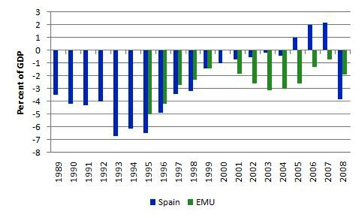
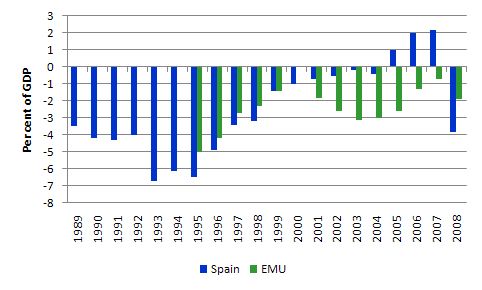
A few years ago, using data fromData from the Banco de España (central bank) Bill Mitchell graphed the nationalbudget deficit as a percentage of GDP for Spain and the EMU overall from 1989to 2008 (data for the EMU clearly didn’t start until 1995). As Mitchell
notes,one can observe the tightening of fiscal positions as the Growth and StabilityPact provisions were forced on the EMU nations:


EMU and Spain: Budget deficit % of GDP,1989 to 2008

Consistent with a tighteningfiscal position leading to surpluses in 2005, the only way that this boom couldcontinue was for the private sector to go increasingly into debt.That is exactly what happened and because the property boom was so large thedebt levels were also very high – average household debt tripled. And that, incontrast to Italy, is the core problem with which Spain is dealing today to asubstantially greater degree than Italy. So it’s wrong to lump the two together interchangeably as the marketshave been doing.  Paella and pasta don’tmix well together.

Okay, but that was the previousZapatero
Administration.  Now we supposedly have a new “responsible” conservativegovernment that promises to carry out the same policies even moreresolutely.  And look how successfulthey’ve been:  Spain’s joblessclaims shot up a further 4% in January from December to 4.59 million, a signthat the euro zone’s fourth-largest economy is still shedding jobs at a recordrate. All sectors posted more claims but the rise was sharpest for services at5.1%. In construction, weighed down by a four-year property slump, the numberof residents registered as job seekers rose 2.1%. Compared with the same perioda year ago, overall claims rose 8%.  GDPcontracted 0.3%.  

Okay,“give them time”, argue the defenders of the new government.  And, if the Rajoy Administration was trulyembarking on a new policy course, that would be a fair comment.  Unfortunately, this government has signed onto even tighter fiscal policy rules.
Somehowthey are expected to suck demand out of their economies through tax increasesand spending cuts, but when the slower growth that results in means the targetfor deficit reduction is not met, the Spanish, like their Greek, Irish,Portuguese and Italian counterparts, will be punished for it.

Eventhe Rajoy Administration implicitly appears to recognize this danger, as it isalready moving the goalposts in regard to its spending cuts targets as apercentage of GDP.  Unfortunately, theyblame this on external circumstances beyond their control. To the extent thatthey agree to submit themselves to rules which were routinely disobeyed by theGermans and French during the EMU’s inception, that is true, although theSpanish government refuses to acknowledge that their resolute tightening fiscalpolicy ex ante might well have something to do with the fact that Spain’seconomy continues to deflate into the ground ex post.  Remember,
thehistory of the Stability and Growth Pact has long demonstrated that thesenonsensical rules are already impossible to keep within during a significantdownturn. And now the new Spanish government wants to tighten them even furtherand invoke pro-cyclical fiscal reactions earlier.
This, at a time when the nationalunemployment rate is approaching 23%, and the youth unemployment rate (25 yearsor younger) is at 49%, according to the latest Eurostat data.

Sonearly 50 per cent of willing workers under the age of 25 in Spain are withoutwork and will remain like that for years to come. That will damage productivitygrowth for the next decade or more. It is an indication that the monetarysystem has failed and attempting to reinforce those failures with moreausterity will only make matters worse.  The new government’s proposed fiscal policy “reforms” areparticularly toxic policy mixture for Spain.

Of course, the ongoing threat ofa disorderly default in Greece also remains a potentially dangerous areaif it is not contained by the ECB’s actions.
 But it’s more interesting to see what happens as the magnitude ofSpain’s problems become more apparent.  Will the troika tell Spain that a Greek style70% haircut is not in the cards?  Willthey try to suggest that the government is rife with corruption, that thecountry is chock-a-block full of scoff-laws and tax evaders, and that theefficient Germans would do a much better job of collecting taxes?

Spain is still a relatively youngdemocracy.
  The transition began a mere37 years ago when Francisco Franco died in 1975, but there was an attemptedcoup by Antonio Tejero as recently as 1981. This is worth pondering whilst observing the implosion of Spain’seconomy. The decision for Europe’s bosses is this: they must ultimately confront theconsequences of their policy choices. They can destroy the eurozone by continuing with the same failed mix ofpolicies or by salvaging it by adding what has been missing from the outset: amechanism for shifting surpluses to the deficit regions in the form ofproductive investments(as opposed to handouts or loans). Turning stateslike Spain into sundrenched economic wastelands within the eurozone, andforcing the rest of the currency area into a debt-deflationary spiral, is amost efficient way of blowing up the whole system and possibly threatening thevery existence of Spanish liberal democracy itself.

MMP #35 Functional Finance: A Conclusion

By L. Randall Wray

Let’sfinish up the discussion of Lerner’s functional finance approach addressing twoissues: functional finance and developing nations and also the functionalfinance approach to trade deficits.

Functional Finance and Developing Nations. Most of the developing nations havea sovereign currency—which means they can “afford” to buy whatever is for salein the domestic currency, including unemployed labor. As Lerner would put it,unemployment is evidence that there is an unmet demand for domestic currencythat can be filled by additional government spending. At the same time, manydeveloping nations have fixed or managed exchange rates that reduce domesticpolicy space to some degree. They can increase policy space either throughpolicies that generate foreign currency reserves (including development thatincreases exports), or they can protect foreign currency reserves throughcapital controls.

Inaddition, they can favour policy that leads to employment and developmentwithout increasing imports (import substitution policies, for example). Theycan create jobs programs that are labor intensive (so that foreign made capitalequipment is not needed) or programs that provide the output that the newlyemployed workers need (so that they do not spend their new incomes on imports).

Governmentcan favour domestic producers over foreign producers. It can limit itspurchases of foreign goods and services to export earnings. It can try to avoidborrowing in foreign currency in order to limit its need to devote foreigncurrency earnings to interest payments.

Asdiscussed, ability to impose and collect taxes can be impaired in a developingnation. This will limit government’s ability to directly command domesticoutput. And even if it finds plenty of unemployed labor willing to work for itscurrency, those workers might find it difficult to purchase output with thatcurrency at stable prices. More diligent tax collection will help to increasedemand for the currency (since taxes are paid in the domestic currency). Inaddition, government needs to focus job creation in those areas that will leadto increased production of the kinds of goods and services the new workers willwant to purchase. That can relieve inflationary pressures resulting from risingemployment. 

For thelong run, avoiding foreign currency indebtedness and moving toward floatingexchange rates would be conducive to expansion of domestic policy space. Fullutilization of domestic resources (most importantly, labor) will allowdeveloping nations to maximize output while reducing inflation caused byinsufficient supply. Full employment of labor also provides many otherwell-known benefits that will not be detailed here.

A sovereigncurrency provides more policy space to government—it spends by crediting bankaccounts and thus is not subject to the budget constraint that applies to acurrency user. A floating exchange rate (or a managed rate with capitalcontrols) expands the policy space further—because the government does not needto accumulate sufficient reserves to maintain a peg. Well-planned use of thispolicy space will allow the government to move toward full employment withoutsetting off currency depreciation or domestic price inflation. To that end, theemployer of last resort or job guarantee model is particularly useful, a topicpursued in more detail elsewhere in the Primer.

Exports are a cost, Imports are a benefit. In real terms, exports are a costand imports are a benefit from the perspective of a nation as a whole. Theexplanation is simple. When resources including labor are used to produceoutput that is shipped to foreigners, the domestic population does not get toconsume that output, or use it for further production (in the case ofinvestment goods). The nation bears the cost of producing the output, but doesnot get the benefit. On the other hand, the importing nation gets the outputbut did not have to produce it. For this reason, in real terms net exports meannet costs; and net imports mean net benefits.

Now thereare several caveats. First, from the perspective of the producer of output, itdoes not matter who buys the produced goods or services—the firm is equallyhappy selling domestically or to foreign buyers. What the firm wants is to sellfor domestic currency in order to cover costs and reap profits. If the outputis sold domestically, the bank accounts of purchasers are debited, and theaccounts of the producing firm are credited. Everyone is happy. If the outputis sold to foreigners, the receipts will need to go through a currency exchangeso that the producer can receive domestic currency while the ultimatepurchasers are using their own currency. We will not concern ourselves with thedetails, but usually a domestic bank or the central bank will end up holdingreserves of the foreign currency (this will normally be a credit to a reserveaccount at the foreign central bank). The fact remains, however, that in termsof real resources, the “fruit of the labor” is enjoyed by foreigners when theoutput is exported, even though in financial terms the producing firm receivesa net credit to a bank account and the nation receives a net financial asset interms of foreign currency.

Second, netexports add to aggregate demand and increase measured GDP and national income.Jobs are created to produce goods and services for export. Hence, a nation thatwould otherwise operate below full employment can put resources to work in theexport sector. Wages and profits are generated, families receive incomes theywould not have received so that they are able to purchase consumption goods,and firms stay in business that otherwise might have gone bankrupt. This isprobably the main reason why governments encourage growth of exports. In themidst of the economic downturn, President Obama announced that his goal for theUS economy was to double its exports. This is a common strategy for nationsthat want to grow. However, note that for every export there must be an import;for every trade surplus there must be a trade deficit. Obviously it is notpossible for all countries to simultaneously grow in this manner—it isfundamentally a “beggar thy neighbour” strategy.

To theextent that resources are mobilized to produce for foreigners, the domesticpopulation does not receive any net real benefit. True, labor and otherresources that would have been left idle are now employed; workers who wouldnot have received a wage now get income; owners of firms who would not havesold output now receive profits. Yet, if the produced output is sent abroad,there is no extra output for domestic residents to purchase. What happens isthat existing output gets redistributed to these additional claimants—who nowhave wage and profit income. Thus, if we have only put unemployed resources towork in order to produce exports, there is no net benefit—the domesticpopulation is working “harder” but not consuming more in the aggregate becausethe “pie” available for the domestic population has not increased. Theredistribution process itself will probably require inflation as those who nowhave jobs compete for a piece of the pie, bidding up prices. To be sure, thiscould be a desirable social outcome—output gets redistributed from the “haves”to the “have-nots”, and putting unemployed people to work has numerous benefitsfor families and society as a whole (in terms of crime, family break-ups, andsocial cohesion).

But notethat this relied on the presumption that the nation had excess capacity tobegin with. If it had been operating at full capacity of labor, plant, andequipment, then it could only increase exports by reducing domesticconsumption, investment, or government use of resources. Labor and otherresources would be shifted from producing for domestic use toward satisfyingforeign demand for output. Clearly it would usually be preferable to achievefull employment by producing for domestic use rather than for export. Theadditional employment would provide both income as well as more output. Thedomestic “pie” would be larger, so that rather than redistributing from “haves”to “have-nots”, the newly employed would get pieces of the larger pie.

Anotherobvious caveat is that producing output for foreigners can be in a nation’seconomic and political interests. A nation might produce goods and servicesthat are sent abroad for humanitarian reasons—to aid in disaster relief, forexample. It might produce military supplies to aid allies. Foreign directinvestment could aid a developing country that might become a strategicpartner. And there is certainly no reason for a nation to balance its currentaccount on an annual basis—something that would be nearly impossible in ahighly globalized economy with international links in production processes.Hence we would not want to ignore various strategic reasons for exportingoutput and running trade surpluses.

We concludethat we should also take a “functional” approach to international trade: itmakes no more sense for a sovereign government that issues its own floatingcurrency to pursue a trade surplus than it does for that government to seek abudget surplus. Maximization of a current account surplus imposes net realcosts (given the caveats discussed above). Instead, it is best to pursue fullemployment at home, and let the current account and budget balances adjust.That is far better than the usual strategy—which is to pursue a trade surplusin order to get to full employment.

We now turnto a policy that will generate full employment at home. Next week: more on theemployer of last resort proposal.

Think Debtors Must Pay and Austerity is the Way?


(h/t Philip Pilkington)

US Employment Growth Shows Fiscal Policy Matters

By Marshall Auerback

US Q4 2011 GDP growth was slightly disappointing, and the mix was terrible as the growth was mostly due to inventories. I took issue with that report, arguing that the weakness was due to statistical distortions in the government spending data and the PCE services data. With that disappointing Q4 GDP report, expectations for quite weak economic growth in this year’s first half were encouraged.

But today’s employment data blows the weak consensus outlook out of the water. The economy created jobs at the fastest pace in nine months in January and the unemployment rate dropped to a near three-year low of 8.3 percent, indicating last quarter’s growth carried into early 2012.

Continue reading

Say W-h-a-a-t?

By Jon Krajack

This past week, in an ironic twist of fate, former Royal Bank of Scotland CEO Fred Goodwin was stripped of his Knighthood. Goodwin presided over RBS’s rapid growth leading up to the 2008 financial crises, but he retired suddenly, just a month before RBS reported roughly $35 billion in losses. Goodwin had been nicknamed “Fred the Shred” for his cost-cutting practices. With “Sir” being cut from Fred Goodwin’s official name, karma seems to have come full circle.


In testimony before the House Budget Committee, Chairman Bernanke warned that in order for the United States to ensure economic and financial stability, it must reduce its debt-to-GDP ratio over time.  We wish the Chairman had warned against cutting the deficit during a balance sheet recession (while households are still trying to deleverage). We wish he had explained that countries that issue a non-convertible fiat currency, like the US, can allow their budgets to remain in deficit until the private sector finishes deleveraging (even if that means the debt/GDP ratio increases).  We wish he had said that when private sector balance sheets have been repaired, the private sector will start spending again, the economy will begin to grow more rapidly, and the debt/GDP ratio will come down the RIGHT way.


Greece finds itself in a precarious situation. It has outstanding debts that it can not afford to repay. Fortunately, Germany has a “solution”! It’s simple: the Greek government should give up what little economic sovereignty they still have. More specifically, Greece should turn over it’s fiscal policy decisions to a euro zone budget commissioner that would have the power to veto budgetary proposals that are “not in line with targets set by international lenders.” If this occurs it will set a very dangerous world precedent:what’s the point of democracy and elections if public policy is in the hands ofinternational financiers?  


This piece at The Economist talks about how recovery from the financial crises is going better in the United States than in Europe. They note that recovery in the United States has occurred against a backstop of loose fiscal policy. Further, they recognize that Europe has “been forced, or chosen” much tighter fiscal policy. What’s interesting here is that The Economist has the dots, but is failing to connect them. Maybe they should consider why it is that the United States is able to have looser fiscal policy?


David Cay Johnston
is one of the few mainstream journalists that demonstrates an understanding of the difference between a currency issuer and a currency user. In this piece he explains that austerity will worsen economic recovery. 

BREAKING NEWS! In order to prevent an election year debt ceiling debate, President Obama and congressional Republicans have reached an agreement. The president will sell his Burning Man tickets and donate the proceeds to help pay off the national debt. Some may argue that his Burning Man tickets will not even make a dent in the debt. Baby steps, folks. Baby steps.

Charles Goodhart once served on the Bank of England’s Monetary Policy Committee.  In this piece, Goodhart explains why the Federal Reserve’s latest attempt to reveal its own expectations about the future path of short-term interest rates makes for fashionable theory but lousy policy.

Doing What Needs to Be Done: Facing the Future with Full Employment and a Renewed Public Sector

By Dan Kervick

As you read this, millions of Americans who desperately want to work either cannot find employment at all, or cannot find the quantity and quality of work they need to meet their own needs and the needs of their families.  This is real suffering.  The unemployed are real flesh-and-blood people, not just fractions of percentage points on Labor Department spreadsheets.

At the same time, we have tremendous unmet social needs.  Any well-informed high school student can point to large, daunting national challenges that we sorely need to address, but that we are not addressing with anything approaching the urgency and commitment that the gravity of the challenges would seem to demand of us.

So the availability of unemployed human labor power is extremely high, while the need for applied, energetic human effort is extremely acute.

Mainstream textbook economics tells us that these kinds of problems are supposed to solve themselves without the need for active government intervention.  The availability of some resource, on the one side, and the need to acquire those resources, on the other, are supposed to meet and court each other in the market.   The former comes dressed as supply, and the latter as demand.   Supply and demand curves intersect and copulate, give birth to a price and – voila! – the market clears as the satisfied suppliers and demanders perform their happy jig of mutual gratification.

Clearly, things are not working out that way, or at least not with the alacrity that the textbook accounts would suggest and that moral decency would require.  Here in the US, while those sterile supply and demand curves languish in the logical space of microeconomic theory, the sorry employment scene has settled down into a new normal of persistently high joblessness with no end in sight.   Yet much of the national discussion of the problem of unemployment in the United States is bogged down in pedantic side-discussions, commingled with cantankerous ideological stubbornness.  The political class addresses the employment crisis with lame half-measures or impotent shrugs on one side of the debate, and with malevolent snickering and scapegoating of the jobless on the other side.  Where the politicians rise above their pattern of neglect to put forward actual policies, the solutions offered consist in part of schemes to bribe corporations and their lobbyists into hiring by greasing corporate palms with crony tax giveaways.

What seems to be missing in the debate is public consideration of the most obvious solution:  A nation faced with both pressing unmet needs for work and a large pool of available unemployed workers, and that also possesses sovereign control over its own currency system, can take on the responsibility of organizing the needed work itself, and then set about directly hiring and training the workers to do that work.


We have so far been hindered from taking this obvious step by our fundamentalist ideological mania for free market solutions and private enterprise.  This stubborn fixation on private markets and private money is a forlorn ancestral doctrine in America which seems strangely resistant even to the most obvious lessons taught by the catastrophic recent failures of the system of private sector finance.   Many Americans are also afflicted by a pathological hatred of the very government of which they themselves are supposed to be the sovereign masters.

And where archaic doctrine doesn’t prevail alone, powerful vested interests pick up the slack.  Throughout the developed world corporate plutocrats and privileged stakeholders in a failing neoliberal order are working overtime to incapacitate democratic governments, starve them with austerity, and seize political control of their desiccated remains.  There is a war going on everywhere between the corporate form of organization based on authoritarian control and elite hierarchy and the democratic form of organization based on shared power, empowered citizenship and the cooperation of equals.  Right now, the corporations and plutocrats are winning.

The result is systemic failure by democratic societies to grasp and accept their historic responsibilities for active self-governance and bold self-determination.   The notion that the private sector mechanisms of free market capitalism are sufficient to meet the emergencies of our time, and to organize and provide all of the work that needs to be done by and for our societies, doesn’t meet the test of either common sense or historical experience.  The failing neoliberal world system is beyond wrong: it is a stupid, backward and barbaric system, and the countries who continue practice it inflict needless losses and suffering on their own citizens.

So it is time to move on and move forward.  We need to revive and renew the public sector, embrace the necessary role of democratic government in setting and achieving large social tasks that the private sector is simply not equipped to handle, and liberate the army of the increasingly desperate unemployed from their indentured dependency on the whims of a dysfunctional and incomplete market system.  It is time for the citizens of the world’s democratic countries to make full employment an axiomatic social goal, and to commit the public sectors of their respective countries to the task of providing the work that the private sector cannot or will not provide.

Let’s be clear about one thing:   Unemployment on the scale we are seeing right now, both in the United States and around the world, is a moral catastrophe.  The human costs of unemployment have been well documented by Bill Mitchell and his colleagues at CofFEE, the Center of Full Employment and Equity at the University of Newcastle in Australia.  The unemployed often experience feelings of worthlessness and incompetence, and suffer higher rates of depression and suicide. They can lose their sense of connection and engagement with the broader society, and their alienation can become self-perpetuating.  Their marketable skills atrophy and are lost as the economy moves forward without them.  Marriages and family relationships are strained by unemployment, sometimes to the breaking point.  Some of the persistently unemployed will turn to crime, and to other forms of self-destructive and anti-social activity.  And in any society that values and promotes hard work, unemployment is simply humiliating, consigning the unemployed person to the lower caste status occupied by the jobless and the needy.  In a word, unemployment sucks.

The problem of unemployment for the jobless individual is thus not solely due to a loss of income, although the loss of income is certainly at the root of many of the problems.  In every thriving society, a tacit bond exists among the members of the society, a bond that is based on norms of reciprocity and mutual obligation.  Each person receives substantial benefits by virtue of their membership in the society, and in return they are made to understand from an early age that they are expected to contribute their fair share of the work burden that is required for the society to prosper.  Most people grasp and internalize these norms, and earnestly seek an opportunity to earn their way in the society and prove their value to their fellow citizens through their work.  People want to be full and equal adult participants in their societies, not dependents on the charity of others.  So when we deprive people of the opportunity to participate in the work force, and to put their best talents and skills to work for the good of themselves, their families and their societies, we rob them of an opportunity to manifest their dignity to others, and we steal their self-respect in the process.

But unemployment is not just a personal problem for the unemployed individual; it is also an economic problem for the larger society.  When there is significant work to be done, mass unemployment represents a tremendous opportunity cost.   It means that the society is failing to invest all they should in their current prosperity, and in the world they are going to leave to their descendants.  We should therefore regard full employment as both a moral and economic imperative.

But a number of arguments have been put forward against a public commitment to a full employment economy.  I want to respond briefly to the ones that seem most common.

One popular line of argument that we hear frequently from free market partisans asserts that the reason that there is so much unemployment these days is because there really isn’t all that much valuable work to be done.  If there were valuable work to be done, the argument goes, the private sector would already be doing it.  The private sector will find it profitable to hire people to do work so long as the marginal costs of hiring the additional workers falls below the marginal addition of value that would be created by doing the work.  Since private businesses are not hiring, there must not be all that much potential value to be produced.  Thus any public program of full employment is destined to be an economically wasteful misallocation of resources, a regime of pointless ditch-digging with the cost of administering the work effort exceeding the benefits of doing the work.
I can only say in response to these critics, “What world are they living in?”  Let’s briefly consider some of the things that need to be done, and remind ourselves of the obvious reasons why the private sector isn’t already doing them all, and will never be able to do them all.

Private sector capital development occurs when some private person or enterprise takes some stuff they already own as inputs, does some work on those inputs, and transforms those inputs into outputs whose combined market value is greater than the combined value of the original inputs.  They are willing to do the work in the first place because the estimated addition of value that results from the work is significantly greater than the estimated costs of the work itself.  And since private enterprise exists to provide goods and services for exchange in markets, the added value that is produced must be marketable.  Obviously, private individuals and enterprises won’t and can’t do the work on inputs that they do not own.  And they obviously do not organize themselves for the production of intangible goods that cannot be bought and sold at a profit.

But just as obviously, there are vast resources in this world that no private sector entity either already owns, or can practically acquire through trade.  Thus no private sector business will undertake capital development with those resources, even if there is great, untapped potential value to be created from those resources.  And similarly, no private sector entity will undertake the expensive task of preserving valuable resources that already exist, if those resources don’t belong to them.

Large amounts of land and structures in this country are public property.  Thus if we citizens want to add value to them through work, or simply maintain and preserve them in the face of threats, the public sector will have to organize and finance that work.  Private capitalists do not own the air we breathe, and the water we drink.  Not yet, at least. And nobody owns our people. Not yet, at least.

Another reason that the private sector cannot organize all of the work that needs to be done is that, even where improvable resources lie in private hands, those hands might be too scattered, too disorganized and too many to combine their resources effectively and do the work needed to realize the maximum potential of their resources.  It might also be the case that no private individual or firm can consolidate the financing necessary to accomplish the task of realizing that potential.  Only the combined power of the whole citizenry, deploying the latent powers that they have vested in their government to command and direct resources, can accomplish tasks that exceed a certain size.  This was noted long ago my Adam Smith, who said governments must take on those tasks which “though they may be in the highest degree advantageous to a great society, are, however, of such a nature that the profit could never repay the expense to any individual or small number of individuals.”

Let’s start with investing in our people:  The development of our fellow citizens can pay vast economic benefits.  I’m not just talking about intangible cultural and social benefits, public goods of the kind markets do not measure and trade, and upon which markets do not place prices – although those benefits also will be very substantial indeed.  I’m talking about economic benefits of very concrete kinds.  If we deepen the pool of mathematical, scientific, imaginative and other intellectual talents, that will pay concrete economic benefits.   If we work to make our people physically stronger and healthier, that also pays concrete economic benefits.  These are the kinds of essential investments that only the public can undertake.

Private sector companies will ever do this human development work in sufficient amounts to realize the vast store of potential value that comes from doing that work.  That’s because when a private company develops an individual human being’s capacities – which is an expensive process – they don’t own the human being that results, and they recover only a small portion of the overall value that is created.  Thus it will never be in their interest to do much beyond the development of rudimentary job skills that pay off for them in the short or immediate term.  It is up to the rest of us to develop our people for the long term.  But due to the habits of an increasingly outdated cultural tradition, this is an investment task that we mainly restrict to the education of young people, after which the adults that result are left to fend for themselves.  This approach no longer makes sense in an innovative, information-driven economy calling for ever-evolving intellectual skills.

So investing in our people is one vital area calling out for work.  But there are others:  Fewer and fewer people these days are able to ignore the fact that we are literally destroying our world, and that the global habitats and environment on which we and all other living things on Earth depend are facing acute threats.   In my state of New Hampshire, for example, the average wintertime temperature has climbed over the past 40 years by over four and a half degrees, and we are experiencing another disturbingly mild winter this year.  USDA scientists have recently noted that planting zones in North America are shifting northward.  Ice caps are melting; water levels are rising; and the voices of the denialists are growing less strident.

I  posit that saving ourselves from this gathering, man-made disaster is every bit as important for the present generation as saving the world from the man-made disaster of fascism was for the generation of the 1930’s and 1940’s. And yet, the private sector cannot wage and win the global war on environmental destruction.  The needed investments are too enormous; the scale is too vast. Only the mobilized efforts of democratic political communities and their governments are up to the task.

During the period 1939 to 1945, in the course of waging a global war against fascism on every continent, the US economy doubled in size, and developed the human skills and material infrastructure that laid the foundation for decades of subsequent prosperity.   And yet at no other time in our history did our government play a more active and engaged role.  This fact is extremely embarrassing to the defenders of laissez faire and the haters of government.  But it is a historical fact.  If we wage a new global war, starting where we can in our own country, to save ourselves and our posterity from the rapid and ongoing destruction of our environment, and from our dependency on outdated, scarce and unhealthy energy resources, not only will we achieve something of inestimable value in itself, but we will also find that the investments we undertake in people, systems and equipment in order to achieve our lofty goals will generate enormous additional benefits.

Another argument we sometimes hear in opposition to a full employment economy is that although there is admittedly much valuable work to be done, we simply cannot afford to do it.  Hiring people and paying them to work costs money.  And we are told that we are “broke” and “out of money”.

This line of argument is profoundly misguided.

Money is a human technology.  It is a tool created and managed by human beings to organize the tasks of assigning prices and values to goods and services, and to organizing the production, exchange and distribution of those goods and services.  A sovereign government like the United States is not the mere user of a form of currency for whose existence it is dependent on someone else.  The United States can always produce and issue the additional monetary resources and financial instruments it needs, in whatever quantities it needs, and it can do so at negligible cost.  In the world of modern money, a sovereign currency issuer can create money simply by using computers to mark up the government accounts it administers.  It is always possible that such a country cannot achieve some desired end because of a shortage or real, non-monetary resources.  But it can never be the case that the government of such a country is incapable of organizing some needed effort of production and exchange because it has “run out” of the money over which that government itself exercises sovereign monopoly control.  That’s like saying that we can’t have any more people in the world because we have run out of names.

These reflections lead, though, to an additional line of argument against a full employment economy.  Even if it is granted that a monetarily sovereign government can never literally be “out of money”, it might still be the case that the government cannot create more money without generating inflation: that is, without sparking an unacceptable rise in the price level.

There are three points to make in response to this argument.   First, increases in the supply of money are supposed to lead to higher prices because the additional money enters the market to bid for a supply of goods and services whose quantity is not increasing at the same pace as the supply of money.  And it is no doubt true that when an economy is running at full capacity, its total output of goods and services cannot increase rapidly.  But our economy in the United States is not at full capacity.  We are nowhere near it.   Nor are the economies of Europe at full capacity.  Over 50% of Spanish youth between the ages of 16 and 24 are unemployed!  In Portugal, Greece and Italy, the unemployment numbers are almost equally ghastly.  Additional government spending and hiring in all of our countries will indeed raise incomes and the demand for goods and services.  But the production of marketable goods and services will ramp up rapidly as well.  We will not face severe inflation as a result.

Second, not every one-time rise in prices is a social burden.   Suppose the government goes into the business of producing new goods and services that are not intended for sale in the market, but are delivered directly to the end users as “free” public goods and public services.  Then it is true that the injection of monetary income might bid up prices on the existing goods and services that are produced for markets. But in return the public has received a valuable new supply of public goods, and the higher prices on ordinary consumer goods can be considered a kind of tax that pays for the public goods and services.  If we have to pay a little bit more for yogurt and iPhones, it will be worth the increase if we receive outstanding public education and infrastructure improvements in return.  Also, it is important to remember that an increase in nominal prices, so long as it is matched by a corresponding increase in nominal wages, helps debtors pay down their debt burdens faster.

Finally, if worries about unacceptable upward pressures on prices become too acute, we can always rely on additional taxation to dampen excess demand.  It is true that in a recessionary economy it is best to avoid additional taxes.  But if vital public needs require significant new outlays of public spending, and if we become convinced we must drain some purchasing power from some parts of the economy to stabilize prices, we can tap into the surplus wealth of the most fortunate members of our society to drain off some of that purchasing power.

This brings us to another argument against a full employment economy.  It is often held that a national commitment to full employment, financed by the government, will increase labor costs.   My response to this complaint is simple:  We should only be so lucky!   Working Americans have endured 20 years of stagnant real wages while the rewards granted to the most fortunate members of our society have rocketed upward.   The ratio of CEO pay to average worker pay in the US is now well up in the hundreds, while in other prosperous countries like Japan and Sweden it stands at 11-to-1 or 12-to-1.  Persistent unemployment provides the management of American corporations with a permanent buyers’ market for labor, which helps them drive down labor costs so they can afford to pay themselves more.  If America’s workers get improved bargaining power, if they have increased work options because of the opening of opportunities in the public sector, and if employers have to compete more aggressively for their services, then competitive international pressures will force corporate management to pay themselves less so they can pay their workers more.

Of course the plutocracy has other ideas.  They have a neo-feudalist strategy to drive labor costs down even further, so that their beggared workers can then “compete” with the Chinese and other serfs.  Yet one notes that the people making these proposals are not offering to slash their own salaries and earnings in order to make themselves more “competitive” with management in other countries.  They are instead doing everything they can to hold onto what they have.

So the complacent intuition that unemployment is an unfortunate by-product of a world in which we have either  run out of work to be done or run out of the money to do it is far, far off the mark.  And the arguments against a full employment economy are unavailing.   There is tremendous untapped potential to be realized.  Our civilization is grossly underperforming, and even destroying itself, because of our stubbornly misguided and ideologically blinkered over-reliance on private sector self-sufficiency and self-correction.  We will always need a vigorous, innovative and creative private sector.   But right now, what we need even more is a renewed public sector, animated by public spirit and determined to live up to its unique obligations and opportunities.   It’s time for us to take charge of our governments again, and use their latent powers to do the things that need to be done.