The Strange Reality of Fiat Money

By J. D. Alt

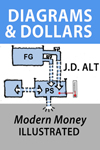
It is time to come to terms with the fact that U.S. dollars are what economists call “fiat money”. Having acknowledged this—and it’s difficult not to accept it as true since the U.S. abandoned the gold-standard over forty years ago—it might be worthwhile to give some consideration to what “fiat money” actually is and the peculiarities of how it works. Continue reading

Austerity’s Irrationality: The Age of Economic Anorexia

By Michael Hoexter

Rational public debate about the economy and government’s role in the economy is currently in extremely short supply.  In a debt-deflation, a weak economy saved from Great Depression-level misery by half-way, inadequate government action, government spending is now blamed categorically for the ills of the economy by the aggressive austerity campaign that has captured the political discussion in major capitals.  Previous flaws in the economic theory of the state and theory of money, typically consigned to the realm of different economic “tastes” or moral persuasions, are now revealed to be catastrophic gaps in most economists’ and the public’s understanding of the basics of the capitalist economy.  The predatory austerity campaigners, many originating from within the financial industry, have turned what should have been an era of greater clarity about government’s critical role in the economy into a scapegoating of government for ills perpetrated for the most part by components of the financial sector or by the subservience of the public sector to the financial sector.  Austerity policies when implemented are the equivalent of ‘economicide’ as they strangle government’s ability to spur lagging demand for real goods and services as well as government’s role in steering the economy to deal with challenges that the private sector can’t or doesn’t want to face on its own.

Continue reading

America’s Deceptive 2012 Fiscal Cliff – Part 3

By Michael Hudson

[Part 1] [Part 2] […]

Quantitative easing as free money creation – to subsidize the big banks

The Federal Reserve’s three waves of Quantitative Easing since 2008 show how easy it is to create free money. Yet this has been provided only to the largest banks, not to strapped homeowners or industry. Ben Bernanke’s helicopter only flies over Wall Street to drop its money. An immediate $2 trillion in “cash for trash” took the form of the Fed creating new bank-reserve credit in exchange for mortgage-backed securities valued far above market prices. QE2 provided another $800 billion in 2011-12. The banks used this injection of credit for interest rate arbitrage and exchange rate speculation on the currencies of Brazil, Australia and other high-interest-rate economies. So nearly all the Fed’s new money went abroad rather than being lent out for investment or employment at home. Continue reading

Functional Finance and the Debt Ratio—Part III

By Scott Fullwiler

[Part 1] [Part 2] […] [Part 4] [Part 5]

This five part series will explore at length (warning!) and in detail (another warning—wonk alert!) the MMT perspective on the debt ratio and fiscal sustainability.  While the approach suggests a macroeconomic policy mix and strategies for both fiscal and monetary policies that most neoclassical economists currently believe are unsustainable, ultimately the MMT preference for a significant role for fiscal policy in macroeconomic stabilization is shown to be consistent with traditional neoclassical views on fiscal sustainability.

This third part discusses the historical behavior of US interest rates on the national debt in the context of fiscal sustainability. 

Continue reading

It’s Time for Progressives to Act

By Dan Kervick

By the time I post this, the Republicans in the House of Representatives may already have torpedoed last night’s fiscal cliff budget deal.  But the miserable lessons of both the budget deal and the White House political strategy that engendered it stand in any case: the Obama administration is both economically incompetent and hostile to progressive values.  Progressives need to stop acting like submissive partisan hacks, and stop offering mealy-mouthed gestures of moral support to a conservative, deceitful and morally bankrupt administration that is complicit in the attack on progressive values and broad prosperity.

Continue reading

Greg Mankiw Discovers the Math and the Arithmetic on the Same Day

By Dale Pierce

Raising taxes is a good idea after all. In fact, it is now quite necessary, according to former Romney flack and alleged deep thinker Greg Mankiw of Harvard University. (Whose introductory textbook in economics may go down in history as the single greatest disinformational success of all time.)

In this Sunday’s New York Times, Prof. Mankiw bravely challenges what he takes to be the newly prevailing group-think in Washington – namely, the bi-partisan idea that “taxes on the middle class must not rise.” This is “Bad Math”, we are told. This does not accord with the “laws of arithmetic” – at least not as Prof. Mankiw understands them. It is, he concludes, our government’s stubborn reluctance to tax the non-rich which explains why “the political process has become so dysfunctional.”

Continue reading

Functional Finance and the Debt Ratio—Part II

By Scott Fullwiler

[Part 1] […] [Part 3] [Part 4] [Part 5]

This five part series will explore at length (warning!) and in detail (another warning—wonk alert!) the MMT perspective on the debt ratio and fiscal sustainability.  While the approach suggests a macroeconomic policy mix and strategies for both fiscal and monetary policies that most neoclassical economists currently believe are unsustainable, ultimately the MMT preference for a significant role for fiscal policy in macroeconomic stabilization is shown to be consistent with traditional neoclassical views on fiscal sustainability.

This second part discusses interest rates on the national debt in the context of a currency issuer operating under flexible exchange rates. Continue reading

Beyond the MSM: the New Wave of Brief Blog Posts on Platinum Coin Seigniorage

By Joe Firestone

Introduction

MSM bloggers and cable hosts weren’t alone in creating the new wave of posts and video segments on Platinum Coin Seigniorage (PCS) at the beginning of December. The blogosphere also produced brief posts from a number of bloggers, as well as a few more substantial ones. I’ll review the brief ones in this post, and the more substantial ones in future posts, but won’t include my own recent posts on PCS during December.

Continue reading

P. J. O’Rourke’s Pizza Boxes Metaphor Explaining the Triumph of Capitalism

By William K. Black
(Cross posted at Benzinga.com)

P.J. O’Rourke’s column:  “Dear Mr. President, Zero-Sum Doesn’t Add Up” claims that the following metaphor explains President Obama’s world view and policy choices: “life [is] like a pizza, where if some people have too many slices, other people have to eat the pizza box.”

A zero-sum interaction occurs when one party’s gain must exactly match the other party’s loss.  Continue reading

America’s Deceptive 2012 Fiscal Cliff – Part 2

By Michael Hudson

[Part 1] […] [Part 3]

Today’s financial war against the economy at large

Today’s economic warfare is not the kind waged a century ago between labor and its industrial employers. Finance has moved to capture the economy at large, industry and mining, public infrastructure (via privatization) and now even the educational system. (At over $1 trillion, U.S. student loan debt came to exceed credit-card debt in 2012.) The weapon in this financial warfare is no longer military force. The tactic is to load economies (governments, companies and families) with debt, siphon off their income as debt service, and then foreclose when debtors lack the means to pay. Indebting government gives creditors a lever to pry away land, public infrastructure and other property in the public domain. Indebting companies enables creditors to seize employee pension savings. And indebting labor means that it no longer is necessary to hire strikebreakers to attack union organizers and strikers. Continue reading