Tag Archives: Monetary policy

From Central Bank Independence to Democratic Public Finance

By Dan Kervick

Effective governance in any country requires a well-designed system of public finance through which that government can achieve its various purposes and pursue the public interest.  If the system of public finance is poorly structured, the public interest will be poorly served.   So, badly designed systems of public finance must be altered or abolished. [1]

We have reached that point in the United States.  The present system of public finance in the US is inefficient and antiquated: its fusty architecture hampers the capacity of the national government to respond to economic fluctuations and crises in a timely and effective manner; its byzantine operational complexity thwarts democratic governance and generates pervasive public confusion about the full range of public policy options; and its over-reliance on government bonds means that wasteful and unearned profits flow to some of the most affluent members of US society, as they are paid service fees for intermediating what ought to be routine operations of the government.

Continue reading

Can the Fed Really do More?

By Stephanie Kelton

I’ve grown increasingly frustrated by the near universal cry for more action from the Fed.  My friend and fellow blogger Marshall Auerback has quipped that it’s as if every mainstream progressive received the same White House memo.  I imagine it looked something like this:

Continue reading

Bernanke Scraps Bold Congress Testimony for Lukewarm Version

By Gal Noir*

In his Congressional testimony on October 4th, Federal Reserve Chairman Bernanke uncharacteristically praised the benefits of fiscal policy, calling it “of critical importance” and conveying concerns with the looming deficit reductions. He cautioned: “an important objective is to avoid fiscal actions that could impede the ongoing economic recovery.”

Many economists expressed worry that such advocacy of fiscal policy will erode America’s (already) wavering confidence in the Fed and will further weaken their support for austerity measures. More troubling still, the economists said, was the possibility that the public may follow suit and start demanding from Congress bolder government action on the jobs front.

A few dissenting scholars thought that it was high time for Bernanke to put his money where his mouth was, so to speak. Among them was Dr. Tcherneva, who had studied Bernanke’s academic proposals for government action during crises and his actual policy moves as Fed Chairman during the Great Recession (2011).**   “I am not at all surprised that Chairman Bernanke is making the case for fiscal policy” Tcherneva said. “I am only astonished that it took him so long. After studying his policy prescriptions for the case of Japan, I am left with the nagging conclusion that Bernanke actually favors fiscal policy over monetary policy. And while the reasons for this position are tucked away in his 2000 paper,***  they were nowhere to be found in his testimony before Congress. This too was very surprising. Considering his scholarship, I was expecting a very different speech today” Tcherneva said.

And indeed Tcherneva may have been right. In a breaking development, housekeeping personnel at the Federal Reserve Board building in D.C. had found a crumpled draft of what appears to be the original speech Chairman Bernanke had intended to deliver. In a NEP exclusive, we reprint the original draft below. Paragraphs in blue are the only ones that made it into the final version.

Chairman Ben S. Bernanke 
Economic Outlook and Recent Monetary Policy Actions 
Before the Joint Economic Committee, U.S. Congress, Washington, D.C. 
October 4, 2011


DRAFT VERSION

 “Chairman Casey, Vice Chairman Brady, and other members of the Committee, I appreciate this opportunity to discuss the economic outlook and recent monetary policy actions. 

Twelve years ago, I published a detailed recipe for stabilization policy during severe recessions. I watched the economic difficulties Japan faced all through the 90s and concluded that it suffered from a case of self-induced paralysis due to policy inaction (Bernanke 2000). Ladies and gentlemen, I fear that the United States may be facing a similar problem today. I for one have tried aggressively to employ various traditional and non-traditional levers of monetary policy, but as I have explained in my 2000 paper, central banks cannot bring recoveries alone. They need their fiscal arm.

Based on the case of Japan, I had concluded that the central bank should take the following steps:

  1. Commit to an inflation target and a long-term low interest rate environment; 
  2. Depreciate the currency through open market purchases of foreign currency; 
  3. Engage in non-traditional OMOs – including purchases of long term government securities and other private sector liabilities such as non-performing loans, commercial paper, corporate bonds, asset-backed securities and other; 
  4. Last but not least, finance various fiscal transfers (e.g., tax cuts) to boost consumption demand 

I admit that I did not entirely follow my own recipe. I did commit to a low-interest rate environment for the foreseeable future, but have opted not to state a specific inflation target. Experience has taught me that it is notoriously difficult to hit an inflation target (especially in a deflationary environment) and I cannot risk the Fed’s credibility further by promising something I cannot deliver. The Fed also did not engage in open market purchases of foreign currency. Although this is a function normally performed by central banks, it is technically a fiscal function because the legal authority over the exchange rate rests with the Treasury (see Bernanke, 2000, p. 161 and Tcherneva 2011, p. 416). I am confident that had the Fed recommended to the Treasury this course of action, the Treasury would have agreed. However, we did not wish to set off a currency war and engage in competitive devaluations. It is bad business and it infuriates our trading partners.

I have, however, employed all sorts of non-traditional Open Market Operations. Yes, I realize that many of them have been controversial, and that their legality has been questioned. But my objective has been to bring short, medium, and long terms rates down by purchasing government securities of various maturities. This is how we accomplished policy prescription #1 above. Through TARP and various other programs, we also purchased $trillions of ‘toxic’ private sector financial assets. I must admit that these (latter) non-traditional OMOs are not technically monetary policy either, even though everyone calls them that. I personally call them ‘monetary policy actions with fiscal components’ (Bernanke 2000), but they are essentially fiscal policies.

For the Fed to execute such purchases, it needs an act of Congress (e.g., TARP I and TARP II) or some other authorization, such as Section 14(b) of the Federal Reserve Act, which many believe I had abused, but that’s a topic for another day. In essence, Congress has to charge the Fed with buying the non-performing private assets. Normally, the public associates fiscal policy with various purchases by Congress (bombs, roads, healthcare), but we at the Fed clear all government payments, whatever they may be. When the Fed purchases some private sector asset (MBS, CDOs, CDSs) on behalf of the government, it is the same thing—it’s is still fiscal policy.

The reason why I favor fiscal policy is that it enables monetary policy through its ‘fiscal components’. The Fed can ‘stimulate’ the economy primarily because of its fiscal arm.

The objective is to generate growth through a wealth effect, which occurs when we increase the holdings of net financial assets (nfa) in the hands of the private sector and, unfortunately, the Fed cannot do this alone. As I have clearly stated before, central banks cannot rain money unilaterally on the population (Bernanke 2000, p. 163). This can be accomplished only in coordination with a country’s fiscal authority. (No wonder everyone is calling for a Fiscal Union for the Euro Zone—after all, that is a perfect example how central banks cannot do much stabilization without fiscal policy).

Creating a wealth effect and boosting private sector holdings of nfa happens only when monetary policy finances its various fiscal components. Buying foreign currency, as I have explained above, has fiscal components but I will skip this discussion since we didn’t use this course of action (you can find a detailed discussion in Tcherneva 2011).

Buying Treasury securities of any maturity does not increase private sector nfa, because these types of OMOs only swap one government liability for another (reserves for Treasuries and vice versa). Buying toxic private financial assets however does, and is best thought of as fiscal policy.

As I wrote in my paper:

“By a fiscal component I mean some implicit subsidy, such as would arise, for example if the BOJ [or any Central Bank] purchased non-performing bank loans at face value (this is of course equivalent to a fiscal bailout of the banks, financed by the Central Bank). This sort of money-financed “gift” to the private sector would expand aggregate demand for the same reason any money-financed transfer does …” (Bernanke 2000, p. 164) 

Yes ‘subsidies’, ‘gifts’, whatever you wish to call them, they are net new additions to private sector financial wealth. I will leave aside the question of whether money drops (or ‘gifts’) to the banking sector boost aggregate demand. After years of stuffing bank balance sheets with reserves through QE1, QE2, and purchases of non-performing private financial assets, without seeing any meaningful growth, I have serious doubts about the transmission mechanism from bank reserves to investment. More importantly, in my 2000 paper I clearly stated that policy action #3 (non-traditional OMOs) is not even necessary, when we have policy action #4 at our disposal (money financed fiscal transfers) (p. 164). But for that we also need Congressional action.

Indeed, I wasn’t very fond of nontraditional OMOs in the first place, but since fiscal policy no longer adds any stimulus to the economy, I am doing the best I can with the limited tools I have.

Here is why I wish I didn’t have to engage in such aggressive nontraditional OMOs. As I said in my 2000 paper:

“Nonstandard open market operations with a fiscal component, even if legal, would be correctly viewed as an end run around the authority of the legislature, and so are better left in the realm of theoretical curiosities” (Bernanke 2000, p. 164) 

I wish I could still call them a ‘theoretical curiosity’! But I stress again, Congress left me no choice but to exercise them, given its own refusal to put in place bold stimulus policies.

Indeed, I find fiscal policy to be more expedient, because such ‘gifts’ to the private sector are better provided through swift votes in Congress on subsidies, tax cuts, and other programs (I made the case for Congressional action in Japan in Bernanke 2000 on p. 164). Again I will leave aside the debate about how effective investment subsidies and tax cuts are, but the point I am making is that fiscal policy is crucial and preferable for several reasons.

  1. First, the impact of non-traditional OMOs may take a long time to kick in. I had argued earlier that as long as the Fed buys real or financial assets, at some point the imperfect substitutability of assets will ensure that the prices of assets purchased would rise (Bernanke, 2000, p 164). We have only bought financial assets so far, but at least we managed to stabilize their prices, which makes me think that maybe we should start buying real assets like labor, for example, to support wages and incomes. That would mean that we will start hiring the unemployed, but that too would require a fiscal component—an act of Congress. Plus it is better for Congress to do this, given its experience with such programs. 
  2. Second, I prefer fiscal policy because there is a real problem with the legitimacy of non-traditional monetary policy actions that seem to circumvent the authority of the legislative body (ibid.). 
  3. Finally, monetary policy can finance all types of fiscal transfers without any concern for solvency or sustainability because government-issued money “is special; it is not only a zero-interest liability, but also a perpetual liability” (Bernanke, 2000, p. 163). In fact, the Fed cannot even refuse to finance fiscal policy. As I have stated before:  
  4. “Under a fiat (that is, paper) money system, a government (in practice, the central bank in cooperation with other agencies) should always be able to generate increased nominal spending and inflation, even when the short-term nominal interest rate is at zero. . . . The U.S. government has a technology, called a printing press (or, today, its electronic equivalent) that allows it to produce as many U.S. dollars as it wishes at essentially no cost.” (Bernanke 2002) 

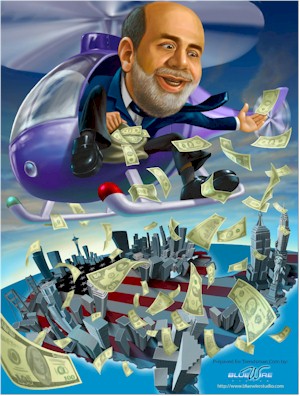
Because of this speech and because of QE1 and QE2, I have been labeled “Helicopter Ben”, but note that I cannot rain money on the population alone. This can be done only when the central bank finances government spending. And if you’d like to call that ‘a helicopter drop of money’, so be it. The point is that the Fed never bounces a government check unless Congress orders us to do so (an absurd scenario which almost became reality in August 2011 during the debt ceiling debates). We are the government’s bank. This is not a proposal, it’s what we do. We help ensure that the U.S. government is solvent, so long as we have Congressional approval.

Some economists have argued that my proposal for government action should not be limited to subsidies and tax cuts, but should include direct job creation for the unemployed, infrastructure investment, universal child allowance, homeowner assistance, stronger social security, universal health and other (e.g., Tcherneva 2011). These are all policies that deal with labor markets, poverty, housing, retirement, and the many other long-term challenges we face.

These are precisely the sorts of policies I am asking you to consider today.

Fiscal policy is of critical importance, as I have noted today, but a wide range of other policies–pertaining to labor markets, housing, trade, taxation, and regulation, for example–also have important roles to play. 

For the case of Japan, I called for a Rooseveltian Resolve. I wrote that “FDR deserves great credit for having the courage to abandon failed paradigms and to do what needed to be done” (ibid. p. 165).

Today I ask of you, esteemed Congressmen and Congresswomen, to do the same. Abandon dated ideas about what constitutes sound finance and spring into action. The Fed is here to help.

For me to be able to do my job, I need you to do yours. Remember, fiscal policy enables monetary policy. The Fed stands ready to fund any and every government program that would bring full employment, sustainable growth, and long term prosperity — be it a ‘New New Deal’, a ‘Green New Deal’, or the ‘Job Guarantee’. Such policies will be sustainable because the Fed stands behind the full faith and credit of the Federal Government.

Monetary policy can be a powerful tool, but it is not a panacea for the problems currently faced by the U.S. economy. Fostering healthy growth and job creation is a shared responsibility of all economic policymakers, in close cooperation with the private sector. Fiscal policy is of critical importance, as I have noted today, but a wide range of other policies–pertaining to labor markets, housing, trade, taxation, and regulation, for example–also have important roles to play. For our part, we at the Federal Reserve will continue to work to help create an environment that provides the greatest possible economic opportunity for all Americans.Thank you.” 

NEP is pleased to bring you this exclusive report. The reasons why the Chairman scrapped this draft of the speech in favor of the lukewarm version he delivered still remain a mystery.

*Gal Noir is an undercover investigator of hijacked economic truths and an occasional blogger at New Economic Perspectives
________________________
**  Tcherneva, P.R. “Bernanke’s paradox: can he reconcile his position on the federal budget with his recent charge to prevent deflation?” Journal of Post Keynesian Economics, Spring 2011, Vol. 33, No. 3, pp. 411-433. www.pavlina-tcherneva.net

*** Bernanke, B.S. “Japanese Monetary Policy: A Case of Self-Induced Paralysis?” In R. Mikitani and A. Posen (eds.), Japan’s Financial Crisis and Its Parallels to U.S. Experience. Washington, DC: Institute for International Economics, 2000, pp. 149–166.

Mr. Greenspan takes it all back. His Old Time Religion was right after all.

By Michael Hudson

It all seems so long ago! On October 23, 2008, Alan Greenspan choked up a mea culpa for his deregulatory policy as Federal Reserve Chairman. “Those of us who have looked to the self-interest of lending institutions to protect shareholders’ equity, myself included, are in a state of shocked disbelief,” he told the House Committee on Oversight and Government Reform. “The whole intellectual edifice, however, collapsed in the summer of last year.”
For a moment he seemed to be rethinking his lifelong assumption that the financial sector would seek to protect its reputation by behaving so honestly that its customers would gain from dealing with it. “I had been going for 40 years with considerable evidence that it was working exceptionally well” – the idea that regulation was not needed because bankers would seek to protect their reputations and their “counter-parties” would look to their own interest.
“Were you wrong?” Congressman Henry Waxman prompted him to elaborate.
“Partially,” the Maestro replied. “I made a mistake in presuming that the self-interest of organizations, specifically banks, is such that they were best capable of protecting shareholders and equity in the firms.” The fact that they simply sought predatory gains for themselves – in the form of losses for their customers and clients (and it turns out, taxpayers”) was “a flaw in the model that I perceived is the critical functioning structure that defines how the world works.”
But the past two or three years evidently have given Mr. Greenspan enough time for a re-think. In Wednesday’s Financial Times (March 30, 2011) he returns to his old job proselytizing for deregulation. His op-ed, “Dodd-Frank fails to meet test of our times,” is a mea culpa to his co-religionists for his apostate 2008 mea culpa. “The US regulatory agencies will in the coming months be bedevilled by unanticipated adverse outcomes,” he warns, “as they translate the Dodd-Frank Act’s broad set of principles into a couple of hundred detailed regulations.” The Act “may create … regulatory-induced market distortion,” because neither lawmakers nor “most regulators” understand how “complex” the financial system is.
But Mr. Greenspan refused to acknowledge the obvious: If Wall Street’s collateralized debt obligations (CDOs) and other derivatives are too complex for regulators to understand, they also must be too complex for buyers and other counterparties to evaluate. This negates a key free market assumption. How can one make an informed choice without understanding the market and the consequences of one’s action? On this logic regulators would follow free market orthodoxy in rejecting derivatives and other such “complex” products.

Many critics would say that CEOs of the banks that went bust don’t understand the complexity that led to their negative equity either. Or, they know all too clearly that they can take a gamble and be bailed out by the government, simply by threatening that the alternative would be monetary anarchy that would drag down consumer banking along with casino banking. The problem is not so much complexity, but gambling – increasingly with computer models and fast mega-trading of swaps and derivatives. This is how investment bankers have made (and often lost) their money.
But they want the game to continue. That is the bottom line. On balance, even if they lose, they will be bailed out. So of course they are all for “complexity” that enables them to make gains at the economy’s expense (Mr. Greenspan’s “flaw” in the system).
But alas, he does not acknowledge the fact that Wall Street blackballs regulators who do understand how the financial system works. An ideological blind spot free-market style is a precondition for deregulators such as Mr. Greenspan. It’s as if he still doesn’t understand that this is precisely why he was hired for his job at the Fed! After rejecting Brooksley Born’s attempt to regulate credit-default swaps at the Commodity Futures Trading Commission in 1998, he served his banking benefactors by passionately supporting Robert Rubin and Larry Summers in pressing the Clinton Administration to repeal Glass-Steagall, opening the door to make consumer banking dependent on wild financial gambling by the likes of Citibank and what has become Bank of America. This self-imposed blindness cost to the economy trillions of dollars and has left a dysfunctional commercial banking system. (At least former S.E.C. Chairman Arthur Levitt has apologized to Ms. Born.)
Mr. Greenspan’s euphemism for dysfunctional is “complex.” His op-ed says what priests or nuns tell parochial school pupils who ask about how God can let so many bad things happen here on earth. The answer is simply to say: “God is too complex for you to understand. Just have faith.” Nobody has sufficient skills to be “entrusted with forecasting, and presumably preventing, all undesirable repercussions that might happen to a market when its regulatory conditions are importantly altered.” Just look at how Bush Administration happy-face appointees at the FDIC and IMF expressed faith that risks were declining in 2007-08. “Regulators were caught ‘flat-footed’ by a breakdown we had erroneously thought was more than adequately reserved against.” Who could have seen that fraud was going on? Certainly nobody that was let into the Fed’s policy meetings.
Federal Reserve Board Governor Ed Gramlich’s warning about subprime mortgage fraud is ignored as an anomaly here. When Mr. Greenspan says “we” in the above quote he means the useful idiots that Wall Street insists that the government hire – true believers in the deregulatory kool-aid being doled out on behalf of their financial god too complex for mortals to know. “The problem is that regulators, and for that matter everyone else, can never get more than a glimpse at the internal workings of the simplest of modern financial systems.” But the “regulators who never got more than glimpse” were co-religionists headed by Bubblemeister Greenspan himself. He bears his failure to “more than glimpse” like a badge of honor.
It seems that only bankers really understand what they’re selling, but you must trust Wall Street to do the right thing. (If Mr. Greenspan mouthed such a claim in Wisconsin, where five school districts were suckered into borrowing $200 million in addition to their original investment in CDOs, he would meet with considerable ridicule.) If bankers do not make money for their customers, they will lose their trust. Why would bankers and financial institutions act in such a way as to profiteer at their customers’ expense (and that of the overall economy for that matter)?
The reason, of course, is that the financial sector notoriously lives in the short run. Countrywide Financial, Lehman Brothers, WaMu, Bear Stearns, A.I.G. et al. gave their managers enormous salaries and even more enormous bonuses to turn themselves into a new power elite with fortunes large and “complex” enough to endow their heirs for a century.
The Federal Reserve Bank of Minneapolis has just published statistics showing that the wealthiest 1% of America’s population doubled its share of wealth over the decade ending in 2007 as the bubble reached its peak. No doubt this polarization is widening as the economy shrinks under the weight of its debt overhead. Mr. Greenspan acknowledges criticisms that Wall Street has used TARP and other bailout money simply to maintain “the outsized (to some, egregious) bankers’ pay packages.” But he points out that “small differences in the skill level of senior bankers tend to translate into large differences in the bank’s bottom line.” Skill is expensive.
What amazes me about mismanagers like Countrywide’s chairman Angelo Mozilo and his counterparts is that when the S.E.C., F.B.I. and state attorneys general open a investigation to see whether to charge them with criminal felonies, the bankers always insist that they were out of the loop, had no idea of what was going on, and are shocked, shocked, to find out that there’s gambling going on in this place.
If they are so unknowledgeable to be even more blind than the regulators and economists who warned about what was happening that has required a $13 trillion government bailout, how can they insist that they are worth whatever they can grab? For that matter, how did they manage to avoid jail terms? This is the real question that “free market” economists should be asking.
Most Wall Street firms have paid substantial settlements, and Mr. Mozilo recently paid the Securities and Exchange Commission $67.5 million to avoid going to trial for civil fraud and insider dealing. But only Martha Stewart became an insider jailbird. For Wall Street, paying a civil fine “without acknowledging wrongdoing” blocks victims from recovering civil damages in the event that they try to sue to get their money back. Evidently the Obama Administration believes that to make the banks pay would simply require yet further bailouts of “taxpayer money.” By refraining from prosecuting, Mr. Geithner at the Treasury and other regulators thus can claim to be saving taxpayers – while permitting the large banks to have grown 20 percent larger today than they were when the bailouts began, by extorting high credit card fees and penalties, and using tax breaks and almost free Fed credit such as the $600 billion QE2 to make money by fleeing the dollar to speculate in foreign currencies and make casino capitalist bets.
Mr. Greenspan insists that the economy would be even poorer under financial regulation. “One of the [Dodd-Frank] law’s provisions,” he criticizes, “made credit-rating organisations legally liable for their opinions about risks.” To avoid killing business with such regulation, “the Securities and Exchange Commission in effect suspended the need for a credit rating.” The idea was to save the ratings agencies from having to take responsibility for the tens of billions of dollars lost as a result of their pasting AAA ratings on junk mortgages.
It is as if fraud is simply part of the free market. In this respect, I find his Financial Times op-ed more damning than his evidently temporary burst of candor in his October 2008 Congressional testimony. Mr. Greenspan has rejoined his flock. And to show how thoroughly he has been cured from his temporary apostasy from free market religion, he belittles the fact that: “In December, the Federal Reserve … proposed to reduce banks’ share of debit card fees associated with retail transactions, leading many lenders to contend they would no longer be able to afford to issue debit cards.”
But can there be a better logic to promote the “public option” and have the Treasury issue credit cards as well as debt cards? The rake-off charged by banks from sellers and buyers alike (not to mention late fees that yield the card companies even more than their interest charges these days) has been a major factor eating into retail profits and personal incomes.
The banks are arguing, in effect: “If we can’t earn back enough profits to cover the losses we’ve made on our junk loans, we’ll organize our own lockout of customers – to force you to pay whatever we demand to cover our costs, pay our salaries and bonuses.” This has been their threat ever since the Lehman Brothers meltdown. They threaten to create financial anarchy if the government does not save them from loss, by shifting it onto taxpayers!
The problem is that the bankers’ solution – the inevitable result of Mr. Greenspan’s policy of shifting central planning onto Wall Street – is that it will culminate in the anarchy of debt deflation, deepening unemployment, more real estate foreclosures, and capital flight out of the dollar. So why not let the government say, “OK, we’ll provide a public-option alternative. And if this works, we’ll use it as a model for our public health insurance option. And then we will look to public banking options, and perhaps to Dennis Kucinich’s American Monetary Act to turn you commercial banks back into savings banks to stem your wild speculation at the economy’s expense.” (Just a modest proposal here for argument’s sake to quiet down the bankers’ threats.)
Mr. Greenspan argues that if banks are regulated to reduce the risk they pose to the economy, they may pack up and take their dealings to London: “concerns are growing that without immediate exemption from Dodd-Frank, a significant proportion of the foreign exchange derivatives market would leave the US.” My own response is to say fine, let them leave. Let Britain’s Serious Fraud Office and bank regulators pick up the pieces from their next opaque gamble “too complex” to understand.
Most slippery is Mr. Greenspan’s attempt to divert attention away from the instability that financial deregulation causes – the extreme and rapid polarization of wealth, the mushrooming of bad debt beyond the ability to pay, and the impoverishment of the economy as a result of its debt overhead. Don’t look there, he says; look at how “the global ‘invisible hand’ has created relatively stable exchange rates, interest rates, prices, and wage rates.” But real estate prices have not been stable – they have been inflated with debt, and then crashed the net worth of hapless borrowers. Employment is not stable, wealth distribution is not stable, nor are commodity prices, especially not the price of Mr. Greenspan’s beloved gold bullion.
Nevertheless, Mr. Greenspan concludes, there can be no such thing as a science of regulation. “Financial market behaviour is subject to so wide a variety of ‘explanations,’ especially in contrast to the physical sciences where cause and effect is much more soundly grounded.” But what sets the physical sciences apart from junk economics is the fact that it is not directly self-interested. There are no huge financial rewards for having a blind spot (except of course for scientists denying global warming or that nuclear power might be dangerous or deep-water oil drilling a risky proposition). There is method in the madness of today’s free market orthodoxy opting for GIGO (garbage in, garbage out) financial models that sing along with maestro Greenspan that Wall Street wealth will all trickle down.
“Is the answer to complex modern-day finance that we return to the simpler banking practices of a half century ago?” he asks rhetorically. By “simpler” banking practices of days of yore, he really means more honest practices, subject to knowledgeable public regulation. It was a world where banks held onto the mortgages they made rather than flipping them to third parties without any responsibility for truth in lending – or in selling, for that matter. “That may not be possible if we wish to maintain today’s levels of productivity and standards of living.” So regulation will make us poorer, not save us from financial fraud and $13 trillion bailouts.
Postulating an admittedly “as yet unproved tie between the degree of financial complexity and higher standards of living,” Mr. Greenspan suggests that wealth at the top is the price to be paid for rising living standards. But they are not rising; they are falling! have Instead of being job creators, bankers are debt creators – and debt deflation is pushing the economy into depression, raising unemployment and driving housing prices further down.
So it sounds like Mr. Greenspan today would do just what he did years ago, and reject warnings that the Fed should regulate reckless bank lending and outright fraud. His mantra is still that the invisible hand is too complex to regulate. It sounds like Willy Sutton bemoaning the fact that policemen keep interfering with his business!
For further commentary on Mr. G’s remarkable “I take it all back” op-ed, I recommend the excellent column of Yves Smith, “OMG, Greenspan Claims Financial Rent Seeking Promotes Prosperity!” Naked Capitalism, March 30, 2011. And if you still believe that Mr. Greenspan can be trusted to provide objective help to today’s financial policy makers, Google the name Brooksley Born and watch the Frontline show “The Warning.” Describing how ferociously Mr. Greenspan and his deregulatory Rubinomics colleagues fought against her attempts to provide information about derivatives so that they might be regulated (saving the U.S. government trillions of dollars), Ms. Born told her interviewer: “They were totally opposed to it. That puzzled me. What was it that was in this market that had to be hidden?”
We now know the answer. Investment bankers were making fortunes at what turned out to be public expense. And that is the real flaw in today’s financial system: most fortunes today, as in past centuries, are made by privatizing wealth from the public domain. To the grabbers, nothing must be allowed to stop that. They insist that is too complex for the regulators to cope with.

Pressures on the Paradigm: The Fall of the New Monetary Consensus

By L. Randall Wray

The following is a paper given at the ASSA conference in Denver this past week for a panel organized by James Galbraith, titled Pressures on the Paradigm, sponsored by Economists for Peace & Security.

The Queen famously asked her economists why none had seen the global crisis coming. Obviously the answer is complex, but it must include the evolution of economic theory over the postwar period—from the “Age of Keynes”, through the Friedmanian era and the return of virulent Neoclassical economics, and finally on to the New Monetary Consensus with a New anti-Keynesian version of fine-tuning by an unaccountable (“independent”) central bank

We cannot leave out the parallel developments in finance theory—with its efficient markets hypothesis—and the subsequent deregulation and de-supervision that led to the financialization of everything.

But to make a long story short: if your theory says that a global collapse is impossible, you won’t see one coming. In truth, as Jamie has argued in his great book, the Predator State, no one outside Chicago and other institutes of the higher learning ever took the free market mantra seriously—outside the ivory towers it was nothing but a slogan, a justification for enrichment of the powerful few.

Like Jamie, I believe orthodox macroeconomics is finished—although not all the zombie practitioners of that dismal religion recognize they are dead. After the crisis hit, Jamie, Duncan Foley and I were invited to appear on panels at the University of Chicago along with a dozen or so of the Chicago boys.

Not surprisingly, none of them was budging from his dogma of free and efficient markets: the crisis was caused by too much government interference; the solution is more deregulation. Three years into this crisis those who never saw it coming proclaim signs of recovery everywhere they look.

And, still, it is only academia that is clueless. Everyone in financial markets saw it coming—indeed, they planned on it and worked fastidiously to create it. They would profit on the way up, and then profit more in the collapse whilst collecting on their credit default swap bets and stealing all the homes.

It is Bush’s ownership society and the goal all along was to transfer all ownership to the top through the creation of serial bubbles—what Michael Hudson calls Bubbleonia. The biggest land grab since the enclosure movement.

So, no, there is no recovery. The banks are more massively insolvent than they were 2 years ago. They are cooking their books so they can pay executive bonuses and reward the traders and the foreclosers who are successfully transferring all wealth to the elite.

But Jamie asked me to address the state of theory—not the economy.

I want to focus on one particular Zombie that needs a stake through its heart or a bullet through its head: the New Monetary Consensus. This is an updated New Keynesian version of the old Bastard ISLM model.

The idea is that inflation slows growth so it must be diligently fought. The Fed will keep inflation expectations low, inflation will be low, and growth will be robust.

Every link in that sentence is a delicious illusion.

The Fed supposedly manages expectations by convincing markets that it controls inflation, and so long as it controls expectations it can control inflation.

But if it cannot control expectations it cannot manage inflation and all bets are off. What a flimsy reed upon which to hang public policy!

And in any case, why should low inflation generate robust growth? Because—well, because the Fed says it will, contrary to all evidence.

Out in the real world, expectations alone cannot govern any economic phenomena: inflation expectations will determine actual inflation only if those with ability to influence prices act on those expectations. And inflation below the high double digits has never proven to be a barrier to economic growth.

Let us take the current experience as an example. We have moved on to QE2, an application of the NMC.

Helicopter Ben is supposedly injecting trillions of dollars of money into the economy to create expectations of inflation—to counter the deflationary real world forces. And many wingnuts actually ARE expecting inflation—running around like Chicken-Littles, buying gold and screaming about hyperinflation and collapse of the dollar. And, yet, no inflation. Why?

Because those who might have pricing power—corporations and organized labor—cannot create inflation. Workers cannot increase their wages given massive global unemployment, and firms cannot increase prices in the face of competitive pressures. So no matter how strong is the will to believe, it has no purchase against the facts.

The wingnuts will be proven wrong. The Fed cannot create inflation. It is within the power of the central bank to lower the price of reserves—the overnight rate–as close to zero as it wants. It can also lower longer term rates on assets it is willing to buy, but there is a nonzero practical limit to that based on what Keynes called the square rule.

Quantitative easing supposedly pumps money into the economy to generate spending in order to create expectations of inflation. But all it really amounts to is substituting reserves for treasuries on bank balance sheets—lowering their interest earnings. QE won’t work because:

• (1) additional bank reserves do not enable or encourage greater bank lending;

• (2) the interest rate effects are small at best, and are swamped by private sector attempts to deleverage;

– The best estimate based on NYFed work: 18 basis points

• (3) purchases of Treasuries are simply an asset swap that reduce the maturity of private sector assets, but do not raise private sector incomes; and

• (4) given the reduced maturity of private sector portfolios, reduced interest income could actually be deflationary.

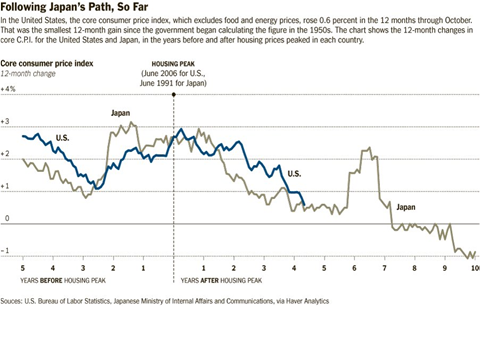
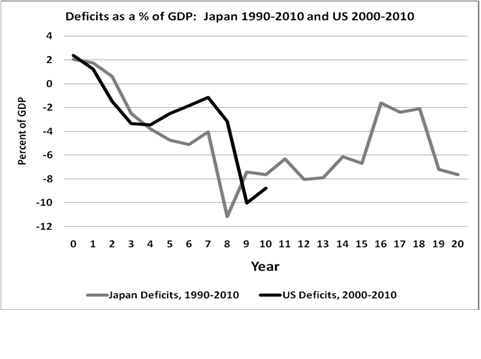
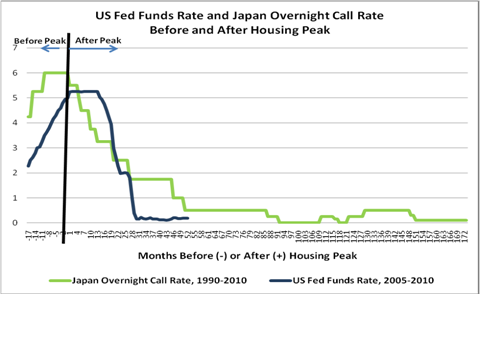
But we knew all that—Japan has been doing QE for 20 years, trying to create expectations of inflation in the face of deflationary headwinds, thus, it is interesting to compare Japanese and US experience (so far) by looking at a series of three graphs.

As they say, history doesn’t repeat itself but in this case it rhymes nicely. Only insanity would lead us to follow Japan’s path while expecting different results.

Let me finish my critique of the NMC with an observation of a Galbraith—John Kenneth this time:

To limit unemployment and recession in the US and the risk of inflation, the remedial entity is the Fed… For many years (with more to come) this has been under the direction from Washington of a greatly respected chairman… The institution and its leader are the ordained answer to both boom and inflation and recession or depression… Quiet measures enforced by the Fed are thought to be the best approved, best accepted of economic actions. They are also manifestly ineffective. They do not accomplish what they are presumed to accomplish. Recession and unemployment or boom and inflation continue. Here is our most cherished and, on examination, most evident form of fraud.

Even if the early postwar “Keynesian” economics had little to do with Keynes at least it had some connection to the real world. What passed for macroeconomics on the precipice of the global collapse had nothing to do with reality—it is as relevant to our economy as flat earth theory is to natural science.

In short, expecting the Queen’s economists to foresee the crisis would be like putting flat- earthers in charge of navigation for NASA and expecting them to accurately predict points of re-entry and landing of the space shuttle. Of course, the economic advisors to Presidents Bush and Obama could do no better.

Referring to the work of the best known economists over the past thirty years, Lord Robert Skidelsky argues “Rarely in history can such powerful minds have devoted themselves to such strange ideas.” Not only were they strange, but the ideas of the Larry Summers’, Bob Rubins, Mankiws, Marty Feldsteins, Bernankes and John Taylors of the world were, predictably, dangerous.

But one economist got it right, and did see it coming. And that is Hyman Minsky. His theory said it can happen again: market forces are destabilizing.

The economy emerged from WWII with a robust financial system—hardly any private debt and lots of safe and liquid government debt. Various New Deal and postwar reforms also made the economy stable: a safety net that stabilized consumption; strict financial regulation; minimum wage laws and support of unions; low cost mortgages and student loans, and so on. And memories of the Great Depression discouraged risky behavior.

Gradually all that changed—memories faded, self-regulation replaced financial regulations, unions lost power and government support, globalization brought low-wage competition, and the safety net was shredded. Further, profit-seeking firms and financial institutions took on greater risks with ever more precarious finance. Thus, fragility grew on trend. This made “it” possible again.

While most who invoke Minsky focus on the crash, he believed that the main instability is a tendency toward explosive euphoria. High aggregate demand and profits associated with high employment raise expectations and encourage increasingly risky ventures based on commitments of future revenues that will not be realized.

A snowball of defaults then leads to a debt deflation and high unemployment unless there are “circuit breakers” that intervene to stop the market forces. The main circuit breakers, are the Big Bank (central bank as lender of last resort) and Big Government (countercyclical budget deficits).

And, boy-oh-boy have we got a Big Bank and a Big Government! Together, the Benny and Timmy tag team have spent, lent, or guaranteed $25 trillion in the name of Uncle Sam. And that still is not enough. “It” is still happening.

The problem is that most of this was done by the Big Bank Fed, aimed at helping financial institutions—trying to prop up their worthless assets. In short, it was based on the theory that we need Money Manager capitalism and that the only hope is to generate another bubble.

It won’t work. Financialization is the problem, not a sustainable economic strategy. We need to turn instead to an updated Keynesian-Minskian New Deal based on jobs, growing wages, consumption—especially public consumption, constrained and downsized finance, and greater equality. Monetary policy also has to be downsized, while fiscal policy has to play a bigger role. Not fine-tuning but a positive and permanent presence to counter and guide and supplement the private purpose.

More importantly we’ve got to formulate theory applicable to the world in which we actually live—not one in which imaginary representative agents allocate resources along an optimal consumption path.

To that end, we stand on the shoulders of the giants like Minsky in the heterodox tradition.

Warren Mosler’s Proposals for the Treasury, the Federal Reserve, the FDIC, and the Banking System

By Warren Mosler

The purpose of this paper is to present proposals for the Treasury, the Fed, and the banking system. Government begins with an assumption that it exists for public purpose, and I use that as the guiding assumption of my proposals. I begin with my proposals for the banking system, as banking operations influence both Fed and Treasury operations.

Proposals for the Banking System

U. S. banks are public/private partnerships, established for the public purpose of providing loans based on credit analysis. Supporting this type of lending on an ongoing, stable basis demands a source of funding that is not market dependent. Hence most of the world’s banking systems include some form of government deposit insurance, as well as a central bank standing by to loan to its member banks.

Under a gold standard or other fixed exchange rate regime, bank funding can’t be credibly guaranteed. In fact, fixed exchange rate regimes by design operate with an ongoing constraint on the supply side of the convertible currency. Banks are required to hold reserves of convertible currency, to be able to meet depositor’s demands for withdrawals. Confidence is critical for banks working under a gold standard. No bank can operate with 100% reserves. They depend on depositors not panicking and trying to cash in their deposits for convertible currency. The U.S. experienced a series of severe depressions in the late 1800’s, with the ‘panic’ of 1907 disturbing enough to result in the creation of the Federal Reserve in 1913. The Fed was to be the lender of last resort to insure the nation would never again go through another 1907. Unfortunately, that strategy failed. The depression of 1930 was even worse than the panic of 1907. The gold standard regime kept the Fed from being able to lend its banks the convertible currency they needed to meet withdrawal demands. After thousands of catastrophic bank failures, a bank holiday was declared and the remaining banks were closed by the government while the banking system was reorganized. When the banking system reopened in 1934, convertibility of the currency into gold was permanently suspended (domestically), and bank deposits were covered by federal deposit insurance. The Federal Reserve wasn’t able to stop depressions. It was going off the gold standard that did the trick.

It has been 80 years since the great depression. It would now take exceptionally poor policy responses for even the current severe recession to deteriorate into a depression, though misguided and overly tight fiscal policies have unfortunately prolonged the restoration of output and employment.

The hard lesson of banking history is that the liability side of banking is not the place for market discipline. Therefore, with banks funded without limit by government insured deposits and loans from the central bank, discipline is entirely on the asset side. This includes being limited to assets deemed ‘legal’ by the regulators and minimum capital requirements also set by the regulators.

Given that the public purpose of banking is to provide for a payments system and to fund loans based on credit analysis, additional proposals and restrictions are in order:

1. Banks should only be allowed to lend directly to borrowers, and then service and keep those loans on their own balance sheets. There is no further public purpose served by selling loans or other financial assets to third parties, but there are substantial real costs to government regarding the regulation and supervision of those activities. And there are severe consequences for failure to adequately regulate and supervise those secondary market activities as well. For that reason (no public purpose and geometrically growing regulatory
burdens with severe social costs in the case of regulatory and supervisory lapses), banks should be prohibited from engaging in any secondary market activity. The argument that these areas might be profitable for the banks is not a reason to extend government sponsored enterprises into those areas.

2. US banks should not be allowed to contract in LIBOR. LIBOR is an interest rate set in a foreign country (the UK) with a large, subjective component that is out of the hands of the US government. Part of the current crisis was the Federal Reserve’s inability to bring down the LIBOR settings to its target interest rate, as it tried to assist millions of US homeowners and other borrowers who had contacted with US banks to pay interest based on LIBOR settings. Desperate to bring $US interest rates down for domestic borrowers, the Federal Reserve resorted to a very high risk policy of advancing unlimited, functionally unsecured, $US lines of credit called ‘swap lines’ to several foreign central banks. These loans were advanced at the Fed’s low target rate, with the hope that the foreign central banks would lend these funds to their member banks at the low rates, and thereby bring down the LIBOR settings and the cost of borrowing $US for US households and businesses. The loans to the foreign central banks peaked at about $600 billion and did eventually work to bring down the LIBOR settings. But the risks were substantial. There is no way for the Fed to collect a loan from a foreign central bank that elects not to pay it back. If, instead of contracting based on LIBOR settings, US banks had been linking their loan rates and lines of credit to the US fed funds rate, this problem
would have been avoided. The rates paid by US borrowers, including homeowners and businesses, would have come down as the Fed intended when it cut the fed funds rate.

3. Banks should not be allowed to have subsidiaries of any kind. No public purpose is served by allowing bank to hold any assets ‘off balance sheet.’

4. Banks should not be allowed to accept financial assets as collateral for loans. No public purpose is served by financial leverage.

5. US Banks should not be allowed to lend off shore. No public purpose is served by allowing US banks to lend for foreign purposes.

6. Banks should not be allowed to buy (or sell) credit default insurance. The public purpose of banking as a public/private partnership is to allow the private sector to price risk, rather than have the public sector pricing risk through publicly owned banks. If a bank instead relies on credit default insurance it is transferring that pricing of risk to a third party, which is counter to the public purpose of the current public/private banking system.

7. Banks should not be allowed to engage in proprietary trading or any profit making ventures beyond basic lending. If the public sector wants to venture out of banking for some presumed public purpose it can be done through other outlets.

8. My last proposal for the banks in this draft is to utilize FDIC approved credit models for evaluation of bank assets. I would not allow mark to market of bank assets. In fact, if there is a valid argument to marking a particular bank asset to market prices, that likely means that asset should not be a permissible bank asset in the first place. The public purpose of banking is to facilitate loans based on credit analysis rather, than market valuation. And the accompanying provision of government insured funding allows those loans to be held to maturity without liquidity issues, in support of that same public purpose. Therefore, marking to market rather
than evaluation by credit analysis both serves no further public purpose and subverts the existing public purpose of providing a stable platform for lending.

Proposals for the FDIC (Federal Deposit Insurance Corporation)

I have three proposals for the FDIC. The first is to remove the $250,000 cap on deposit insurance. The public purpose behind the cap is to help small banks attract deposits, under the theory that if there were no cap large depositors would gravitate towards the larger banks. However, once the Fed is directed to trade in the fed funds markets with all member banks, in unlimited size, the issue of available funding is moot.
The second is to not tax banks in order to recover funds lost on bank failures. The FDIC should be entirely funded by the US Treasury. Taxes on solvent banks should not be on the basis of the funding needs of the FDIC. Taxes on banks have ramifications that can either serve or conflict with the larger public purposes presumably served by government participation in the banking system. These include sustaining the payments system and lending based on credit analysis. Any tax on banks should be judged entirely by how that tax
serves or doesn’t serve public purpose.

My third proposal for the FDIC is to do its job without any assistance by Treasury (apart from funding any FDIC expenditures). The FDIC is charged with taking over any bank it deems insolvent, and then either selling that bank, selling the bank’s assets, reorganizing the bank, or any other similar action that serves the public purpose government participation in the banking system. The TARP program was at least partially established to allow the US Treasury to buy equity in specific banks to keep them from being declared insolvent by the FDIC, and to allow them to continue to have sufficient capital to continue to lend. What the
TARP did, however, was reveal the total failure of both the Bush and Obama administrations to comprehend the essence of the workings of the banking system. Once a bank incurs losses in excess of its private capital, further losses are covered by the FDIC, an arm of the US government. If the Treasury ‘injects capital’ into a bank, all that happens is that once losses exceed the same amount of private capital, the US Treasury, also an arm of the US government is next in line for any losses to the extent of its capital contribution, with the FDIC covering any losses beyond that. So what is changed by Treasury purchases of bank equity? After the private capital is lost, the losses are taken by the US Treasury instead of the FDIC, which also gets its funding from the US Treasury. It makes no difference for the US government and the ‘taxpayers’ whether the Treasury covers the loss indirectly when funding the FDIC, or directly after ‘injecting capital’ into a bank. All that was needed to accomplish the same end as the TARP program- to allow banks to continue to function and acquire FDIC insured deposits- was for the FDIC to directly reduce the private capital requirements. Instead, and as direct evidence of a costly ignorance of the dynamics of the banking model, both the Obama and Bush administrations burned through substantial quantities of political capital to get the legislative authority to allow the Treasury to buy equity positions in dozens of private banks. And, to make matters worse, it was all accounted for as additional federal deficit spending. While this would not matter if Congress and the administrations understood the monetary system, the fact is they don’t, and so the TARP has therefore restricted their inclination to make further fiscal adjustments to restore employment and output. Ironically, the overly tight fiscal policy continues to contribute to the rising delinquency and default rate for
bank loans, which continues to impede the desired growth of bank capital.

Proposals for the Federal Reserve

1. The fed should lend unsecured to member banks, and in unlimited quantities at its target fed funds rate, by simply trading in the fed funds market. There is no reason to do other wise. Currently the Fed will only loan to its banks on a fully collateralized basis. However, this is both redundant and disruptive. The Fed demanding collateral when it lends is redundant because all bank assets are already fully regulated by Federal regulators. It is the job of the regulators to make sure that all FDIC insured deposits are ‘safe’ and ‘taxpayer money’ is not at risk from losses that exceed the available private capital. Therefore, the FDIC has already determined that funds loaned by the Fed to a bank can only be invested in ‘legal’ assets and that the bank is adequately capitalized as required by law. There is no room for funding from the Fed to be ‘misused’ as banks already can obtain virtually unlimited funding by FDIC insured deposits. The only difference between banks funding with FDIC insured deposits and funding directly from the Fed might be the interest rate the bank may have to pay, however it’s the further purpose of the Fed’s monetary policy to target the fed funds rate. The Fed also tends to set quantity limits when it lends to its member banks, when there is every reason to instead lend in unlimited quantities. Bank lending is not reserve constrained, so constraining lending to the banks by quantity does not alter lending. What constraining reserves does is alter the fed funds rate, which is the rate banks pay for reserves as well as the Fed’s target rate. So the only way the Fed can fully stabilize the fed funds rate at its target rate is to simple offer to provide unlimited funds at that rate as well as offer to accept fed funds deposits at that same target rate. And with no monetary risk or adverse economic consequences for lending unlimited quantities at its target rate there is no reason not to do this. Another benefit of this policy would be to entirely eliminate the inter bank fed funds market. There is no public purpose served by banks trading fed funds with each other when they can do it with the Fed, and transactions costs are reduced as well. And to eliminate the inter bank markets entirely the Fed has the further option to provide funding with an entire term structure of rates to its banks to both target those rates and also eliminate the need for any inter bank trading.
2. I would limit the Fed to using banks as agents for monetary policy. I would not pursue the policy of attempting to establish additional public/private partnerships for the purpose of buying various financial assets. Instead, if I agreed with the need to purchase those assets, I would enable the banking system to do this along the same lines proposed for the new public/private partnerships. That might take the form of allowing banks to put these ‘qualifying assets’ in a segregated account, where losses to bank capital would be limited to, for example, 10% of the investment in those accounts. This would have the same result as the recently proposed public/private partnerships but within the existing highly regulated and supervised banking system. Banks are the appropriate instrument of monetary policy for targeting the risk adjusted term structure of interest rates. Why go to the expense and risk of creating new public/private partnerships when there are already approximately 8,000 member banks already set up for that purpose?
3. I would make the current zero interest rate policy permanent. This minimizes cost pressures on output, including investment, and thereby helps to stabilize prices. It also minimizes rentier incomes, thereby encouraging higher labor force participation and increased real output. Additionally, because the non government sectors are net savers of financial assets, this policy hurts savers more than it aids borrowers, so a fiscal adjustment such as a tax cut or spending increase would be appropriate to sustain output and employment.
4. I would instruct the Fed to offer credit default insurance on all Treasury securities through its banking system to any buyer. There is no default risk in US Treasury securities, but, if market participants do want to buy such credit default insurance, I would make it available through the Fed. This would keep the premiums and the perception of risk down to a level determined by the Fed. I would suggest they offer it freely at 5 basis points for any maturity.

Proposals for the Treasury

1. I would cease all issuance of Treasury securities. Instead any deficit spending would accumulate as excess reserve balances at the Fed. No public purpose is served by the issuance of Treasury securities with a non convertible currency and floating exchange rate policy. Issuing Treasury securities only serves to support the term structure of interest rates at higher levels than would be the case. And, as longer term rates are the realm of investment, higher term rates only serve to adversely distort the price structure of all goods and services.
2. I would not allow the Treasury to purchase financial assets. This should be done only by the Fed as has traditionally been the case. When the Treasury buys financial assets instead of the Fed all that changes is the reaction of the President, the Congress, the economists, and the media, as they misread the Treasury purchases of financial assets as federal ‘deficit spending’ that limits other fiscal options.

Conclusion

I conclude with my proposals to support aggregate demand and restore output and employment.

1. A full payroll tax holiday where the Treasury makes all the contributions for employees and employers. This immediately restores the purchasing power of those still working and enables them to make their mortgage payments which also stabilizes the banking system.
2. I would distribute $150 billion of revenue sharing to the State governments on a per capita basis. This would stabilize State governments currently cutting back on public services due to revenue short falls caused by the recession. Distribution on per capita basis makes it ‘fair’ and does not ‘reward bad behavior.
3. I would have the Federal government fund $8/hr full time jobs for anyone willing and able to work, that includes health care benefits. This provides an employed labor buffer stock that’s a superior price anchor to our current unemployed buffer stock. This helps support an expansion in private sector employment as the economy improves. It’s been demonstrated that the private sector prefers to hire those already working rather than those who are unemployed. These three proposals, along with above proposals for the Fed, the Treasury, the FDIC, and banking system, will quickly restore the US economy to positive growth, full employment, and establish a banking system that will promote the intended public purpose and require less regulation while substantially reducing the systemic risk inherent in our current institutional arrangements.

Warren Mosler
October 11, 2009
President, Valance Co.
www.moslereconomics.com
www.mosler2012.com

The Bernanke Reappointment: Be Afraid; Be Very Afraid

By Michael Hudson

If the economy deteriorates in the L-shaped “hockey-stick” rut that many economists forecast, what political price will President Obama and the Democrats pay for having returned the financial keys to the Bush Republican appointees who gave away the store in the first place? Reappointing Federal Reserve Chairman Ben Bernanke may end up injuring not only the economy but also the Democratic Party for years to come. Recognizing this, Republicans made populist points by opposing his reappointment during the Senate confirmation hearings last Thursday, January 27 – the day after Mr. Obama’s State of the Union address.

The hearings focused on the Fed’s role as Wall Street’s major lobbyist and deregulator. Despite the fact that its Charter starts off by directing it to promote full employment and stabilize prices, the Fed is anti-labor in practice. Alan Greenspan famously bragged that what has caused quiescence among labor union members when it comes to striking for higher wages – or even for better working conditions – is the fear of being fired and being unable to meet their mortgage and credit card payments. “One paycheck away from homelessness,” or a downgraded credit rating leading to soaring interest charges, has become a formula for labor management.

As for its designated task in promoting price stability, the Fed’s easy-credit bubble has made asset-price inflation the path to wealth, not tangible capital investment. This has brought joy to bank marketing departments as homeowners, consumers, corporate raiders, states and localities run further and further into debt in an attempt to improve their position by debt leveraging. But the economy has all but neglected its industrial base and the employment goes with manufacturing. The Fed’s motto from Bubblemeister Alan Greenspan to Ben Bernanke has been “Asset-price inflation, good; wage and commodity price inflation, bad.”

Here’s the problem with that policy. Rising prices for housing have increased the cost of living and doing business, widening the excess of market price over socially necessary costs. In times past the government would have collected the rising location rent created by increasing prosperity and public investment in transportation and other infrastructure making specific sites more valuable. But in recent years taxes have been rolled back. Land sites still cost as much as ever, because their price is set by the market. Land itself has no cost of production. Locational value is created by society, and should be the natural tax base because a land tax does not increase the price of real estate; it lowers it by leaving less “free” rent to be paid to the banks.

The problem is that what the tax collector relinquishes is now available to be paid to banks as interest. And prospective buyers bid against each other until the winner is whoever is first to pay the land’s location rent to the banks as interest.

This tax shift – to the benefit of the bankers, not homeowners – has made Mr. Obama’s hope of doubling U.S. exports during the next five years ring hollow. This is the upshot of “creating wealth” in the form of a debt-leveraged real estate and stock market bubble. Labor must pay more for debt-financed housing and education, not to mention payments to health insurance oligopoly and higher sales and income taxes shifted off the shoulders of financial and real estate.

Once the Republicans were certain which way the vote would go, they were able to voice some nice populist sound bites for the mid-term elections this November. Jeff Sessions of Alabama and Sam Brownback of Kansas voted against Mr. Bernanke’s confirmation. Jim deMint of South Carolina warned that reappointing him would be “The biggest mistake that we’re going to make for a long time.” He added: “Confirming Bernanke is a continuation of the policies that brought our economy down.”

Among Democrats running for re-election, Barbara Boxer of California pointed out that by spurring the asset-price inflation, the Fed’s pro-Bubble (that is, pro-debt policy) has crashed the economy, shrinking employment. The Fed is supposed to protect consumers, yet Mr. Bernanke is a vocal opponent of the Consumer Finance Products Agency, claiming that the deregulatory Fed alone should be the sole financial regulator – seemingly an oxymoron.

Mr. Obama supports Mr. Bernanke and his State of the Union address conspicuously avoided endorsing the Consumer Financial Products Agency that he earlier had claimed would be the centrepiece of financial reform. Wall Street lobbyists have turned him around. Their logic was the same mantra that Connecticut insurance industry’s Sen. Chris Dodd repeated at the confirmation hearings: Mr. Bernanke has “saved the economy.”

How can the Fed be said to do this when the volume of debt is growing exponentially beyond the ability to pay? “Saving the debt” by bailing out creditors – by adding bad private-sector debts to the public sector’s balance sheet – is burdening the economy, not saving it. The policy only postpones the crisis while making the ultimate volume of debt that must be written off higher – and therefore more traumatic to write off, annulling a corresponding volume of savings on the other side of the balance sheet (because one party’s savings are another’s debts).

What really is at issue is the economic philosophy that Mr. Bernanke will apply during the coming four years. Unfortunately, Mr. Bernanke’s questioners failed to ask relevant questions along these policy lines and the economic theory or rationale underlying his basic approach. What needed to be addressed was not just his deregulatory stance in the face of the Bubble Economy and exploding consumer fraud, or even the mistakes he has made. Republican Sen. Jim Bunning elicited only smirks and pained looked as Mr. Bernanke rested his chin on his hand, as if to say, “I’m going to be patient and let you rant.” The other Senators were almost apologetic.

One popular (and thoroughly misleading) description of Bernanke that has been cited ad nauseum to promote his reappointment is that he is an expert on the causes of the Great Depression. If you are going to create a new crash, it certainly helps to understand the last one. But economic historians who have compared Mr. Bernanke’s writings to actual history have found that it is precisely his misunderstanding of the Depression that is leading him tragically to repeat it.

As a trickle-down apologist for high finance, Prof. Bernanke has drawn systematically wrong conclusions as to the causes of the Great Depression. The ideological prejudice behind his view is of course what got him his job in the first place, for as numerous observers have quipped, a precondition for being hired as Fed Chairman is that one does not understand how the financial system actually works. Instead of recognizing that deepening debt, low wages and the siphoning up of wealth to the top of the economic pyramid were primary causes of the Depression, Prof. Bernanke attributes the main problem simply to a lack of liquidity, causing low prices.

As my Australian colleague Steve Keen recently has written in his Debtwatch No. 42, the case against Mr. Bernanke should focus on his neoclassical approach that misses the fact that money is debt. He sees the financial problem as being too low a price level for assets to be collateralized for bank loans. And to Mr. Bernanke, “wealth” is synonymous with what banks will lend, under existing credit terms.

In 1933, the economist Irving Fischer (mainly responsible for the “modern” monetarist tautology MV = PT) wrote a classic article, “The Debt-Deflation Theory of the Great Depression,” recanting the neoclassical view that had led him to lose his personal fortune in the 1929 stock market crash. He explained how the inability to pay debts was forcing bankruptcies, wiping out bank credit and spending power, shrinking markets and hence the incentive to invest and employ labor.

Mr. Bernanke rejects this idea, or at least the travesty he paraphrases in his Essays on the Great Depression (Princeton, 2000, p. 24), as Prof. Keen quotes:

Fisher’ s idea was less influential in academic circles, though, because of the counterargument that debt-deflation represented no more than a redistribution from one group (debtors) to another (creditors). Absent implausibly large differences in marginal spending propensities among the groups, it was suggested, pure redistributions should have no significant macroeconomic effects.
All that a debt overhead does is transfer purchasing power from debtors to creditors. Bernanke is reminiscent here of Thomas Robert Malthus, whose Principles of Political Economy argued that landlords (Malthus’s own class) were necessary to maintain economic equilibrium in a way akin to trickle-down theorists through the ages. Where would English employment be, Malthus argued, without landlords spending their revenue on coachmen, fine clothes, butlers and servants? It was landlords spending their rental income (protected by England’s agricultural tariffs, the Corn Laws, until 1846) that kept buggy-makers and other suppliers working. And by the same logic, this is what wealthy Wall Street financiers do today with the money they make by lending to enable homeowners and savers to get rich making capital gains off asset-price inflation.

The reality is that wealthy Wall Street financiers who make multi-million dollar salaries and bonuses spend their money on trophies: fine arts, luxury apartments or houses in gated communities, yachts, fancy handbags and high fashion, birthday parties with appearances by modish pop singers. (“I see the yachts of the stock brokers; but where are those of their clients?”) This is not the kind of spending that reflects the “real” economy’s production profile.

Mr. Bernanke sees no problem, unless rich people spend less of their gains on consumer goods and the products of labor than average wage earners. But of course this propensity to consume is precisely the point John Maynard Keynes made in his General Theory (1936). The wealthier people become, the lower a proportion of their income they consume – and the more they save.

This falling propensity to consume is what worried Keynes about the future. He imagined that as economies saved more as their income levels rose, they would spend less on goods and services. So output and employment would not be able to keep pace – unless the government stepped in to make up the gap.
Consumer spending is indeed falling, but not because economies are experiencing a higher net saving rate. The U.S. saving rate has fallen to zero – because despite the fact that gross savings remain high (about 18 percent), most is lent out to become other peoples’ debts. The effect is thus a wash on an economy-wide basis. (18 percent saving less 18 percent debt = zero net saving.)

The problem is that workers and consumers have gone deeper and deeper into debt, saving less and less. This is just the opposite of what Keynes forecast. Only the wealthiest 10 percent or so of the population save more and more – mainly in the form of loans to the “bottom 90 percent.” Saving less, however, goes hand in hand with consuming less, because of the revenue that the financial sector drains out of the “real” economy’s circular flow (wage-earners spending their income to buy the goods they produce) as debt service. The financial sector is wrapped around the production-and-consumption economy. So an inability to consume is part and parcel of the debt problem. The basis of monetary policy throughout the world today therefore should be how to save economies from shrinking as a result of their exponentially growing debt overhead.

Bernanke’s apologetics for finance capital: Economies seem to need more debt, not less

Bernanke finds “declines in aggregate demand” to be the dominant factor in the Great Depression (p. ix, as cited by Steve Keen). This is true in any economic downturn. In his reading, however, debt seems not to have anything to do with falling spending on what labor produces. Taking a banker’s-eye view, he finds the most serious problem to be the demand for stocks and real estate. Mr. Bernanke promises not to let falling asset demand (and hence, falling asset prices) happen again. His antidote is to flood the economy with credit as he is now doing, emulating Alan Greenspan’s Bubble policy.

The wealthiest 10 percent of the population do indeed save most of their money. They lend savings – and create new credit – to the bottom 90 percent, or gamble in derivatives or other zero-sum activities in which their gain (if indeed they make any) finds its counterpart in some other parties’ loss. The system is kept going not by government spending, Keynesian-style, but by new credit creation. That supports consumption, and indeed, lending against real estate, stocks and bonds enables borrowers to bid up their prices, enabling their owners to borrow yet more against these assets. The economy expands – until current revenue no longer covers the debt’s carrying charges.

That’s what brings the Bubble Economy down with a crash. Asset-price inflation gives way to crashing prices and negative equity for real estate and for much financial debt leveraging as well. It is in this sense that Prof. Bernanke’s blames the Depression on lower prices. When prices for real estate or other collateral plunge, it no longer can be pledged for more loans to keep the circular flow of lending and debt repayment in motion.
This circular financial flow is quite different from the circular flow that Keynes (and Say’s Law) discussed – the circulation where workers and their employers spent their wages and profits on consumer goods and investment goods. The financial circular flow is between the banks and their clients. And this circular flow swells as it diverts more and more spending from the “real” economy’s circular flow between income and spending. Finance capital expands relative to industrial capital*.

Higher prices in the “real” economy may help maintain the circular financial flow, by giving borrowers more current income to pay their mortgages, student loans and other debts. Mr. Bernanke accordingly sees FDR’s devaluation of the dollar as helping reflate prices.

Today, however, a declining dollar would make imports (including raw materials as well as key consumer goods) more costly. This would squeeze the budgets of most families, given America’s rising import dependency as its economy is post-industrialized and financialized. So Mr. Bernanke’s favored policy is to get banks lending again – not for the government to spend more on deficit spending on infrastructure, social services or other full employment projects. The government spending that Mr. Bernanke has endorsed is pure bailouts to the banks, insurance companies, real estate packagers and other Wall Street institutions so that they can support asset prices and thereby save the economy’s financial balance sheet, not its employment and living standards.

More debt thus is not the problem, in Chairman Bernanke’s view. It is the solution. This is what makes his re-appointment so dangerous.
Devaluation of the dollar FDR-style will make U.S. real estate, corporations and other assets cheaper to global investors. It thus will have the same “positive” effects (if you can call making homes and office buildings more costly to buyers a “positive” effect) as more credit – and without the debt service needing to be raked off from the economy. This policy is akin to the International Monetary Fund’s “stabilization” and austerity programs that have caused such havoc over the past few decades**. It is the policy being prepared for imposition on the United States. This too is what makes Bernanke’s re-appointment so dangerous.
The problem is a combination of Mr. Bernanke’s dangerous misreading of economic history, and the banker’s-eye perspective that underlies this view – which he now has been empowered to impose from his perch as central planner at the Federal Reserve Board. Pres. Obama’s support for his reappointment suggests that the recent economic rhetoric heard from the White House is a faux populism. The President promises that this time, it will be different. The former Bush appointees – Geithner, Bernanke and the Goldman Sachs managers on loan to the Treasury – will be willing to stand up to Goldman Sachs and the other bankers. And this time the Clinton-era Rubinomics boys will not do to the U.S. economy what they did to the Soviet Union.
With this stance, it is no wonder that the Obama Democrats are relinquishing the populist anti-Wall Street card to the Republicans!
The Bernanke albatross
Mr. Bernanke misses the problem that debts need to be repaid – or at least carried. This debt service deflates the non-financial “real” economy. But the Fed’s analysis stops just before the crash. It is a “good news” theory limited to the happy time while the bubble is expanding and homeowners borrow more and more from the banks to buy houses (or more accurately, their land sites) that are rising in price. This was the Greenspan-Bernanke bubble in a nutshell.
We need not look as far back as the Great Depression. Japan since 1990 is a good example. Its land prices declined every quarter for over 15 years after its bubble burst. The Bank of Japan did what the Federal Reserve is doing now: It lowered lending rates to banks below 1%. Banks “earned their way out of debt” by lending to global speculators who used the yen loans to convert into foreign currency and buy higher-yielding assets abroad – capped by Icelandic government bonds paying 15%, and pocketing the arbitrage difference.
This steady conversion of speculative money out of yen into foreign currency held down Japan’s exchange rate, helping its exporters. Likewise today, the Fed’s low-interest policy leads U.S. banks to borrow from it and lend to arbitrageurs buying higher-yielding bonds or other securities denominated in euros, sterling and other currencies.
The foreign-exchange problem develops when these loans are paid back. In Japan’s case, when global financial markets turned down and Japanese interest rates began to rise in 2008, arbitrageurs decided to unwind their positions. To pay back the yen they had borrowed from Japanese banks, they sold euro- and dollar-denominated bonds and bought the Japanese currency. This forced up the yen’s exchange rate – eroding its export competitiveness and throwing its economy into turmoil. The long-ruling Liberal Democratic Party was voted out of power as unemployment spread.
In the U.S. case today, Chairman Bernanke’s low interest-rate regime at the Fed has spurred a dollar-denominated carry trade estimated at $1.5 trillion. Speculators borrow low-interest dollars and buy high-interest foreign-currency bonds. This weakens the dollar’s exchange rate against foreign currencies (whose central banks are administering higher interest rates). The weakening dollar leads U.S. money managers to send more investment funds out of our economy to those promising stock market gains as well as a foreign-currency gain.
The prospect of undoing this credit creation threatens to lock the United States into a low-interest trap. The problem is that if and when the Fed begins to raise interest rates (for instance, to slow the new bubble that Mr. Bernanke is trying to inflate), global speculators will repay their dollar debts. As the U.S. carry trade is unwound, the dollar will soar in price. This threatens to make Mr. Obama’s promise to double U.S. exports within five years seem an impossible dream.
The prospect is for U.S. consumers to be hit by a triple whammy. They must pay higher prices for the goods they buy as the dollar declines, making imports more expensive. And the government will be spending less on the economy’s circular flow as a result of Pres. Obama’s three-year spending freeze to slow the budget deficits. Meanwhile, states and cities are raising taxes to balance their own budgets as tax receipts fall. Consumes and indeed the entire economy must run more deeply into debt simply to break even (or else see living standards eroded).
To Mr. Bernanke, economic recovery requires resuscitating the Goldman Sachs squid that Matt Taibbi so artfully has described as being affixed to the face of humanity, duly protected by the Fed. The banks will lend more to keep the debt pyramid growing to enable consumers, businesses and local government to avoid contraction.
All this will enrich the banks – as long as the debts can be paid. And if they can’t be paid, will the government bail them out all over again? Or will it “be different” this time around?
Will our economy flounder with Mr. Bernanke’s reappointment as the rich get richer and the American family comes under increasing financial pressure as incomes drop while debts grow exponentially? Or will Americans get rich off the new bubble as the Fed re-inflates asset prices?
The Road to Debt Peonage
Last week, Senator John Kerry of Massachusetts acknowledged many Americans’ anger about the bailouts of the big banks: “It’s understandable why there is debate, questioning and even anger” about Mr. Bernanke’s re-nomination. “Still,” he added, “out of this near calamity, I believe Chairman Bernanke provided leadership that was urgent, nimble, strong and vital in staving off greater disaster.”
Unfortunately, by “disaster” Sen. Kerry seems to mean losses for Wall Street. He shares with Chairman Bernanke the idea that gains in raising asset prices are good for the economy – for instance, by enabling pension funds to pay retirees and “build wealth” for America’s savers.
While the Bush-Obama team hopes to reflate the economy, the $13 trillion bailout money they have spent trying to fuel the destructive bubble takes the form of trickle-down economics. It has not run up public debt in the Keynesian way, by government spending such as in the modest “Stimulus” package to increase employment and income. And it is not providing better public services. It was designed simply to inflate asset prices – or more accurately, to prevent their decline.
This is what re-appointment of the Fed Chairman signifies. It means a policy intended to raise the price of housing on credit, with a corresponding rise in consumer income paid to bankers as mortgage debt service.
Meanwhile, rising stock and bond prices will increase the price of buying a retirement income. A higher stock price means a lower dividend yield. The same is true for bonds. Flooding the capital markets with credit to bid up asset prices thus holds down the yield of the assets of pension funds, pushing them into deficit. This enables corporate managers to threaten bankruptcy of their pension plans or entire companies, General Motors-style, if labor unions do not renegotiate their pension contracts downward. This “frees” yet more money for financial managers to pay creditors at the top of the economic pyramid.
Mr. Bernanke’s opposition to regulating Wall Street
How does one overcome this financial polarization? The seemingly obvious solution is to select Fed and Treasury administrators from outside the ranks of ideologues supported by – indeed, applauded by – Wall Street. Creation of a Consumer Financial Products Agency, for instance, would be largely meaningless if a deregulator such as Mr. Bernanke were to run it. But that is precisely what he is asking to do in testifying that his Federal Reserve should be the sole regulatory agency, nullifying the efforts of all others – just in case some state agency, some federal agency or some Congressional committee might move to protect consumers against fraudulent lending, extortionate fees and penalties and usurious interest rates.
Mr. Bernanke’s fight against proposals for such regulatory agencies to protect consumers from predatory lending is thus a second reason not to re-appoint him. How can Mr. Obama campaign for his reappointment as Chairmanship of the Fed and at the same time endorse the consumer protection agency? Without dumping Bernanke and Geithner, it doesn’t seem to matter what the law says. The Democrats have learned from the Bush and Reagan administrations that all you have to do is appoint deregulators in key positions, and legal teeth are irrelevant.
Independence of the Federal Reserve is a euphemism for financial oligarchy
This brings up the third premise that defenders of Mr. Bernanke cite: the much vaunted independence of the Federal Reserve. This is supposed to be safeguarding democracy. But the Fed should be subject to representative democracy, not independent of it! It rightly should be part of the Treasury representing the national interest rather than that of Wall Street.
This has emerged as a major problem within America’s two-party political system. Like the Republican team, the Obama administration also puts financial interests first, on the premise that wealth flows from its credit activities, the financial time frame tends to be short-run and economically corrosive. It supports growth in the debt overhead at the expense of the “real” economy, thereby taking an anti-labor, anti-consumer, anti-debtor policy stance.
Why on earth should the most important sector of modern economies – finance – be independent from the electoral process? This is as bad as making the judiciary “independent,” which turns out to be a euphemism for seriously right-wing.
Over and above the independence issue, to be sure, is the problem that the government itself if being taken over by the financial sector. The Treasury Secretary, Fed Chairman and other financial administrators are subject to Wall Street’s advice and consent first and foremost. Lobbying power makes it difficult to defend the public interest, as we have seen from the tenure of Mr. Paulson and Mr. Geithner. I don’t believe Mr. Obama or the Democrats (to say nothing of the Republicans) is anywhere near rising to the occasion of solving this problem. One can only deplore Mr. Obama’s repetition of his endorsements.
Allied to the “independence” issue is a fourth reason to reject Mr. Bernanke personally: the Fed’s secrecy from Congressional oversight, highlighted by its refusal to release the names of the recipients of tens of billions of Fed bailouts and cash-for-trash swaps.
Does it matter?
Now that the confirmation arguments against Mr. Bernanke’s reappointment have been rejected, what does it mean for the future?
On the political front, his reappointment is being cited as yet another proof that the Democrats care more for bankers than for American families and employees. As a result, it will do what seemed unfathomable a year ago: enable GOP candidates to strike the pose of FDR-type saviors of the embattled middle class. No doubt another decade of abject GOP economic failure would simply make the corporate Democrats appear once again to be the alternative. And so it goes … unless we do something about it.
The problem is not merely that Mr. Bernanke failed to do what the Fed’s charter directs it to do: promote employment in an environment of stable prices. The Republicans – and some Democrats – read out the litany of Bernanke abuses. The Fed could have raised interest rates to slow the bubble. It didn’t. It could have stopped wholesale mortgage fraud. It didn’t. It could have protected consumers by limiting credit card rates. It didn’t.
For Bernanke, the current financial system (or more to the point, the debt overhead) is to be saved so that the redistribution of wealth upward will continue. The Congressional Research Service has calculated that from 1979 to 2003 the income from wealth (rent, dividends, interest and capital gains) for the top 1 percent of the population soared from 37.8% to 57.5%. This revenue has been expropriated from American employees pushed onto debt treadmills in the face of stagnating wages.
Meanwhile, the government is permitting corporate tollbooth to be erected across our economy – and un-taxing this revenue so that it can be capitalized into financialized wealth paying only a 15% tax rate on capital gains. It pays these taxes not as these gains accrue, but and only when they realize them. And the tax does not even have to be paid if the sales proceeds of these assets is reinvested! Financial and fiscal policy thus reinforce each other in a way that polarizes the economy between the financial sector and the “real” economy.
Behind these bad policies is a disturbing body of junk economics – one that, alas, is taught in most universities today. (Not at the University of Missouri at Kansas City, and a few others, to be sure.) Mr. Bernanke views money simply as part of a supply and demand equation between money and prices – and he refers here only to consumer prices, not the asset prices which the Fed failed to address. That is a big part of the Fed’s blind spot: Messrs. Greenspan and Bernanke imagined that its charter referred only to stabilizing consumer prices and wages – while asset prices – the cost of obtaining housing, an education or a retirement income – have soared as a result of debt leveraging.
What Mr. Bernanke misses – along with his neoclassical colleagues – is that the money that is spent bidding up prices is also debt. This means that it leaves a debt legacy. When banks “provide credit” by writing loans, what they are selling is debt.
The question their marketing departments ask is, how large is the market for debt? When I went to work for Chase Manhattan in 1967 as its balance-of-payments analyst, for example, I liaised with the marketing department to calculate how large the international debt market was – and how large a share of this market the bank could reasonably expect to get.
The bank quantified the debt market by measuring how large a surplus borrowers could squeeze out over and above basic break-even needs. For personal loans, the analogy was how much could a wage earner afford to pay the bank after meeting basic essentials (rent, food, transportation, taxes, etc.). For the real estate department, how much net rental income could a landlord pay out, after meeting fuel and other operating costs and taxes? The anticipated surplus revenue was capitalized into a loan. From the marketing department’s vantage point, banks aimed at absorbing the entire surplus as debt service.
Financial debt service is not spent on consumer goods. It is recycled into new loans, after paying dividends to stockholders and salaries and bonuses to its managers. Stockholders spend their money on buying other investments – more stocks and bonds. Managers buy trophies – yachts, trophy paintings, trophy cars, trophy apartments (whose main value is their location – the neighborhood where their land is situated), foreign travel and other luxury. None of this spending has much effect on the consumer price index, but it does affect asset prices.
This idea is lacking in neoclassical and monetarist theory. Once “money” (that is, debt) is spent, it has an effect on prices via supply and demand, and that is that. There is no dynamic over time of debt or wealth. Ever since Marxism pushed classical political economy to its logical conclusion in the late 19th century, economic orthodoxy has been traumatized from dealing about wealth and debt. So balance-sheet relationships are missing from the academic economics curriculum. That is why I stopped teaching economics in 1972, until the UMKC developed an alternative curriculum to the University of Chicago monetarism by focusing on debt creation and the recognition that bank loans create deposits, inverting the usual “Austrian” and other individualistic parallel universe theories.
*I elaborate the logic in greater detail in “Saving, Asset-Price Inflation, and Debt-Induced Deflation,” in L. Randall Wray and Matthew Forstater, eds., Money, Financial Instability and Stabilization Policy (Edward Elgar, 2006):104-24. And I explain how the recent expansion of credit and easing of lending terms fueled the real estate bubble in “The New Road to Serfdom: An illustrated guide to the coming real estate collapse,” Harpers, Vol. 312 (No. 1872), May 2006):39-46.
**I explain the workings of these plans in greater detail in Super Imperialism: The Economic Strategy of American Empire (1972; new ed., 2002), “Trends that can’t go on forever, won’t: financial bubbles, trade and exchange rates,” in Eckhard Hein, Torsten Niechoj, Peter Spahn and Achim Truger (eds.), Finance-led Capitalism? (Marburg: Metropolis-Verlag, 2008), and Trade, Development and Foreign Debt: A History of Theories of Polarization v. Convergence in the World Economy (1992, new ed. 2009).

“Giving up on the Fed”

By Warren Mosler

We’re getting closer to the point discussed a few weeks ago about markets giving up on the Fed.

At the time the 10 year was maybe 3.75-3.80, gold had gone about 1,200, the dollar was near the lows, crude was back over 80, stocks were up, all based on the belief the Fed had the power to ‘reflate’ and was ‘printing money’ through trillions of ‘quantitative easing’ which was, sooner or later, hyper inflationary, along with 0 interest rates and ‘record deficits’ which would drive up interest rates, risk default and a sudden breakdown of the $US, all contributing to the same inflationary collapse.

Now that the bets have been placed, and none of that is happening, it’s all starting to erode. Crude is back below 75 (the Saudis’ actual target/range?), gold is selling off, the dollar is edging higher, the 10 year just traded at 3.57, stocks are selling off, etc.

The next step is for first markets and then policy makers to realize the Fed has no tools to inflate. That 0 rates and qe don’t cut it. Nor are deficits large enough to reflate. Bernanke was asked by Time magazine late last year if he had any tools left. He said yes. When asked what they were, he had no specific answer. Well, if he does have more tools, with 10% unemployment and weak prices and a dual mandate for full employment and price stability, what’s he waiting for?

Should market psychology turn to the notion that the Fed has no tools to inflate, and we have a Congress dead set against larger deficits, it can all get very ugly very quickly in the race to the exit from the inflation plays (including steepeners) currently on the books.

Will Bernanke Be Reappointed? Does It Matter?

By L. Randall Wray

There is a lot of speculation over the reappointment of Ben Bernanke to continue to head the Fed, with the Obama Administration pushing hard. Of course, Wall Street is also calling in its favors. It looks like a done deal. The Administration has probably got the 60 votes required in the Senate to remove the hold, and the 51 votes needed for confirmation.

Does it matter? Well, on one level, this is a reward for incompetence—something that is never a good idea. Chairman Bernanke never saw “it” (the great financial crisis) coming, and indeed, actively promoted practices that made the crisis inevitable. However, on that score he is not nearly as guilty as his predecessor—Greenspan–who ruled monetary policy from 1987 to 2005. Poor Bernanke was left to clean up the mess, while Greenspan got to retire to great acclaim (that did not last long!). As the crisis unfolded, Bernanke had to learn on the job. While he was supposedly a student of the Great Depression and thus should have known what to do, in truth, he had always misunderstood the crisis of the 1930s. Hence, he has taken many half-steps and made many mis-steps over the past three years that made matters worse. Yet, if we look at where the Fed stands now, it has finally got to the position it should have immediately taken. It has satisfied the liquidity desires of the private financial system by expanding its own balance sheet to $2 trillion, and it is paying interest on reserves (reducing the “tax” on banks and simplifying interest rate targeting procedure). It took some time, but Bernanke finally figured out how to deal with the crisis. The liquidity crisis is over (at least for now). Banks are still insolvent—but that is a matter mostly for the FDIC, not for the Fed.

Here are my fears should Bernanke be reappointed.

1. He does not understand that “unwinding” the Fed’s balance sheet is nothing to be concerned about. As I have written previously, this will occur naturally as banks pay-off their loans that the Fed extended in the crisis, and as banks repurchase the assets they sold to the Fed to obtain reserves. However, Bernanke still seems to believe in the discredited “deposit multiplier” and believes the Fed will have to take action to drain reserves (“reverse the quantitative easing”) to prevent excess reserves from fueling inflation. This is nonsense. Banks do not lend reserves and existence of excess reserves does not make them more willing to lend. The Fed does not need to do anything more than to accommodate banks—no concerted action is required. Still, even in the worst case, the Fed will not be able to create a huge mess. Since it operates with an overnight interest rate target, if it tries to remove reserves that the banks want to hold, it will drive rates above the target—so will have to add back the reserves. This could create some uncertainty but it is not likely to generate any crisis.

2. Bernanke might appear to be a “born again” regulator, but that is highly doubtful. The Fed will never take regulation seriously because it is captured by Wall Street. So the important thing is to ensure that the Fed does not become the “super duper systemic regulator” that many are now proposing. This job needs to go to the FDIC, which has in the past actually done some regulating.

3. A win for Bernanke might energize the forces that want to keep Timmy Geithner and Larry Summers in their jobs. In truth, it is far more important to remove Timmy and Larry (and to remove Robert Rubin from his position as advisor to the administration). I have not seen any evidence that Bernanke has been corrupted by Wall Street. Unfortunately, the same cannot be said of Geithner and Summers—where apparent conflicts of interest abound, and questionable decisions have been taken that favor Wall Street institutions. And the Treasury is far more important than the Fed. If we are going to reregulate financial institutions (as Obama now seems inclined to do), we have got to have real regulators at the Treasury. Neither Timmy nor Larry has ever indicated any interest in “interfering” with Wall Street. Indeed, Geithner seems to have been leaking to the press his dissatisfaction with Obama’s recent proposals. Perhaps he is already angling for his Wall Street rewards—seeking a well-compensated position in a financial institution should he be fired.

To be clear, I would prefer to replace Bernanke with someone who actually understands monetary policy and who advocates regulation and supervision of financial institutions. Unfortunately, that looks unlikely. We need to turn our attention to Rubin, Geithner and Summers. Obama does not need any action by Congress to rid himself of these anchors that are dragging down his administration, as well as the Democratic party.

Helicopter Drops Are FISCAL Operations

By Scott Fullwiler

Given all the chatter in the blogosphere about “Helicopter Ben” Bernanke, it’s probably time to look more carefully at the actual accounting behind so-called “helicopter drops of money,” made famous years ago by Milton Friedman. As most everyone knows, the idea behind a hypothetical helicopter drop is that the central bank would essentially drop currency from a helicopter in an effort to stimulate aggregate spending. One could modernize the story and presume that the central bank credits X number of dollars to the bank (deposit) accounts of all (or even some) individuals. And while traditionally it’s been presumed that it would be the Fed that would be dropping money from the helicopter(s), it could just as easily be action taken by the Treasury – e.g. by requiring the Treasury to take an overdraft on its account at the central bank via mandate from Congress and the President.

Let’s look at both of these scenarios—helicopter drops of currency and credits to deposit accounts—to see how they affect the balance sheets of a representative private individual that is the recipient of the increased currency or deposit.

First, the helicopter drop:

Figure 1:
Helicopter Drop of Currency: Effect on Balance Sheet of Currency Recipient
Assets
Liabilities and Equity
+ Currency
+ Net Worth

So, we see that the increase in currency holdings has raised the net worth of the private individual.
Next, let’s see what happens when the Fed credits bank accounts instead of dropping actual currency. The credit to the individual’s deposit account begins with a credit to his/her bank’s reserve account and an instruction (from the Fed) that the bank increases the size of its customer’s account(s). Figure 2 shows the (resulting) effects on both the individual’s balance sheet and that of his/her bank.

Figure 2
Credit to Deposit Account: Effects on Balance Sheets of Recipient and His/Her Bank
Recipient’s Balance Sheet
Bank’s Balance Sheet
Assets
Liabs. & Equity
Assets
Liabs. & Equity
+ Deposits
+ Net Worth
+ Reserve Bal.
+ Deposit

Again, there has been an increase in the net worth of the private individual (once the bank received a reserve balance and was simultaneously instructed to credit the account of the recipient).
We can compare this outcome with the more traditional open market operations in which the central bank purchases a Treasury (or a financial asset originally issued in the private sector) or lends a private bank or non-bank entity. First, here’s what the open market operation looks like, again considering the balance sheet effects for both the private entity selling the asset and also for his/her/its bank:

Figure 3
Open Market Purchase by Fed: Effects on Private Sector Balance Sheets
Fin. Asset Seller’s Balance Sheet
Bank’s Balance Sheet
Assets
Liabs. & Equity
Assets
Liabs. & Equity
+ Deposits
No Change
+ Reserve Bal.
+ Deposit
- Security

So, here we see that the open market operation has NOT affected the net worth of either the private entity selling the security or the entity’s bank. This is simply a swap of financial assets. If the financial asset in question was privately issued, then now the issuer has a debt to the Fed, and this is still a simple asset swap with no change in net worth (of course, some would argue that the financial asset could turn out to be worth far less than what the Fed paid for it—which could happen with treasuries, too, of course, if interest rates rise—and I will discuss this caveat below).

Similarly, if the Fed simply lends to banks or to private non-bank entities, there is clearly no increase in net wealth for the borrowing banks or the borrowing non-bank entities and their banks. Fed lending to non-banks is shown in Figure 4:

Figure 4
Lending by Fed to Non-Banks: Effects on Private Sector Balance Sheets
Non-Bank Borrower’s Balance Sheet
Bank’s Balance Sheet
Assets
Liabs. & Equity
Assets
Liabs. & Equity
+ Deposits
+ Debt to Fed
+ Reserve Bals.
+ Deposit

Obviously neither the borrower nor his/her/its bank has seen an increase in net worth. Figure 5 shows the effects of a Fed loan to a bank on the bank’s balance sheet:

Figure 5:
Fed Lending to Bank: Effects on Bank’s Balance Sheet
Assets
Liabilities and Equity
+ Reserve Balances
+ Debt to Fed

Again, even without Figures 4 and 5, it should be obvious that lending by the Fed doesn’t increase the net worth of the non-government sector.
As anyone who has paid attention to the Fed’s actions in the recent crisis should know, the Fed’s operations in the recent crisis have been loans to banks and other financial institutions, and purchases of financial assets, as in Figures 3, 4, and 5. There has been no increase in the net worth of the non-government sector as a result of these actions, unlike that created by a helicopter drop in Figures 1 and 2. Further, while the Fed’s actions since September 2008 have raised reserve balances, these do not enable any greater quantity of credit creation than could be had without the reserve balances (see here, here, and here, for instance). Anyone using the label “Helicopter Ben” to describe the actions of our Fed President simply demonstrates his/her lack of understanding of monetary operations and basic accounting as shown here.
On the other hand, consider fiscal policy. Figure 6 shows balance sheet effects for a representative recipient of government spending and for his/her bank.
Figure 6
Effects of a Government Deficit on Balance Sheets of Recipient and His/Her Bank
Recipient’s Balance Sheet
Bank’s Balance Sheet
Assets
Liabs. & Equity
Assets
Liabs. & Equity
+ Deposits
+ Net Worth
+ Reserve Bals.
+ Deposit

Note that a government deficit induced by a cut in taxes would have the exact same effects, with the private individual keeping more deposits and thus more net worth than otherwise. Furthermore, as I explained here, whether the Treasury sells bonds when it runs deficits doesn’t change the fact that the deficit has raised the net worth of the non-government sector—since, again, a bond sale is simply an asset swap of reserve balances for a Treasury security (and this is the case regardless of whether one prefers to believe that the Treasury sells bonds before it runs deficits . . . the increase in the non-government sector’s net worth created by the deficit remains).

So, here we have an interesting fact: UNLIKE EVERY OTHER monetary policy operation, BUT LIKE EVERY OTHER fiscal policy operation (with or without bond sales), helicopter drops of “money” as shown in Figures 1 and 2 raise the net worth of the non-government sector. Therefore, I (and my fellow bloggers on this site) argue that it is more appropriate to label helicopter drops as FISCAL operations, NOT monetary operations.

To update the helicopter drop story for actual monetary operations in the real world, let’s realize further that helicopter drops as shown in Figures 1 and 2 are not actually operationally possible unless the Fed pays interest on reserve (as it does now) balances at its target rate or provides term-deposit accounts to banks (as it proposes to do shortly) or otherwise engages in open market sales of financial assets on its balance sheet. Consider Figure 1 . . . as individuals place their new currency in their bank accounts (or spend it and then the businesses selling their products/services put the currency in their bank accounts), banks find themselves with far more currency than necessary to meet normal withdrawal demands. So, they sell the currency back to the Fed for reserve balances. But this rise in reserve balances lowers the federal funds rate below its target, requiring open market sales by the Fed to drain the reserve balances. The progression is much quicker to the same outcome in Figure 2, as the crediting of deposits has resulted in the direct creation of excess reserve balances that again must be drained in order to sustain the federal funds rate at the Fed’s target.

Furthermore, consider now what the effects are, following the Fed engaging in a helicopter drop as in Figures 1 or 2 AFTER it has exchanged reserve balances for financial assets or term deposit accounts OR instead paid interest on reserve balances at the target rate. Note that the Fed is legally required to credits almost all of its annual profits to the Treasury’s account at the Fed. But by selling Treasuries, instead of the Treasury paying interest to the Fed and then having it credited back to its account at the end of the year, the Fed no longer has the interest income it would have received and that income instead goes to the non-government sector that now owns the securities. Similarly, by paying interest on time-deposits or reserve balances held by banks in their reserve accounts, the Fed’s profits that it returns to the Treasury are reduced. And increased Treasury outlays or reduced revenues for the Treasury are changes in the government’s deficit, otherwise known as . . . FISCAL OPERATIONS. Lastly, if the Fed purchases private sector financial assets that turn out to be worth less than the original purchase price due to defaults, this again reduces profits sent to the Treasury, thereby raising the government’s deficit and the net worth of the non-government sector; increases in private financial assets held have the opposite effect of reducing the government’s deficit and reducing the net worth of the non-government sector.

(As an aside, it’s also highly doubtful that the Fed can carry out helicopter drops as in Figures 1 or Figure 2 absent legal blessing from Congress and the President given the effects on its own capital account. That is, the increase in currency (in Figure 1) or deposits (in Figure 2) would be accompanied by a reduction in the Fed’s capital, as there is no rise in the Fed’s assets. Given the already almost negligible quantity of capital held by the Fed—since it has always been legally required to turn its profits over to the Treasury instead of retaining its earnings—the Fed’s capital would turn negative very quickly were it to engage in helicopter-drop like actions, and the political fallout could be disastrous for the Fed. While there is no problem operationally with the currency issuer having negative equity, the politics of such an outcome are otherwise.)

In closing, this post hopefully provides some insight into the MMT or Chartalist taxonomy for monetary and fiscal policies. We define fiscal policy actions as those which alter the non-government sector’s holdings of net financial assets (net worth in the figures here), since that’s what EVERY fiscal action actually does. Monetary policy actions in Figures 3, 4, and 5 typically do not change the net worth of the non-government sector but are instead loans or asset swaps related to setting interest rate targets and managing the payments system. Hypothesized helicopter drops have nothing in common with typical monetary policy operations, but the balance sheet effects are IDENTICAL to those of fiscal operations. Other central bank actions certainly can affect the net financial assets of the non-government sector, such as the interest payments between the Fed and banks, or capital gains/losses from open market operations, but it should be recognized that when these changes to the net worth of the non-government sector occur they simultaneously bring the exact opposite effect on the federal government’s budget.