Think Unemployment Claims Show a Glimmer of Hope? Think Again.

by Pavlina R. Tcherneva

Last week 565,000 people filed first time jobless claims. Although this is the smallest number since January 2009, it is hardly cause for celebration. The unemployment claims data is highly volatile, and numbers reported during holiday weeks are especially poor indicators of employment trends. More telling is the number of continuing unemployment claims, which hit yet another record high of 6,883,000.

While many economists think that the economy is experiencing a labor market shock which will correct sooner or later, data on the duration of unemployment paints a different picture. Problems with the labor market have been brewing for decades.

Continue reading

Time For the Third Stimulus Package

by L. Randall Wray

According to Paul Krugman “voices calling for stronger stimulus are, may I say, sorta kinda respectable — several Nobelists in the bunch, plus a large fraction of the prominent economists who predicted the housing crash before it happened.”

Professor Krugman provides a link to those who argued that the second stimulus was too small, as well as to those who are already calling for a third stimulus. Three UMKC-affiliated professors are listed, including yours truly. With some immodesty, I’d like to point out that Wynne Godley and I were already calling for a stimulus package in 1999. We were worried that a tightening fiscal stance forced our economy to rely on unsustainable private sector deficits. We said:

“Growing government budget surpluses combined with growing trade deficits have generated record private sector deficits. Unless households continue to reduce their saving—creating an increasingly unsustainable debt burden—the impetus that has driven the expansion will evaporate.”

Of course the economy did quickly collapse into recession, but emerged due to restoration of a budget deficit plus a growing domestic private sector deficit. Over the years, many of us continued to warn that the budget remained too tight while private sector deficits were unsustainable. It all went on far longer than we expected, which does not prove us wrong but rather means that the slump will be immensely worse than it would have been had it come to an end earlier. That is why many of us believe the stimulus is orders of magnitude too small. The private sector is left with a monumental debt overhang and things will not get better until private balance sheets recover.

The best thing that the government can do now is to stop the job losses and to start creating jobs. We are not talking about a couple of million new jobs at this point—we need 6.5 million to replace those already lost, plus another 1-2 million to provide jobs for those who would have entered the labor force (high school and college graduates, for example) if the economy had not collapsed. Reports this morning show that President Obama’s approval rating is falling—below 50% in the swing state of Ohio—and job loss is a big part of the reason. Pessimism is setting in and it will be hard to overcome because it is well-founded. Job losses are devastating for communities—retailers are hit, real estate prices continue to fall, and state and local governments are forced to cut spending.

Many are looking back to 1937, when fiscal policy inappropriately tightened and threw the economy back into depression; indeed the collapse in 1937 was faster than the original crash that started the Great Depression off. To some extent that is not the correct analogy because most of the second stimulus package has yet to be spent, and recent data reported by Mike Norman shows that the federal deficit has actually increased in recent days. But it is still not enough, as evidenced by the growing economic stress around the country.

I realize that it is important for Congress to settle on some dollar figures for a third stimulus because that is the way that budgeting works. But in truth it is impossible to say beforehand how much we will need to stop the carnage. As James Galbraith has been warning, it is better to err on the upside. So far we have done the opposite—with the predictable result that the economy continues on a path toward another great depression.

Loans, Asset Purchases, and Exit Strategies—Why the WSJ Doesn’t Understand the Fed’s Operations

by Scott Fullwiler

Some may have noticed a few weeks ago when the European Central Bank – the counterpart to the Federal Reserve in the Eurozone – conducted a one-day operation that resulted in $622 billion in 1-year loans to the European banking system. At the time, I and others wondered where the fanfare was, as a similar operation by the Fed would surely have resulted in an outcry about the inflationary impact of such a large “liquidity” injection. But a piece by Simon Nixon in the Wall Street Journal explains why there was so little fanfare. As Nixon put it:

Continue reading

A Twelve-Step Program for Economic Recovery

by Stephanie Kelton

  1. Admit that the real economy is powerless against a de-regulated and de-supervised financial system
  2. Recognize that the fiscal powers of the federal government can restore stability
  3. Ignore the debt-to-GDP ratio; allow it to drift to whatever value is consistent with an economic recovery and a return to high employment
  4. Enact a full payroll tax holiday by setting employer and employee FICA contributions to zero
  5. Provide $1,000 per resident to state governments to help them stabilize projected budget shortfalls
  6. Commit $2.5 trillion to restore our nation’s crumbling infrastructure and build a modern energy superhighway to facilitate expanded use of renewable energy, reduce greenhouse gas emissions and lessen our dependence on fossil fuels
  7. Downsize the financial system; reduce the size of banks to the point that they no longer pose systemic risk
  8. Ban the securitization of non-prime loans
  9. Determine the real worth of bank assets; instruct the U.S. Treasury to conduct a survey of the underlying loan tapes and require banks to aggressively mark-to-market
  10. Stabilize the housing market by creating a Home Owners’ Loan Corporation and bestow upon it a full range of powers, including renegotiation and rental-conversions, as deemed appropriate in each case
  11. Announce a job guarantee program (like the WPA) to provide employment and income to the millions of Americans who will not find jobs in the private sector even after the economy recovers
  12. Carry these messages to elected officials and urge them to practice these principles in all our affairs

The Carnage Continues: Time To Ramp Up the Stimulus

By L. Randall Wray

Some like to see green shoots everywhere, but that is becoming an increasingly audacious hope. Here are four related stories from the July 5th edition of the New York Times:

Tax Bill Appeals Take Rising Toll on Governments By JACK HEALY

Homeowners across the country are challenging their property tax bills in droves as the value of their homes drop, threatening local governments with another big drain on their budgets…. The tax appeals and reassessments present a new budget nightmare for governments. In a survey conducted by the National Association of Counties, 76 percent of large counties said that falling property tax revenue was significantly affecting their budgets…. Officials in some states say their property tax revenue is falling for the first time since World War II.

Safety Net Is Fraying for the Very Poor By ERIK ECKHOLM

Government “safety net” programs like Social Security and food stamps have pulled growing numbers of Americans out of poverty since the mid-1990s. But even before the current recession, these programs were providing less help to the most desperately poor, mainly nonworking families with children… The recession is expected to raise poverty rates, economists agree, although the impact is being softened by the federal stimulus package adopted this year…. “It’s a good thing we have the stimulus package,” Mr. {Arloc} Sherman said. “But what happens to the most vulnerable families in two years, when most of the provisions expire?”

Employment Report Sours the Market By JEFF SOMMER

A grim report on unemployment on Thursday let the air out of the stock market…. In a monthly report, the Labor Department said that 467,000 jobs were lost in June. In surveys, most economists expected 100,000 fewer jobs lost. The unemployment rate edged up to 9.5 percent from 9.4 percent the previous month, to its highest level in 26 years, and virtually all analysts expect joblessness to mount in the coming months.

So Many Foreclosures, So Little Logic By GRETCHEN MORGENSON

LAST week, the stock market tumbled on news that housing foreclosures and delinquencies rose again in the first quarter. The Office of the Comptroller of the Currency said that among the 34 million loans it tracks, foreclosures in progress rose 22 percent, to 844,389. That figure was 73 percent higher than in the same period last year…. But the most fascinating, and frightening, figures in the data detail how much money is lost when foreclosed homes are sold. In June, the data show almost 32,000 liquidation sales; the average loss on those was 64.7 percent of the original loan balance.

What do these reports have in common? They provide powerful evidence that the federal government is not doing enough to help the “real” economy. As Sam Gompers famously responded when asked what workers wanted–“More!”—our nation’s state and local governments, households, workers, and poor need more help, now. We have tried the Reagan/Paulson/Rubin/Geithner “trickle down” approach of targeting relief to Wall Street, but the only thing trickling down is misery. The only way to stop the downward spiral is to substitute trickle-up policy—and even if nothing trickles-up, at least we will have helped those most in need.

I have already outlined a comprehensive recovery package so will here simply summarize four policies that would bring immediate relief.

1. Payroll tax holiday: This provides nearly $2500 of tax relief per year for each worker, with the same amount of relief going to that worker’s employer. The total stimulus to the economy would be somewhere around $650 billion per year. The relief is well-targeted (to workers and employers), immediate (take home pay rises as soon as the holiday takes effect), simple to administrate, and can be phased out (if desired) after the economy recovers.

2. State and local government assistance: The current stimulus package provided some relief to state and local governments, but was so little that it is forcing them to make Hobson’s choices: cut poor children from Medicaid roles or decimate universities? Furloughs for firefighters or postpone bridge repairs? Increase real estate taxes or raise fees for services? Only the federal government can resolve revenue shortfalls by providing funding to keep state and local governments running. Perhaps $400 billion, allocated by population (a bit over $1200 per capita) across state and local governments would be sufficient. If President Obama really could reform healthcare, that would generate tremendous savings for state governments that are saddled with exploding Medicaid costs to cover low income and elderly patients. Until then, direct grants are required. As I have argued, for the long-term we need a permanent program of federal transfers to states, with some of that attached to a requirement that they reduce reliance on regressive taxes.

3. Jobs to reduce poverty: Last week Pavlina Tcherneva provided an excellent argument for direct job creation by the federal government. We have already lost 6 million jobs, and Tcherneva notes that unemployed plus discouraged workers total about twice that number. However, a plausible case can be made that we are short more than 20 million jobs—as Marc Andre Pigeon and I demonstrated a decade ago. Further, as Stephanie Kelton and I showed, a substantial amount of America’s poverty problem is really a jobless problem. We found that in 2002 the poverty rate of families with no member working reached nearly 26%; on the other hand, if the family had at least one member working full-time, the poverty rate fell to just 3.5%. Our conclusions were similar to those offered by Hyman Minsky: “The achievement and sustaining of tight full employment could do almost all of the job of eliminating poverty” (1968, p. 329); “a large portion of those living in poverty and an even larger portion of those living close to poverty do so because of the meager income they receive from work” (p. 328). Minsky believed that “a suggestion of real merit is that the government become an employer of last resort” (1968, p. 338). Thus, not only will direct job creation reverse the trend toward ever-higher unemployment rates, but it will also go a long way toward filling the growing holes in the social safety net.

4. Homeowner relief: The plan offered by Warren Mosler provides an alternative to the current painful foreclosure process. When banks begin to foreclose, the government would step in to purchase the property at the lower of market price or outstanding mortgage balance. Of course, establishing market price in a glut is not simple and I will leave it to real estate market experts to compose a plan. What is more important is to keep people in their homes. Mosler proposes that the federal government would rent homes back to the dispossessed owners (Dean Baker has a similar plan) for a specified period (perhaps two years) at fair market rent. At the end of that period, the government would sell the home, with the occupant having the right of first refusal to buy it. By itself, this proposal would do little to stop spiraling delinquencies and foreclosures, and home prices will probably continue to decline for many months (or even years). However, as the other parts of this stimulus package begin to spur recovery, the real estate sector freefall will (eventually) be halted. I am somewhat ambivalent about continued falling house prices—on one hand, this will make housing more affordable; on the other it is devastating for families. Still, reducing evictions by offering a rental alternative will help reduce the pain of foreclosure. It might also allow the process to speed up (with smaller losses for banks) since many families would choose to stay-on as renters, with the possibility that they could later buy their homes at more reasonable prices.

I will not address here the preposterous argument that failure of the economy to swiftly recover is evidence against the Keynesian belief that government spending is the answer. Leaving to the side the Wall Street bail-outs (that do little to stimulate production and jobs), only a small portion of the stimulus package has been spent to date. There is evidence, however, that the automatic stabilizers (falling federal tax revenue and rising federal spending) are doing some good already—and would eventually pull the economy out of this depression. However, there is no reason to wait for our ship to hit bottom before it slowly resurfaces. Active, discretionary, targeted policy can reduce suffering and generate the forces that will be required to overcome substantial headwinds created by the private sector as well as by our state and local governments. Only the federal government has the fiscal wherewithal to lead us out.

“The Great American Bank Robbery”

William K. Black is interviewed by Bill Moyers. Black offers his insights of what went wrong and his critique of the bailout.

BIS Report Warns That Main Problems Have Not Been Solved

by Eric Tymoigne

The Bank for International Settlements (BIS) in its 79th Report makes several interesting points that are consistent with what has been argued on this blog. Echoing an argument made by William Black, the BIS notes that we must thoroughly analyze banks’ balance sheets in order to rebuild the financial system: “A major cause for concern is the limited progress in addressing the underlying problems in the financial sector . . . a precondition for a sustainable recovery is to force the banking system to take losses, dispose of non-performing assets, eliminate excess capacity and rebuid its capital base. These conditions are not being met. . . The banks must . . . adjust by becoming smaller, simpler and safer.”

The report also notes rightly that worries about “exit strategies” for current central banks’ policies are misplaced, because “even if central banks are not able to shrink their balance sheets, they can withdraw liquidity through repurchase operations or the issuance of central bank bills or by making it more attractive for banks to hold reserves.” As noted in previous posts by Scott Fullwiler and L. Randall Wray, there are straightforward means for a central bank to always meet its interest rate targets, and these strategies are not intrinsically inflationary.

The report also recognizes that “there must be a mechanism for holding securities issuers accountable for the quality of what they sell. This will mean that issuers bear increased responsibility for the risk assessment of their products.” The Report, however, does not go far enough in recognizing that some products should be banned even if used by “sophisticated” financial institutions. Not all financial innovations are a desirable sign of progress. This is especially so if they promote Ponzi finance, which should be a central criterion to judge the safety of a financial product and an institutional organization.

A final interesting point is the acknowledgement that price stability and economic growth are not guaranteed by fine-tuning policies, and that there is a need to manage financial stability. Indeed, the crisis has shown that price stability does not guarantee financial stability and that, contrary to what most economists believed until very recently (and some still believe), the fine-tuning of inflation by interest rates is of limited effectiveness. “The crisis has confirmed that the monetary and fiscal policy framework that delivered the Great Moderation cannot be relied upon to stabilize prices and real growth forever . . . policymakers must be given an explicit financial stability mandate and that they will need additional tools to carry it out.”

However, the way financial stability should be promoted is highly contentious. Most economists argue that the causes of financial instability are imperfections of markets (asymmetry of information, mispricing, etc.) or of individuals (lack of financial education, irrationality, etc.). Hyman Minsky provided a very different explanation of financial instability that did not rely on imperfections and bubbles but on the intrinsic mechanisms of market economies over a long period of economic growth. According to Minsky, over periods of long-term expansion, economic growth and the maintenance of competitiveness require the growing use of Ponzi finance. As a consequence, not only illegal and fraudulent activities, but also legal economic activities become financially fragile. He advocated policies that strongly discourage the use of Ponzi practices (e.g., tax incentives) and/or an outright elimination of legal and illegal Ponzi processes, no matter how necessary they may seem to be for the (short-term) improvement of standards of living and competitiveness. This, rather than improvements of risk-management techniques or improvements in the management of asset prices (detection and pricking of bubbles), would help to prevent financial instability. That would require a much more flexible regulatory system that includes all financial institutions and products, without any exception, and that constantly monitors innovations (i.e. new ways of using existing products or new products) to prevent the emergence of Ponzi processes.

Coherently Confronting US Macro Challenges

Many investors, policy makers, and economists find themselves unnerved by current economic conditions, and reasonably so. Depression or recovery, deflation or run away inflation, private or public insolvency – debates rage on all fronts. The disarray reflects in part the uncharted waters the global economy has sailed into over the past year, but it also reflects the inadequacy of contemporary macro frameworks. The financial balance approach is a simple yet powerful lens that can help clarify relationships that otherwise remain elusive at the macroeconomic level. Without this lens, it is hard to think coherently about the options available and their possible consequences.

We first encountered the financial balance approach[1] in the work of Wynne Godley at the Levy Institute for Economics over a decade ago, but this framework also informed the contributions of Hy Minsky and Dr. Kurt Richebacher in anticipating the conditions that give rise to financial instability at the level of the economy as a whole. It is not a difficult approach to follow, but it has proven very useful in thinking through the implications of recent credit bubbles and episodes of financial instability.

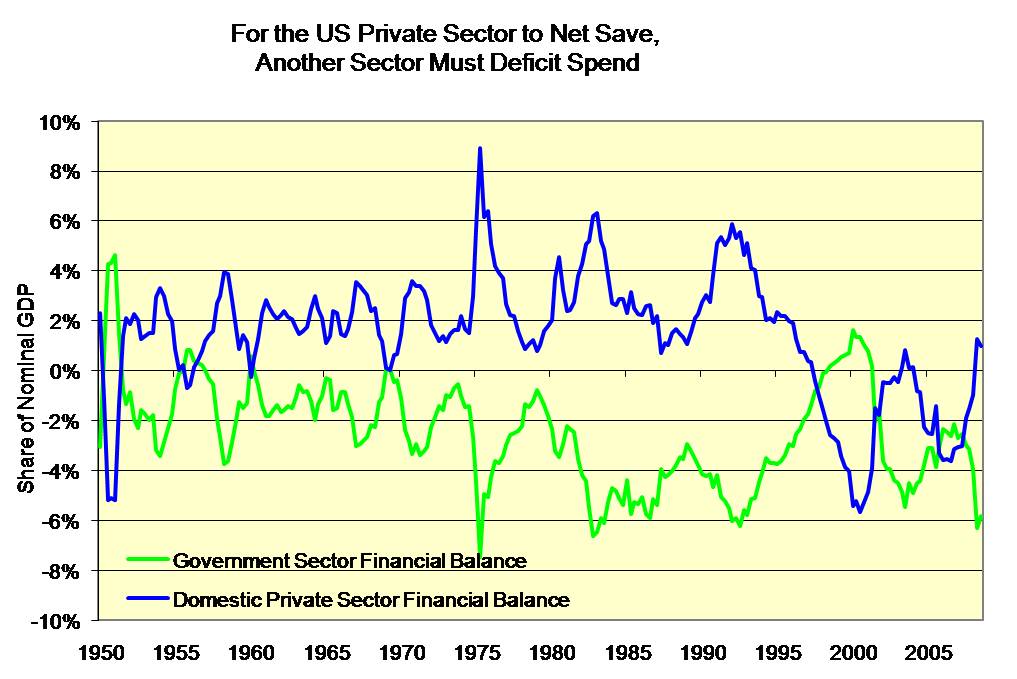
We can enter this approach from the standard macro observation that in any accounting period, total income in an economy must equal total outlays, and total saving out of income flows must equal total investment expenditures on tangible assets. The financial balance of any sector in the economy is simply income minus outlays, or its equivalent, saving minus investment. A sector may net save or run a financial surplus by spending less than it earns, or it may net deficit spend as it runs a financing deficit by earning less than it spends.

Furthermore, a net saving sector can cover its own outlays and accumulate financial liabilities issued by other sectors, while a deficit spending sector requires external financing to complete its spending plans. At the end of any accounting period, the sum of the sectoral financial balances must net to zero. Sectors in the economy that are net issuing new financial liabilities are matched by sectors willingly owning new financial assets. In macro, fortunately, it all has to add up. This is not only true of the income and expenditure sides of the equation, but also the financing side, which is rarely well integrated into macro analysis.

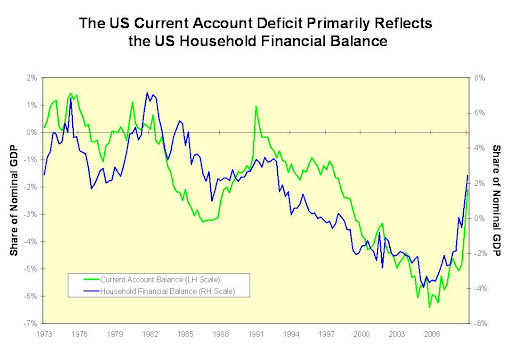
We can next divide the economy into three major sectors: the domestic private sector (including households and businesses), the government sector, and the foreign sector and ask a simple question relevant to current developments. What happens if the domestic private sector tries to net save, with no attending change in the government or foreign sector financial balances?

If households attempt to net save by spending less than they are earning, and businesses attempt to net save (reinvesting less than their retained earnings), then nominal incomes and real output will be likely to fall. Money incomes and economic activity will tend to contract until private savings preferences are reduced (with essential goods and services taking up a larger share of household income as incomes fall), or until depreciation leaves businesses and households inclined to invest once again in durable assets. Common sense suggests that a drop in private income flows while private debt loads are high is an invitation to debt defaults and widespread insolvencies – that is, unless creditors are generously willing to renegotiate existing debt contracts en masse.

In other words, such a configuration is an invitation to Irving Fisher’s cumulative debt deflation spiral which has been discussed on this website and in prior Richebacher letters. So unless some other sector is willing to reduce its net saving (as with the foreign sector recently, via a reduction in the US current account deficit as US imports have fallen faster than US exports) or increase its deficit spending (as with the federal budget balance of late) then the mere attempt by the domestic private sector to net save out of income flows, given the existing private debt overhang, can prove very disruptive.

In fact, the US economy has dipped into a mild version of Fisher’s debt deflation process as nominal GDP has fallen, wage and salary income flows have fallen, the CPI and other inflation measures have dropped into deflation, and private debt delinquencies and defaults are still spreading. Following the shocks to tangible and financial asset prices, credit availability, and the labor market, the US private sector, by our calculations, has swung from a 4.5% of GDP deficit spending position three and a half years ago to a 4% net saving position as of Q1 2009. This exceeds the 8% of GDP swing in the private sector financial balance witnessed as the tail end of the 1973-5 recession – it is an enormous adjustment, to put it mildly.

Had the current account deficit (which, remember, is the trade balance plus net income flows related to asset holdings, equals foreign net saving) not shrunk from 6% to 2% of GDP over the same period, while the combined government fiscal deficit increased from 1.5% to 6% of GDP, then the attempt by the private sector to complete such a dramatic swing in its financial balance position would have ended in a very sharp and severe debt deflation.

From an Austrian School perspective, nothing less than that is required to wipe the slate clean of excess private debt and to free up productive resources misallocated during the credit boom years. However, the political appetite for an Austrian solution appears to have all but disappeared following the global repercussions of the Lehman derailment. Investors and policy makers looked into the abyss, and they could not stomach what they saw. Even Germany Chancellor Merkel, who appears to have the most Austrian orientation among G7 policymakers, has chosen to introduce some degree of fiscal stimulus and financial sector intervention in the German economy.

To further illustrate the current situation, we can use the 1973-5 recession as a rough guide – after all, as mentioned above, that is when domestic private net saving jumped to its highest share of GDP in the post WWII period. Currently, we appear to have an even deeper recession, and we know the drop in the ratio of household net worth to disposable income is over four times that experienced in the 1973-5 episode. What happens if private net saving preferences run all the way up to 10% of GDP, with say an additional 4% of GDP increase from the household side, and another 2% from the business side?

If the swing evident from 2006 is any indication, the hypothetical 4% increase in the household financial balance as a share of GDP will take the current account back to balance (for the first time in nearly two decades) from its recent 2% of GDP deficit position. To further contain debt deflation dynamics, given a domestic private sector attempting to save 10% of GDP, the combined fiscal balance will need to expand out to 10% of GDP, or else private income will fall further. The reduction in foreign net saving and the increase in fiscal deficit spending will then match the increase in private net saving from Q1 2009 values assumed above.

If the combined government deficit aims for 12-13% of GDP while the domestic private sector is shooting for 10% and net foreign saving is zero, then the odds improve that an economic recovery can take root alongside a larger private sector deleveraging than we witnessed in Q1 2009. Household and business incomes will be buttressed by tax cuts and government spending, which will allow higher private spending for any given private saving target. In other words, in a worst case scenario, it does appear debt deflation dynamics can be contained and reversed, but at the price of a rather large fiscal deficit that in essence validates higher domestic private sector net saving. The linkages between rising private sector net saving and deflation, and between fiscal deficits and private net saving, are currently poorly understood, but the financial balance approach helps bring some clarity to these questions.

Normally, the business sector tends toward a deficit spending position as profitable investment opportunities exceed retained earnings. This makes a certain amount of sense: debt imposes future cash flow commitments on borrowers, and using debt to expand productive capacity allows the borrower to have a decent shot at generating sufficient cash flow to service debt. Notice this is not usually the case with consumer debt, except perhaps with the case of mortgages used to purchase rental properties, or credit cards used to finance new small businesses. Households do not directly increase their income earning capacity, and hence their debt servicing capacity, by purchasing a flat screen TV or a larger house on credit. Of course, businesses that use credit to buy back shares or complete a merger or acquisition similarly are not directly enhancing their ability to service debt with new productive capacity, so the intended use of new debt is relevant in either sector.

Richard Koo makes the related point in his book, “The Holy Grail of Macroeconomics”, that following the bursting of an asset bubble, businesses often move into a debt reduction mode that takes over their usual search for profitable opportunities. For the current post bubble period, reeling fiscal deficit spending back in before the business sector is headed back toward its more “natural” deficit spending position, or before the rest of the world has found its way to a faster pace of recovery than the US (thereby aiding US export growth), could prove disruptive.

Ideally then, fiscal deficit spending would be designed to encourage businesses to reinvest in more efficient technology or in new product innovation, both of which could help improve US export competitiveness. Alternatively, public/private cooperation in R&D projects like Sematech could be explored with various emerging energy technologies, for example, in order to reduce US energy dependence. Such moves would speed the transition away from deep fiscal deficit spending which began riling investors in longer dated Treasury debt back in March. Nevertheless, such a shift in the fiscal deficit was required for the domestic private sector to return to a net saving position and begin reducing its debt load without setting off a full blown debt deflation.

At best, favorable effects on business investment will arise be secondary or peripheral results of some of the infrastructure and green tech investments in the current fiscal stimulus package, generally due to ramp up in 2010 and 2011. Unfortunately, since few economists work with the financial balance approach we shared with you above, policy makers are not yet emphasizing this type of policy design. Nevertheless, the financial balance approach does offer a more coherent way of thinking about the macroeconomic dynamics currently underway, and the plausible paths ahead. From this framework, we can see the situation is indeed difficult, but not insurmountable, as some of the necessary adjustments in US sector financial imbalances are already in motion. Deflation in the US does look like it can be contained and reversed, but the quest for a new growth model – one that does not rely on serial asset bubbles, household deficit spending and debt accumulation, and imported consumer goods leading to a perpetually rising current account deficit – remains ahead. No doubt it will test the ingenuity and adaptability of an entire generation – a generation that through the abundance of credit, may have forgotten that in order to consume, one must first produce.

[1] Very simply, if income (Y) equals expenditures (E) at the level of the whole economy, and we split the economy into three sectors, domestic private (dp), government (g), and foreign (f) then the following holds true:

Y = E
Ydp + Yg + Yf = Edp + Eg + Ef
(Ydp-Edp) + (Yg-Eg) + (Yf – Ef) = 0

The first term in parentheses is the domestic private financial balance, the second is the combined government financial balance, and the third term is the inverse of the current account balance, since US imports are income to foreign producers, and US exports are expenditures of foreign economic agents. The sum of the domestic private financial balance and the combined government financial balance minus the current account balance must net to zero.

This is an ex post accounting identity that must hold true. It could equally be derived using the saving equals investment identity for the economy as a whole. Values for these concepts can be derived from the Fed’s Flow of Funds quarterly report. In general, nominal income adjusts to reconcile divergences in planned investment relative to intended saving.

Bring the Stubborn Unemployment Numbers Down Now

by Pavlina R. Tcherneva

Every month this year (perhaps with the exception of May) economic forecasters were stunned by the unexpectedly high unemployment numbers. Today the Bureau of Labor Statistics reported that in June employers shed 467,000 jobs, pushing the unemployment rate to 9.5%, a 25-year high. With an ever gloomier jobs picture, President Obama’s economic team has started to change its tune with respect to the promised job creation. The first economic report on the job impact of his recovery plan carefully phrased the objectives to include “creating or saving” at least 3 million jobs by the end of 2010. Those early projections called for peak unemployment of 8% in the third quarter of this year, far less than today’s actual unemployment rate of 9.5%

Continue reading

‘Easy Money’ Didn’t Sink the Economy

By Stephanie Kelton

Brad DeLong, Mark Thoma and David Beckworth have spent the last few days debating the extent to which Alan Greenspan’s easy money stance (2001-2004) qualifies as a “significant policy mistake.” DeLong asks:

“Should Alan Greenspan have kept interest rates higher and triggered a much bigger recession with much higher unemployment back then in order to head off the growth of a housing bubble?”

As I see it, these are really two separate questions: (1) Did Greenspan’s easy money policy cause the bubble? (2) Should Greenspan have attempted to diffuse the bubble – with higher interest rates — once he identified it?

I wrestled with these precise questions in a presentation I have given many times since last fall. I started with Greenspan’s own argument.

In an interview with a reporter from the Wall Street Journal, Greenspan characterized himself as “an old 19th-century liberal who is uncomfortable with low interest rates.” Yet he lowered the federal funds rate thirteen times from 2001-2003, pushing it to just 1% at the end of the easing cycle. Looking back on that period, Greenspan admits that his “inner soul didn’t feel comfortable” with those sustained rate cuts, but he maintains that it was the right policy in the aftermath of the dot.com bubble. Moreover, he insists that the run-up in housing prices was not the result of his monetary easing and that “no sensible policy . . . could have prevented the housing bubble.” Indeed, Greenspan maintains that the housing bubble emerged because risk premiums – not interest rates – were kept too low for too long.

As Greenspan argued in his memoir, geopolitical forces outside the control of the Fed caused risk premiums to decline, and this, ultimately, led to the housing bubble. In his view, there was nothing the Fed could have done to prevent the decline in risk premiums, which had its roots “in the aftermath of the Cold War.” His argument runs as follows: Over the past quarter century, the fall of the Berlin Wall, the collapse of the Soviet Union, China’s protection of foreigner’s property rights, the adoption of export-led growth models by the Asian Tigers, and the reinstatement of free trade produced significant productivity growth in much of the developing world. And because developing nations save more than developed nations – in part due to weaker social safety nets – there has been a shift in the share of world GDP from low-saving developed nations to higher-saving developing countries. Greenspan believes that this resulted in excessive savings worldwide (as saving growth greatly exceeded planned investment) and placed significant downward pressure on global interest rates. Thus, as he sees it, the demise of central planning ushered in an era of competitive pressures that reduced labor compensation and lowered inflation expectations. As a result, the global economy experienced years of unprecedented growth, markets became euphoric, and risk became underpriced.

This takes me back to Mark Thoma’s argument. Thoma believes that Greenspan’s easy money policy was a significant policy mistake. He said:

“It seems, then, the Fed did push its policy rate below the natural rate and in the process created a huge Wicksellian-type disequilibria.”

But Greenspan seems to be arguing that the natural rate was also declining, so it isn’t clear that market rates were pushed too low. And while I don’t buy Greenspan’s argument, I also don’t believe easy money sunk the economy.

I think there is an alternative explanation that is based on factors that had little (if anything) to do with Greenspan’s monetary easing from 2001-2003 or with geopolitical factors. To be sure, this sustained period of low interest rates made home ownership more affordable and increased the demand for home loans. But the increase in home prices could not have expanded at such a frenzied pace in the absence of rating agencies, mortgage insurance companies and appraisers who validated the process at each step.

As my colleague Jan Kregel put it, “the current crisis has little to do with the mortgage market (or subprime mortgages per se), but rather with the basic structure of a financial system that overestimates creditworthiness and underprices risk.” Like Greenspan, Kregel views the housing bubble and ensuing credit crisis as the inevitable consequence of sustaining risk premiums at too low a level. Unlike Greenspan, however, he maintains that bubbles and crises are an inherent feature of the “originate and distribute” model. Under the current model, risks become discounted because “those who bear the risk are no longer responsible for evaluating the creditworthiness of borrowers.”

Thus, with respect to the debate over the role of low interest rates, I would argue that it was not loose monetary policy but loose lending standards (abetted by a hefty dose of control fraud) that brought us to where we are today.

Now to the second question: Should Greenspan have raised rates sooner, in order to “head off the bubble”?

DeLong has admitted to being “genuinely not sure which side I come down on in this debate.” Unlike Thoma, DeLong appears sympathetic, even empathetic, trying to imagine what it must have been like to be in Alan Greenspan’s shoes:

“If we push interest rates up, Alan Greenspan thought, millions of extra Americans will be unemployed and without incomes to no benefit . . . . If we allow interest rates to fall, Alan Greenspan thought, these extra workers will be employed building houses and making things to sell to all the people whose incomes come from the construction sector . . . . If a bubble does develop, Greenspan thought, then will be the time to deal with that.”

But Alan Greenspan was never so clear-headed in his thinking. Indeed, like DeLong, Greenspan appears to have been genuinely conflicted. He has argued that it is virtually impossible to spot an emerging bubble:

“The stock market as best I can judge is high; it’s not that there is a bubble in there; I am not sure we would know a bubble if we saw it, at least in advance.” (FOMC transcripts, May 1996)

Then, just four months later, Greenspan indicated that he could not only spot an emerging bubble but that it would be dangerous to ignore it:

“Everyone enjoys an economic party, but the long term costs of a bubble to the economy and society are potentially great. As in the U.S. in the late 1920s and Japan in the late 1980s, the case for a central bank to ultimately to burst that bubble becomes overwhelming. I think that it is far better that we do so while the bubble still resembles surface froth, and before the bubble caries to the economy to stratospheric heights. Whenever we do it, it is going to be painful, however.” (FOMC transcripts, September 1996)

In 2004, Greenspan spoke before the American Economics Association and took the position that it is dangerous to address a bubble, insisting that it is preferable to let the bubble burst on its own and then lower interest rates to help the economy recover:

“Instead of trying to contain a putative bubble by drastic actions with largely unpredictable consequences, we chose, as noted in our mid-1999 congressional testimony, to focus on policies to mitigate the fallout when it occurs and, hopefully, ease the transition to the next expansion”.

Since then, Greenspan has argued that the Fed actually was trying to address the emerging housing bubble when it began to raise rates in the mid-2000s, but he says the policy was unsuccessful because long-term rates remained stubbornly low. Of course, he also said:

“I don’t remember a case when the process by which the decision making at the Federal Reserve failed.”

And I think we can all agree to disagree on that point.