Teaching the Fallacy of Composition: The Federal Budget Deficit

SUMMARY: One of the most important concepts to be taught in economics is the notion of the fallacy of composition: what might be true for individuals is probably not true for society as a whole. The most common example is the paradox of thrift: while an individual can save more by reducing spending (on consumption), society can save more only by spending more (for example, on investment). Another useful and very topical example involves the federal government’s budget deficit. Politicians and the media often argue that the government must balance its books, just like a household. If a household were to continually spend more than its income, it would eventually face insolvency; it is thus claimed that government is in a similar situation. However, careful examination of macroeconomic relations will show that this analogy is incorrect, and that it would lead to improper budgetary policy. This example can drive home the fallacy of composition.

One of the most important concepts we teach in economics, and most importantly in macroeconomics, is the notion of the fallacy of composition.

Students and others who haven’t been exposed to macroeconomics naturally extrapolate from their own individual situation to society and the economy as a whole.

This often leads to the problem of the fallacy of composition. Of course, that isn’t just restricted to economics. While a few people could exit the doors of a crowded movie theatre, all of us could not.

The macroeconomics example of the fallacy of composition most often used is the paradox of thrift. Any individual can increase her saving by reducing her spending—on consumption goods. So long as her decision does not affect her income—and there is no reason to assume that it would—she ends up with less consumption and more saving.

The example I always use involves Mary who usually eats a hamburger at Macdonald’s every day. She decides to forego one hamburger per week, to accumulate savings. Of course, so long as she sticks to her plan, she will add to her savings (and financial wealth) every week.

The question is this: what if everyone did the same thing as Mary—would the reduction of the consumption of hamburgers raise aggregate (national) saving (and financial wealth)?

The answer is that it will not. Why not? Because Macdonald’s will not sell as many hamburgers, it will begin to lay-off workers and reduce its orders for bread, meat, catsup, pickles, and so on.

All those workers who lose their jobs will have lower incomes, and will have to reduce their own saving. You can use the notion of the multiplier to show that this process comes to a stop when the lower saving by all those who lost their jobs equals the higher saving of all those who cut their hamburger consumption. At the aggregate level, there is no accumulation of savings (financial wealth).

Of course that is a simple and even silly example. But the underlying explanation is that when we look at the individual’s increase of saving, we can safely ignore any macro effects because they are so small that they have only an infinitely small impact on the economy as a whole.

But if everyone tries to increase saving, we cannot ignore the effects of lower spending on the economy as a whole. That is the point that has to be driven home.

We can then again return to the notion of the multiplier, and show that the way to increase aggregate saving is by increasing spending, specifically, nonconsumption spending—spending on investment, spending by government, or spending by foreigners on our exports.

I don’t want to go into that particular example any further. Another example that is less frequently used concerns unemployment.

The view shared by most of my undergraduate students is that unemployment is caused by laziness or lack of training. The argument they often use is that “I can get a job, therefore all the unemployed could get jobs if only they tried harder, or got better education and training”.

The way I go about demonstrating that fallacy is a dogs and bones example. Say we have 10 dogs and we bury 9 bones in the backyard. We send the dogs out to find bones. At least one dog will come back without a bone.

We decide that the problem is lack of training. We put that dog through rigorous training in the latest bone finding techniques. We bury 9 bones and send the 10 dogs out again. The trained dog ends up with a bone, but some other dog comes back without a bone (empty-mouthed, so to speak).

The problem, of course, is that there are not enough bones and jobs to go around. It is certainly true that a well-trained and highly motivated jobseeker can usually find a job. But that is no evidence that aggregate unemployment is caused by laziness or lack of training.

We could also go into the common belief that minimum wages cause unemployment. It is at least partly true that for an individual firm, higher wages reduce the number of workers hired. But we cannot extrapolate that to the economy as a whole. Higher wages mean higher income and thus higher consumption spending, which induces firms to employ more labor. So the truth is that economic theory does not tell us that raising minimum wages will lead to more unemployment, indeed, theory tells us it can go the other way—raising the minimum wage could increase employment.

Again, the reason we can reach the wrong conclusion in all of these cases when we aggregate up from the micro level to the macro is because we ignore the impacts that behavior of individuals or firms has on other individuals or firms. That can be OK for the case of the individual firm or household, but is almost certainly incorrect for firms and households taken as a whole.

Let me move on to a more important fallacy of composition. We hear politicians and the media arguing that the current federal budget deficit is unsustainable. I have heard numerous politicians refer to their own household situation: if my household continually spent more than its income year after year, it would go bankrupt. Hence, the federal government is on a path to insolvency, and by implication, the budget deficit is bankrupting the nation.

That is another type of fallacy of composition. It ignores the impact that the budget deficit has on other sectors of the economy. Let me go through this in some detail, as it is more complicated than the other examples.

We can divide the economy into 3 sectors. Let’s keep this as simple as possible: there is a private sector that includes both households and firms. There is a government sector that includes both the federal government as well as all levels of state and local governments. And there is a foreign sector that includes imports and exports; (in the simplest model, we can summarize that as net exports—the difference between imports and exports—although to be entirely accurate, we use the current account balance as the measure of the impact of the foreign sector on the balance of income and spending).

At the aggregate level, the dollar spending of all three sectors combined must equal the income received by the three sectors combined. Aggregate spending equals aggregate income. But there is no reason why any one sector must spend an amount exactly equal to its income. One sector can run a surplus (spend less than its income) so long as another runs a deficit (spends more than its income).

Historically the US private sector spends less than its income—that is it runs a surplus. Another way of saying that is that the private sector saves. In the past, on average the private sector spent about 97 cents for every dollar of income.

Historically, the US on average ran a balanced current account—our imports were just about equal to our exports. (As discussed below, that has changed in recent years, so that today the US runs a huge current account deficit.)

Now, if the foreign sector is balanced and the private sector runs a surplus, this means by identity that the government sector runs a deficit. And, in fact, historically the government sector taken as a whole averaged a deficit: it spent about $1.03 for every dollar of national income.

Note that that budget deficit exactly offsets the private sector’s surplus—which was about 3 cents of every dollar of income. In fact, if we have a balanced foreign sector, there is no way for the private sector as a whole to save unless the government runs a deficit. Without a government deficit, there would be no private saving. Sure, one individual can spend less than her income, but another would have to spend more than his income.

While it is commonly believed that continual budget deficits will bankrupt the nation, in reality, those budget deficits are the only way that our private sector can save and accumulate net financial wealth.

Budget deficits represent private sector savings. Or another way of putting it: every time the government runs a deficit and issues a bond, adding to the financial wealth of the private sector. (Technically, the sum of the private sector surpluses equal the sum of the government sector deficits, which equals the outstanding government debt—so long as the foreign sector is balanced.)

Of course, the opposite would also be true. Assume we have a balanced foreign sector and that the government runs a surplus—meaning its tax revenues are greater than government spending. By identity this means the private sector is spending more than its income, in other words, it is deficit spending. The deficit spending means it is going into debt, and at the aggregate level it is reducing its net financial wealth.

At the same time, the government budget surplus means the government is reducing its debt. Effectively what happens is that the private sector returns government bonds to the government for retirement—the reduction of private sector wealth equals the government reduction of debt.

Now let us return to the Clinton years when the federal government was running the biggest budget surpluses the government has ever run. Everyone thought this was great because it meant that the government’s outstanding debt was being reduced. Clinton even went on TV and predicted that the budget surpluses would last for at least 15 years and that every dollar of government debt would be retired.

Everyone celebrated this accomplishment, and claimed the budget surplus was great for the economy.

In the middle of 2000, I wrote a contrary opinion (“Implications of a budget surplus at mid-year 2000, CFEPS Policy Note 2000/1). I made several arguments. First, I pointed out that the budget surplus meant by identity that the private sector was running a deficit. Households and firms were going ever farther into debt, and they were losing their net wealth of government bonds.

Second, I argued that this would eventually cause a recession because the private sector would become too indebted and thus would cut back spending. In fact, the economy went into recession within half a year.

Third, I argued that the budget surpluses would not last 15 years, as Clinton claimed. Indeed, I expected they would not last more than a couple of years. In fact, the budget turned around to large and growing deficits almost immediately as soon as the economy went into recession.

And of course we still have large budget deficits. No one talks any more about achieving budget surpluses this decade; almost everyone agrees that we will not see budget surpluses again in our lifetimes—if ever.

The question is whether the US government can run deficits forever. The answer is emphatically “yes”, and that it had better do so. If you look back to 1776, the federal budget has run a continuous deficit except for 7 short periods. The first 6 of those were followed by depressions—the last time was in 1929 which was followed by the Great Depression. The one exception was the Clinton budget surplus, which was followed (so far) only by a recession.

Why is that? By identity, budget surpluses suck income and wealth out of the private sector. This causes private spending to fall, leading to downsizing and unemployment. The only way around that is to run a trade or current account surplus.

The problem is that it is hard to see how the US can do that—in fact, our current account deficit is now rising toward 7% of GDP. All things equal, that means our budget deficit has to be even larger to allow our private sector to save. Given our current account balance, the budget deficit would have to reach 9% of GDP to allow our private sector to have a surplus of 2% of GDP.

I don’t want to give the impression that government deficits are always good, or that the bigger the deficit, the better. The point I am making is that we have to recognize the macro relations among the sectors.

If we say that a government deficit is burdening our future children with debt, we are ignoring the fact that this is offset by their saving and accumulation of financial wealth in the form of government debt. It is hard to see why households would be better off if they did not have that wealth.

If we say that the government can run budget surpluses for 15 years, what we are ignoring is that this means the private sector will have to run deficits for 15 years—going into debt that totals trillions of dollars in order to allow the government to retire its debt. Again it is hard to see why households would be better off if they owed more debt, just so that the government would owe them less.

There are other differences between the federal government and an individual household. The government is the issuer of our currency, while households are users of the currency. That makes a big difference, and one explored in many other CFEPS publications. However, the purpose of this particular note is to explain why we cannot aggregate up from the individual household situation to the economy as a whole. The US government’s situation is not in any way similar to that of a household because its deficit spending is exactly offset by private sector surpluses; its debt creates equivalent net financial wealth for the private sector.

The Great American Bank Robbery

http://p.castfire.com/8Fi1I/video/129363/129363_2009-07-22-233157.flv

(From UCLA’s Hammer Forum) — William K. Black, the former litigation director of the Federal Home Loan Bank Board who investigated the Savings and Loan disaster of the 1980s, discusses the latest scandal in which a single bank, IndyMac, lost more money than was lost during the entire Savings and Loan crisis. He will examine the political failure behind this economic disaster, in which not only massive fraud has taken place, but a vast transfer of wealth from the poor and middle class continues as the federal government bails out the seemingly reckless, if not the criminal. Black teaches economics and law at the University of Missouri, Kansas City and is the author of The Best Way to Rob a Bank Is to Own One. (Run Time: 1 hour, 38 min.)

Leakages and Potential Growth

In his book, Leakages, Treval Powers makes the outrageous claim that without leakages, the US economy could grow at a sustained rate of 13% annually. According to his calculations (based on empirical evidence), normal leakages of 7.4% reduce the rate of growth to 5.6%, leaving the economy operating at only 92.6% of its capacity. Periodic restrictive policy by the Federal Reserve adds another layer of leakages, which can reduce growth to zero, causing the economy to operate at only 87% of potential.

Ironically, the Fed imposes tight policy because it wrongly believes that inflationary pressures result from excessive demand, even though the economy chronically operates well below capacity. Indeed, Powers argues that the greater the leakages, the higher the price level, hence, when the Fed tightens it actually puts upward pressure on prices. In his view, the economy has not been supply constrained, at least in the postwar era, so there has been no reason to fight inflation by constraining demand.

All of this goes against the conventional wisdom. Powers might be dismissed as a crank, as someone who simply does not understand economics. While I do find most of his analysis of monetary policy somewhat confusing, I agree with the general conclusions. What I will do in this note is to concur on two main points:


1. the US economy suffers from chronic inadequate demand, and has rarely been subject to any significant supply constraints—whether of productive capacity or of labor;

2. and leakages have been the cause of the demand constraints

Thus, I also agree with the policy conclusions of Powers: Fed policy can be seen as a string of mistakes guided by a fundamentally flawed view that causes the Fed to tighten policy exactly when it should be loosened. Inflation in the US does not result from excessive aggregate demand and, indeed, our worst bouts with inflation have come during periods of above-normal slack.

However, I do not believe that Fed policy normally has a huge impact on the economy, and for that we should be eternally grateful given how misguided it has been. This is the major disagreement I would have with Powers and other critics of the Fed. I could go even further and argue that we really do not know whether restrictive policy by the Fed actually reduces aggregate demand—and whether lower interest rates stimulate demand—but that would take us too far afield.

Fiscal policy is the primary way in which government impacts the economy, and, unfortunately, it has become increasingly misguided in ways that many do not understand—especially during the Bush dynasty era in which populists, leftists, and the Democratic party have wrongly advocated a return to what they call fiscal responsibility. Thus, rather than focusing on monetary policy failings as the cause of demand slack, I highlight the role played by fiscal policy.

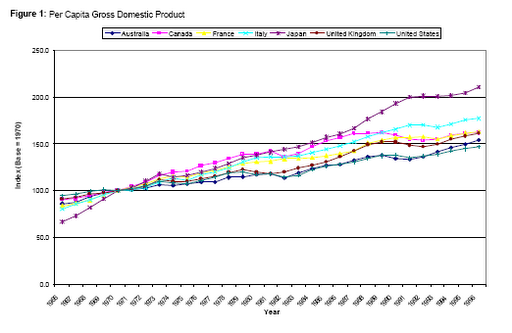
Let me begin with my argument that the US economy, as well as the economies of all the other major nations, have suffered from demand constrained growth. Figure 1 compares the per capita inflation-adjusted GDP growth of the major developed nations—indexed to 100 in 1970. Note the relatively rapid growth of Japan.

Per capita (inflation adjusted) GDP growth can be attributed by identity to growth of the employment rate (workers divided by population) plus growth of productivity per worker. Figure 2 shows employment rate growth by nation. Note that only the US and Canada had much growth of the employment rate. The long term trend in these two countries is rising as more women come into the labor force. There are also obvious cyclical trends—especially in Canada—when employment rates can actually fall off due to unemployment. Employment rates actually fell in France on a long-term trend, while they were more or less stable in the other nations.

I attribute the low growth of employment rates to slow growth of aggregate demand; that is, if aggregate demand does not grow at a clip sufficiently above productivity growth, then employment rate growth must (identically) suffer. Indeed, growth in Japan and Europe has not been high enough to increase employment rates—so they have come up with all these schemes to increase vacations, lower retirement ages, and share work (France’s experiment with mandated work week reductions is the most glaring example).

Figure 3 shows productivity growth. Recall that the sum of growth of the employment rate plus growth of productivity equals total per capita GDP growth. Japan, Italy and France had the best productivity growth—these are all nations that had no employment growth. Note that the US is at the bottom here. In the US our employment rate grows fairly strongly (for a number of reasons: population growth, immigration, and women entering the labor force) but given low growth of GDP, our productivity suffers. Figure 4 shows that our growth is just about evenly divided between employment growth and productivity growth.

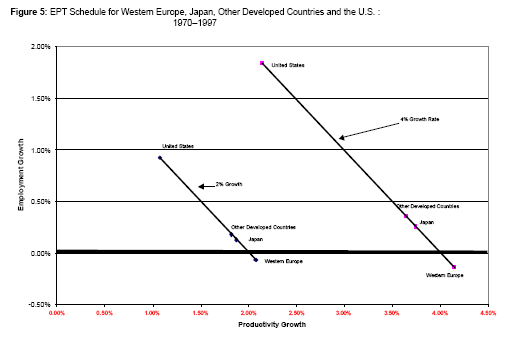
These two figures shed light on a three-decades long controversy over productivity growth in the US. All during the 1970s and 1980s there was this hysteria about low productivity growth that was supposed to be the cause of low GDP growth. This is a supply side argument and led to all the policy measures, like tax cuts for the rich and other schemes to raise saving, to try to stimulate productivity through induced investment. In fact, the low productivity falls out of an identity; if the US grows at only 3% and if our employment rate grows at 2% it is mathematically impossible for productivity to grow at anything other than 1%.

Figure 5 shows a hypothetical trade-off for the US, Europe and Japan. In other words, for the US to have productivity growth as high as that of Japan or Europe—or as high as we had during the so-called new economy boom under Clinton–we must grow above 4 or 5% per year. This is something we rarely achieve for very long—for reasons I’ll get to in a second. During the Clinton boom there was all this nonsense about information technology that had suddenly made it possible to grow at such rates precisely because productivity was supposed to be able to grow fast. In reality, the fast growth of the Clinton years could have been achieved at any time, if only demand had been that robust.

That brings me to my second main point—the leakages that constrain demand, resulting in chronic underperformance. We can think of the economy as being composed of 3 sectors: a domestic private sector, a government sector, and a foreign sector. If one of these spends more than its income, at least one of the others must spend less than its income because for the economy as a whole, total spending must equal total receipts or income. So while there is no reason why any one sector has to run a balanced budget, the system as a whole must. In practice, the private sector traditionally runs a surplus—spending less than its income. This is how it accumulates net financial wealth. For the US this has averaged about 2-3% of GDP, but it does vary considerably over the cycle. That is a leakage that must be matched by an injection.

Before Reagan we essentially had a balanced foreign sector—we ran trade surpluses or deficits, but they were small. After Reagan, we ran growing trade deficits, so that today they run about 5% of GDP. That is another leakage.

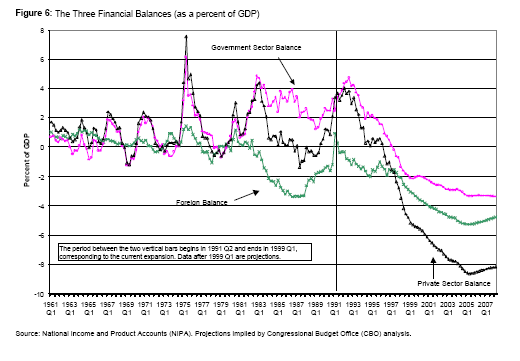
Finally, our government sector taken as a whole almost always runs a budget deficit. This has reached to around 5% under Reagan and both Bushes. That is the injection that offsets the private and foreign sector leakages. With a traditional private sector surplus of 3% and a more or less balanced trade account, the “normal” budget deficit needed to be about 3% during the early Reagan years. In robust expansions, before the Clinton years, the domestic private sector occasionally ran small and short lived deficits—an injection that allowed a trade deficit to open up, and reduced the government budget deficit. See Figure 6.

Until the Clinton expansion, the private deficits never exceeded about 1% of GDP and never lasted more than 18 months. However, since 1996 the private sector has been in deficit every year, and that deficit climbed to more than 6% of GDP at the peak of the boom. This actually drove the budget into surplus of about 2.5% of GDP. With the trade deficit at about 4% of GDP, the private sector deficit was the sum of those—almost 6.5%. While everyone thought the Clinton budget surplus was a great achievement, they never realized that by identity it meant that the private sector had to spend more than its income, so that rather than accumulating financial wealth it was running up debt.

Let me link this back to the leakages discussed by Powers. The trade deficit represents a leakage of demand from the US economy to foreign production. There is nothing necessarily bad about this, so long as we have another source of demand for US output, such as a federal budget that is biased to run an equal and offsetting deficit. Private sector net saving (that is, running a surplus) is also a leakage. As discussed above, that was typically 2-3% in the past. If we add in the trade deficit that we have today (5% of GDP), that gives us a total “normal” leakage out of aggregate demand of 7 or 8%–about equal to the estimates of Powers.

This leakage has to be made up by an injection from the third sector, the government. The only way to sustain a leakage of 7-8% is for the overall government to run a deficit of that size. Since state and local governments have to balance their budgets, and on average actually run surpluses, it is up to the federal government to run deficits. The federal budget deficit is largely non-discretionary over a business cycle, and at least over the shorter run we can take the trade balance as also outside the scope of policy.

The driving force of the cycle, then, is the private sector leakages. When the private sector has a strong desire to save, it tries to reduce its spending below its income. Domestic firms cut production, and imports might fall too. The economy cycles downward into a recession as demand falls and unemployment rises. Tax revenues fall and some kinds of social spending (such as unemployment compensation) rise. The budget deficit increases more-or-less automatically. That is where we are today, with Bush budget deficits rising to 5% of GDP and, soon, beyond. They will probably need to reach 8% before we get a sustained recovery.

In sum, we experienced something highly unusual during the Clinton expansion because the private sector was willing to spend far more than its income; the normal private sector leakages turned into very large injections. The economy grew quickly and tax revenues literally exploded. State governments and the federal government experienced record surpluses. These surpluses represented a leakage that brought the expansion to a relatively sudden halt. What we have now is a federal budget that is biased to run surpluses except when growth is very far below potential. This means is that the “normal” private sector balance now must be a large deficit in order for the economy to grow robustly.

Rather than the government sector being a source of injections that allow the leakages that represent private sector savings, we now have the private sector dissaving in order to allow the foreign and government sector leakages. This sets up a highly unstable situation because private debt ratios rise quickly and a greater percentage of income goes to service those debts. While I said at the beginning that Fed policy normally doesn’t matter much, in a highly indebted economy, rising interest rates can increase debt problems very quickly—setting off bankruptcies that can snowball into a 1930s-style debt deflation. A far more sensible policy would be to reverse course and lower interest rates, then keep them low.

At the same time, the federal government should take advantage of slack demand and abundant labor by increasing its spending on domestic programs. Robust economic growth fueled by federal deficits is the best way to reduce over-indebtedness. It is hard to say what to do (if anything) about euphoric stock or real estate markets that could be stoked by renewed growth. But the Fed’s sledgehammer approach of jacking up interest rates does not work. We will probably need selective credit controls to constrain financial speculation, if such is desired.

In conclusion, I agree with Powers that growth in the postwar period has mostly been demand constrained, due to leakages. If demand were to grow at 7% or even 10% on a sustained basis, I see no reason to believe that supply could not keep pace. This is all the more true in today’s global economy with massive quantities of underutilized resources all over the world, and with the rest of the world desires to accumulate dollar-denominated financial assets. This requires that they sell output to the US—which is just the counterpart to our trade deficit leakage. In real terms, a trade deficit means we can enjoy higher living standards without placing pressure on our own nation’s productive capacity. While it is hard to project maximum sustainable growth rates, there can be little doubt that our economy chronically operates far below feasible rates. The best policy would be to push up demand, allow growth rates to rise, and try to test those frontiers.

Reference:

Treval C. Powers, Leakage: The bleeding of the American economy, Benchmark Publications, Inc, New Canaan, Connecticut, 1996.

Social Security: Another Case of Innocent Fraud?

By Warren Mosler* and Mathew Forstater**

In his recent book, The Economics of Innocent Fraud, John Kenneth Galbraith surveys a number of false beliefs that are being perpetuated among the American people about how our society operates: innocent (and sometimes not-so-innocent) frauds. There is perhaps no greater fraud being committed presently—and none in which the stakes are so high—as the fraud being perpetrated regarding government insolvency and Social Security. President Bush uses the word “bankruptcy” continuously. And the opposition agrees there is a solvency issue, questioning only what to do about it.

Fortunately, there is a powerful voice on our side that takes exception to the notion of government insolvency, and that is none other than the Chairman of the Federal Reserve. The following is from a transcript of a recent interview with Fed Chairman Alan Greenspan:

RYAN… do you believe that personal retirement accounts can help us achieve solvency for the system and make those future retiree benefits more secure?

GREENSPAN: Well, I wouldn’t say that the pay-as-you-go benefits are insecure, in the sense that there’s nothing to prevent the federal government from creating as much money as it wants and paying it to somebody. The question is, how do you set up a system which assures that the real assets are created which those benefits are employed to purchase. (emphasis added)

For a long time we have been saying there is no solvency issue (see C-FEPS Policy Note 99/02 and the other papers cited in the bibliography at the end of this report). Now with the support of the Fed Chairman, maybe we can gain some traction.

Let us briefly review, operationally, government spending and taxing. When government spends it credits member bank accounts. For example, imagine you turn on your computer, log in to your bank account, and see a balance of $1,000 while waiting for your $1,000 Social Security payment to hit. Suddenly the $1,000 changes to $2,000. What did the government do to make that payment? It did not hammer a gold coin into a wire connected to your account. It did not somehow take someone’s taxes and give them to you. All it did was change a number on a computer screen. This process is operationally independent of, and not operationally constrained by, tax collections or borrowing.

That is what Chairman Greenspan was telling us: constraints on government payment can only be self-imposed.

And what happens when government taxes? If your computer showed a $2,000 balance, and you sent a check for $1,000 to the government for your tax payment, your balance would soon change to $1,000. That is all—the government changed your number downward. It did not “get” anything from you. Nothing jumped out of the government computer into a box to be spent later. Yes, they “account” for it by putting information in an account they may call a “trust fund,” but this is “accounting”—after the fact record-keeping—and has no operational impact on government’s ability to later credit any account (i.e., spend!).

Ever wonder what happens if you pay your taxes in actual cash? The government shreds it. What if you lend to the government via buying its bonds with actual cash? Yes, the government shreds the cash. Obviously, the government doesn’t actually need your “funds” per se for further operational purpose.

Put another way, Congress ALWAYS can decide to make Social Security payments, previous taxing or spending not withstanding, and, operationally, the Fed can ALWAYS process whatever payments Congress makes. This process is not revenue constrained. Operationally, collecting taxes or borrowing has no operational connection to spending. Solvency is not an issue. Involuntary government bankruptcy has no application whatsoever! Yet “everyone” agrees—in all innocence—that there is a solvency problem, and that it is just a matter of when. Everyone, that is, except us and Chairman Greenspan, and hopefully now you, the reader, as well!

So if solvency is a non-issue, what are the issues? Inflation, for one. Perhaps future spending will drive up future prices. Fine! How much? What are the projections? No one has even attempted this exercise. Well, it is about time they did, so decisions can be made on the relevant facts.

The other issue is how much GDP we want seniors to consume. If we want them to consume more, we can award them larger checks, and vice versa. And we can do this in any year. Yes, it is that simple. It is purely a political question and not one of “finance.”

If we do want seniors to participate in the future profitability of corporate America, one option (currently not on the table) is to simply index their future Social Security checks to the stock market or any other indicator we select—such as worker productivity or inflation, whatever that might mean.

Remember, the government imposes a 30% corporate income tax, which is at least as good as owning 30% of all the equity, and has at least that same present value. If the government wants to take a larger or smaller bite from corporate profits, all it has to do is alter that tax—it has the direct pipe. After all, equity is nothing more than a share of corporate profits. Indexation would give the same results as private accounts, without all the transactional expense and disruption.

Now on to the alleged “deficit issue” of the private accounts plan. The answer first—it’s a non-issue. Note that the obligation to pay Social Security benefits is functionally very much the same as having a government bond outstanding—it is a government promise to make future payments. So when the plan is enacted the reduction of future government payments is substantially “offset” by future government payments via the new bonds issued. And the funds to buy those new bonds come (indirectly) from the reductions in the Social Security tax payments—to the penny. The process is circular. Think of it this way. You get a $100 reduction of your Social Security tax payment. You buy $100 of equities. The person who sold the equities to you has your $100 and buys the new government bonds. The government has new bonds outstanding to him or her, but reduced Social Security obligations to you with a present value of about $100. Bottom line: not much has changed. One person has used his or her $100 Social Security tax savings to buy equities and has given up about $100 worth of future Social Security benefits (some might argue how much more or less than $100 is given up, but the point remains). The other person sold the equity and used that $100 to buy the new government bonds. Again, very little has changed at the macro level. Close analysis of the “pieces” reveals this program is nothing but a “wheel spin.”

Never has so much been said by so many about a non-issue. It is a clear case of “innocent fraud.” And what has been left out? Back to Chairman Greenspan’s interview—what are we doing about increasing future output? Certainly nothing in the proposed private account plan. So if we are going to take real action, that is the area of attack. Make sure we do what we can to make the real investments necessary for tomorrow’s needs, and the first place to start for very long term real gains is education. Our kids will need the smarts when the time comes to deal with the problems at hand.

Bibliography

Galbraith, John Kenneth, 2004, The Economics of Innocent Fraud: Truth for Our Time, Boston: Houghton Mifflin.

Wray, L. Randall, 1999, “Subway Tokens and Social Security,” C-FEPS Policy Note 99/02, Kansas City, MO: Center for Full Employment and Price Stability, January, (http://www.cfeps.org/pubs/pn/pn9902.html).

Wray, L. Randall, 2000, “Social Security: Long-Term Financing and Reform,” C-FEPS Working Paper No. 11, Kansas City, MO: Center for Full Employment and Price Stability, August, (http://www.cfeps.org/pubs/wp/wp11.html).

Wray, L. Randall and Stephanie Bell, 2000, “Financial Aspects of the Social Security ‘Problem’,” C-FEPS Working Paper No. 5, Kansas City, MO: Center for Full Employment and Price Stability, January, (http://www.cfeps.org/pubs/wp/wp5.html).

——————————————————————————–

[*] Associate Fellow, Cambridge University Centre for Economic and Public Policy;
Distinguished Research Associate, Center for Full Employment and Price Stability

[**] Associate Professor and Director, Center for Full Employment and Price Stability, University of Missouri-Kansas City

Subway Tokens and Social Security

There is a wide-spread belief that Social Security surpluses must be “saved” for future retirees. Most believe that this can be done by accumulating a Trust Fund and ensuring that the Treasury does not “spend” the surplus. The “saviors” of Social Security thus insist that the rest of the government’s budget must remain balanced, for otherwise the Treasury would be forced to “dip into” Social Security reserves.

Can a Trust Fund help to provide for future retirees? Suppose the New York Transit Authority (NYTA) decided to offer subway tokens as part of the retirement package provided to employees—say, 50 free tokens a month after retirement. Should the city therefore attempt to run an annual “surplus” of tokens (collecting more tokens per month than it pays out) today in order to accumulate a trust fund of tokens to be provided to tomorrow’s NYTA retirees? Of course not. When tokens are needed to pay future retirees, the City will simply issue more tokens at that time. Not only is accumulation of a hoard of tokens by the City unnecessary, it will not in any way ease the burden of providing subway rides for future retirees. Whether or not the City can meet its obligation to future retirees will depend on the ability of the transit system to carry the paying customers plus NYTA retirees.


Note, also, that the NYTA does not currently attempt to run a “balanced budget”, and, indeed, consistently runs a subway token deficit. That is, it consistently pays-out more tokens than it receives, as riders hoard tokens or lose them. Attempting to run a surplus of subway tokens would eventually result in a shortage of tokens, with customers unable to obtain them. A properly-run transit system would always run a deficit—issuing more tokens than it receives.

Accumulation of a Social Security Trust Fund is neither necessary nor useful. Just as a subway token surplus cannot help to provide subway rides for future retirees, neither can the Social Security Trust Fund help provide for babyboomer retirees. Whether the future burden of retirees will be excessive or not will depend on our society’s ability to produce real goods and services (including subway rides) at the time that they will be needed. Nor does it make any sense for our government to run a budget surplus—which simply reduces disposable income of the private sector. Just as a NYTA token surplus would generate lines of token-less people wanting rides, a federal budget surplus will generate jobless people desiring the necessities of life (including subway rides).
Financial Engineers and The Brave New World

And some people say that no one saw this crisis coming. Bright people almost 10 years ago foresaw and understood the risks and consequences of private sector indebtedness and its relation to government surpluses.

by Warren Mosler and Eileen Debold

Just as the Corps of Engineers sustains the army’s fighting ability, our financial engineers have been sustaining the US post-Cold War economic expansion. Financial engineering has effectively supported an expansion that could have long ago succumbed to the ‘financial gravity’ economists call ‘fiscal drag.’ For even with lower US tax rates, the surge in economic growth has generated federal tax revenues in excess of federal spending. This has led to both record high budget surpluses and the record low consumer savings that is, for all practical purposes, the other side of the same coin. As the accounting identity states, a government surplus is necessarily equal to the non-government deficit. The domestic consumer is the largest component of ‘non-government’ trailed by domestic corporations, and non- resident (foreign) corporations, governments, and individuals.


It is our financial engineers who have empowered American consumers with innovative forms of credit, enabling them to sustain spending far in excess of income even as their net nominal wealth (savings) declines. Financial engineering has also empowered private-sector firms to increase their debt as they finance the increased investment and production. And, with technology increasing productivity as unemployment has fallen, prices have remained acceptably stable.

Financial engineering begins deep inside the major commercial and investment banks with ‘credit scoring.’ This is typically a sophisticated analytical process whereby a loan application is thoroughly analyzed and assigned a number representing its credit quality. The process has a high degree of precision, as evidenced by low delinquencies and defaults even as credit has expanded at a torrid pace. Asset securitization, the realm of another highly specialized corps of financial engineers, then allows non-traditional investors to be part of the demand for this lending-based product. Loans are pooled together, with the resulting cash flows sliced and diced to meet the specific needs of a multitude of different investors. Additionally, the financial engineers structure securities with a careful eye to the credit criteria of the major credit rating services most investors have come to rely on. The resulting structures range from lower yielding unleveraged AAA rated senior securities to high yielding, high risk, ‘leveraged leverage’ mezzanine securities of pools of mezzanine securities.

Private sector debt growth can only exceed income growth for a limited time, even if the debt growth is also driving asset prices higher. At some point the supply of credit wanes. But not for lack of available funds (since loans create deposits), but when even our elite cadre of financial engineers exhaust the supply of creditworthy borrowers who are willing to spend. When that happens asset prices go sideways, consumer spending and retail sales soften, jobless claims trend higher, leading indicators turn south, and car sales and housing slump. There is a scramble to sell assets and not spend income in a futile attempt to replace the nominal wealth being drained by the surplus. Consequently, as unemployment bottoms and begins to increase, personal and corporate income decelerate, and government revenues soon fall short of expenditures as the economy slips into recession. The financial engineers then shift their focus to the repackaging of defaulted receivables.

Both Presidential candidates have voiced their support for maintaining the surplus to pay down the debt, overlooking the iron link between declining savings and budget surpluses. For as long as the government continues to tax more than it spends, nominal $US savings (the combined holdings of residents and non-residents) will be drained, keeping us dependent on financial engineering to sustain spending and growth in the global economy.

Mr. Mosler is the chairman of A.V.M. L.P. and director of economic analysis, III Advisors Ltd. Ms. Debold is vice president, Global Risk Management Services, The Bank of New York.

***************

Another interesting piece, an interview of Professor L. Randall Wray, almost 9 years old saw the current crisis coming.

Q:Based on the current economic scenario, and taking into account the recent interest rates increases, how probable is the hypothesis of a “soft-landing” for the American economy?

LRW: It is highly improbable that an economic slowdown could stop at a “soft-landing”, given economic conditions that exist today. The U.S. expansion of the past half dozen years has been driven to an unprecedented extent by private sector borrowing. Indeed, the private sector has been spending more than its income in recent years, with its deficit reaching 5.5% of GDP in 1999. In order for the economy to continue to grow, this gap between income and spending must continue to grow. My colleague at the Jerome Levy Economics Institute, Wynne Godley, has projected that the private sector’s deficit would have to climb to well over 8% of GDP by 2005 in order to keep economic growth just above 2.5%. Even that is below the current rate of growth (about 4%). A smaller private sector deficit would mean even lower growth. There are two problems with this scenario. First, our private sector has never run deficits in the past as large as those experienced in this current expansion. In the past, private sector deficits reached a maximum of about 1% of GDP and then quickly reversed toward surplus as households and firms cut back spending to bring it below income. Not only are current deficits already five times higher than anything achieved in the past, they have already lasted two or three times longer than any previous deficits. Even more importantly, the private sector has had to borrow in order to finance its deficit spending, which increases its indebtedness. Private sector debt is already at a record level relative to disposable income. As interest rates rise, this increases what are known as debt service burdens—the percent of disposable income that must go to pay interest (and to repay principal) on debt. In combination with an economic slowdown, which reduces the growth of disposable income, many firms and households will find it impossible to meet their payment commitments. Defaults and bankruptcies are already on the rise, and things will only get worse. Thus, I believe there is a real danger that an economic slowdown could degenerate into a deep recession—or even worse.

***************
Wray also saw it coming (see here), as he put it:

How would Minsky explain the processes that brought us to this point, and what would he think about the prospects for continued Goldilocks growth?

First, I think he would argue that consumers became ready, willing, and able to borrow, probably to a relative degree not seen since the 1920s. Credit cards became much more available; lenders expanded credit to sub-prime borrowers; bad publicity about redlining provided the stick, and the Community Reinvestment Act provided the carrot to expand the supply of loans to lower income homeowners; deregulation of financial institutions enhanced competition. All of these things made it easier for consumers to borrow. Consumers were also more willing to borrow. As Minsky used to say, as memories of the Great Depression fade, people become more willing to commit future income flows to debt service. The last general debt deflation is beyond the experience of almost the whole population. Even the last recession was almost half a generation ago. And it isn’t hard to convince oneself that since we’ve really only had one recession in nearly a generation, downside risks are small. Add on top of that the stock market’s irrational exuberance and the wealth effect, and you can pretty easily explain consumer willingness to borrow.

I would add one more point, which is that until very recently, most Americans had not regained their real 1973 incomes. Even over the course of the Clinton expansion, real wage growth has been very low. Americans are not used to living through a quarter of a century without rising living standards. Of course, the first reaction was to increase the number of earners per family—but even that has allowed only a small increase of real income. Thus, I think it isn’t surprising that consumers ran out and borrowed as soon as they became reasonably confident that the expansion would last.

The result has been consistently high growth of consumer credit…The expansion might not stall out in the coming months, but continued expansion in the face of a trade deficit and budget surplus requires that the private sector’s deficit and thus debt load continue to rise without limit…What would Minsky recommend? So long as private sector spending continues at a robust pace, he would probably recommend that we do nothing today about the budget surplus. He would oppose any policies that would tie the hands of fiscal policy to maintenance of a surplus. Rather, he would push toward recognition that tax cuts and spending increases will be needed as soon as private sector spending falters. That means it is time to begin discussion of the types of tax cuts and spending programs that will be rushed through as the recession begins. For the longer run, he would recommend relaxation of the fiscal stance so that surpluses would be achieved only at high growth rates (in excess of the full employment rate of economic growth). For the shorter run, he would oppose monetary tightening, which would increase debt service ratios and push financial structures into speculative or Ponzi positions. He would support policies aimed at reducing “irrational exuberance” of financial markets; most importantly, increased margin requirements on stock markets would be far more effective and narrowly targeted than are general interest rate hikes that have been the sole instrument of Fed policy to this point. Most importantly, Minsky would try to shift the focus of policy formation away from the belief that monetary policy, alone, can be used to “fine-tune” the economy, and from the belief that fiscal policy should be geared toward running perpetual surpluses—in Minsky’s view, this would be high risk strategy without strong theoretical foundations.

A thorough investigation of the financial collapse

The original Pecora investigation documented the causes of the economic collapse that led to the Great Depression. It was named after Ferdinand Pecora, lead counsel for the Senate Banking and Currency Committee investigation, whose inquiries established that conflicts of interest and fraud were common among elite finance and government officials.

The Pecora investigations provided the factual basis that produced a consensus that the financial system and political allies were corrupt. They did not divide the nation or divert its response to the economic crisis. The investigations discredited the elites that benefited from that system and were blocking reform. By identifying the most acute problems, Pecora provided the basis for Congress to draft specific legislation that restored public confidence in the financial markets and helped honest bankers. This staved off future crises in the U.S. for 45 years until the protections were removed by deregulation and desupervision.

The Pecora investigation teaches us how to create a successful investigation that can provide the basis for the fundamental reforms necessary to protect the nation from future economic collapses. Pecora was a prosecutor in New York that had brought cases against “bucket shops” (fraudulent sellers of securities) and corrupt politicians (primarily Democrats). He was not a financial specialist. These are the key factors that made Pecora successful and that need to replicated today:

Leadership and accountability

Pecora lead the investigation and conducted the questioning. There was no “bipartisan” fiction or friction: Pecora was in charge. A professional with expertise in investigations must conduct the questioning, as members of Congress cannot do so effectively. Pecora picked his aides, not Congress.
Pecora was non-partisan and known to be non-partisan.
Pecora was fearless.
Pecora was relentless and confrontational.
President Roosevelt personally and strongly supported Pecora.

Power

The broadest subpoena authority is essential.
No one, and no subject, is off limits to the investigation.
No special treatment for elites. Everyone testifies under oath.
No time limits that will encourage the subjects of the investigation and their political allies to stall. Pick a top investigator that wants to get the work done effectively and promptly but is willing to commit to stay as long as at takes to conduct a thorough investigation.
Conduct hearings that do not permit interference by witnesses’ counsel. Counsel can obstruct an investigative hearing if they are not limited to their proper role in such a setting (where evidentiary rules are not at issue). Witness counsel’s function at such a hearing is to advise their client as to whether they should assert their Fifth Amendment right against self-incrimination. Their function is not to make statements, ask purportedly clarifying questions, or assert objections. The Committee members must back up the new Pecora (and, of course, avoid similar interventions of their own that would disrupt the questioning). In this era, this will require tremendous, non-partisan self-restraint by Committee members.

Resources

Ample budget appropriated for multiple years. This must be done so that opponents of the investigation cannot impede it through the appropriations process


No political limits on how that budget can be used. No limits on the number of staff that can be hired.

Time to Foreclose the Mortgage Companies

One thing that puzzles many people is how on earth could a relatively small problem with subprime mortgage loans in America have generated a global financial and economic calamity that is already (arguably) rivaling the Great Depression of the 1930s. After all, the total residential mortgage backed securities universe was only $7.1 trillion at its peak, of which just $1.3 trillion were subprimes. Other asset-backed securities were $2.5 trillion, with home equity loans amounting to $600 billion of that. Yes these are big numbers, but US home values were worth $20 trillion. If real estate prices fell by 30%, values would still be worth twice as much as the securities based on homes. And even if defaults reached 50% on subprime loans, it would appear that losses on the securities that used them as collateral could not amount to much more than a hill of beans ($650 billion of defaults, of which 70% is recovered through sale of the home generates losses of less than half a trillion). Even if we add losses on Alt A’s and prime mortgages, plus home equity loans, how could banks have already lost many trillions of dollars, requiring a federal government commitment of $23 trillion to try to resolve the crisis?

Here are three answers offered in partial explanation:

1. In the right conditions, a relatively small perturbation can generate huge fluctuations—like the flapping of a butterfly’s wings in India that creates a tornado in Kansas. Many point to the 1929 stock market crash as the trigger that began the Great Depression because speculators had to meet margin calls, thus, began to sell assets and default on liabilities. Yet, as John Kenneth Galbraith argues in his “The Great Crash”, the total number of players in that stock market boom could not have been a million people. It was the fragile condition of the entire financial system (and of the economy itself, in part due to a grossly unequal distribution of income) that allowed the crash to trigger a depression. As Hyman Minsky argued, over the entire postwar period, the US and even the Global financial system were evolving toward fragility, making “it” (another great debt deflation) possible. The trigger happened to be subprimes, but there were any number of other possibilities waiting to happen. Add onto that a distribution of income that is as bad as it was in 1929 and you have a recipe for disaster.

2. That leads to the second point: the problem was not just with subprimes. All kinds of debts—including those associated with other kinds of mortgages, with commercial real estate, with credit cards, with auto finance, with small business loans, and so on—were structured in a similar manner. To put it bluntly, much of the finance was “Ponzi”—pyramid schemes that make Bernie Madoff look like a piker. As soon as asset prices stopped rising, the pyramid collapsed—so the losses are across all asset classes, and all over the globe.

3. The same financial institutions that created this mess are preventing resolution because it is far more profitable for them to ride out the collapse. They made money hand over fist on the way up, and plan to continue to do so as they drive the economy to hell. Much of the profits are illusory or are provided by government handouts. But there is real money to be made squeezing debtors, as reported in today’s NYT.

Let me give just one example, based on that NYT article and some research done by UBS (UBS Investment Research. 2007. “Investment Strategist” Digital newsletter, November 27). Keep in mind that when we destroyed the thrifts in the 1980s, we transitioned to a new “market-based” home finance model that involves independent mortgage brokers, property appraisers, risk raters, title companies, mortgage insurers, credit default swap sellers, mortgage servicers, securitizers, accounting firms, commercial banks, investment banks, and pension funds and other managed money that hold the securities. In this “originate to distribute” model, almost all concerned live on fee income rather than on the interest and principal payments of homeowners (which service the securities). Of course, this is part of the reason that no one ever bothered to check whether the homeowner would actually be able to make the mortgage payments.

It is also the reason that almost no one in the home finance food chain cares about resolving the home mortgage crisis—it is far more profitable to most concerned parties if the homeowner cannot and does not make any payment. When the homeowner stops making payments, the mortgage company that services the loan makes the payments that are then distributed to the securities holders. In return, the mortgage company collects its normal servicing fee, plus late fees of 6% of the monthly payment. As the NYT reports, these late fees alone can amount to 12% of the total revenue received by loan servicers. (Of course, it is no different in the video rental business or in the credit card business—better late than on time!) It is in the interest of the mortgage companies to maximize the number of delinquencies as well as the amount of time each household is delinquent.

When a house is finally foreclosed, the mortgage servicer has first dibs on the revenue from sale of the house. According to the UBS study, foreclosure can take up to two years (depending on the state and on complications) and total costs—including paying off the servicer—can eat up 90% of the revenue from the home sale. This is why the total losses on home mortgages (absorbed mostly by the securities holders) are so huge even if home values fall by “only” 30%.

As the NYT reports, these mortgage companies actively interfere to ensure that homeowners are not able to renegotiate terms of mortgages instead of going into foreclosure. They prefer a “purgatory—neither taking control of houses and selling them, nor modifying loans to give homeowners a break.” When the foreclosure proceeds, the mortgage companies not only accumulates late fees, but also pay for many other services– often to their own subsidiaries–such as title searches, insurance policies, appraisals, and legal findings. That is all recouped with the property sale. This explains why none of the government policies to date have been able to keep people in their homes by negotiating better mortgages. Indeed, even though the government is trying to bribe mortgage companies with $4000 to modify a loan, they make more money if they drive the owner out of the home. Ideally, they will accumulate claims on the house up to the total market value!

It is time to foreclose on the mortgage companies. As I have explained before, we ought to adopt the plan proposed by Warren Mosler and Dean Baker: allow people to stay in their homes, paying fair market rent. Put the homes through a simple and quick foreclosure with the government standing ready to buy the houses at either current market value or at the value of the outstanding mortgage (whichever is less). The former owners would then have first right of refusal to repurchase the home in two years, at market value and with good mortgage terms. We also need to get back to a more sensible home finance system, based on simple mortgages that are held to maturity by lenders, and with far fewer fees. That means shutting most players out of the home finance business.

A similar story can be told for other sectors, where parasitic financial market participants are making out like bandits (yesterday I discussed Black Rock’s new scheme to bilk investors by selling them the toxic waste Wall Street doesn’t want). Washington is facilitating this by contracting with the same firms that caused the crisis to deal with the fall-out. The longer and deeper the crisis, the more money there is to be made. As long as Wall Street runs government, do not expect resolution.

Your Cash for Trash Redux

By L. Randall Wray

The Money Managers have come up with a new way to lose your money. Recall that Wall Street banks are sitting on, perhaps, a gazillion dollars worth of trash assets, and that our government has so far lent, spent, or provided guarantees to them in an amount recently calculated at $23.7 trillion.) A big chunk of the government’s largesse has gone to provide much deserved bonuses to the geniuses who have so far lost forty or fifty percent of the value of your pension. Wall Street knows that makes you angry. You have only experienced the downside costs of an economy run by and for the money managers: you lost your pension, your job, and your house.

So here is what Black Rock proposes to do for you: it will let you buy into a new fund that will purchase garbage assets from Wall Street. The federal government will kick in some more money to capitalize the fund (that way Black Rock won’t need to put its own money at risk). If the trash then sends out some green shoots, you win twice: once as a taxpayer with capital at risk and once as an investor with your remaining life’s savings at risk. Please don’t think about the alternative scenario, in which your trash assets continue to rot on the vine. Wall Street is optimistic and you ought to be, too. Its bankers will sleep a whole lot better if you would just buy the assets they do not want to hold.

After all, what is good for Wall Street is good for you. Isn’t it?

The government still has to approve Black Rock’s plan. But that should be a done deal because no firm save Goldman Sachs is so well connected to Washington. As reported in today’s NYT, those two firms essentially controlled the Federal Pension Benefit Guarantee Corporation when it was headed by Charles Millard—who is now being investigated for improper conduct. Black Rock was pretty confident it would get a contract to invest PGBC funds in toxic waste: “It sounds like we may have a tiger by the tail here,” one Black Rock executive purred in an e-mail message, referring to Millard. Not to be outdone with metaphors, another Black Rock executive wrote, “This is a very big fish on the line.” Even as Millard was rewarding Goldman and Black Rock with the lucrative contracts they expected, he was looking for jobs with the firms. On one hand, it is comforting to learn that it is not just Goldman that benefits from what James Galbraith calls our Predator State. On the other, as Arianna Huffington says, it is yet another example of more pigs at the government trough.

Now, that is the real swine flu we ought to be worried about—a pestilence that some years from now will be remembered as the worst scandal in human history. Assuming that we can somehow wrest control of our government and our economy from the clutches of Wall Street so that there will be a future from which we can look back to the past with amazement.

The Sector Financial Balances Model of Aggregate Demand—Revised

By Scott Fullwiler

Given the recent posts by Daniel Negreiros Conceição and Eric Tymoigne to this blog, and conversations both in the comments section and privately, a revision of my previous post on the topic of modeling the sector financial balances is in order. As before, earlier posts by Rob Parenteau, and Bill Mitchell, in addition to later posts by Daniel and Eric, describe many of the details of this approach and how they fit the graph posted by Paul Krugman. Rob is correct to suggest this would be a much better framework for understanding macroeconomics than the traditional IS-LM model, which was highly flawed to begin. My purpose here is as before is to build on these posts and demonstrate a few uses of the model.First, it must be noted that what we are doing here is merely putting a simple graphical representation to a model that has already been in wide use by many of us for years, and the details for which have been elaborated in much more complex models commonly referred to as “stock-flow consistent models” developed by Wynne Godley, Genarro Zezza, Claudio Dos Santos, Marc Lavoie, and numerous others. Much of this research can be found in publications on the Levy Institute’s website or in the book Monetary Economics: An Integrated Approach to Credit, Money, Income, Production, and Wealth (2006, Palgrave-Macmillan) by Godley and Lavoie. Also, as Eric noted, the SFB model presented here illustrates only financial flows; it is thus showing only a slice of what is presented in the larger models these authors have developed that integrate both flows and stocks coherently and consistently.

Continue reading