Let’s Defend Social Security and Other Entitlements With the Second Bill Of Rights

By Joe Firestone

The favorite defense of Social Security by progressives harkens back to Franklin Roosevelt who famously said:

Continue reading

The Bank of Canada Governor is Wrong on Too Big To Fail and Wrong on Canada’s Banking System

By Marshall Auerback

As a Canadian, perhaps I should feel a surge of patriotic pride now that Mark Carney has been designated the new head of the Bank of England – quite a step up for the current governor of the Bank of Canada.  There is no question that Mr. Carney is a market-savvy guy (he did, after all, work for the vampire squid), and his experiences as Chairman on the Financial Stability Board (FSB) suggests that he is sensitive to the ongoing systemic risks present in our increasingly complex global banking system.

Continue reading

Two Ideas for Promoting Multi-Sectorial Analysis

By Thornton (Tip) Parker

This discussion goes beyond MMT and MS, and advocates of those ideas may or may not agree.  Much written here is prefaced with “I think”.

Wealth and income concentration:  The claim that money in the hands of the wealthy trickles down through the economy is just backward.  Money is like cream—it rises to the top.  In 2007, the ten percent with the highest incomes received nearly half of all personal incomes in the country.  This concentration was not just due to merit, much of it was  structural, institutional, and rent seeking.  In part because of Occupy, the public is gradually becoming aware of this fundamental problem.        Continue reading

William Black on HuffPost Live

NEP’s William Black appeared on Huff Post Live’s Sound Off hosted by Mike Sacks. The topic was tax hikes on the middle class. You can view the clip below or if you want to go to HuffPost Live – click here.

Ecuador: Bank Spreads, Taxes, Executive Compensation and Growth

By William K. Black
(Cross Posted at Benzinga.com)

One of the distinctive features of banking in scores of developing nations is the very large spreads between the rate of interest they pay their depositors and the rate they charge borrowers.  Academics have frequently focused on the exceptionally high spreads in Latin America in articles published over the last three decades.  Economic theory predicts that these spreads should impose a major drag on development.  The high interest rates charged to lenders should lead to very large “hurdle rates” for prospective borrowers’ projects.  The two obvious implications of high hurdle rates, sometimes discussed in the literature, are that fewer worthwhile investments will be made by prospective entrepreneurs and more of the loans in Latin America are likely to go to high risk borrowers.  High risk investments should be, if financial markets are efficient, more likely to produce higher returns exceeding the hurdle rate.  The standard neo-classical economic assumption is that financial markets are efficient.

Continue reading

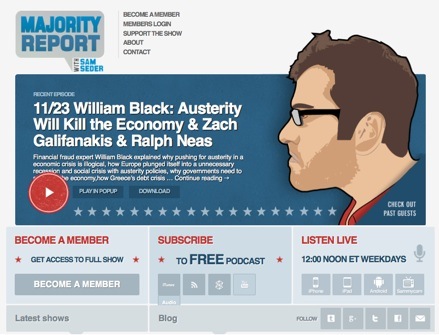
William Black appears on Majority Report

William Black appeared on Majority Report with Sam Seder on 11/23/2012. The image as well as this link will take you to the Majority Report web site.

The podcast can be downloaded or listened to by clicking this link (opens in new window).


Stop Using Obama for America Against the People!

By Joe Firestone

Obama for America, the campaign apparatus with the very large e-mailing list and great segmentation techniques that exploited Romney’s weaknesses to help the President to eke out (yes, I know the electoral vote involved no “eking out,” but the popular vote was something else again) his re-election victory, is now trying to mobilize people who voted for the President to work against their own interests by supporting his deficit/debt cutting activities. So, I couldn’t resist the following commentary on their mobilization e-mail. Continue reading

Even a deal on the budget is bad for the American economy

By Marshall Auerback

Looking at the latest US data, business sentiment and capital spending have been eroding, and given the lagged impact of capex, that trend looks set to continue for the next few months. Against that, a number of consumer sentiment indicators remain upbeat and housing looks like it is in a firmly established uptrend, after a 5 year bear market.  In fact, the existing home inventory to sales ratio is as low as it ever gets, and that is with still very depressed sales. If sales pick up further, given low inventories and with new housing starts still below the replacement rate, home prices could lurch forward.

Continue reading

Craziness on Three Continents

NEP’s William Black appears on The Real News Network discussing problems in Ecuador, Spain and the heartland of the U.S.
More at The Real News

How the “Takers” Voted

By Stephanie Kelton

In any fiscal union, some states will benefit disproportionately from the way federal dollars are collected and allocated. In the US, roughly half of all states are net recipients of federal spending (i.e. they receive more in federal spending than they pay in federal taxes). These welfare queens are supported by fiscal transfers from the remaining states, who sacrifice their tax dollars but don’t enjoy the same investments in their infrastructure, industries, schools and communities. Continue reading