Category Archives: Taxes

Will We Be The Lamest Generation?

By Dan Kervick

Matt Yglesias is now hawking an initial White House budget proposal that is apparently being negotiated by Tim Geithner.   Predictably, the two-stage proposal involves entitlement “savings” and cuts in both stage one and stage two, and backs off a bit on higher tax rates on the rich.  In exchange, the White House gets some more stimulus spending.  Yglesias advises Republicans to tell Obama:

… he can have his stimulus and he can even have higher tax revenue if he really wants it, but that the price is giving up his obsession with higher rates. Is he more interested in soaking the rich or in creating jobs? I don’t think Obama says no to a deal like that, and if he does lots of sensible liberals (like this guy) will call him out on it. Then we can put this sorry episode behind us, proclaim the Grand Bargaining Era done for, and hopefully move on to other things.

It seems strange to endorse a grand bargain in order to move on and proclaim the Grand Bargaining Era over.  Maybe next week Democrats should propose the elimination of the minimum wage so we can then declare an end to the Era of the Fight Over the Minimum Wage?

Continue reading

Michael Hudson on the State and Local Budget Crisis


The State and Local Budget Crisis

The cost of the 2011 cutbacks in federal spending will fall most directly on consumers and retirees by scaling back Social Security, Medicare, Medicaid and social spending programs. The population also will suffer indirectly, by lower federal revenue sharing with U.S. states and cities. The following chart from the National Income and Product Accounts (NIPA, Table 3.3) shows how federal financial aid has helped cities shift the tax burden off real estate, although the main shift has been off property taxes onto income – and onto consumption (sales) taxes.
State and Local revenue, 1930-2007
Untaxing real estate has served mortgage bankers by freeing more rental income (the land’s site value) to be paid as interest. Property taxes have not absorbed anywhere near the rise in debt-leveraged housing and commercial prices. However, this has not lowered the cost of housing for most people. New buyers must pay a price that capitalizes the property’s rental value. Less and less of this payment has taken the form of local property taxes. More and more has been paid to mortgage lenders as interest. So cutting property taxes has simply left more revenue to be capitalized into higher debt-financed prices.

While homeowners saw their carrying charges rise, they nonetheless felt more affluent as real estate prices rose – inflated on easier and easier credit terms. Prices rose faster than mortgage debt as long as (1) interest rates were declining; (2) loan maturities were stretched out (ultimately reaching the point of zero amortization rather than the old-fashioned 30-year self-amortizing mortgages); (3) down payments were shrinking toward zero (rather than requiring 20 percent equity as used to be the case) and indeed as “liars’ loans” led prices to be bid up recklessly; and finally (4) cities refrained from raising property taxes as fast as market prices were rising. This left more revenue to be capitalized into higher prices, providing capital gains that home owners were encouraged to treat like “money in the bank” – by taking out home equity loans. This rising mortgage debt was increasingly important in enabling people to maintain their living standards, especially as they had to pay more for housing. So what appeared to be affluence and rising net worth from the value of one’s home on the asset side of the balance sheet found its counterpart in debt on the liabilities side.

From the local fiscal vantage point, these debt-leveraged price gains represented uncollected user fees for the site value provided by public infrastructure and rising prosperity. The bankers ended up with the rising flow of rental value, not the cities. This obliged tax collectors to look to other sources of revenue. So homeowners paid out what they seemed to be saving in modest property taxes in the form of rising sales taxes and income taxes.

By 2008 these financial system’s easing of credit terms had reached its limit. No more room for credit inflation remained, so speculators began to withdraw from the market. (They accounted for about one-sixth of demand for housing.) When the credit spigot was turned off, prices plunged – leaving the debts in place. (So taking out a home-equity mortgage was not really like drawing down money from a piggy bank after all. Years of future income had to be diverted to spend for past shortfalls.)

Now that federal aid is falling – along with revenue from sales and income taxes – local budgets are falling into deficit. But for many cities and states, their constitutions and regulations prevent them from running deficits. So they face a number of hard choices.

It is hard to raise property taxes back toward earlier rates, because the rental income already has been pledged to the mortgage bankers. To tax heavily indebted property would lead to more foreclosures and abandonment. And the Obama Administration’s hope that banks somehow will use the Federal Reserve’s tsunami of cheap (0.25%) reserves and credit to re-inflate a new real estate bubble is in vain, because bankers have little interest in lending to property that is still sinking in market price. It is easier to speculate on interest-rate arbitrage with the BRICS and get a foreign-exchange premium as well, or simply to play the market. Banks report winnings in the derivatives trade day after day, with nary a loss – an indication of how poorly their hapless customers and other outsiders must be doing! So the path of least resistance for most cities and states is to cut back spending on public services, and above all on pension plan contributions.

The ultimate sacrifice (and the aim of financial predators) is to sell off public land and buildings, roads and other transportation services, sewer systems and other basic infrastructure. In this aim, the investment bankers are being aided and abetted by the credit ratings industry, threatening to downgrade cities that do not sell off their public domain. In this respect the financial end-game of privatization is similar in the United States to pressures by the European Central Bank to force the indebted PIIGS economies to engage in privatization sell-offs, Third World and post-Soviet style.

Just as in Europe, when revenues are squeezed and something must give – either debt service, payment to pensioners or current payments to labor – the financial sector is seeking to take all the available surplus for itself. This puts creditors in the forefront of today’s class war against labor.

On the eve of the September 2008 financial crash, cities such as Birmingham, Alabama and Chicago already were looking for ways to cope with the fiscal squeeze imposed by political pressures from the major local campaign contributors – the real estate and banking sectors – to cut property taxes. One seeming path of little resistance was to gamble in the Wall Street financial casino, hoping to make easy gains rather than making landlords, wage earners or consumers pay higher taxes.

Landlords and bankers encouraged this speculation as an alternative to taxing property. Landlords wanted to pay less in property taxes, and banks knew that whatever rental value buyers could save in the form of lower taxes would end up being used to bid up prices to capitalize into debt service for mortgages to buy properties up for sale.

Here is the dilemma that states and cities now face: So much urban property is sinking into negative equity territory that a rise in property taxes will lead to even more foreclosures and abandonments, and hence even lower fiscal returns. To avoid this, cities are seeing Chapter 9 bankruptcy as the main route to free themselves, especially from problems that stem from an unwarranted trust in bankers to help them out of the earlier fiscal squeeze by putting them into losing financial gambles. Orange County in California successfully sued Merrill Lynch to recover damages, and Birmingham also was awarded recovery payments from JP Morgan Chase.
Birmingham and Chicago as Microcosms of the National Debt Squeeze

Now that financial fraud has been decriminalized for all practical purposes, most financial victims are obliged to sue for reimbursement in civil court without much help from prosecutors. Alabama’s state capital Birmingham is a case in point. After a predatory financing arrangement to upgrade its sewers in 2008 forced its Jefferson County into bankruptcy, the Securities and Exchange Commission (S.E.C.) negotiated $75 million in fines and reimbursement of fees to be paid by JP Morgan Chase as lead lender and negotiator for the complex interest-rate swaps they had advised the country to take, ostensibly to protect its economic interest. The banks also forfeited nearly ten times this sum ($647 million) in termination fees. But the court-appointed receiver grabbed the $75 million settlement for payment on the debts the country still owed.
As usual, the banks had paid the fine and made reimbursement without admitting any wrongdoing. To the financial sector, deception and fraud is part of the game, after all, not a tactic that can be prosecuted as criminal. They paid their fines without admitting any wrongdoing, and without even admitting the S.E.C. charges. They merely paid up and kept silent – while the Justice Department and Internal Revenue Service were still in the time-taking process of ruling on legal claims brought by Jefferson County. The case prompted bankers and bondholders to bring pressure on the state of Alabama to take responsibility (that is, take on the debt liability) all on behalf of statewide taxpayers, and to demand that all lawsuits brought for financial fraud to be dropped.[1] “Responsibility” is supposed to be only for debtors, not for the financial sector itself. This is how the banks have managed to rewrite the laws, after all.

Jefferson County is now debating whether to declare Chapter 9 bankruptcy to free itself from debts that can be paid only at the cost of disrupting economic continuity and living standards. The city’s debt quandary is a microcosm for the U.S. economy as a whole. Its lowest-income residents are burdened with financialized charges for sewer-system debt payments so far beyond their ability to pay that they face the same fate as Latvians, Irish and Greeks: As the local economy shrinks, they must move in order to find jobs – in places less debt-burdened and hence lower-cost. The “free market” choice is to emigrate to flee the debts imposed on their economies and on themselves personally.

Well-to-do Birmingham families have yards large enough to have their own septic tanks as an alternative to paying for access to sewers, but lower-income families living in small houses or apartment buildings lack this option. One county commissioner asked: “Why should the poor have to pay for the ill-gotten gain of some of these banks who poisoned the well in the very first place?”[2] Other commissioners demanded that bondholders “bear the entire cost of a $20 million fund that is being created to help low-income residents pay their sewer bills.”[3]

But the government usually provides relief only for creditors – above all, relief from criminal prosecution for their business plan that involved making loans beyond the debtors’ ability to pay. Some states have fraudulent conveyance laws to prevent this, as well as to prevent banks from misrepresenting the quality of their loans to outside investors. There are laws to punish appraisers who give false appraisals, and mortgage brokers who fill in false income reports to qualify for loans. But the S.E.C. has seen its staff and budget slashed and deregulators appointed to oversee its affairs. It has no authority to prosecute, only to make recommendations to the Justice Department, where Attorney General Eric Holder has followed the Obama Administration’s support of Wall Street, feeling no obligation to live up to the promises to make that a change from the Bush Administration’s similar lax behavior.

The financial sector recognizes a dimension of economic behavior that textbooks politely refrain from citing: the ability to capture regulatory agencies, gain control of the courts and buy control of politics. The Supreme Court has ruled that corporations have the same rights as individuals to contribute to campaigns, a euphemism for buying the loyalty of politicians and judges, and obtaining veto power over regulatory appointees. Corporations pay lower income-tax rates and are free of value-added and excise or other sales taxes paid by consumers.

Unlike real people, corporations cannot be sent to jail. Corporate shells shield owners and managers from criminal prosecution for the wholesale frauds that have left Countrywide Financial, Bank of America, Citibank, JP Morgan Chase and other pillars of the banking community free to make civil settlements for deceptive policies without admitting wrongdoing. And whereas individual crooks need to pay their own lawyers, corporations pick up the tab for their managers, while contributing generously to politicians who rewrite the laws to decriminalize fraud and deceptive business dealing. The corporate-backed media applaud politicians who insist that families “take responsibility” for their unemployment risk, debts and health care – while bailouts free the wealthy from having to suffer losses on bad loans.

Rhode Island recently rewrote its laws to place bondholders ahead of other creditors, including pension recipients. Under the new law, “city officials who intentionally fail to pay bondholders can be removed from office or held personally liable for the payments.”[4] In contrast to the pro-debtor trend of legislation since the 13th century, wealth at the top of the pyramid takes precedence over retired schoolteachers and other public employees. The effect has been for the city of Central Falls, Rhode Island, to seek Chapter 9 bankruptcy protection to avert a 34 percent cut in pensions to its retirees in order to pay bondholders.

Rhode Island is not alone in giving legal priority to bondholders. “Illinois has some of the strongest bondholder protections anywhere, which explains how a state that began its fiscal year with $3.8 billion in unpaid bills from last year – and whose pension system has less than half of the money it needs – is able to keeping selling bonds. State law requires Illinois to make ‘an irrevocable and continuing appropriation’ of tax revenues into a special fund every month that can be used only to pay bondholders.”[5]

Chicago has balanced its budget not by taxing finance and real estate gains, but by selling off its roads and other basic infrastructure. Much as in feudal Europe, the leverage is financial. Privatizers are charging tolls and even installing parking meters on the city’s sidewalks to charge cars for parking by the minute. New York City has slashed is public subway and bus service, extending commuting times and making life harder. It has privatized its television and radio, replacing public airtime with commercial advertising.

The ending of federal revenue sharing will exacerbate local budget constraints. The fact that many cities and states have constitutional requirements of balanced budgets – just as Republicans advocated for the federal government in the 2011 debt-ceiling agreement – requires that taxes be raised, public services cut, or assets sold off. California’s Proposition 13 prevents the state from raising property taxes in keeping with market prices, tying its hands fiscally and obliging it to commercialize its once-great university system. Students must now take on enormous education debt for what formerly was free or subsidized. New York City’s real estate tax likewise favors large investors and wealthy homeowners, at the expense of co-ops and condominium owners in apartment buildings. The rising rental value that local tax collectors relinquish does not lower housing costs; it merely enables the land’s site value to be paid to bankers. Rising debt-inflated housing prices have priced the city out of the market as the manufacturing center it formerly was. Its textile buildings and other industrial properties have been gentrified, leaving it a one-industry (finance) town focused on Wall Street.

At the international level, Irish voters confirmed the policy of taking bad European Central Bank advice to put the interest of bondholders first by taking bad bank loans onto the government’s balance sheet and taxing the population to make up the losses, even at the cost of imposing a generation of debt-strapped depression on their economy. This is the self-destructive road to debt peonage that the IMF and World Bank forced Third World countries to follow for many decades. The fact that this ethic reverses centuries-long social values promises to make the great debate of the 21st century over the issue of which debts are paid and which will not be – and how much debts should be written down.

To read more from Michael Hudson

[1] Mary Williams Walsh, “A County in Alabama Puts Off Bankruptcy,” The New York Times, August 13, 2011.
[2] Michael Corkery and Kelly Nolan, “Alabama Bankruptcy Fight Hinges on Sewer-Rate Increase; Impact on Poor Bedevils Deal,” Wall Street Journal, August 11, 2011.
[3] Michael Corkery and Michael Aneiro, “Alabama County Rejects Creditor Plan but Delays Bankruptcy Decision,” Wall Street Journal, August 13, 2011.
[4] Michael Corkery, “Bondholders Win in Rhode Island,” Wall Street Journal, August 4, 2011.
[5] Mary Williams Walsh and Michael Cooper, “Faltering Rhode Island City Tests Vows to Pensioners,” The New York Times, August 13, 2011. The article adds that: “The federal bankruptcy code says pensioners and general-obligation bondholders are both unsecured creditors, stuck at the back of the line and treated as equals. But there is maneuvering room in the welter of state and federal laws.”

Time to panic? You Betcha.

By Stephanie Kelton

Earlier this week, President Obama talked about the weakening state of the economy, telling us that he’s not worried about a double-dip recession and that the nation should “not panic.” It’s hard to imagine a more alarming assessment at this juncture.

The recovery is faltering. Our economy is growing at annual rate of just 1.8 percent. Manufacturing just grew at its slowest pace in 20 months. More than 44 million Americans – one in seven – rely on food stamps. Employers hired only 54,000 new workers in May, the lowest number in eight months. Jobless claims increased to 427,000 in the week ended June 4. The unemployment rate rose to 9.1 percent. Nearly half of all unemployed Americans have been without work for more than 6 months. About 25% of all teenagers who are looking for work are unemployed. Eight-and-a-half million Americans are underemployed – i.e. working part-time because their hours have been cut or because they can’t find full-time work. There are, on average, 4.6 unemployed people for every 1 job opening. And even if all the open positions were filled, there would still be 10.7 million people looking for work.

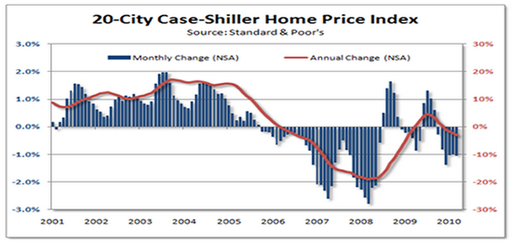
The Case-Shiller index shows that the housing market has already double-dipped.

And, because of the huge shadow inventory of yet-to-be-foreclosed homes, Robert Shiller, a co-creator of the index, thinks home prices could easily fall another 15-25% before bottoming out. If he’s right – and I suspect he is – this spells the end of the recovery. As prices continue to decline they create hidden losses elsewhere in the economy, hurting not just homeowners but the financial institutions that hold their mortgages. The list goes on and on.

These are not, as Obama said, “headwinds” that will slow the pace of our recovery. They are gale force winds that will push millions of families into poverty and thousands of business into bankruptcy.

There is a way out, but it seems unlikely that Congress and the White House will work together to do what’s necessary to turn things around.  Why?  Because a recent poll shows that 59 percent of the public disapproves of the president’s handling of the economy.  And Republicans smell blood.  They know that since WWII no president has been re-elected with unemployment above 7.2 percent, so they see Harry Hard Luck and Sally Sob Story as their best chance at reclaiming the White House in 2012.  It’s a victory the Republicans have been masterfully engineering since February 2009, when they succeeded in restricting the size and scope of the American Recovery and Reinvestment Act (ARRA).
Some of us saw this coming.  For example, Jamie Galbraith and Robert Reich warned, on a panel I organized in January 2009, that the stimulus package needed to be at least $1.3 trillion in order to create the conditions for a sustainable recovery.  Anything shy of that, they worried, would fail to sufficiently improve the economy, making Keynesian economics the subject of ridicule and scorn.
But it’s easy to see why the $787 billion package we ended up with didn’t do the trick.  Remember that the stimulus didn’t take effect all at once – it was spread out over a three-year period.  And while the left hand of the federal government was trying to rev up the economy with increased spending, the right hand of the private sector (together with state and local governments) was dutifully stomping on the breaks.  Just consider the fact that bank lending declined by $587 billion in 2009 alone – the biggest one-year drop since the 1940s.  That’s a $587 billion hole that businesses and households created just as the stimulus was rolling out the first $200 billion or so.  ARRA was the right medicine, but it was administered in the wrong dosage, and this became clear within months of its passage.

In July 2009, I wrote a post entitled, “Gift-Wrapping the White House for the GOP.” In it, I said:

“If President Obama wants a second term, he must join the growing chorus of voices calling for another stimulus and press forward with an ambitious program to create jobs and halt the foreclosure crisis.”

Two years later, both crises are still with us, and the election is just around the corner.
Meanwhile, a new Washington Post-ABC News poll shows former Massachusetts Governor Mitt Romney with a slight edge in a hypothetical race against President Obama, and Howard Dean is warning that without a marked improvement in the economy, even Sarah Palin could clobber Obama in 2012.
To avoid this, President Obama must get his economics right.  Unfortunately, he’s too busy fanning the flames of the phony debt crisis and complaining that the discouraging data is hampering the recovery because it “affects consumer confidence, and it affects business confidence.” But here’s the thing – the recovery isn’t going to be driven by a change in our mentality.  It’s going to be driven by a change in our reality.
So here’s what he needs to do – stop talking about the deficit.  It has always been his Achilles’ heel.  The US is not broke and cannot go bankrupt.  Let go of that myth, and deliver one of those jaw-dropping, awe-inspiring speeches of yesteryear.  Tell the American people that he’s calling on the Republicans to help him enact the most sweeping tax relief since Ronald Reagan was in office — a full payroll tax holiday for every employee and every employer in the nation.  Tell us that you understand that sales create jobs, and income creates sales.  Tell us that families and small businesses don’t have enough income to dig us out of the ditch we’re still in.  Tell us that you will not withhold a dime from our paychecks until cash registers across the nation are chiming and unemployment has fallen below 5 percent.  Tell us before it’s too late.

The Perfect Fiscal Storm: Causes, Consequences, Solutions

Approximately a decade ago I wrote a paper with a similar title, announcing that forces were aligned to produce the perfect fiscal storm. What I was talking about was a budget crisis at the state and local government levels. I had recognized that the economy of the time was in a bubble, driven by what I perceived to be unsustainable deficit spending by the private sector—which had been spending more than its income since 1996. As we now know, I called it too soon—the private sector continued to spend more than its income until 2006. The economy then crashed—a casualty of the excesses. What I had not understood a decade ago was just how depraved Wall Street had become. It kept the debt bubble going through all sorts of lender fraud; we are now living with the aftermath.
Still, it is worthwhile to return to the “Goldilocks” period to see why economists and policymakers still get it wrong. As I noted in that earlier paper:
It is ironic that on June 29, 1999 the Wall Street Journal ran two long articles, one boasting that government surpluses would wipe out the national debt and add to national saving—and the other scratching its head wondering why private saving had gone negative. The caption to a graph showing personal saving and government deficits/surpluses proclaimed “As the government saves, people spend”. Almost no one at the time (or since!) recognized the necessary relation between these two that is implied by aggregate balance sheets. Since the economic slowdown that began at the end of 2000, the government balance sheet has reversed toward a deficit that reached 3.5% of GDP last quarter, while the private sector’s financial balance improved to a deficit of 1% of GDP. So long as the balance of payments deficit remains in the four-to-five percent of GDP range, a private sector surplus cannot be achieved until the federal budget’s deficit rises beyond 5% of GDP (as we’ll see in a moment, state and local government will continue to run aggregate surpluses, increasing the size of the necessary federal deficit). [I]n recession the private sector normally runs a surplus of at least 3% of GDP; given our trade deficit, this implies the federal budget deficit will rise to 7% or more if a deep recession is in store. At that point, the Wall Street Journal will no doubt chastise: “As the people save, the government spends”, calling for a tighter fiscal stance to increase national saving!


Turning to the international sphere, it should be noted that US Goldilocks growth was not unique in its character. [P]ublic sector balances in most of the OECD nations tightened considerably in the past decade–at least in part due to attempts to tighten budgets in line with the Washington Consensus (and for Euroland, in line with the dictates of Maastricht criteria). (Japan, of course, stands out as the glaring exception—it ran large budget surpluses at the end of the 1980s before collapsing into a prolonged recession that wiped out government revenue and resulted in a government deficit of nearly 9% of GDP.) Tighter public balances implied deterioration of private sector balances. Except for the case of nations that could run trade surpluses, the tighter fiscal stances around the world necessarily implied more fragile private sector balances. Indeed, Canada, the UK and Australia all achieved private sector deficits at some point near the beginning of the new millennium.

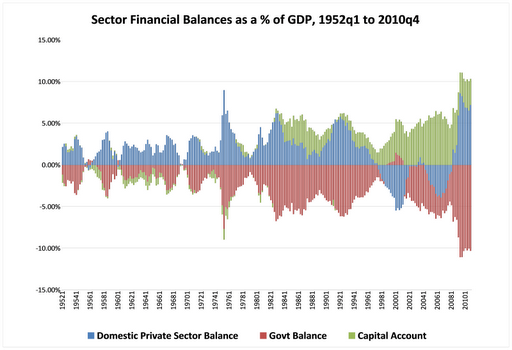
As we now know, my short-term projections were not too bad, but the medium-term projections were off. The Bush deficit did grow to 5% of GDP, helping the economy to recover. But then the private sector moved right back to huge deficits as lender fraud fueled a real estate boom as well as a consumption boom (financed by home equity loans). See the following chart (thanks to Scott Fullwiler):


This chart shows the “mirror image”: a government deficit from 1980 through to the Goldilocks years is the mirror image of the domestic private sector’s surplus plus our current account deficit (shown as a positive number because it reflects a positive capital account balance). During the Clinton years as the government budget moved to surplus, it was the private sector’s deficit that was the mirror image to the budget surplus plus the current account deficit. This mirror image is what the Wall Street Journal had failed to recognize—and what almost no one except MMT-ers and the Levy Economic Institute’s researchers understand. After the financial collapse, the domestic private sector moved sharply to a large surplus (which is what it normally does in recession), the current account deficit fell (as consumers bought fewer imports), and the budget deficit grew mostly because tax revenue collapsed as domestic sales and employment fell.  

Unfortunately, just as policymakers learned the wrong lessons from the Clinton administration budget surpluses—thinking that the federal budget surpluses were great while they actually were just the flip side to the private sector’s deficit spending—they are now learning the wrong lessons from this crash. They’ve managed to convince themselves that it is all caused by government sector profligacy. Especially, spending on public sector workers.

For example, Wisconsin Governor Walker’s attack on workers has been taken on the pretext that state employee wages and pensions have driven the budget into deficit. We all know that is ridiculous. The reality is simple: Wall Street crashed the economy, crashed state revenues, and crashed workers’ pensions. Washington responded with a massive bail-out for Wall Street—perhaps $25 trillion worth. It gave a mere pittance to “Main Street” in its $1 trillion stimulus package. Since the recession manufactured on Wall Street cost the economy a lot more than that, Main Street is not on the road to recovery. No one is projecting that jobs will return for many more years. It is delusional to believe that economic recovery can really get underway until we have added 8 million jobs.

In other words, the fiscal storm that killed state budgets is the same fiscal storm that created federal budget deficits. You cannot lose about 8% of GDP (due to spending cuts by households, firms and governments) and over 8 million jobs without negatively impacting government budgets. Tax revenue has collapsed at an historic pace. State governments really do need to balance their budgets, and they really do need tax revenue to finance their spending or to service debt. The federal government, as the sovereign issuer of the currency is in a different situation. I will not go through the MMT approach to sovereign currency spending as all readers here are familiar with that. My point is that states really are facing a funding crisis. The federal government does not face a solvency constraint and it can always afford to buy anything for sale in dollars. Still, as we all know, Washington Beltway insiders have manufactured a fake budget crisis to serve political ends.

State spending cuts (or tax increases) will not restore their budgets. Just take a look at the results of austerity in Greece or the UK. Budget-cutting in a downturn does not reduce deficits significantly. The reason is obvious: austerity slows the economy and reduces tax revenue. Art Laffer’s supply siders were onto something, although they mostly got it the wrong way around. Yes, a booming economy will generate a movement toward balanced government budgets. They thought that tax cuts are always the answer to everything—cut tax rates and you get more tax revenue. I would not say that that never works, but it didn’t when Presidents Reagan and Bush tried it. However, if we get the Laffer Curve the right way around, we can use it to explain why austerity in a downturn just makes budget deficits worse.
In truth, state budgets will not recover before the economy recovers. And state austerity will just make the economy worse. So, as a Thatcher might say: TINA: there is no alternative–to federal government stimulus, that is. I realize that goes against the deficit hysteria in Washington. But it is the truth.
What kind of stimulus makes the most sense? I think we need another trillion dollars, minimum. This can be split equally between aid to the states and extension of the payroll tax holiday. The federal government should provide $500 billion in block grants to the states, on a per capita basis. On the condition that they stop attacking state workers. The funds would be used to replace lost tax revenue—to cover operating expenses (and where possible, to actually increase spending on priority projects). This program would continue until economic growth and job creation reaches established thresholds. Let us say 10 million more jobs or a measured unemployment rate of 4%.

The payroll tax holiday would also be expanded, with a moratorium on taxes for both workers and employers until those thresholds are reached. Why penalize job creation with an employment-killing payroll tax? Reward firms for providing jobs by giving them tax relief. Let workers keep more of their hard-earned pay. This is the quickest and best way to give significant tax relief to most Americans. In addition, we need to stop the attacks on unemployment compensation. To be sure, jobs should always be favored over unemployment compensation—but until we get the jobs we must extend the unemployment benefits. Cutting benefits will just prevent the jobs from coming back.

These measures are only a first step. We still have a lot of damage to repair—damage caused by Wall Street’s excesses. And we will need to reign-in and prosecute the fraudsters, otherwise they will blow up the economy again. Actually, they are already trying to do that—creating yet another commodities market speculative bubble. It is looking an awful lot like 2006 all over again. However this time, we are down by 8 million jobs and trillions of dollars of household wealth. Wall Street is bubbling up even as the economy as a whole is in the trenches. This bubble will not last long. It is going to crash. That will expose the huge accounting holes in the bank balance sheets. Wall Street will want another 25 trillion dollar bail out. This time, we’ve got to follow Nancy’s dictum: just say no.

While Labor Unions celebrate Anti-Austerity Day in Europe, European Neoliberals raise the ante: Governments must Lower Wages or Suffer Financial Blackmail

By Michael Hudson

Most of the press has described Europe’s labor demonstrations and strikes on Wednesday in terms of the familiar exercise by transport employees irritating travelers with work slowdowns, and large throngs letting off steam by setting fires. But the story goes much deeper than merely a reaction against unemployment and economic recession. At issue are proposals to drastically change the laws and structure of how European society will function for the next generation. If the anti-labor forces succeed, they will break up Europe, destroy the internal market, and render that continent a backwater. This is how serious the financial coup d’etat has become. And it is going to get much worse – quickly. As John Monks, head of the European Trade Union Confederation, put it: “This is the start of the fight, not the end.”
Spain has received most of the attention, thanks to its ten-million strong turnout – reportedly half the entire labor force. Holding its first general strike since 2002, Spanish labor protested against its socialist government using the bank crisis (stemming from bad real estate loans and negative mortgage equity, not high labor costs) as an opportunity to change the laws to enable companies and government bodies to fire workers at will, and to scale back their pensions and public social spending in order to pay the banks more. Portugal is doing the same, and it looks like Ireland will follow suit – all this in the countries whose banks have been the most irresponsible lenders. The bankers are demanding that they rebuild their loan reserves at labor’s expense, just as in President Obama’s program here in the United States but without the sanctimonious pretenses.
The problem is Europe-wide and indeed centered in the European Union capital in Brussels, where fifty to a hundred thousand workers gathered to protest the proposed transformation of social rules. Yet on the same day, the European Commission (EC) outlined a full-fledged war against labor. It is the most anti-labor campaign since the 1930s – even more extreme than the Third World austerity plans imposed by the IMF and World Bank in times past.

The EC is using the mortgage banking crisis – and the needless prohibition against central banks monetizing public budget deficits – as an opportunity to fine governments and even drive them bankrupt if they do not agree roll back salaries. Governments are told to borrow at interest from the banks, rather than raising revenue by taxing them as they did for half a century following the end of World War II. Governments unable to raise the money to pay the interest must close down their social programs. And if this shrinks the economy – and hence, government tax revenues – even more, the government must reduce social spending yet further.
From Brussels to Latvia, neoliberal planners have expressed the hope that lower public-sector salaries will spread to the private sector. The aim is to roll back wage levels by 30 percent or more, to depression levels, on the pretense that this will “leave more surplus” available to pay in debt service. It will do no such thing, of course. It is a purely vicious attempt to reverse Europe’s Progressive Era social democratic reforms achieved over the past century. Europe is to be turned into a banana republic by taxing labor – not finance, insurance or real estate (FIRE). Governments are to impose heavier employment and sales taxes while cutting back pensions and other public spending.
“Join the fight against labor, or we will destroy you,” the EC is telling governments. This requires dictatorship, and the European Central Bank (ECB) has taken over this power from elected government. Its “independence” from political control is celebrated as the “hallmark of democracy” by today’s new financial oligarchy. This deceptive newspeak evokes Plato’s view that oligarchy is simply the political stage following democracy. The new power elite’s next step in this eternal political triangle is to make itself hereditary – by abolishing estate taxes, for starters – so as to turn itself into an aristocracy.
It is a very old game indeed. So it is time to put aside the economics of Adam Smith, John Stuart Mill and the Progressive Era, to forget Marx and even Keynes. Europe is ushering in an era of totalitarian neoliberal rule. This is what Wednesday’s strikes and demonstrations were about. Europe’s class war is back in business – with a vengeance!
This is economic suicide, but the EU is demanding that Euro-zone governments keep their budget deficits below 3% of GDP, and their total debt below 60%. On Wednesday the EU passed a law to fine governments up to 0.2% of GDP for not “fixing” their budget deficits by imposing such fiscal austerity. Nations that borrow to engage in countercyclical “Keynesian-style” spending that raises their public debt beyond 60% of GDP will have to reduce the excess by 5% each year, or suffer harsh punishment.[1] The European Commission (EC) will fine euro-area states that do not obey its neoliberal recommendations – ostensibly to “correct” budget imbalances.
The reality is that every neoliberal “cure” only makes matters worse. But rather than seeing rising wage levels and living standards as being a precondition for higher labor productivity, the EU commission will “monitor” labor costs on the assumption that rising wages impair competitiveness rather than raise it. If euro members cannot depreciate their currencies, then they must fight labor – but not tax real estate, finance or other rentier sectors, not regulate monopolies, and not provide public services that can be privatized at much higher costs. Privatization is not deemed to impair competitiveness – only rising wages, regardless of productivity considerations.
The financial privatization and credit-creation monopoly that governments have relinquished to banks is now to really pay off – at the price of breaking up Europe. Unlike central banks elsewhere in the world, the charter of the European Central Bank (ECB, independent from democratic politics, not from control by its commercial bank members) forbids it to monetize government debt. Governments must borrow from banks, which are create interest-bearing debt on their own keyboards rather than having their national bank do it without cost.
The unelected members of the European Central Bank have taken over planning power from elected governments. Beholden to its financial constituency, the ECB has convinced the EU commission to back the new oligarchic power grab. This destructive policy has been tested above all in the Baltics, using them as guinea pigs to see how far labor can be depressed before it fights back. Latvia gave free reign to neoliberal policies by imposing flat taxes of 51% and higher on labor, while real estate is virtually untaxed. Public-sector wages have been reduced by 30%, prompting labor of working age (20 to 35 year-olds) to emigrate in droves. This of course is contributing to the plunge in real estate prices and tax revenue. Lifespans for men are shortening, disease rates are rising, and the internal market is shrinking, and so is Europe’s population – as it did in the 1930s, when the “population problem” was a plunge in fertility and birth rates (above all in France). That is what happens in a depression.
Iceland’s looting by its bankers came first, but the big news was Greece. When that nation entered its current fiscal crisis as a result of not collecting taxes on the wealthy, European Union officials recommended that it emulate Latvia, which remains the poster child for neoliberal devastation. The basic theory is that inasmuch as members of the euro cannot devalue their currency, they must resort to “internal devaluation”: slashing wages, pensions and social spending. So as Europe enters recession it is following precisely the opposite of Keynesian policy. It is reducing wages, ostensibly to “free” more income available to pay the enormous debts that Europeans have taken on to buy their homes and pay for schooling (hitherto provided freely in many countries such as Latvia’s Stockholm School of Economics), transportation and other public services. Manly such services have been privatized and subsequently raised their rates drastically. The privatizers justify this by pointing to the enormously bloated financial fees they had to pay their bankers and underwriters in order to get the credit to buy the infrastructure that was being sold off by governments.
So Europe is committing economic, demographic and fiscal suicide. Trying to “solve” the problem neoliberal style only makes things worse. Latvia’s public-sector workers, for example, have seen their wages cut by 30 percent over the past year, and its central bankers have told me that they are seeking further cuts, in the hope that this will lower wages in the private sector as well, just as neoliberals in other European countries hope, as noted above.
About 10,000 Latvians attended protest meetings in the small town of Daugavilpils alone as part of the “Journey into the Crisis.” In Latvia’s capital city, Riga, yesterday’s Action Day saw the usual stoppage of transportation and an accompanying honk concert for 10 minutes at 1 PM to let the public know that something was happening. Six independent trade unions and the Harmony Center organized a protest meeting in Riga’s Esplanade Park that drew 700 to 800 demonstrators, relatively large for so small a city. Another union protest saw about half that number gather at the Cabinet of Ministers where Latvia’s austerity program has been planned and carried out.
What is happening most importantly is the national parliamentary elections this Saturday (October 2). The leading coalition, Harmony Center, is pledged to enact an alternative tax and economic policy to the neoliberal policies that have reduced labor’s wages and workplace standards so sharply over the past decade. A few days earlier a bus tour drove journalists to the most visible victims – schools and hospitals that had been closed down, government buildings whose employees had seen their salaries slashed and the workforce downsized.
These demonstrations seem to have gained voter sympathy for the more militant unions, headed by the hundred individual unions belonging to the Independent Trade Union Association. The other union group – the Free Trade Unions (LBAS) lost face by acquiescing in June 2009 to the government’s proposed 10% pension cuts (and indeed, 70% for working pensioners). Latvia’s constitutional court was sufficiently independent to overrule these drastic cuts last December. And if the government does indeed change this Saturday, the conflict between the Neoliberal Revolution and the past few centuries of classical progressive reform will be made clear.
In sum, the Neoliberal Revolution seeks to achieve in Europe what the United States has achieved since real wages stopped rising in 1979: doubling the share of wealth enjoyed by the richest 1%. This involves reducing the middle class to poverty, breaking union power, and destroying the internal market as a precondition.
All this is being blamed on “Mr. Market” – presumably inexorable forces beyond politics, purely “objective,” a political power grab. But is not really “the market” that is promoting this destructive economic austerity. Latvia’s Harmony Center program shows that there is a much easier way to cut the cost of labor in half than by reducing its wages: Simply shift the tax burden off labor onto real estate and monopolies (especially privatized infrastructure). This will leave less of the economic surplus to be capitalized into bank loans, lowering the price of housing accordingly (the major factor in labor’s cost of living), as well as the price of public services. (Owners of monopoly utility services would be prevented from factoring interest charges into their cost of doing business. The idea is to encourage them to take returns on equity. Whether or not they borrow is a business decision of theirs, not one that governments should subsidize.) The tax deductibility of interest will be repealed – there is nothing intrinsically “market dictated” by this fiscal subsidy for debt leveraging. This program may be reviewed at rtfl.lv, the Renew Task Force Latvia website.
No doubt many post-Soviet economies will find themselves obliged to withdraw from the euro area rather than see a flight of labor and capital. They remain the most extreme example of the Neoliberal Experiment to see how far a population can have its living standards slashed before it rebels.
But so far the neoliberals are fully in control of the bureaucracy, and they are reviving Margaret Thatcher’s slogan, TINA: There Is No Alternative. But there is an alternative, of course. In the small Baltic economies, pro-labor parties are pressing for the government to shift the tax burden off employees and consumers back onto property and financial wealth. Bad debts beyond the reasonable ability to pay must be scaled back. It may be necessary to let the banks go under (they are mainly Swedish), even if this means withdrawing from the Euro. The choice is between who will be destroyed: the banks, or labor?
European politicians now view this as being truly a fight to the death. This is the ideology that has replaced social democracy.

[1] Matthew Dalton, “EU Proposes Fines for Budget Breaches,” Wall Street Journal, September 29, 2010.

“Fed Chairman Ruml got it right in 1946″

Hat tip Warren Mosler’s blog (http://www.moslereconomics.com/)

On his recent piece “Taxes For Revenue Are Obsolete ” that appeared on the Huffington Post he notes:

April 15th has come and gone, but the issue of taxation remains the course de jour. I was recently forwarded an article entitled Taxes For Revenue Are Obsolete, written in 1946 by Beardsley Ruml, the former Chairman of the Federal Reserve Bank of New York and published in a periodical named American Affairs. While Ruml was writing about the merits of corporate taxes, it is his discussion about how the function of taxes changed after the nation exited the gold standard that make this a must read. As Ruml’s stated, with an “…inconvertible currency, a sovereign national government is finally free of money worries and need no longer levy taxes for the purpose of providing itself with revenue… It follows that our Federal Government has final freedom from the money market in meeting its financial requirements… All federal taxes must meet the test of public policy and practical effect. The public purpose which is served should never be obscured in a tax program under the mask of raising revenue.” He goes on to explain how, with Federal spending not revenue constrained, the first function of taxation is to regulate the value of the dollar, which we know as regulating inflation. The notion of the Federal government ‘running out of money’ and ‘dependence on foreign borrowing’ as well as ‘sustainability’ is categorically inapplicable. The operative CBO ‘scoring’ is the inflationary effect, rather than simply a revenue forecast. And while Social Security and Medicare may turn out to be inflationary, they are not ‘bankrupting the nation’ as most believe, including a Democratic Congress that cut Medicare spending with the recent health care bill and has all entitlements ‘on the table.’

See also here.

A Plea to the President: Tear Up That Speech

By Stephanie Kelton

My colleague and fellow blogger, Randy Wray, has just argued that President Obama should scrap the speech he’s planning to deliver tonight and surprise the American people with something entirely different. I couldn’t agree more. And while I agree that job creation must be JOB ONE in the months (and years) ahead, I would encourage the President to make massive tax relief the cornerstone of tonight’s speech.
Specifically, the President should call on Congress to support a full and immediate payroll tax holiday. Right now, the government takes away about 15% of our incomes in the form of payroll taxes. With a full payroll tax holiday, a married couple earning $60,000 a year would see their take-home pay increase by about $750 each month. In the aggregate, this will help millions of Americans pay their mortgages, student loans, credit card bills, and so on, while at the same time reducing business expenses (remember that employers contribute to the payroll tax too). All told, a full payroll tax holiday would allow Americans to keep about $1 trillion this year.
So stand before us, Mr. President, and tell us that you want to stop taking this income away from us until we, as a nation, have clawed back every job that has been lost since the start of the recession. Tell us that you intend to take bold steps to protect jobs, keep families intact and provide relief for millions of American businesses. Tell us that you have done all you intend to do to help the banks and the automakers and that you will not accept a jobless recovery — that an increase in economic activity is meaningless without rising employment in good jobs.
And, most importantly, tell us that you refuse to adopt a timeline for cutting the deficit. Tell us that you will not take one dime of payroll taxes away from us until your Administration can declare “Mission Accomplished” on the job front.
Finally, tell the American people that anyone who opposes a payroll tax holiday wants to keep taking hundreds, perhaps thousands, of dollars from them every month. Then watch what happens in 2012.

What If the Government Just Prints Money?

By Scott Fullwiler

As Congress gets set in the near future to consider raising the debt ceiling yet again, my fellow blogger L. Randall Wray creatively suggests not raising the debt ceiling but instead having the Treasury continue spending as it always does: by simply crediting bank accounts. As he puts it:

The anti-deficit mania in Washington is getting crazier by the day. So here is what I propose: let’s support Senator Bayh’s proposal to “just say no” to raising the debt ceiling. Once the federal debt reaches $12.1 trillion, the Treasury would be prohibited from selling any more bonds. Treasury would continue to spend by crediting bank accounts of recipients, and reserve accounts of their banks. Banks would offer excess reserves in overnight markets, but would find no takers—hence would have to be content holding reserves and earning whatever rate the Fed wants to pay. But as Chairman Bernanke told Congress, this is no problem because the Fed spends simply by crediting bank accounts.
This would allow Senator Bayh and other deficit warriors to stop worrying about Treasury debt and move on to something important like the loss of millions of jobs.
Wray’s proposal is based upon modern monetary theory (MMT) that is the focus this blog and those by Bill Mitchell, Warren Mosler, and Winterspeak. Of course, given the lack of understanding of basic reserve accounting at the heart of MMT and Wray’s proposal on the part of the public, the financial press, and the vast majority of economists, one can already anticipate the outpouring of criticism suggesting that such a proposal amounts to “printing money” and thereby destroying the value of the currency. Some probably will even argue that this would put the US on the road to a fate much like Zimbabwe’s (for a good analysis of what’s actually happening in Zimbabwe, see here).

As such, this post considers whether a given deficit resulting in more reserves in circulation and fewer bonds held by the non-government sector raises the likelihood of spiraling inflation, as most interpretations of the government budget constraint (GBC) assume. The approach here recognizes the importance of understanding the balance sheet implications of both of these options that are central to MMT. While most economists typically assume a supply and demand relationship, as in the hypothesized loanable funds market, and then build models accordingly, such an approach can miss important relationships in the real world. In particular, any transaction in a capitalist economy results in changes in the agents’ financial statements; if the hypothesized supply and demand relations are not consistent with the actual changes occurring within the financial statements of the relevant agents, then the hypothesized model is irrelevant. In a modern money regime such as ours in which there is a sovereign currency issuer operating under flexible exchange rates, “monetization” versus “financing” as characterized both in the GBC and in the hypothesized loanable funds market fall into this category.

Consider first the case in which the federal government runs a deficit but neither the Treasury nor the Fed sells bonds. This is “monetization” as usually suggested by the GBC. As always, and as noted by Wray, the Treasury spends by crediting bank reserve accounts at the Fed, while simultaneously instructing the banks to credit the deposit accounts of the recipients of the spending. (The process is simply delayed a bit where the Treasury sends the recipient a check, triggered when the recipient deposits the check at his/her bank.) Taxes have the reverse effects. For a government deficit, the Treasury’s credits to accounts are greater than what has been debited via taxation. Figure 1 shows the balance sheet effects of a government deficit for the private sector, with the effects on banks and non-banks shown separately.

As the quantity of reserve balances banks desire to hold to settle payments and meet reserve requirements is already accommodated by the Fed, the deficit in Figure 1 creates excess balances. Prior to fall 2008, Fed operating procedures set the federal funds rate target above the rate paid on reserve balances; in that case, the federal funds target would be bid down—theoretically, to the rate paid on reserve balances. Figure 1—or, “monetization”—thus was not an operational possibility under previous Fed procedures that set the target rate above the rate paid on reserve balances. In other words, prior to fall 2008, even if the federal government wanted to “monetize” the deficit, either the Treasury or the Fed would still have been required to sell bonds to hit the Fed’s target rate. However, since the Fed now sets the target rate equal to the rate paid on reserve balances, no such bond sales by the Fed or the Treasury are necessary. Instead, as the Treasury spends and excess balances increase, the Fed’s target can still be achieved and the Fed can raise or lower its target as desired by simply announcing an equivalent change to both the target rate and the rate paid on reserve balances.

Figures 1 (above), 2 (below), and 3 (below) demonstrate that government deficits create increased net saving in the non-government sector. By definition, additional net saving flows to a given sector are shown on a balance sheet as additional net financial assets and net worth for that sector. The creation of any financial asset generates both an asset and a liability given the two-sided nature of financial assets; in the case of a government deficit, the liability remains on the government’s balance sheet while there is a simultaneous increase in net equity or wealth in the non-government sector.

In Figure 1, the new net financial assets for the non-government sector are the additional deposits—the M1 measure of money—on the non-bank sector’s balance sheet unaccompanied by an offsetting increase in its liabilities.

Figure 2 shows the same deficit accompanied by a bond sale that is purchased by banks. The Treasury security purchase by the banking sector is settled by a debit to reserve accounts. As already explained above, the operational effect of the reserve balance drain is to support the interest rate target under traditional operating procedures. There is still an increase in net financial assets or wealth of the non-government sector, as the deposits (M1) remain on the non-bank private sector’s balance sheet. Figure 3 shows the same deficit accompanied by a bond sale to the non-bank private sector, as in sales to non-bank Treasury dealers. As in Figure 2, the reserve drain enables the Fed to sustain the federal funds rate target under traditional operating procedures, and there are again net financial assets created for the private sector in the form of Treasuries on the non-bank private sector’s balance sheet. (While some may object to the placement of the deficit as the first event and the bond sale as the second event in Figures 2 and 3, note that the ultimate effect on net financial assets is identical regardless of how one orders the transactions.)

In terms of the effect on net financial assets for the non-government sector, the figures show that there is no difference between “monetization” or bond sales besides potential effects on the federal funds rate that depend on the Fed’s chosen method of achieving its target. But from the widely-held view that “monetization” is more inflationary than bond sales, Figure 1 is assumed to be more inflationary than Figures 2 and 3. Regarding Figure 1, though, recall that banks do not use reserve balances or deposits to make loans, as loans CREATE deposits; bank lending or money creation instead occurs when banks are presented with opportunities to lend at an expected profit (and have sufficient capital). Banks instead hold reserve balances ONLY for settling payments and meeting reserve requirements (see, for example, my previous post on bank lending and reserve balances here), and their desired holdings for these purposes are always accommodated by the Fed at its target rate. What this means is that the reserve balance drain shown in Figures 2 or 3 can in no way restrict potential money creation by banks.

Another implication, or (at least) interpretation, of the GBC view and the loanable funds market is that the Treasuries added to the non-bank private sector’s net wealth in Figure 3 are less stimulative than the deposits created in Figure 1. But this is also clearly false, as it ignores the fact that M1 money is left circulating when bonds are sold to banks, as well (as shown in Figure 2), so the distinction to be made in that case is actually between bond sales to the non-bank public and bond sales to banks (i.e., Figures 1 and 2 versus Figure 3) even though to my knowledge no economist has ever suggested that bond sales to banks were more inflationary than bond sales to the non-bank private sector.

Finally, that the non-bank private sector is holding Treasuries rather than deposits in Figure 3 does not somehow constrain its spending. Rather, just as current holders of deposits could choose to convert their new wealth to time deposits instead of spending, individuals holding Treasuries (which are essentially time deposits at the Fed) could opt alternatively to leverage their wealth (and Treasuries happen to be highly valuable as loan collateral). Indeed, whether holding deposits or Treasuries, with greater net wealth and net income flows provided by a government deficit, the non-government sector might logically be more likely to spend than without the deficit while also appearing more creditworthy to banks (who again themselves are never constrained by the quantity of reserve balances or deposits in the amount of lending or money creation they can engage in). In any event, in the presence of a government deficit, spending by the non-government sector is in no plausible way constrained by the fact that it currently might be holding Treasuries instead of deposits.

In sum, whether or not a deficit is accompanied by bond sales is irrelevant for understanding the potential inflationary effects of the deficit. Under normal Fed operating procedures in place until fall 2008, the operational function of bond sales was to support the interest rate target, not to “finance” a deficit. A government bond sale does not somehow reduce funds available for non-government agents to borrow as presumed in the loanable funds market approach, while the absence of a bond sale does not somehow mean there is a greater amount of liquid financial assets, income, or “funds available” for borrowing or spending than without the bond sale. Instead, a government deficit always adds to the non-government sector’s net financial wealth whether or not a bond sale occurs. Both the Treasury’s bond sales and the Fed’s operations affect only the relative quantities of securities, reserve balances, and currency held by the non-government sector; the total sum of these is set by the outstanding government debt. With or without bond sales, it is the non-government sector’s decision to spend or save that matters in regard to the potential inflationary impact of a given government deficit. Indeed, to be more precise, a deficit accompanied by bond sales is actually the MORE potentially inflationary option, as the net financial assets created by the deficit will be increased still further when additional debt service is paid.

Memo to Congress: Don’t Increase the Government’s Debt Limit!

By L. Randall Wray

In a piece written for CNN, Senator Evan Bayh rails against the growing federal government budget deficit. He warns that next month the Treasury will ask Congress to raise the debt limit from its current $12.1 trillion, and promises that he will vote “no”. It is time, he argues, for Congress to stand up for our nation’s future by creating a bi-partisan debt commission that would finally put an end to “unsustainable” deficit spending.

The Senator goes on:

When President George W. Bush took office in 2001, our public debt amounted to 33 percent of our economy. Today, it is 60 percent of our gross domestic product. If we do nothing, our debt is projected to swell to over 70 percent by 2019. To put those numbers in perspective: If you divided the debt equally among all Americans, every man, woman and child living in the United States today would owe more than $39,000.

I presume the Senator has got his math correct, but there is a glaring error in his English that can be corrected by substituting an “n” for an “e”: If you divided the debt equally among all Americans, every man, woman and child living in the United States today would own more than $39,000. Government debt is a private asset. You and I do not owe government debt, we own it. Indeed, the only source of net dollar-denominated financial wealth is federal government debt.

The good Senator continues, comparing his proposed debt commission with an earlier successful bi-partisan effort:

There is precedent to create this type of commission with real teeth. President Ronald Reagan created a commission, chaired by Alan Greenspan, to shore up Social Security in the early 1980s.

That commission hiked payroll taxes to transform Social Security from a “pay-as-you-go” system (payroll taxes collected were matched to current year spending) to an “advanced funded” system that accumulated “Trust Fund assets”. In truth the Trust Fund is nothing but an accounting gimmick in which one arm of government (the Treasury) owes another arm of government (Social Security), with workers and their firms saddled with payroll taxes that are a third larger than Social Security spending. Like almost everything else Alan Greenspan did, the Social Security commission was a monumental failure and its actions were completely unnecessary. All Social Security payments can be made as they come due whether the Trust Fund holds Treasury debt or not, and no matter how much “revenue” the payroll tax collects. Like the bowling alley that credits points when pins are knocked down, the Treasury cannot run out of “points” credited to the accounts of pensioners.

The anti-deficit mania in Washington is getting crazier by the day. So here is what I propose: let’s support Senator Bayh’s proposal to “just say no” to raising the debt ceiling. Once the federal debt reaches $12.1 trillion, the Treasury would be prohibited from selling any more bonds. Treasury would continue to spend by crediting bank accounts of recipients, and reserve accounts of their banks. Banks would offer excess reserves in overnight markets, but would find no takers—hence would have to be content holding reserves and earning whatever rate the Fed wants to pay. But as Chairman Bernanke told Congress, this is no problem because the Fed spends simply by crediting bank accounts.

This would allow Senator Bayh and other deficit warriors to stop worrying about Treasury debt and move on to something important like the loss of millions of jobs.

Should America Kowtow to China?

By Marshall Auerback
First Published on New Deal 2.0.

Do the Chinese really fund our deficit? Or is this more Neo-classical money mythology?

Another Presidential junket to Asia and another one of the usual lectures from China, decrying our “profligate ways”. Today’s Wall Street Journal reports:, “China’s top banking regulator issued a sharp critique of U.S. financial management only hours before President Barack Obama commenced his first visit to the Asian giant, highlighting economic and trade tensions that threaten to overshadow the trip.”

According to Liu Mingkang, chairman of the China Banking Regulatory Commission, a weak U.S. dollar and low U.S. interest rates had led to “massive speculation” that was inflating asset bubbles around the world. It has created “unavoidable risks for the recovery of the global economy, especially emerging economies,” Mr. Liu said. The situation is “seriously impacting global asset prices and encouraging speculation in stock and property markets.”

Well, “them’s fightin’ words”, as we say over here. And of course, the President and his advisors are supposed to accept this criticism mildly because in the words of the NY Times, the US has assumed “the role of profligate spender coming to pay his respects to his banker.”

The Times actually does believe this to be true. They refer to China’s role as America’s largest “creditor” as a “stark fact”. They do not seem to understand that simply because a country issuing debt which it creates, it does not depend on bond holders to “fund” anything. Bonds are simply a savings alternative to cash offered by the monetary authorities, as we shall seek to illustrate below.

It is less clear to us whether the Chinese actually believe this guff, or simply articulate it for public consumption. China has made a choice: for a variety of reasons, it has adopted an export-oriented growth strategy, and largely achieved this through closely managing its currency, the remnimbi, against the dollar.

One can query the choice, as many would argue that it is more economically and socially desirable for China to consume its own economic output. According to Professor Bill Mitchell, for example, “once the Chinese citizens rise up and demand more access to their own resources instead of flogging them off to the rest of the world…then the game will be up. They will stop accumulating financial assets in our currencies and we will find it harder to run [current account deficits] against them.”

But there have undoubtedly been certain benefits that have accrued to the Chinese as a consequence of this strategy. The export prices obtained by Chinese manufacturers are about 10 times as high as the prices obtained in the more competitive domestic markets, and the challenge of competing in global markets has forced Chinese manufacturers to adhere to higher quality standards. This, in turn, has improved the overall quality of Chinese products. In the words of James Galbraith:

“Is there a way for the Chinese manufacturing firm to turn a profit? Yes: the alternative to selling on the domestic market is to export. And export prices, even those paid at wholesale, must be multiples of those obtained at home. But the export market, however vast, is not unlimited, and it demands standards of quality that are not easily obtained by neophyte producers and would not ordinarily be demanded by Chinese consumers. Only a small fraction of Chinese firms can actually meet the standards. These standards must be learned and acquired by practice.” (”The Predator State, Ch. 6, “There is no such thing as free trade”, pg. 84).

What about the US government? What should it do? Should it actually respond to China’s complaints by trying to “defend the dollar”?

I hear this recommendation all of the time in the chatterplace of the financial markets, but seldom do those who fret about the dollar’s declining level actually suggest a concrete strategy to achieve the objective. In fact, it is unclear to me that there is any measure the Fed or Treasury could adopt which might support the dollar’s external value.

And why should they? Given the horrendous unemployment data, and 65% capacity utilization, it is hard to view imported inflationary pressures via a weaker dollar actually becoming a serious threat.

But wait? Don’t the Chinese (and other external creditors) “fund” our deficit? And won’t they demand a higher equilibrating interest rate in order to offset the declining value of their Treasury hoard?

Again, this displays a seriously lagging understanding of how much modern money has changed since Nixon changed finance forever by closing the Gold window in 1973. Now that we’re off the gold standard, the Chinese, and other Treasury buyers, do not “fund” anything, contrary to the completely false & misguided scare stories one reads almost daily in the press.

This claim is seldom challenged, but our friend, Warren Mosler, recently gave an excellent illustration of this fact in an interview with Mike Norman. Mosler provides a hypothetical example in which China decides to sell us a billion dollars’ worth of T-shirts. We buy a billion dollars’ worth of T-shirts from China:

“And the way we pay them is somebody pays China. And the money goes into their checking account at the Federal Reserve. Now, it’s called a reserve account because it’s the Federal Reserve, and they give it a fancy name. But it’s a checking account. So we get the T-shirts, and China gets $1 billion in their checking account. And that’s just a data entry. That’s just a one and some zeroes.

Whoever bought them gets a debit. You know, it might have been Disneyland or something. So we debit Disney’s account and then we credit China’s account.

In this situation, we’ve increased our trade deficit by $1 billion. But it’s not an imbalance. China would rather have the money than the T-shirts, or they wouldn’t have sent them. It’s voluntary. We’d rather have the T-shirts than the money, or we wouldn’t have bought them. It’s voluntary. So, when you just look at the numbers and say there’s a trade deficit, and it’s an imbalance, that’s not correct. That’s imbalance. It’s markets. That’s where all market participants are happy. Markets are cleared at that price.

Okay, so now China has two choices with what they can do with the money in their checking account. They could spend it, in which case we wouldn’t have a trade deficit, or they can put it in another account at the Federal Reserve called a Treasury security, which is nothing more than a savings account. You give them money, you get it back with interest. If it’s a bank, you give them money, you get it back with interest. That’s what a savings account is.”

The example here clearly illustrates that bonds are a savings alternative which we offer to the Chinese manufacturer, not something which actually “funds” our government’s spending choices. It demonstrates that rates are exogenously determined by our central bank, not endogenously determined by the Chinese manufacturer who chooses to park his dollars in treasuries (credit demand, by contrast, is endogenous).

Here is how the mechanics actually work: government spending and lending adds reserves to the banking system because when the government spends, it electronically credits bank accounts.

By contrast, government taxing and security sales (i.e. sales of bonds) drain (subtract) reserves from the banking system. So when the government realizes a budget deficit (as is the case today), there is a net reserve add to the banking system, WHICH BRINGS RATES LOWER (not higher). That is, government deficit spending results in net credits to member bank reserves accounts. If these net credits lead to excess reserve positions, overnight interest rates will be bid down by the member banks with excess reserves to the interest rate paid on reserves by the central bank (currently .25% in the case of the US since the Fed started to pay interest on these reserves). If the central bank has a positive target for the overnight lending rate, either the central bank must pay interest on reserves or otherwise provide an interest bearing alternative to non interest bearing reserve accounts. But this is a choice determined by our central bank, not an external creditor.

Yet we are constantly being told by the financial press that the dollar’s weakness was supposed be the factor that would “force” the Fed to raise rates, since the Chinese supposedly “fund” our deficits.

So far, that thesis hasn’t been borne out. And it won’t be, because this isn’t how things operate in a post gold-standard world.

And a second and equally salient point: what would those who fret about the dollar, have the Fed do? Should they raise rates to defend it? It is unclear that this would work. The relationship between a given level of interest rates offered by the central bank and the external value of a currency is tenuous. Consider Japan as Exhibit A. The BOJ has been offering virtually free money for 15 years and yet the yen today remains a strong currency (much to the chagrin of the likes of Toyota or Sony).

Of course, higher rates can have an offsetting beneficial income impact (what Bernanke calls the “fiscal channel”), but it does not follow that a decision to raise rates would actually elevate the value of the dollar (and the benefits of higher rates from an income perspective could just as easily be achieved via lower taxation).

The reality is that private market participants could well view the move as something akin to a panicked response by the Fed, and the decision could well trigger additional capital flight, which could weaken the value of the dollar.

So it is unclear to me what the Tsy or Fed should be doing about the dollar. My view is that this is a private portfolio preference shift and I don’t think central banks should be responding to every vicissitude of changing market preferences. The US government should simply ignore the market chatter and idle threats from the Chinese and do nothing.