Geithner as Our “Last Action Hero”

By William K. Black
Associate Professor of Law and Economics, University of Missouri-Kansas City

This is my third essay commenting on Bo Cutter’s essay defending Treasury Secretary Geithner.

The prior installments can be found here and here.

Bo was a managing partner of Warburg Pincus, a major global private equity firm and led President Obama’s Office of Management and Budget (OMB) transition team. He was Bob Rubin’s deputy at the National Economic Council and Deputy Director of OMB for Carter. Bo’s defense of Geithner ends with his view that Geithner emerged as The Last Action Hero:

Tim Geithner acted. He acted at the moment action was required … with the full knowledge that he would face exactly what he is now facing.

Get off his back.

This essay provides an alternative view. I have written elsewhere of why Geithner’s actions once he became Treasury Secretary were so harmful. This essay discusses his failures to act when he was President of the Federal Reserve Bank of New York (FRBNY). First, Bo concedes that Geithner did not act “at the moment action was required” – he was years late and trillions of dollars short.

[T]his crisis was long in coming and it was a totally integrated failure of intellectual traditions, global macro-economic imbalances, government policy making, regulatory supervision, financial sector greed, incomprehensible boards of directors’ absences without leave, and breath-taking management short-sightedness. No one and no institution put together an understanding of the set of factors that triggered this particular debacle. Tim [Geithner] is included in this “no one,” but so is everyone else.

I think the last two years have revealed the single largest failure of senior management in the financial sector, and of the board system in American history. I think I am correct in saying that there was not a single independent director in America who stood up on this issue. I do not understand why every board of every institution that failed was not asked to resign immediately. But I guess the answer is “when you are up to your ass in alligators, it is hard to think about draining the swamp.” Geithner had other things to do at that moment than settle scores.

In fact, by 2006 and early 2007 everyone thought we were headed to a cliff, but no one knew when or what the triggering mechanism would be. The capital market experts I was listening to all thought the banks were going crazy, and that the terms of major loans being offered by the banks were nuttiness of epic proportions.

Bo admits that even the most ideologically-blinded theoclassical economists (his phrase is “failure of intellectual traditions”) knew “we were headed to a cliff” by 2006. “Everyone,” including “the capital market experts” knew that “the banks were going crazy.” Moreover, the experts all knew that the banks were not merely “crazy” but farblondget (a Yiddish term literally meaning “lost” but with the connotation of insanely lost: as in I tried to drive from Kansas City, Missouri to Lawrence, Kansas and 28 hours later it began to dawn on me that I might be lost because all the signs were in Spanish). The banks were so farblondget that Bo aptly describes the “terms of major loans” as “nuttiness of epic proportions.” In my first essay I explained that this pattern demonstrates that there was an epidemic of what white-collar criminologists term “accounting control fraud.” Honest banks would not make loans on such terms because they were suicidal. The housing bubble had already stopped inflating by 2006 and the nonprime specialty lenders were blowing up.

The FBI warned publicly in September 2004 that an “epidemic” of mortgage fraud was developing and that it would cause a crisis if it were not stopped. It later emphasized that 80% of mortgage fraud losses occurred when lender personnel were involved in the frauds. Geithner, Bernanke, Paulson, and Greenspan took no effective action against the growing epidemic – even when Fed Member Ned Gramlich warned them of the housing bubble and urged Greenspan to send in the examiners to contain the raging problems in nonprime lending. Geithner, Bernanke, and Greenspan bear special culpability for their refusal to act against the epidemic of accounting control fraud because (1) Congress mandated that the Fed hold hearings on nonprime loans (which revealed (a) extremely high delinquencies, (b) frequent predation, and (c) widespread mortgage fraud involving lender personnel), and (2) the Fed had unique statutory authority to regulate otherwise unregulated mortgage lenders. The Fed refused to use its authority despite Gramlich’s warnings, the hearing record demonstrating widespread lender abuses and fraud, the rapidly inflating housing bubble, the warnings of non-theoclassical economists, and the FBI’s 2004 warnings.

Bo is correct, “the crisis was long in coming.” Bo is incorrect in claiming that “no one” saw it coming. Many others did and they warned Geithner and Bernanke years before the crisis while they had ample time to act and prevent the crisis from occurring. (Here, I will not set out the number of non-theoclassical economists that got it right. We all know that Geithner and Bernanke still ignore these voices. For the purposes of this essay I discuss only a few warnings we know they received – and ignored.) Bernanke and Geithner held key positions during the long period in which the crisis grew. Geithner was President of the Federal Reserve Bank of New York from October 23, 2003 until President Obama chose him as his Treasury Secretary. In that role he was supposed to serve as the lead regulator of many of the nation’s largest bank holding companies. He was an abject failure as a regulator, and a major cause of the “economy falling off the cliff.” Bernanke held prominent positions in the Bush administration from 2002 through the administration’s end (as a Fed member, Chair of Bush’s Council of Economic Advisors, and then his return to the Fed as its Chair). He was an abject failure as a regulator and as Bush’s economic advisor.

Bo does not recognize that his account of the industry’s long, downward spiral into an epidemic of control fraud while Geithner and Bernanke stood silent and impotent while closing their ears to the timely warnings of the coming crisis constitutes a scathing critique of Geithner’s and Bernanke’s failures as regulators. He literally has zero expectation that Geithner and Bernanke would do anything useful as regulators before the global crisis raged and he imposes no accountability on them for failing to act. Bo was Carter’s Deputy head of OMB and Obama’s transition team leader for OMB. OMB is, in every administration, the institutional enemy of vigorous regulation and vigorous regulators. (It was OMB that threatened to make a criminal referral against Bank Board Chairman Gray on the “grounds” that he was closing too many insolvent S&Ls.)

If we continue to have low expectations for our regulators, we will continue to have failed regulation. Let us reprise Bo’s facts, using a radically different standard under which we expect senior regulators making roughly $400,000 annually (Geithner as FRBNY President) and roughly $200,000 annually (Bernanke as Fed Chairman) to take regulatory action against unsafe and unlawful practices so obviously disastrous that “everyone thought we were headed to a cliff.” When capital market analysts “all thought the banks were going crazy, and that the terms of major loans being offered by the banks were nuttiness of epic proportions” even minimally competent regulators would order them to cease such lending immediately and make criminal referrals.

As two of the most important regulatory leaders, Geithner and Bernanke had the duty (and the power) to fix the broken regulatory system. Bo makes the point that “this crisis was long in coming” and arose from the “failure” of “government policy making [and] regulatory supervision.” Bernanke and Geithner were leaders in shaping those failed government policies and regulatory supervision. Those failures continued for over five years under their leadership and still have not been fixed.

In addition to Bo’s demonstration (1) that Geithner and Bernanke failed to order an end to lending practices they knew were suicidal (and should have known were fraudulent) and (2) their failure to fix their failed regulatory agency and their failed governmental policies, he shows (3) that they also failed to deal with endemic failure of bank managers and directors.

I think the last two years have revealed the single largest failure of senior management in the financial sector, and of the board system in American history. I think I am correct in saying that there was not a single independent director in America who stood up on this issue. I do not understand why every board of every institution that failed was not asked to resign immediately. But I guess the answer is “when you are up to your ass in alligators, it is hard to think about draining the swamp.” Geithner had other things to do at that moment than settle scores.

Bo asks why the directors of every failed institution were “not asked to resign immediately.” That’s a necessary but incomplete question. The first question is why senior regulatory leaders, including Geithner and Bernanke, did not act to end “the single largest failure of senior management” and the failure of every “single independent director.” Real regulators don’t wait for the bank to fail before acting against the largest failure of senior management in history. The second question is who failed to ask for the boards (and the officers) to “resign immediately” upon the failure of the banks. Bernanke and Geithner are two of the regulatory leaders that should have adopted policies mandating those resignations.

The third question is when these banks “failed.” Bo implies that they failed in late 2008 and 2009, but the facts he presents demonstrate that they had failed years before. When banks made “major loans” in 2006 on terms that “were nuttiness of epic proportions” they made themselves insolvent. Bo’s colorful phrase means that the yield on the loans was not remotely adequate to allow the lender to earn a profit because so many of the loans would default as soon as the housing bubble stalled. If the lenders, as required by generally accepted accounting principles (GAAP), established adequate loss reserves to cover those losses from the coming wave of defaults they would report massive losses and be forced to recognize that they were insolvent. Instead, even as they made loans on terms of ever increasing “nuttiness of epic proportions,” which required record high loss reserves they instead reduced their already grossly inadequate loss reserves to record low levels so that they could report (fraudulent) profits. A.M. Best warned in its 2005 report that “the industry’s reserves-to-loan ratio has been setting new record lows for the past four years.” These “profits” led to enormous “performance” bonuses to the senior executives running the control frauds.

The same A.M. Best report made a point that has great importance for considering Geithner’s failures as a regulator and Bernanke’s failures as both a regulator and as Bush’s chief economic advisor: a “10-year record low number of problem banks for the quarter results ended Sept. 30, 2005.” The regulators determine which banks are “problems.” It sounds like good news, but the finding is actually proof of a catastrophic regulatory failure. The number of failed – not simply “problem” – banks was surging but the regulators were blind to the epidemic of accounting control fraud that was masking their failures. The greatest value that banking regulators can add is to recognize the distinctive pattern of such accounting frauds and to close them at the earliest possible time.

Nonprime specialty lenders loan terms exhibited “nuttiness of epic proportions” well before 2006 and that made them insolvent well before 2006. “MBA [Mortgage Bankers’ Association] data show that interest-only and adjustable-rate mortgages made up 65% of new mortgages in 2004, up from 18% in 2003″ (February 27, 2006). The FBI’s September 2004 warning about the epidemic of mortgage fraud and coming crisis was spot on.

The nonprime specialty lenders, of course, did not report that they were insolvent when then made loans on terms certain to destroy the lenders. They followed the standard recipe for lenders optimizing accounting control fraud: extremely rapid growth, making exceptionally bad loans, extreme leverage, and providing only minimal loss reserves. This guaranteed that they would report record “income” in the short-term.

The fourth set of questions is where are the enforcement actions by the Fed to remove and prohibit the officers and directors that Bo confirms represent an endemic failure to comply with their fiduciary duties or safety and soundness, and where are the Fed enforcement actions to recover their bonuses and other fraudulent gains? The fifth question is where are the Fed’s criminal referrals against the accounting control frauds. Bo’s answer to this question is fully representative of big finance’s attitude towards the prosecution of elite white-collar criminals:

I do not understand why every board of every institution that failed was not asked to resign immediately. But I guess the answer is “when you are up to your ass in alligators, it is hard to think about draining the swamp.” Geithner had other things to do at that moment than settle scores.

I write now from the perspective of one wearing both regulatory and white-collar criminology “hats.” When the industry has become an alligator-filled swamp draining that swamp is precisely what you need to do. The swamp is the “criminogenic environment” that creates perverse incentives that produce the alligators (control frauds) and gives them cover so that they can attack with impunity. You need to drain the swamp and you need to simultaneously target the biggest, “baddest” alligator. You tan his hide on the side of your shed and show that no alligator is too big to flail. Bo will not hold any financial elite accountable. He treats accountability – which is essential if we are to reduce the risk of future crises – as a shameful practice: “settling scores.” Is it any wonder that while we obtained felony convictions in over 1000 “priority” cases during the S&L debacle there has yet to be a single indictment of a senior manager of a large nonprime lender?

The sixth set of questions has to do with loss reserves. The banks’ loss reserves were unlawfully low in order to inflate income and the senior officers’ bonuses. The banks’ loss reserves were obscenely inadequate – often a small percentage of the actual losses. Instead of demanding that the banks add adequate loss reserves, Geithner and Bernanke acquiesced to legalized accounting fraud. They stood by while the industry extorted Congress and Congress extorted the accounting profession to reprise the disastrous Reagan era policy of covering up a financial crisis through accounting scams. The Fed, however, can use its supervisory powers to mandate adequate loss reserves regardless of whether the newly neutered GAAP requires adequate reserves. Geithner and Bernanke are refusing to use their supervisory powers to require banks to recognize their losses. Without honest accounting for losses virtually all supervisory powers are crippled.

If Geithner and Bernanke (or Greenspan) had acted as minimally competent regulators in response to the FBI’s September 2004 warnings the epidemic of accounting control fraud could have been contained and an acute financial crisis prevented. As late as 2006, they could have prevented over a trillion dollars in losses had they been effective regulators.

Geithner’s Self-fulfilling Prophecy of Regulatory Failure

The questions above arise from Bo’s indictment of the finance industry and implicit admissions as to Geithner’s and Bernanke’s recurrent failures. This essay concludes by asking the broader question of why Geithner failed so badly as a regulator. Geithner does not understand, or value, regulation or white-collar crime prosecutions. Consider three aspects of this that draw on his statements. First, he admits (see here and here) that he has never regulated even though one of his primary duties was to lead the examination and supervision of many of our nation’s largest bank holding companies.

Tim Geithner: I would just want to correct one thing. I’ve never been a regulator….

Second, he testified, in response to a question from Representative Ron Paul in 2009, that excessive regulation was among the fundamental problems leading to the crisis was:

Tim Geithner: We have parts of our system, which are overwhelmed by regulations. Overwhelmed by regulations. It wasn’t the absence of regulations that was the problem, it was despite the presence of regulations, and you have huge risk built up.

Third, he believes that regulators are helpless in the face of an inflating asset bubble. On March 6, 2008, Geithner offered this explanation for his failure to take any regulatory action against the housing bubble and the nonprime lending crisis: “I don’t believe that asset price and credit booms are preventable.” There is nothing as debilitating as believing that one is helpless. Geithner and Greenspan believed that they were helpless as regulators, which created a self-fulfilling prophecy of failure.

Fourth, Geithner’s testimony in response to Ron Paul’s questions indicates that he believes that, absent deposit insurance, there is no risk of “moral hazard” and no strong basis for regulation.

Because they’re vulnerable to runs, governments around the world have put in place insurance protections to protect the inside risks.

Because of the existence of those protections, you have to impose standards on them on leverage to protect against the moral hazard created by the insurance. That is a good economic case for regulation –

This is good theoclassical economics, which is to say it is devastatingly bad economics that has been repeatedly falsified by reality and by white-collar criminological research. Geithner has been taught that “private market discipline” prevents fraud absent government “interference” in the markets (e.g., deposit insurance) that removes the incentive of creditors to exercise discipline against fraud. It follows that financial derivatives pose no meaningful fraud risk and financial markets will be “efficient.” The problem is that accounting control fraud does not simply defeat private market discipline – it renders it perverse and creates a “Gresham’s dynamic” in which dishonest corporate officers and firms that cheat gain a competitive advantage and may drive honest actors from the marketplace. Enron, WorldCom, and the 80% of the nonprime specialty lenders that were unregulated have repeatedly shown that accounting control fraud can become endemic in industries that do not have government guarantees. Greenspan shared Geithner’s failure to understand how accounting control frauds work and why anti-regulation effectively decriminalizes the fraud and turns it into virtually a perfect crime.

Bo seeks to make light of Geithner’s critics by joking that we’re upset at Geithner’s being short of height. Our concern is that he is short of integrity, independence from Wall Street, and ability. Geithner knew that he had unlawfully failed to pay taxes. He also knew he could get away with not paying many of those taxes because the statute of limitations had run. The context of his moral challenge was an IRS audit in 2006 while he was President of the FRBNY. That is one of the most prestigious and senior regulatory positions in the world. Geithner had been highly compensated while working for the International Monetary Fund (IMF), which is where he failed to pay a substantial (but small relative to his wealth) amount of taxes. His compensation as FRBNY President (roughly $400,000 by 2007) placed him in the upper tiers of income. He was probably the most highly compensated regulator in the world. He chose not to pay the taxes he owed that were past the statute of limitations because he could get away with it. That’s the perfect circumstance to judge a person’s core integrity. He was already wealthy and could have paid the taxes without any meaningful sacrifice. He did not need the money to educate his kids or pay for their health care. He was simply greedy and willing to cheat if he could do so with impunity.

Geithner did not act as FRBNY President to protect the public. He wasn’t heroic, competent, or even honest. If Bo is correct and Geithner and Bernanke represent the very best of the leaders of the finance industry, then the inevitable conclusion is that we need to remove not only Geithner and Bernanke, but also clean the entire Stygian Stables that is Wall Street. That task is so large as to be a modern labor of Hercules.

Geithner as Martyr to an Ungrateful Nation: Bo Cutter’s Tragicomic Portrayal of Tim as Our “Man for all Seasons”

By William K. Black

This is the second installment in my comments on Bo Cutter’s essay defending Treasury Secretary Geithner.
Bo was a managing partner of Warburg Pincus, a major global private equity firm and led President Obama’s Office of Management and Budget (OMB) transition team. He was Bob Rubin’s deputy at the National Economic Council. The first installment discussed Bo’s extraordinary indictment of the finance industry.

Bo views Geithner as a martyr subjected to unfounded, ungrateful attacks for his actions that prevented the Second Great Depression. Bo doesn’t have much use for Americans that are upset with the senior managers of the finance industry. (This is a bit weird because Bo denounces these senior managers as universally incompetent, cowardly, and unethical.)

[L]iberals hate [Geithner] because he did not take over or dismember the banks, and publicly execute their senior managements.


This passage tells us nothing about liberals, but much about Bo and his peers’ fears of the public. The finance leaders know they are guilty of destroying much of the global economy – while growing extraordinarily wealthy in the process. They know that their primary means of destruction was accounting “control fraud.” They cannot understand why the public has not turned on the finance industry and demanded that the fraudulent financial leaders be prosecuted and their immense gains from fraud recovered. They also cannot understand why we allow the continued existence of systemically dangerous institutions (SDIs). Geithner, Paulson, and Bernanke have warned that the failure of any SDI could cause a global crisis. Under their logic, SDIs are ticking time bombs that will cause recurrent global crises. Geithner, like Paulson, is making the SDIs much larger and much more dangerous by using them to acquire other large, failed financial institutions. This policy is insane. Virtually no one (that isn’t on their payroll) supports the continued existence of SDIs and no one publicly argues they should be made even larger – but that is our policy. Bo is the authentic voice of giant finance: the idea of shrinking the giant banks to this community is so painful, so personal that it is equivalent to “dismemberment.” (It also shows that the giant finance is predisposed to view itself and its allies as tragic martyrs.)

Bo is only getting started with Geithner’s martyrdom and the ingratitude of the murderous mob to this modern martyr.

And no one thinks he is tall enough. If you read the accounts of Secretary Geithner’s hearings last week, you know this is all classic Washington behavior. If there is one thing at which the glibocracy in DC excels, it is coming out of the hills after the battle is over and shooting the wounded. This is Washington today, a system in total gridlock, in which counting coup is the central activity.

So, Geithner is picked on by nearly everyone, not given any respect because he is short, and now that he is wounded the D.C. denizens are out to shoot him. Despite our scorn, Geithner continues to step into the breach on our behalf. Bo was a senior federal official in crises and found his peers to be cowards: “the crowd of people willing to join you in taking responsibility gets smaller by the second.”

This is why he is so impressed by Geithner:

Then, beginning with his assumption of the Treasury job in November — long before he was confirmed, so he was clearly going to be beaten up on every action he took, but he went ahead and took them – he was at the lead of every major decision made in the recovery effort. (During this presidential transition period, it would have been easy to keep away from the decisions by saying that power was still in the hands of President Bush. But the Bush Administration by that point was completely spent. Someone had to step up and Tim Geithner did.)

Unlike Bo’s cowardly heroes, Geithner is a hero – repeatedly taking the lead in responding to the crises even when he knew that if he did so “he was clearly going to be beaten up on every action he took.” Geithner was abused for using stress tests.

His use of stress tests, which was roundly laughed at by everyone, worked,helping enormously to make much more transparent and less scary the situations all of the major banks were in.

The purported stress tests [see here, here, and here] did make banking seem “less scary” because they were not real and were part of the Geithner/Summers/Bernanke coverup strategy. The SDIs demanded that the accounting rules on loss recognition be junked – and the trio acceded to that travesty. Bo tells us why the SDIs demanded that they be able to hide their massive losses when he explains why he supports the Bush/Obama administration bailouts of AIG’s counterparties: “most of the banks had either insufficient or no capital.” To put it more bluntly, most of them were insolvent and the remainder had so little capital that they posed intense, global systemic risk. The Bush and Obama administration have followed a three-part strategy towards these insolvent and crippled SDIs: (1) cover up the losses through (legalized) accounting fraud, (2) launch an “everything is great” propaganda campaign (the faux stress tests were key to this tactic), and (3) provide a host of secret taxpayer subsidies to the SDIs. This strategy is the opposite of making banks “much more transparent.” The strategy is not shaped by finance, but by politics. Both administrations have sought to keep the American people from knowing about these cover-ups and secret subsidies because they know that we would not tolerate either policy. The cover-ups and secret subsidies are not simply awful financial policies; they are also a betrayal of democracy. When Bernanke writes that the sky will fall if the Fed is subject to audit it is precisely because he knows that the Fed’s policies cannot withstand scrutiny by anyone serving the interests of the citizens (as opposed to the interests of the SDIs). (John 3:20 “For every one that doeth evil hateth the light.”)

Bernanke may believe that when he acts in the interests of the SDIs he is acting in our interests. Charlie Wilson (GM President and President Eisenhower’s nominee as Secretary of Defense): “I thought that what was good for our country was good for GM, and vice versa.” But that’s the point; the Fed and so many of its senior officials such as Bernanke and Geithner are dangerous because the institution identifies too completely with the SDIs. Like Bo, they also see us as murderous populists that cannot be trusted to make democratic decisions about SDIs. Calling Geithner’s and Bernanke’s cover-ups and secret subsidies “transparency” is Orwellian. The best one can say is that Paulson, Geithner, and Bernanke decided (undemocratically) that it had become necessary to destroy capitalism and democracy in order to save them.

Bo’s final claim in support of his martyrdom motif is:

Tim Geithner acted. He acted at the moment action was required … with the fullknowledge that he would face exactly what he is now facing.

Get off his back.

Luckily, I like Star Trek so I have experience puzzling through time paradoxes similar to the one Bo presents here. Geithner had “full knowledge … that he would face exactly what he is now facing.” What he’s facing is calls for him to resign his position as Treasury Secretary. He became Treasury Secretary in 2009. Bo, however, emphasizes:

Starting from late 2007, as the crisis began to unfold, Geithner was at the spear point of every issue and, along with Bernanke, was a creative policy maker who clearly saw the immense dangers we faced and stretched all of the powers of the Federal Reserve Board to find solutions no one else could.

So, Geithner acted “from late 2007” with “full knowledge” that his actions would be so unpopular that it would destroy his career and that he “would face exactly what he is now facing” (calls for him to resign as Treasury Secretary). Geithner’s career went ballistic after “late 2007.” In 2009, President Obama appointed him Treasury Secretary and has moved to reappoint Bernanke as Fed Chairman. Those are the two most prestigious financial positions in the world. Exactly which aspect of being promoted to his dream job made Geithner a martyr? Where can we sign up for similar martyrdom? Tevye’s response to Perchik’s claim that “money is the world’s curse” applies to Bo’s claim that Bernanke’s promotion makes him a martyr.

May the Lord smite me with it. And may I never recover. [Fiddler on the Roof.]

All time paradoxes are, of course, paradoxical and Bo’s doesn’t disappoint. How exactly did Geithner know in “late 2007” that (1) Obama would be elected President, (2) would appoint Geithner as his Treasury Secretary, and (3) that he would face calls in 2009 to resign as Treasury Secretary?

Why Praise Faux Martyrs When Ed Gray is Available?

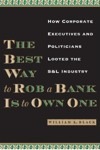
If Bo wants to praise a real regulatory martyr – one who got the finance and regulatory issues correct early enough to prevent an economic crisis, reregulated successfully in the face of virulent, powerful opposition, and who did so despite knowing that it would destroy his career at a point where he was in financial distress the obvious candidate is Ed Gray. As Paul Volcker wrote about Ed Gray in a post-publication blurb for my book, The Best Way to Rob a Bank is to Own One (2005 University of Texas Press):

Bill Black has detailed an alarming story about financial and political corruption….the lessons are as fresh as the morning newspaper. One of those lessons really sticks out: one brave man with a conscience could stand up for us all.

Paul Volcker was Ed Gray’s only pillar of support for his reregulation of the S&L industry. When Gray became Federal Home Loan Bank Board Chairman in 1983 the S&L industry was coming out of the first (interest rate risk) phase of the debacle but descending into an even more severe second phase of accounting control fraud. The National Commission on Financial Institution Reform, Recovery and Enforcement’s 1993 report on the causes of the debacle explained the characteristic failure pattern:

The typical large failure was a stockholder-owned, state-chartered institution in Texas or California where regulation and supervision were most lax…. [It] had grown at an extremely rapid rate, achieving high concentrations of assets in risky ventures…. [E]very accounting trick available was used to make the institution look profitable, safe, and solvent. Evidence of fraud was invariably present as was the ability of the operators to “milk” the organization through high dividends and salaries, bonuses, perks and other means (NCFIRRE 1993: 3-4).

In 1983, the S&L accounting control frauds grew at an average rate of 50%. The Texas state S&L Commissioner was sleeping with prostitutes provided by the second worst control fraud in the nation – Vernon Savings (known as “Vermin” to its federal regulators). The California state commissioner, according to the documents, was secretly in business with the worst control fraud in the nation – Charles Keating’s Lincoln Savings. Texas and California approved over 300 new S&L charters. Most of them were troubled real estate developers with severe conflicts of interest. Many of them were control frauds. The rate of applications for new charters was expanding.

Gray’s predecessor, Richard Pratt (a theoclassical finance professor) led the deregulation of the industry at a time of mass insolvency. He also largely desupervised the industry. He gimmicked the accounting rules to cover up losses and create fictional income. He cut the number of examiners. There were no criminal referrals or prosecutions of senior S&L officials. The industry was completely out of control. A regional bubble in commercial real estate was already growing in 1983.

Gray reregulated and re-supervised the industry. He ended most regulatory accounting abuses. He doubled the number of examiners and supervisors (over the vigorous objection of OPM and OMB). We began targeting the worst control frauds for closure while they were still reporting record profits and minimal losses. We adopted a rule restricting growth aimed at the Achilles’ heel of every Ponzi scheme – the need to grow massively. Gray brought in experienced regulators with a track record of vigor, courage, and professionalism and put them in place in the Dallas (Joe Selby) and San Francisco (Mike Patriarca) because they were the two worst regions. We deliberately burst the Southwest’s commercial real estate bubble.

Gray put in place a system of criminal referrals and made supporting criminal prosecutions a top priority. The agency (and here great credit must also be given to OTS Director Ryan and the Department of Justice and FBI) effort was so successful that over 1000 “priority” felony convictions of senior S&Ls insiders were obtained – the most successful effort in history against elite white-collar criminals.

We almost always resolved serious failures in a manner that wiped out entirely “risk capital” (shareholders and subordinated debt holders). Gray blocked Texas’ and California’s land rush style grants of hundreds of new charters by refusing to approve FSLIC insurance for any new S&Ls in those states. Gray did all this with the certain knowledge (which he often stated to us) that it would end his career. He was in his 50s and he was in financial distress, so he knew the sacrifice he would make would be severe.

Gray took on, simultaneously, the Reagan administration (particularly Don Regan and the OMB), a majority of the members of the House (who co-sponsored a resolution calling on us not to reregulate), House Speaker Jim Wright, five U.S. Senators (the “Keating Five”), the S&L trade association (which some political scientists rated the third most powerful in the U.S., his two fellow Bank Board members, much of the agency (including two of our economists that met secretly with Keating’s lawyers), and most of the media (which sometimes referred to him as “Mr. Ed” – from the TV program about the talking horse). Charles Keating sued him in his personal capacity for $400 million. The administration threatened to prosecute him for closing too many insolvent S&Ls (under the Anti-Deficiency Act). The administration tried to appoint two members chosen by Charles Keating (the most notorious S&L control fraud) to the agency (which would have given them majority control of the three-person Bank Board). (Pause for two minutes and consider how catastrophic it would have been if the administration had succeeded in giving control of the agency to that decade’s most notorious control fraud.) He served as a “mole” for Keating and proposed to amend the direct investment rule (which Lincoln Savings had violated by more than $600 million) that would have had the effect of exempting it from enforcement. Lincoln’s lawyers drafted the amendment (which, of course, never mentioned Lincoln). I blew the whistle on Keating’s mole, which eventually led him to resign. After I blew the whistle (but before he resigned), the administration nominated him for a full term. The day after he resigned four U.S. Senators (the “Keating Five” minus Senator Riegle) met with Gray to pressure him not to take enforcement action against Lincoln’s massive violation of the direct investment rule.

Don Regan tried very hard to force Gray to resign. He refused, so Treasury Secretary Baker met secretly with Speaker Wright (who, at the behest of Texas control frauds, was holding our proposed bill to recapitalize the FSLIC insurance fund hostage in order to prevent us from securing the funds to close more of the control frauds). Baker and Wright reached a cynical deal: the administration would not reappoint Gray to a new term and would not oppose Wright’s demands for “regulatory forbearance” (which included debasing – again – the accounting rules and adopting other measures drafted by attorneys for the control frauds designed to make it far harder to close insolvent S&Ls. Wright agreed that he would support a $15 billion FSLIC recapitalization bill (instead of the $5 billion bill that the industry and control frauds supported. Wright got the better of the deal because his allies spread the word that the Speaker didn’t really support the $15 billion bill and the House voted for the $5 billion bill.

Gray remains unemployed and unemployable today. But he doesn’t have to avoid mirrors.

Unlike Geithner, Paulson, and Bernanke, Gray acted before the epidemic of accounting control fraud produced a bubble so large that it produced a general economic crisis. Consider what would have happened had Gray not reregulated and resupervised the industry beginning in November 1983. The roughly 300 control frauds in 1984 would have grown at 50% annually and scores of new Texas and California frauds would have entered each year. The result would have been a commercial real estate bubble of epic proportions. Such a bubble would have taken down not only the S&L industry, but also the banking industry (which had massive commercial real estate exposure) and would have severely damaged the insurance industry (which provides much of the permanent/takeout financing for commercial real estate). We cannot yet demonstrate when a bubble will collapse, but we know that accounting control fraud epidemics are capable of extending the life of financial bubbles and hyper-inflating them for several years. The direct losses among S&Ls, absent Gray’s reregulation, would have been over a trillion dollars within five years. The losses to banks and insurance companies would have exceeded the S&L losses. Losses of that magnitude would have caused a severe recession.

It also needs to be stressed that subprime and alt-a loans, qualifying loans based on teaser rates, bonuses to loan officers based on volume (not loan quality), inflated appraisals, and accounting control fraud are not new. They always end badly. Mike Patriarca lead the supervisory effort in 1990-92 that prevented a nonprime lending crisis by forbidding lending practices that we have long known end in disaster. He then left federal service and went into business.

You might think that the first two calls Geithner, Paulson, Summers, Rubin, and Bernanke would have made once they finally realized there was a crisis would have been to Ed Gray and Mike Patriarca to see how successful reregulation is accomplished and how one successfully prosecutes the accounting control frauds that drove the current crisis. But, if you think that you probably also think that the one regulator that stood openly in support of Gray’s reregulation of the industry – Paul Volcker – would be President Obama’s primary economic advisor. Instead, Summers, Geithner, and Bernanke have marginalized Volcker. The Bush and Clinton anti-regulatory Wrecking Crews remain in power in the Obama administration despite a dismal record. They are never held accountable. Bo wants them left in power. He wants us to stop criticizing their failures, to apologize to them for our ingratitude, and to honor them for the terrible career sacrifices they have (mythically) made to protect us from harm.

I disagree. I urge us to learn the lessons not simply of regulatory failures but regulatory and prosecutorial successes (the Gray and Ryan years). Mike Patriarca is in his prime. Put him in charge of a major regulatory agency immediately. Paul Volcker is a national treasure that petty, power-hungry failures (yes, I mean Summers) are wasting.

Oh, and Jim Baker, Jim Wright, and John McCain should show some class and apologize for the shoddy treatment they handed out. Let me be clear on this last point – they shouldn’t apologize for the shoddy treatment of Ed Gray the man – they should apologize for the damage they caused our nation when they took their policy advice from major political contributors (that were leading control frauds) and impeded Gray’s substantive reforms that were essential to protecting our citizens.

Bo Cutter’s Indictment of the Finance Industry

By William K. Black

Bo Cutter has presented the best possible defense of Treasury Secretary Geithner.

It is a remarkable defense because it is premised on a scathing indictment of Wall Street, theoclassical economics, modern finance, and the sycophants that the financial community installed as anti-regulators. Indeed, Bo’s account is sometimes particularly credible because it is a confession. Bo was a managing partner of Warburg Pincus, a major global private equity firm and led President Obama’s Office of Management and Budget (OMB) transition team. His defense of Geithner provides so rich a vein of ore that I will mine it in three installments: (1) Bo’s indictment of the finance industry, Greenspan, Geithner, Paulson and Bernanke, (2) the martyrdom of Geithner, and (3) Geithner as Bo’s Last Action Hero.

Bo’s explanation of Geithner’s unique virtues begins the indictment.

It comes down to this: the combination of brains, guts, calmness, and a willingness to act are virtually non-existent in Washington in any era, but particularly in this one. When you find the combination in a significant cabinet level job, you should value it.


“Virtually non-existent … particularly in this [era].” This phrase comes from the head of President Obama’s OMB transition team. Bo, an Obama Democrat, believes that Geithner represents the epitome of Obama appointees. President Obama’s other appointees are far worse than Geithner. That is an extraordinary indictment of the administration.

Bo’s indictment then expands to the financial community:

[T]his crisis was long in coming and it was a totally integrated failure of intellectual traditions, global macro-economic imbalances, government policy making, regulatory supervision, financial sector greed, incomprehensible boards of directors absences without leave, and breath-taking management short-sightedness. No one and no institution put together an understanding of the set of factors that triggered this particular debacle. Tim [Geithner] is included in this “no one”, but so is everyone else.

I think the last two years have revealed the single largest failure of senior management in the financial sector, and of the board system in American history. I think I am correct in saying that there was not a single independent director in America who stood up on this issue. I do not understand why every board of every institution that failed was not asked to resign immediately.

Bo’s indictment is compelling, but his logic proves a deeper failure. There is no reason to restrict his indictment to “the last two years.” The senior managers’ and directors’ failure did not begin with the recession. They failed throughout the expansion of the bubble, the backdating of stock options, after-hours trading, the collapse of the auction rate securities market, the “epidemic” of mortgage fraud by lenders, the massive scandals of the Enron and Worldcom era, and the savings and loan debacle. The financial sector has been in recurrent, intensifying scandals for decades.

Bo’s arguments require us to focus on at least the last four years (even if he continues to ignore the FBI’s 1984 warning that the mortgage fraud “epidemic” would cause a crisis).

In fact, by 2006 and early 2007 everyone thought we were headed to a cliff, but no one knew when or what the triggering mechanism would be. The capital market experts I was listening to all thought the banks were going crazy, and that the terms of major loans being offered by the banks were nuttiness of epic proportions.

By early 2006 – roughly four years ago – “everyone” agreed “we were headed to a cliff” and that the banks’ “major loans” were “nuttiness of epic proportions.” An industry, whose claimed expertise is the sophisticated evaluation of risk and value, universally failed to come remotely close to valuing either. As Bo emphasizes, these were massive errors. These managers got immensely wealthy because – not despite – their willingness to make hundreds of thousands of loans that were certain to crash and burn as soon as the bubble ceased to inflate (which it did in 2006). Bo knows them, and Bo says that every independent (sic) director betrayed their fiduciary duties to shareholders. Every senior officer at the major banks failed. Bo portrays them as incompetents, cowards, and moral failures.

Bo’s indictment of his finance peers is even more severe than his portrayal. White-collar criminologists have shown that the lending pattern he describes (“nuttiness of epic proportions” when “everyone” agrees “we were headed to a cliff”) demonstrates that the lenders are frauds that have produced an epidemic of accounting “control fraud” (where the persons controlling a seemingly legitimate organization use it as a “weapon”). The FBI began publicly warning of an “epidemic” of mortgage fraud in September 2004, with 80% of the losses occurring when lender personnel were involved in the fraud. The number of criminal referrals for mortgage fraud indicates an annual rate of mortgage fraud in the many hundreds of thousands. The recipe for a lender optimizing accounting control fraud is: (A) grow extremely rapidly, (B) make extremely bad loans, (C) have extreme leverage, and (D) provide minimal loss reserves. (The first two ingredients are related. In a mature product like home mortgages the optimal way to grow extremely rapidly while increasing yield is to make loans to individuals that cannot repay the loans. The rapidly expanding bubble allows fraudulent lenders to postpone loss recognition by refinancing the bad loans.) Nonprime specialty lenders followed this recipe. The pattern produces guaranteed, record accounting profits in the short-term. Because a significant number of lenders follow the same strategy the result was a hyper-inflated financial bubble followed by an economic crisis.

The accounting fraud optimization pattern that a lender follows, however, creates two weaknesses that we exploited as S&L regulators during the debacle. The lender must gut its loan underwriting standards and suborn its internal controls. Secured lenders must encourage inflated appraisals. Officers must be disciplined for rejecting bad loans and given bonuses for making bad loans. No honest lender would follow such suicidal practices. Bank examiners can easily, quickly, and precisely identify these perversions of honest, normal underwriting practices. We made closing such lenders our top priority – while they were still reporting record profits and minimal losses. The Best Way to Rob a Bank is to Own One (University of Texas Press 2005). The economists and lawyers thought that this proved we were insane because they were clueless about accounting fraud. The second weakness is that optimizing accounting fraud requires extremely rapid growth. This provided a quick screening device for identifying likely frauds and a means to force their rapid collapse – by restricting their growth. Regulators could have targeted these same weaknesses and contained the ongoing crisis. Instead, despite the FBI’s early warnings about the fraud epidemic, they functioned as anti-regulators. The FBI has put the matter starkly: it is “irresponsible” to purport to explain the crisis without discussing fraud.

Update: See Prof. Black’s selected posts here, here, and here.

“Why is Obama Championing Bush’s Financial Wrecking Crew?”

By William K. Black

“First Published on New Deal 2.0
Tom Frank’s book: The Wrecking Crew explains how the Bush administration destroyed effective government and damaged our social fabric and our economy. The Obama administration has chosen to reward two of the worst leaders of Bush’s crew – Geithner and Bernanke – with promotion and reappointment. Embracing the Wrecking Crew’s most destructive members has further damaged the economy and caused increasing political and moral injury to the administration.

Last week was a bad one for Geithner and Bernanke. Senator Dodd said that Bernanke’s confirmation was no longer a done deal. The House Financial Services Committee revolted against the administration, the Fed, and Chairman Barney Frank. It voted for a strong bill to audit the Fed. Senate Banking Chairman Schumer went to a conference at Columbia University – where a generation of students salivated at the prospects of Wall Street wealth – and was overwhelmed by an audience denouncing the continuing stranglehold of the finance industry over successive administrations and the Congress. Neither Barney’s blarney nor Schumer’s schmooze was any avail before an outraged public.


The administration promptly secured a column in the Washington Post claiming that the effort to fire Geithner “buoy[ed]” him because, as the subtitle to the article explained: “Even ex-Bush aides sympathetic, sources say.” The article didn’t note that Geithner is an “ex-Bush” senior official who, with his fellow “ex-Bush aides” (particularly Bernanke and Paulson) produced a chain of disasters: the bubble, an “epidemic of mortgage fraud” by lenders, the Great Recession, and the scandalous TARP and AIG bailouts. Of course they’re “sympathetic” to a fellow member of the Wrecking Crew that destroyed effective regulation and turned the nation over to Wall Street. The craziest part of the story is that the anonymous Obama administration flack that spread this anecdote believes that we should support Geithner because his fellow members of the Bush Wrecking Crew empathize with him because they too have been criticized for wrecking the economy.

The Washington Post article then offers a metaphor that serves as an apology for the Bush Wrecking Crew. The metaphor is driving over a cliff.

“Secretary Geithner has helped steer the American economy back from the brink, and is now leading the effort on financial reform,” White House spokeswoman Jen Psaki said.

Geithner pushed back against Republicans who questioned his performance, telling them, “you gave this president an economy falling off the cliff.”

“You” – how about “we”? Bush’s financial Wrecking Crew “gave this president an economy falling off the cliff.” Geithner was President of the Federal Reserve Bank of New York from October 23, 2003 until President Obama chose him as his Treasury Secretary. He was supposed to be the lead regulator of many of the largest bank holding companies. His failures as a regulator were a major cause of the “economy falling off the cliff.” Bernanke held prominent positions in the Bush administration from 2002 to the end of the administration and failed as a regulator and as an economist. Geithner and Bernanke failed to regulate even after the FBI publicly warned in September 2004 that (1) there was an “epidemic” of mortgage fraud and (2) it would lead to a financial crisis if it were not contained. Their refusal to take responsibility for the harm they did our nation as leaders of Bush’s financial Wrecking Crew adds to their unsuitability. Rewarding their perennial failures with a promotion and reappointment represents a dereliction of duty by the Obama administration.

The administration apologists praise Geithner and Bernanke for “steer[ing] the American economy back from the brink.” Greenspan, Paulson, Bernanke, and Geithner were the leaders of Bush’s financial Wrecking Crew. They were the guys blinded by their pro Wall Street ideology that drove the car 120 mph down an icy mountain road and lost control of it. They took us to the “brink” of running “off the cliff” and creating the Second Great Depression. The bizarre claim is that we should praise them because they, and Wall Street, only wrecked the economy – they haven’t (yet) utterly destroyed it. Under their metaphor, we’re supposed to cheer Geithner and Bernanke because once they finally figured out that they were careening toward the cliff they decided to sideswipe a row of trees in order to avoid going off the cliff. They wrecked the car but they walked away from the crash without a scratch. If your teenager gets drunk, speeds, crashes into a school bus (injuring dozens of kids), and flips the Ford Focus – but walks away from the crash – you don’t praise him, give him the keys to the family minivan, and have him drive the soccer team to practices. You take all the keys away from him and ground him.

The Obama administration promoted Bush’s architects of the financial disaster and demands that we hail them as heroes. President Bush was ridiculed for saying: “Brownie, you’re doing a heck of a job.” FEMA administrator Michael Brown stood by while Hurricane Katrina reduced a single large city to ruin. Geithner and Bernanke stood by while scores of large cities were devastated.

I suggest that we will build on the momentum we’ve achieved on the Fed audit by making the following issues our near term financial priorities:

1. Fire the senior leaders of Bush’s and Clinton’s financial Wrecking Crews and stop treating them as financial experts. President Obama should not reappoint Bernanke as Fed Chairman. He should dismiss Geithner and Summers and cease to take any advice from Rubin. Replace them with the Reconstruction Crew – people with a track record of getting things right and being effective economists, regulators, and prosecutors. Members of Bush’s financial Wrecking Crew run far too many regulatory agencies, often as “Actings.” They can, and should, be replaced promptly.

2. End “too big to fail.” These banks are “systemically dangerous institutions” (SDIs). They should not be allowed to grow, they should be shrunk to the point that they no longer pose systemic risk, and they should be subject to vigorous regulation while shrinking. They are too big to manage and too big to regulate. They are ticking time bombs that will cause recurrent global crises as long as they are SDIs.

3. Adopt Representative Kaptur’s proposed to provide the FBI with at least 1000 additional white-collar specialists. Senator Durbin and (then) Senator Obama made a similar proposal several years ago.

4. End the perverse executive compensation systems that reward failure and fraud. The private sector has made compensation worse since the crisis. Modern executive compensation creates a virtually perfect crime – “accounting control fraud.” Until we fix the perverse incentives of executive compensation we will have recurrent epidemics of fraud and global financial crises.
5. Kill TARP and PPIP. Use the funds to help honest homeowners that would otherwise lose their homes because of predatory loan terms.

6. Make the Federal Reserve System public. It is a largely private structure that creates intense conflicts of interest and ensures that it is controlled by the systemically dangerous institutions. We have already decided that such a structure is inherently improper. The Federal Home Loan Bank System was set up along the same institutional lines and suffered from the same conflicts of interest. Congress ordered an end to these conflicts in the 1989 FIRREA legislation. It should end private control of the Fed.

7. Defeat any proposal to make the Fed the “Uberregulator.” The Fed, for inherent institutional reasons, is unsuited to be the “systemic risk regulator.” The Fed has never cared about regulation. The Fed cares about monetary policy and (theoclassical) economic theory and research. Regulation is, at best, a tertiary concern. Its economists wrote frequently about systemic risk – but missed the obvious, massive systemic risk of the financial bubble and the epidemic of accounting control fraud. Its policies intensified rather than restricting systemic risk. Theoclassical economists have no effective theories (or policies) to deal with bubbles or epidemics of accounting control fraud. Greenspan, Bernanke, and Geithner epitomize the Fed’s inability to recognize or reduce systemic risk. Their policies consistently increased systemic risk. Greenspan didn’t believe that the Fed should act against fraud. Geithner testified before Congress that he had never been a regulator (a true statement – but one that should have gotten him fired rather than promoted). Bernanke praised the subprime loans that caused the crisis and were so often fraudulent.

8. Sever the Consumer Financial Product Agency portion from the broader (and deeply flawed) regulatory reform bills in the House and Senate and adopt it into law. Revise the broader bill to strip out its many anti-reform provisions.

9. End the waste of long-term unemployment. Anyone able and willing to work should be employed by the government as an employer of last resort and should help repair our crumbling infrastructure. Paying people to do nothing or allowing them to become homeless (the status quo) is an insane system.

10. Adopt a $250 billion revenue sharing program. American state and local governments are in economic crisis. They are slashing spending at the worst possible time when their services are most vital and when cutting spending is pro-cyclical and will delay our recovery from the Great Recession. Revenue sharing was a Republican initiative. Republicans and “Blue Dog” Democrats killed the revenue sharing provisions of the administration’s proposed Stimulus bill. That was an enormous mistake. The federal government is not like a state government (or a household). It is a sovereign government with its own currency and a central bank. It can – and should – run large deficits during deep recessions, but the states and local governments cannot. Revenue sharing is the ideal answer to the crisis and it is an answer with an impeccable conservative pedigree. State and local governments should come together and demand a program to offset the state and local cutbacks – roughly $250 billion. (The Obama administration’s claim that reducing the deficit should be a priority – at a time when unemployment has reached tragic levels – is economically illiterate. It repeats the error that FDR made when he listened to conservative economic advisors and slashed the budget deficit during the Great Depression – causing a surge in unemployment and the extension of the depression. The large federal deficits of World War II reversed the policies of his conservative economic advisors and ended the Great Depression.)

What If the Government Just Prints Money?

By Scott Fullwiler

As Congress gets set in the near future to consider raising the debt ceiling yet again, my fellow blogger L. Randall Wray creatively suggests not raising the debt ceiling but instead having the Treasury continue spending as it always does: by simply crediting bank accounts. As he puts it:

The anti-deficit mania in Washington is getting crazier by the day. So here is what I propose: let’s support Senator Bayh’s proposal to “just say no” to raising the debt ceiling. Once the federal debt reaches $12.1 trillion, the Treasury would be prohibited from selling any more bonds. Treasury would continue to spend by crediting bank accounts of recipients, and reserve accounts of their banks. Banks would offer excess reserves in overnight markets, but would find no takers—hence would have to be content holding reserves and earning whatever rate the Fed wants to pay. But as Chairman Bernanke told Congress, this is no problem because the Fed spends simply by crediting bank accounts.
This would allow Senator Bayh and other deficit warriors to stop worrying about Treasury debt and move on to something important like the loss of millions of jobs.

Memo to Congress: Don’t Increase the Government’s Debt Limit!

By L. Randall Wray

In a piece written for CNN, Senator Evan Bayh rails against the growing federal government budget deficit. He warns that next month the Treasury will ask Congress to raise the debt limit from its current $12.1 trillion, and promises that he will vote “no”. It is time, he argues, for Congress to stand up for our nation’s future by creating a bi-partisan debt commission that would finally put an end to “unsustainable” deficit spending.

The Senator goes on:

When President George W. Bush took office in 2001, our public debt amounted to 33 percent of our economy. Today, it is 60 percent of our gross domestic product. If we do nothing, our debt is projected to swell to over 70 percent by 2019. To put those numbers in perspective: If you divided the debt equally among all Americans, every man, woman and child living in the United States today would owe more than $39,000.

I presume the Senator has got his math correct, but there is a glaring error in his English that can be corrected by substituting an “n” for an “e”: If you divided the debt equally among all Americans, every man, woman and child living in the United States today would own more than $39,000. Government debt is a private asset. You and I do not owe government debt, we own it. Indeed, the only source of net dollar-denominated financial wealth is federal government debt.

The good Senator continues, comparing his proposed debt commission with an earlier successful bi-partisan effort:

There is precedent to create this type of commission with real teeth. President Ronald Reagan created a commission, chaired by Alan Greenspan, to shore up Social Security in the early 1980s.

That commission hiked payroll taxes to transform Social Security from a “pay-as-you-go” system (payroll taxes collected were matched to current year spending) to an “advanced funded” system that accumulated “Trust Fund assets”. In truth the Trust Fund is nothing but an accounting gimmick in which one arm of government (the Treasury) owes another arm of government (Social Security), with workers and their firms saddled with payroll taxes that are a third larger than Social Security spending. Like almost everything else Alan Greenspan did, the Social Security commission was a monumental failure and its actions were completely unnecessary. All Social Security payments can be made as they come due whether the Trust Fund holds Treasury debt or not, and no matter how much “revenue” the payroll tax collects. Like the bowling alley that credits points when pins are knocked down, the Treasury cannot run out of “points” credited to the accounts of pensioners.

The anti-deficit mania in Washington is getting crazier by the day. So here is what I propose: let’s support Senator Bayh’s proposal to “just say no” to raising the debt ceiling. Once the federal debt reaches $12.1 trillion, the Treasury would be prohibited from selling any more bonds. Treasury would continue to spend by crediting bank accounts of recipients, and reserve accounts of their banks. Banks would offer excess reserves in overnight markets, but would find no takers—hence would have to be content holding reserves and earning whatever rate the Fed wants to pay. But as Chairman Bernanke told Congress, this is no problem because the Fed spends simply by crediting bank accounts.

This would allow Senator Bayh and other deficit warriors to stop worrying about Treasury debt and move on to something important like the loss of millions of jobs.

Should America Kowtow to China?

By Marshall Auerback
First Published on New Deal 2.0.

Do the Chinese really fund our deficit? Or is this more Neo-classical money mythology?

Another Presidential junket to Asia and another one of the usual lectures from China, decrying our “profligate ways”. Today’s Wall Street Journal reports:, “China’s top banking regulator issued a sharp critique of U.S. financial management only hours before President Barack Obama commenced his first visit to the Asian giant, highlighting economic and trade tensions that threaten to overshadow the trip.”

According to Liu Mingkang, chairman of the China Banking Regulatory Commission, a weak U.S. dollar and low U.S. interest rates had led to “massive speculation” that was inflating asset bubbles around the world. It has created “unavoidable risks for the recovery of the global economy, especially emerging economies,” Mr. Liu said. The situation is “seriously impacting global asset prices and encouraging speculation in stock and property markets.”

Well, “them’s fightin’ words”, as we say over here. And of course, the President and his advisors are supposed to accept this criticism mildly because in the words of the NY Times, the US has assumed “the role of profligate spender coming to pay his respects to his banker.”

The Times actually does believe this to be true. They refer to China’s role as America’s largest “creditor” as a “stark fact”. They do not seem to understand that simply because a country issuing debt which it creates, it does not depend on bond holders to “fund” anything. Bonds are simply a savings alternative to cash offered by the monetary authorities, as we shall seek to illustrate below.

It is less clear to us whether the Chinese actually believe this guff, or simply articulate it for public consumption. China has made a choice: for a variety of reasons, it has adopted an export-oriented growth strategy, and largely achieved this through closely managing its currency, the remnimbi, against the dollar.

One can query the choice, as many would argue that it is more economically and socially desirable for China to consume its own economic output. According to Professor Bill Mitchell, for example, “once the Chinese citizens rise up and demand more access to their own resources instead of flogging them off to the rest of the world…then the game will be up. They will stop accumulating financial assets in our currencies and we will find it harder to run [current account deficits] against them.”

But there have undoubtedly been certain benefits that have accrued to the Chinese as a consequence of this strategy. The export prices obtained by Chinese manufacturers are about 10 times as high as the prices obtained in the more competitive domestic markets, and the challenge of competing in global markets has forced Chinese manufacturers to adhere to higher quality standards. This, in turn, has improved the overall quality of Chinese products. In the words of James Galbraith:

“Is there a way for the Chinese manufacturing firm to turn a profit? Yes: the alternative to selling on the domestic market is to export. And export prices, even those paid at wholesale, must be multiples of those obtained at home. But the export market, however vast, is not unlimited, and it demands standards of quality that are not easily obtained by neophyte producers and would not ordinarily be demanded by Chinese consumers. Only a small fraction of Chinese firms can actually meet the standards. These standards must be learned and acquired by practice.” (”The Predator State, Ch. 6, “There is no such thing as free trade”, pg. 84).

What about the US government? What should it do? Should it actually respond to China’s complaints by trying to “defend the dollar”?

I hear this recommendation all of the time in the chatterplace of the financial markets, but seldom do those who fret about the dollar’s declining level actually suggest a concrete strategy to achieve the objective. In fact, it is unclear to me that there is any measure the Fed or Treasury could adopt which might support the dollar’s external value.

And why should they? Given the horrendous unemployment data, and 65% capacity utilization, it is hard to view imported inflationary pressures via a weaker dollar actually becoming a serious threat.

But wait? Don’t the Chinese (and other external creditors) “fund” our deficit? And won’t they demand a higher equilibrating interest rate in order to offset the declining value of their Treasury hoard?

Again, this displays a seriously lagging understanding of how much modern money has changed since Nixon changed finance forever by closing the Gold window in 1973. Now that we’re off the gold standard, the Chinese, and other Treasury buyers, do not “fund” anything, contrary to the completely false & misguided scare stories one reads almost daily in the press.

This claim is seldom challenged, but our friend, Warren Mosler, recently gave an excellent illustration of this fact in an interview with Mike Norman. Mosler provides a hypothetical example in which China decides to sell us a billion dollars’ worth of T-shirts. We buy a billion dollars’ worth of T-shirts from China:

“And the way we pay them is somebody pays China. And the money goes into their checking account at the Federal Reserve. Now, it’s called a reserve account because it’s the Federal Reserve, and they give it a fancy name. But it’s a checking account. So we get the T-shirts, and China gets $1 billion in their checking account. And that’s just a data entry. That’s just a one and some zeroes.

Whoever bought them gets a debit. You know, it might have been Disneyland or something. So we debit Disney’s account and then we credit China’s account.

In this situation, we’ve increased our trade deficit by $1 billion. But it’s not an imbalance. China would rather have the money than the T-shirts, or they wouldn’t have sent them. It’s voluntary. We’d rather have the T-shirts than the money, or we wouldn’t have bought them. It’s voluntary. So, when you just look at the numbers and say there’s a trade deficit, and it’s an imbalance, that’s not correct. That’s imbalance. It’s markets. That’s where all market participants are happy. Markets are cleared at that price.

Okay, so now China has two choices with what they can do with the money in their checking account. They could spend it, in which case we wouldn’t have a trade deficit, or they can put it in another account at the Federal Reserve called a Treasury security, which is nothing more than a savings account. You give them money, you get it back with interest. If it’s a bank, you give them money, you get it back with interest. That’s what a savings account is.”

The example here clearly illustrates that bonds are a savings alternative which we offer to the Chinese manufacturer, not something which actually “funds” our government’s spending choices. It demonstrates that rates are exogenously determined by our central bank, not endogenously determined by the Chinese manufacturer who chooses to park his dollars in treasuries (credit demand, by contrast, is endogenous).

Here is how the mechanics actually work: government spending and lending adds reserves to the banking system because when the government spends, it electronically credits bank accounts.

By contrast, government taxing and security sales (i.e. sales of bonds) drain (subtract) reserves from the banking system. So when the government realizes a budget deficit (as is the case today), there is a net reserve add to the banking system, WHICH BRINGS RATES LOWER (not higher). That is, government deficit spending results in net credits to member bank reserves accounts. If these net credits lead to excess reserve positions, overnight interest rates will be bid down by the member banks with excess reserves to the interest rate paid on reserves by the central bank (currently .25% in the case of the US since the Fed started to pay interest on these reserves). If the central bank has a positive target for the overnight lending rate, either the central bank must pay interest on reserves or otherwise provide an interest bearing alternative to non interest bearing reserve accounts. But this is a choice determined by our central bank, not an external creditor.

Yet we are constantly being told by the financial press that the dollar’s weakness was supposed be the factor that would “force” the Fed to raise rates, since the Chinese supposedly “fund” our deficits.

So far, that thesis hasn’t been borne out. And it won’t be, because this isn’t how things operate in a post gold-standard world.

And a second and equally salient point: what would those who fret about the dollar, have the Fed do? Should they raise rates to defend it? It is unclear that this would work. The relationship between a given level of interest rates offered by the central bank and the external value of a currency is tenuous. Consider Japan as Exhibit A. The BOJ has been offering virtually free money for 15 years and yet the yen today remains a strong currency (much to the chagrin of the likes of Toyota or Sony).

Of course, higher rates can have an offsetting beneficial income impact (what Bernanke calls the “fiscal channel”), but it does not follow that a decision to raise rates would actually elevate the value of the dollar (and the benefits of higher rates from an income perspective could just as easily be achieved via lower taxation).

The reality is that private market participants could well view the move as something akin to a panicked response by the Fed, and the decision could well trigger additional capital flight, which could weaken the value of the dollar.

So it is unclear to me what the Tsy or Fed should be doing about the dollar. My view is that this is a private portfolio preference shift and I don’t think central banks should be responding to every vicissitude of changing market preferences. The US government should simply ignore the market chatter and idle threats from the Chinese and do nothing.

When All Else Has Failed, Why Not Try Job Creation?

By L. Randall Wray

The US continues to hemorrhage jobs even as some purport to see “green shoots”. All plausible projections show that unemployment will rise even if our economy begins to grow. Personally, I think those green shoots will die this winter because the stimulus package is far too small and because the financial system is going to crash again. The longer we wait to actually address the unemployment problem, the worse are the prospects for a real recovery.

In his recent piece, Paul Krugman writes:

Just to be clear, I believe that a large enough conventional stimulus would do the trick. But since that doesn’t seem to be in the cards, we need to talk about cheaper alternatives that address the job problem directly. Should we introduce an employment tax credit, like the one proposed by the Economic Policy Institute? Should we introduce the German- style job-sharing subsidy proposed by the Center for Economic Policy Research? Both are worthy of consideration.

The point is that we need to start doing something more than, and different from, what we’re already doing. And the experience of other countries suggests that it’s time for a policy that explicitly and directly targets job creation.


As Krugman reports, Germany has avoided massive job losses by subsidizing firms that retain workers but reduce hours worked. The EPI’s proposal follows a similar strategy. This is fine so far as it goes—in a sense it allows workers, firms, and government to share the burden of reduced output and thus reduced work hours required. That is more equitable but in my view it is not a path toward recovery. While I do agree with Krugman that greater aggregate demand stimulus is required, there is no reason to believe that would provide a sufficient supply of jobs for all who want to work.

The final sentence in the Krugman post makes far more sense: let’s create MORE jobs, MORE work hours, and MORE payroll. A new, New Deal program with a permanent and universal job guarantee that will supply as many jobs as there are job seekers. Not only will this provide jobs in the New Deal style program, but it will also save jobs and increase work hours in the rest of the economy. Why go for second or third best when the best option is available?

Winston Churchill remarked “The Americans will always do the right thing………. after they`ve exhausted all the alternatives”. Direct job creation is the right way to put the economy onto a sustainable path to recovery.

For discussion and ideas on direct job creation and full employment, go here; here; here; and here.

One To Watch

By Stephanie Kelton

So far, President Obama has shown little understanding of our domestic monetary system. His pledge to cut the deficit in half by the end of his first term, together with his assertion that the federal government is “out of money”, reveal deep flaws in his understanding of key issues related to the workings of government finance. Unless he masters the basics of double-entry bookkeeping — and fast — the nation’s job numbers will remain grim, social unrest will mount, and every one of his political challengers will adopt the same battle cry in 2012: “President Obama mishandled the economy — Vote for me if you want a better tomorrow.”

Almost none of them will have a better understanding of the issues than our current president, but one candidate will, and his name is Warren Mosler. I ran across this interview yesterday and thought it was worth sharing. He is one to watch.

Prof. William K. Black on the Financial Crisis in the United States

Our own Prof. William K. Black delivered a presentation at the Corruption Forum 2009-University of Calgary.


See also the videos below.