What Do You Want For America

By Thornton Parker

People who understand how this country’s financial system works know the American dream doesn’t have to die.  They know why the federal budget is not like a family’s budget or the budgets of companies and states.  They know why the government can’t run out of money, default, or go bankrupt; and why Europe’s financial troubles won’t come here.  They know the government can afford to do more to help educate young people, improve everyone’s health, provide income assistance as people age, foster a sound economy with good jobs, modernize the infrastructure, and protect the environment.  And they also know that popular myths and deliberate misrepresentations of the system are hurting America.  Continue reading

The Growing Pain in Spain

By Marshall Auerback

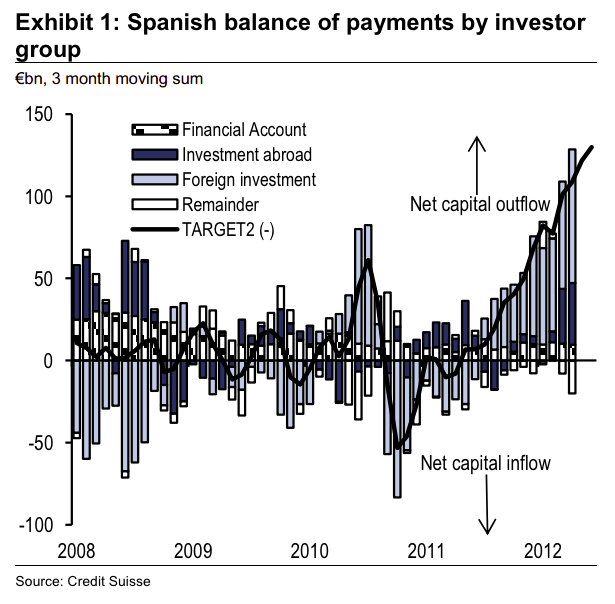
Just when you think that things can get no worse in Spain, they do. Take a look at this chart, courtesy of Credit Suisse via FT’s Alphaville

http://ftalphaville.ft.com/blog/2012/07/11/1080121/just-another-scary-spanish-capital-flight-chart/#comments

Yiagos Alexopoulos at Credit Suisse estimates that Spanish capital outflows are currently running at an annualised rate of 50 per cent of GDP. No question, the bank run is clearly accelerating, and one can easily understand why. The country is turning into a Little House of Economic Horrors. The alleged “rescue” of Madrid’s banks is a non-starter. 100 billion euros won’t begin to cover the scale of the problem on any honest accounting or “stress test” (and that’s before we get to the next phase of announced austerity measures). Continue reading

What’s The Plan?

By Dan Kervick

The politicians always seem to be the last people to get it.   But anyone who actually works in the corporate world knows that the central economic concern these days, the thing that is holding us all back economically, is not uncertainty about tax rates.  They also know the core problem is not frustration with regulation and red tape.  Nor is the problem an epidemic of nocturnal terrors about government deficits.   The problem is this: not enough customers.  And the problem of not enough customers right now is exacerbated by the fact that there is also low confidence that there will be more customers in the foreseeable future.   With low confidence that broad prosperity will return to customers, the willingness to invest and hire aggressively is limited.  And since so many businesses perceive the world the same way, the combined effect of their general unwillingness to hire is persistent high unemployment, and a self-reinforcing perpetuation of the low demand that is the cause of the unwillingness to hire in the first place.

Continue reading

A Guide to the Deficit Aviary

By Rose Cahalan
(Cross-posted from Alcalde)

UT professor James Galbraith is drawing attention for his unconventional position on the U.S. deficit. Galbraith and his fellow “deficit owls” stand apart from the better-known deficit hawks and deficit doves. Hawks think we should act now to reduce the deficit; doves think we should act later. Owls, by contrast, think the deficit isn’t a problem, now or later; it’s just a natural part of growth. Continue reading

A Public Policy School Professor Glorifies Lies, Murder, and Crony Capitalism

By William K. Black

“When plunder becomes a way of life for a group of men living together in society, they create for themselves in the course of time a legal system that authorizes it and a moral code that glorifies it.” ~ Frederic Bastiat

Up with Chris Hayes is a remarkable show in which Chris Hayes and his guests have a two-hour discussion on a handful of issues.  This allows in-depth discussions instead of sound bites.  On Saturday, July 7, 2012, Hayes framed a discussion of Libor (London Inter-Bank Offered Rate).  The segment was prompted by Barclays’ settlement with U.S. and UK authorities of claims based on the banks’ submitting false data to the British Bankers trade association so that they would announce manipulated Libor rates.  Hayes used two similes for Libor to try to explain the fraud to an U.S. audience.  He said it would be as if the gauge on the gas pump was tampered with by the seller so that he could over charge consumers.  Let me add a few facts from my perspective as a white-collar criminologist.  This is a very old problem.  The bible and Talmud contain injunctions designed to forbid fraud in weights and measures.  Those religious provisions are supplemented now with state inspections of gasoline pump meters.  One common, sophisticated way that gasoline sellers continue to defraud their customers is a twist on something the ancient texts understood millennia ago – the actual quantity of fluids that are sold by volume is determined by their weight, not their volume.  The ancients forbade pouring wine from a significant height because the admixture with air allowed the merchant to fill a glass with only two-thirds of a glass of frothy wine.  A modern variant leads gasoline stations to sell their product without adjusting the fuel gages to reflect the actual (higher) temperature of the gasoline in their tanks.  The higher temperature expands the fuel’s volume but not its weight or energy content.  In the trade, this is known as “hot gas” or “hot fuel.”  Continue reading

A Communication from Your Central Bank

By Dan Kervick

Nick Rowe recently argued that there can be certain types of products for which the market might allow multiple equilibria.  This can happen because the willingness of an individual to buy some product might depend on how many other people buy that product.  The upshot, Rowe suggests, is an unusual, non-functional shape to the demand curve characterizing the market for the product in question, resulting in two distinct equilibrium demand quantities corresponding to the same price.

Continue reading

Denison Volunteer Dollars: The Currency of Civic Engagement

The BBC as Apologist for Lying about Libor

By William K. Black

The right has a reservoir of writers who can be relied on to defend and even praise elite white-collar criminals, but the center has managed to produce eager apologists for lies.  This column discusses the BBC’s Business Editor, Robert Preston.  The title of his article emphasizes his view that it is exceptionally difficult to know whether the banks’ lying about Libor was desirable: “The elusive truth about Barclays’ lie.”  Preston frames the question in a fashion that favors finding Barclays’ lies desirable.

“Aside from the forensic analysis about who said what to whom, there is a very simple question at the heart of the furore of Barclays’ involvement in the LIBOR-rigging scandal: is it ever acceptable to lie?” Continue reading

MMT, The Euro and The Greatest Prediction of the Last 20 Years

By L. Randall Wray

Lest you think NEP is tooting its own hyperbolic horn a bit too much, I borrowed the title of this post from a 2011 piece written by someone who is currently hostile to MMT even though he acknowledges its predictive accuracy. Continue reading

Paul De Grauwe is Right: All Roads Lead Back to the ECB

By Marshall Auerback

We’ve always been a fan of Professor Paul De Grauwe from University of Leuven, who has consistently pointed out the structural flaws inherent in the original structures of the EU. Recently, Professor de Grauwe wrote an excellent analysis explaining why the latest “rescue plan” cobbled together by the Eurozone authorities is destined to fail.

The key points:

1) ECB is not currently a ‘lender of last resort’. The ECB was set up with fundamental flaws, where “… one of the ECB’s main concerns is the defense of its balance sheet quality. That is, a concern about avoiding losses and showing positive equity- even if that leads to financial instability.” This is a profoundly misconceived idea. As we have noted many times, a private bank needs capital – clearly because there are prudential regulations requiring that – but because it can become insolvent. It has not currency-issuing capacity in its own right. While the ECB has an elaborate formula for determining how capital is from the national member banks at an intrinsic level, it has no need for capital. It could operate forever with a balance sheet that if held by a private bank would signal insolvency. There are no comparable concepts for a currency issuer and a currency user in terms of solvency. The latter is always at risk of insolvency the former never, so the ECB’s focus on profitability is not only misguided, but leading to inadequate policy responses.

2) The creation of the European Financial Stability Facility (EFSF) and the ESM has been motivated by the overriding concern of the ECB to protect its balance sheet and to avoid engaging in “fiscal policy”. The problem again goes back to the creation of the euro: no supranational fiscal authority to go with a supranational central bank, which means that the only entity that can conceivably carry out “fiscal transfers” of the sort exemplified by a bond buying operation is the ECB. Sure, the actual fiscal transfers can be ‘subcontracted” to the EFSF and ultimately the ESM, but it can only work if the latter’s balance sheet is linked to the ECB’s, giving it the same unlimited capacity to buy up the bonds and thereby deal with the insolvency issue. As things stand now, per de Grauwe: “The enlarged responsibilities that are now given to the ESM are to be seen as a cover-up of the failure of the ECB to take up its responsibility of the guardian of financial stability in the Eurozone; a responsibility that only the ECB can fulfill”.

3)   Related to this problem is the fact that the ESM has been given only finite resources as per Germany’s stipulation the minute it begins. It is capitalised at 500bn euros. And it’s unclear that Germany can go much further, given that there are currently 3 constitutional challenges which the ESM is now facing within Germany’s courts. This will delay ratification of the vote taken last week by Germany’s parliament to ratify the ESM’s existence, as well as limiting its firepower going forward. The ESM’s “bazooka” is in effect a pop-gun. Consequently, as de Grauwe argues, “Investors will start forecasting the moment when the ESM will run out of cash. They will then do what one expects from clever people. They will sell bonds now rather than later.”

As is clear from every FX crisis in the past, “A central bank that pegs the exchange rate and has a finite stock of international reserves to defend its currency against speculative attacks faces the same problem. At some point, the stock of reserves is depleted and the central bank has to stop defending the currency. Speculators do not wait for that moment to happen. They set in motion their speculative sales of the currency much before the moment of depletion, triggering a self-fulfilling crisis. “

Until Europe’s authorities have this figured out, the crisis will continue. All roads lead back to the ECB.