By Jonathan Denn
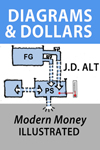
This demonstration will work well in the classroom or barroom. There are five levels, the first is designed for someone who knows nothing about sector balances, each level adds a new variable and complexity. Continue reading
By Jonathan Denn
This demonstration will work well in the classroom or barroom. There are five levels, the first is designed for someone who knows nothing about sector balances, each level adds a new variable and complexity. Continue reading
By Dale Pierce
III. Taxing and Spending
MMT 101
The state’s money is a good store of value and a reliable medium of exchange because absolutely everybody needs at least a little of it. Even off-the-grid survivalists and doomsday preppers need it. Because when they pay for their hollow-point ammunition at Dick’s, or for their freeze-dried mashed potatoes at Costco, they not only pay for the goods – they also pay the sales tax. Now, Dick’s and Costco only take dollars or dollar-denominated credit anyway, but what makes the state’s money valuable is that every company has to collect the tax piece in dollars and cents – and pay dollars to the government at the close of each week or month or other accounting period. Between sales taxes, property taxes, income taxes and all other taxes, everyone knows that there will be a stable, long-term demand for the currency which the state alone can issue. If this currency is reasonably well-managed by the country’s monetary authorities, it will remain everyone’s preferred legal tender – unless a person really is a survivalist or some other kind of crank. Continue reading
Neil Irwin at Wonkblog has a new post up: The Deficit is Falling Fast. Can Washington Accept Victory?
He quotes John Makin of the American Enterprise Institute, who says, approvingly, that the U.S. has probably imposed enough austerity “for now.” Then he shows us the evidence. Continue reading
By Dale Pierce
II. The Science of Government
Backlash
The wave of capitalist triumphalism that spread around the world from the 1980s on was, and remains, a very complex social, political and economic phenomenon. Future historians, if there are any, will marvel at the suddenness of its rise and the completeness of its victory. Margaret Thatcher and Ronald Reagan seemed to come out of nowhere. Working class Tories and Reagan Democrats rose up in their millions – to vote against the very parties and ideas that had made them prosperous. And which had also made it possible for many of them to send their kids to college for the very first time. The kids themselves graduated into an economy plagued by inflation and full of uncertainties and unknowable quantities that everyone, everywhere seemed determined to blame on some English guy named John Maynard Keynes. Him and his Welfare State. And all that reckless deficit spending. And all those high taxes. Who wanted to be for things like Welfare and taxes? So, a lot of those kids went ahead and took the logical next step and became Young Republicans. Continue reading
By Dale Pierce
Chapter One
Introduction
This is Chapter One of a three-part overview of a body of economic thought known popularly as “Modern Monetary Theory” or “MMT”. The aim of this chapter is to explain the basic dynamics of our present-day “fiat-money” economy through the dual lenses of government spending and taxation. We will also explore some contested history, and examine some of the ways we need to think about money differently, now that the United States, along with the rest of the world, has gone off any version of a gold standard. The intent is to be as non-technical as possible, but some parts of the subject are, unavoidably, a little complex. In these areas, keeping the logic as step-by-step as possible will be the goal. In Chapter Two we will look at the ways money systems sometimes go haywire, through either inflationary malfunctions or through the (thankfully) less-familiar phenomenon called deflation, including “debt deflation”. Chapter Three will be about Jobs, Jobs, Jobs. Continue reading
The latest in the MMPP Seminars at Columbia feature NEP’s Scott Fullwiler. The topic of this seminar is Interactions Between Monetary and Fiscal Policy. You can watch below or visit MMPP’s site.
Posted in Scott Fullwiler
Tagged MMT, Modern Monetary Theory, Modern Money and Public Purpose
By William K. Black
(Cross posted from Benzinga.com)
Robert Reich has written a column entitled “Why this is the Worst Recovery on Record.” It’s an odd title because the article makes no reference to this being “the worst recovery on record.” Unlike a newspaper column, we know that Reich chose the title, because it comes from his own blog.
The current U.S. recovery is not “the worst recovery on record” – it is not faintly close to the worst recovery on record. Rhetorical claims like this are dependent on highly selective choices of what years one compares. In 1937 and 1938, President Roosevelt listened to the incoherent claims of his economic advisors that stimulus was bankrupting the Nation and that it had spurred a sufficiently robust recovery that the private sector could now be relied upon to lead the Nation promptly back to prosperity. The advisors recommended that FDR act urgently to impose austerity. FDR cut spending and increased taxes and the Federal Reserve tightened the monetary supply. The result was that a robust recovery from the Great Depression that reduced unemployment by two-thirds during FDR’s first term from a high of 25%. Real GDP growth averaged 12% during that term. Continue reading
Deficit spending by the government is merely the counterpart of private sector saving. What government deficit spending does is to permit the private sector to achieve its level of desired saving. When the latter changes, government spending ought to be adjusting in the opposite direction to offset it (unless the current account balance happens to do the job).
This very simple statement by Marshall Auerback reflects the Sector Financial Balances (SFB) Model I discussed in “A Plague On All Your Budgets.” The Sector Financial Balances Model:
Domestic Private Balance + Domestic Government Balance + Foreign Balance = 0; Continue reading
Barry Eichengreen’s and Tim Hatton’s January 1988 paper entitled “Interwar Unemployment in International Perspective” is a useful starting point for any effort to compare unemployment during the Great Depression and the Great Recession.
It is useful to begin by recognizing three related cautions that the authors make in that paper. First, the modern sense of the term “unemployment” (willing and able to work, but unable to find a job commensurate with the worker’s skills) was not common until the decades before the Great Depression. The prior assumption was that people were unemployed because they were lazy. There was little understanding of business cycles or inadequate demand, little sympathy for the unemployed, and no sense that business or government were primarily responsible for the the level of unemployment. This meant that keeping data on unemployment was rarely a concern of government. Data on unemployment in Europe was largely collected through industrial trade unions.
Posted in William K. Black
Tagged austerity, Eurozone, MMT, Modern Monetary Theory, unemployment
I thought readers might enjoy taking a peek back in time to 1999, to a conference organized at the New School by Stephanie Bell (Kelton), Mat Forstater and Edward Nell. This was pre-UMKC, just before we made the big move. The Center for Full Employment and Price Stabililty was housed at the Levy Economics Institute and Ms. Bell was pursuing a PhD. I’m including the conference program, my outline, and my notes for presentation. Note that the conference was organized around Charles Goodhart’s presentation, based on his deservedly famous article, “The Two Concepts of Money”, published in the European Journal of Political Economy in 1998. Hence in my presentation, I adopt his taxonomy of approaches to money as the “M form” (metalist or monetarist) and the “C form” (cartalist or chartalist or state money). You will see that it’s all there–the basics of what became MMT: state money of account, taxes drive money, endogenous (private) money, and labor bufferstock to stabilize prices.