Professor L. Randall Wray responds to a question:

Question: I heard a news report that the US Government is issuing bonds to finance its budget deficit, and that this will drive up interest rates and might even threaten government solvency. Also I have heard that the US Government has to rely on China to finance our deficit. Isn’t that why the stock and bond markets are bearish?

Answer: This news report reflects two related misunderstandings: first, that government “funds” its deficit by borrowing; second that a large deficit threatens government with insolvency. Let me first deal with those fallacies, then move on to what is happening in markets.

Government spends by crediting bank accounts (bank deposits go up, and their reserves are credited by the Fed). All else equal, this generates excess reserves that are offered in the overnight interbank lending market (fed funds in the US) putting downward pressure on overnight rates. Let me repeat that: government spending pushes interest rates down. When they fall below the target, the Fed sells bonds to drain the excess reserves—pushing the overnight rate back to the target. Continuous budget deficits lead to continuous open market sales, causing the NY Fed to call on the Treasury to soak up reserves through new issues of bonds. The purpose of bond sales by the Fed or Treasury is to substitute interest-earning bonds for undesired reserves—to allow the Fed to hit its interest rate target. (In the old days, these reserves earned no interest; Chairman Bernanke has changed that, effectively eliminating the difference between very short-term Treasuries and bank reserves. It also entirely eliminates the need to issue Treasuries—but that is a topic for another day.) We conclude: government deficits do not exert upward pressure on interest rates—quite the contrary, they put downward pressure that is relieved through bond sales.

On to the question of insolvency. Let me state the conclusion first: a sovereign government that issues its own floating rate currency can never become insolvent in its own currency. (While such a currency is often called “fiat”, that is somewhat misleading for reasons I won’t discuss here—I prefer the term “sovereign currency”.) The US Treasury can always make all payments as they come due—whether it is for spending on goods and services, for social spending, or to meet interest payments on its debt. While analogies to household budgets are often made, these are completely erroneous. I do not know any households that can issue Treasury coins or Federal Reserve Notes (I suppose some try occasionally, but that is dangerously illegal counterfeiting). To be sure, government does not really spend by direct issues of coined nickels. Rather, it spends by crediting bank accounts. It taxes by debiting them. When its credits to bank accounts exceeds its debits to them, we call that a budget deficit. The accounting and operating procedures adopted by the Treasury, the Fed, special deposit banks, and regular banks are complex, but they do not change the principle: government spending is accomplished by crediting bank accounts. Government spending can be too big (beyond full employment), it can misdirect resources, and it can be wasteful or undesirable, but it cannot lead to insolvency.

Constraining government spending by imposing budgets is certainly desirable. We want to know in advance what the government is planning to do, and we want to hold it accountable; a budget is one lever of control. At this point, it is impossible to know how much additional government spending will be required to get us out of this deep recession. Whether the Obama team finally settles on $850 billion worth of useful projects, or $1.5 trillion, voters have the right to expect that the spending is well-planned and that the projects are well-executed. But the budgets ought to be set with regard to results desired and competencies to execute plans—not out of some pre-conceived notion of what is “affordable”. Our federal government can afford anything that is for sale in terms of its own currency. The trick is to ensure that it spends enough to produce sustainable growth and other desired outcomes while at the same time ensuring that its spending does not have undesirable outcomes such as fueling inflation or taking away resources that could be put to better use by the private sector.

Why do stock markets and bond markets react the way they do, given that insolvency is out of the question? Sophisticated market players do recognize that government cannot go insolvent and that government will always make all interest payments as they come due. Markets are, however, concerned that all the government spending plus the Fed bail-outs (lending reserves and buying bad assets) will be inflationary. In the current environment, that is quite unlikely. Even if oil prices stabilize at a higher level, that will not compensate for all the deflationary pressures around the world as firms cut prices to maintain sales in the face of plummeting demand. Still, it is not really inflation that bond markets are worried about, but rather future Fed interest rate hikes. (Again, that will not happen in the near future, and might not happen for several years—but there is little doubt that the Fed will eventually raise rates when the economy finally recovers.) Rate hikes lead to capital losses on longer-maturity bonds (interest rates and bond prices always move in the opposite direction). The Treasury persists in issuing bonds with a range of maturities (although the maturity structure in recent years has shortened). This is evidence that the Treasury does not fully understand the purpose of bond sales (since bonds are simply an alternative to bank reserves, it makes most sense to offer only overnight bonds)—but, again, that is a topic for another day.

The Treasury is having some trouble selling the longer maturity bonds (so their price is low and their interest rate is high). China is probably playing a role in this because they are shunning longer maturity debt out of fear of capital losses; they have also shifted some of their portfolio to other currencies (partly to diversify so that they will not lose if the dollar depreciates, and perhaps to pressure US authorities to keep the dollar strong). The solution is that the Treasury should shift even more strongly to shorter maturities—something it will do even if it does not fully understand why it should: Treasury sees that short term interest rates are much lower, hence, will sell short term debt to reduce the “cost of funding the deficit”. If Treasury really understood what it was doing, it would simply offer overnight deposits at the Fed, paying the Fed’s target interest rate. Then it would not “need” to sell bonds at all, and we could stop worrying about government “borrowing from the Chinese”. If the Fed wanted to control interest rates of longer term debt, it can offer interest on deposits of different maturities—for example, it can offer an overnight rate, a 30 day rate, a 90 day rate, and so on, for deposits held at the Fed.

Don’t Fear the Rise in the Fed’s Reserve Balances

By Scott Fullwiler

Many in the financial press have noted the rise since September 2008 in the Fed’s reserve balances from about $20 billion to more than $800 billion today. A number of well-known economists have expressed concern that this will be inflationary.

However, fears that these are inflationary are misplaced, even inapplicable, as they apply only to a monetary system operating under a gold standard, currency board, or similar arrangement, not the flexible exchange rate system of the U. S.

Under a gold standard, for instance, banks must be careful when creating loans that they have sufficient gold or central bank reserves to meet depositor outflows or legal reserve requirements. This is the fractional banking, money multiplier system standard in the economics textbooks. If there is an inflow of gold, then bank deposit creation can increase and prices can rise. The same can occur if the central bank raises the quantity of reserves circulating relative to its own gold reserves.

Continue reading

Will the Run-Up in Government Debt Doom Us All?

By Stephanie Kelton

Arthur Laffer has taken aim at Chairman Bernanke and President Obama, warning that somewhere down the road their policies will exact a huge price on the American economy. With respect to the Chairman’s handling of monetary policy, Mr. Laffer predicts “rapidly rising prices and much, much higher interest rates.” I am not going to critique Laffer on this point, because Paul Krugman and Mark Thoma have already done so in fine form.

Instead, I want to address Mr. Laffer’s fiscal concerns. He said:

“Here we stand more than a year into a grave economic crisis with a projected budget deficit of 13% of GDP. . . With U.S. GDP and federal tax receipts at about $14 trillion and $2.4 trillion respectively, such a debt all but guarantees higher interest rates, massive tax increases, and partial default on government promises.”

I believe that he is wrong on each of the above points, and here is why:

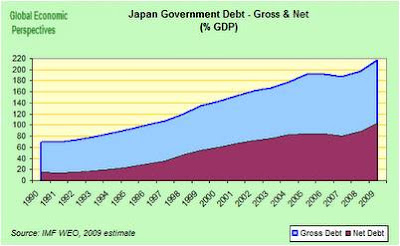
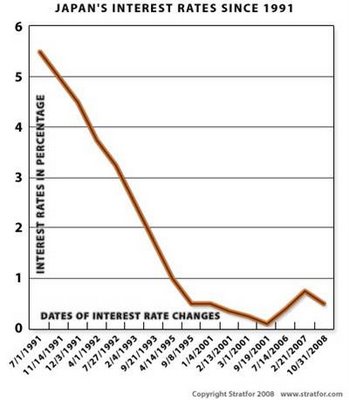
1. Increases in the federal deficit tend to decrease, rather than increase, interest rates. This is because deficit spending leads to a net injection of reserves into the banking system. (And big deficits imply big injections of reserves.) When the banking system is flush with reserves, the price of those reserves – in the U.S. the federal funds rate – is driven to zero (yes, zero!). Unless a zero-bid is consistent with Fed policy, the central bank will begin selling bonds in order to drain excess reserves. The bond sales continue until the fed funds rate falls within the Fed’s target band. The Federal Reserve sets the key interest rate in the U.S., and it can always hit any nominal interest rate it chooses, regardless of the size of the budget deficit (or debt). And this isn’t just true of the Fed. Just look at the Japanese experience:

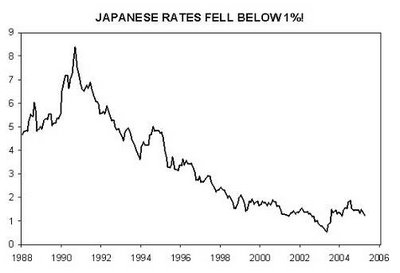
Thus, despite a debt-to-GDP ratio in excess of 200%, the Bank of Japan never lost the ability to set the key overnight interest rate, which has remained below 1% for about a decade. And, the debt didn’t drive long-term rates higher either. The chart below shows that rates on 10-yr government bonds trended sharply downward as Japan’s public sector debt exploded:

Laffer’s prediction about what will happen to U.S. interest rates as a consequence of the Obama stimulus package are based on a faulty understanding of the relationship between deficit spending, bank reserves and interest rates. The Japanese experience serves as prime example of his flawed logic. (My fellow bloggers, Scott Fullwiler, Randy Wray and I have all published numerous articles that lay out the technical details surrounding the coordination of Treasury Fed operations and the management of U.S. interest rates.)

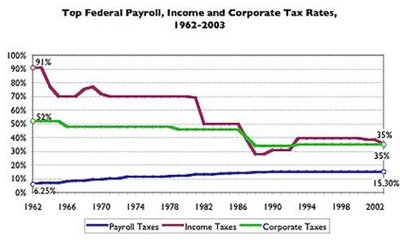
2. Increases in the federal deficit (and the subsequent run-up in outstanding debt) do not mandate higher taxes in the future. Taxes do not “pay for” the deficits we ran in the past. Taxes drain reserves (an important function) and constrain aggregate demand. Tax revenue obviously moves endogenously, with the business cycle, but revenues can also change as a matter of policy. What Mr. Laffer is apparently arguing is that today’s deficits will require “tomorrow’s” leaders to raise marginal tax rates (or impose new taxes). But this isn’t the U.S. experience.

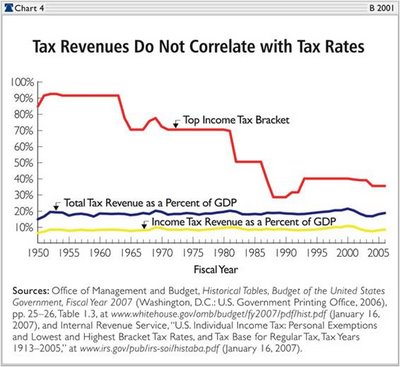
Corporate taxes, as well as taxes on the wealthiest Americans, have trended downward for decades, even as the U.S. debt quadrupled in size.

And, while payroll taxes have risen steadily over the past 40 years, tax revenues, as a percentage of GDP have hardly budged in more than 50 years.

Thus, Laffer’s assertion that the current run-up in government debt will require “massive tax increases” isn’t borne out by our experience. And, it wasn’t the case in Japan either:

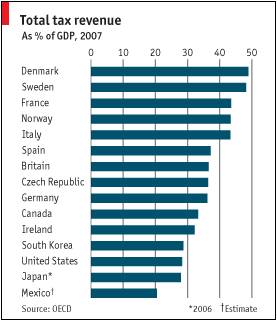
Despite an explosive increase in the government debt in both the U.S. (throughout the 1980s and again under George W. Bush) and Japan (especially in the late 1990s and early 2000s), taxes in both countries are among the lowest in the developed world.

3. Laffer contends that a “partial default on government promises” is an inevitable consequence of the Obama administration’s “ill-conceived” fiscal policies. A statement like this is at best misleading and at worst intellectually dishonest.

As any serious macro economist knows, a government like the United States – i.e. one that controls its own currency – can meet any and all outstanding financial obligations, provided the debts are denominated in the national currency. This is a point that Alan Greenspan made several years ago, when he wrote that “the U.S. government, by virtue of its ability to create money, can never become insolvent with respect to obligations in its own currency.”

Fiscal Sustainability

James K. Galbraith (via Julie Kosterlitz) on “What Is Fiscally — And Politically — ‘Sustainable’?”

James K. Galbraith, Professor of Economics, University of Texas

“Chairman Bernanke may, if he likes, try to define “fiscal sustainability” as a stable ratio of public debt to GDP. But this is, of course, nonsense. It is Ben Bernanke as Humpty-Dumpty, straight from Lewis Carroll, announcing that words mean whatever he chooses them to mean.

Now, we may admit that the power of the Chairman of the Board of Governors of the Federal Reserve System is very great. But would someone please point out to me, the section of the Federal Reserve Act, wherein that functionary is empowered to define phrases just as he likes?

A stable ratio of federal debt to GDP may or may not be the right policy objective. But it is neither more nor less “sustainable,” under different economic conditions, than a rising or a falling ratio.

In World War II, from 1940 through 1945, the ratio of US federal debt to GDP rose to about 125 percent. Was this unsustainable? Evidently not. The country won the war, and went on to 30 years of prosperity, during which the debt/GDP ratio gradually fell. Then, beginning in the early 1980s, the ratio started rising again, peaked around 1993, and fell once more.

Thus, a stable ratio of debt to GDP is not a normal feature of modern history. Gradual drift in one direction or the other is normal. There seems no great reason to fear drift in one direction or the other, so long as it is appropriate to the underlying economic conditions.

History has a second lesson. In a crisis, the ratio of public debt to GDP must rise. Why? Because a crisis – and this really is by definition – is a national emergency, and national emergencies demand government action. That was true of the Great Depression, true of war, and true of the Great Crisis we’re now in. Moreover, we’ve designed the system to do much of this work automatically. As income falls and unemployment rises, we have an automatic system of progressive taxation and relief, which generates large budget deficits and rising deficits. Hooray! This is precisely what puts dollars in the pockets of households and private businesses, and stabilizes the economy. Then, when the private economy recovers, the same mechanisms go to work in the opposite direction.

For this reason, a sharp rise in the ratio of debt to GDP, reflecting the strong fiscal response to the crisis, was necessary, desirable, and a good thing. It is not a hidden evil. It is not a secret shame, or even an embarrassment. It does not need to be reversed in the near or even the medium term. If and as the private economy recovers, the ratio will begin again to drift down. And if the private economy does not recover, we will have much bigger problems to worry about, than the debt-to-GDP ratio.

It is therefore a big mistake to argue that the next thing the administration and Congress should do, is focus on stabilizing the debt-to-GDP ratio or bringing it back to some “desired” value. Instead, the ratio should go to whatever value is consistent with a policy of economic recovery and a return to high employment. The primary test of the policy is not what happens to the debt ratio, but what happens to the economy.

*****

Now, what about those frightening budget projections? My friend Bob Reischauer has a scary scenario, in which a very high public-debt-to-GDP ratio leaves the US vulnerable to “pressure from foreign creditors” – a euphemism, one presumes, for the very scary Chinese. Under that pressure, interest rates rise, and interest payments crowd out other spending, forcing draconian cuts down the line. To avert this, Bob has persuaded himself that social spending cuts are required now, not less draconian but implemented gradually. Thus the frog should be cooked bit by bit, to avoid an unpleasant scene later on when the water is really boiling hot.

With due respect, Bob’s argument displays a very vague view of monetary operations and the determination of interest rates. The reality is in front of our noses: Ben Bernanke sets whatever short term interest rate he likes. And Treasury can and does issue whatever short-term securities it likes at a rate pretty close to Bernanke’s fed funds rate. If the Treasury doesn’t like the long term rate, it doesn’t need to issue long-term securities: it can always fund itself at very close to whatever short rate Ben Bernanke chooses to set.

The Chinese can do nothing about this. If they choose not to renew their T-bills as they mature, what does the Federal Reserve do? It debits the securities account, and credits the reserve account! This is like moving funds from a savings account to a checking account. Pretty soon, a Beijing bureaucrat will have to answer why he isn’t earning the tiny bit of extra interest available on the T-bills. End of story.

The only thing the scary foreign creditors can do, if they really do not like the returns available from the US, is sell their dollar assets for some other currency. This will cause a decline in the dollar, some rise in US inflation, and an improvement in our exports. (It will also cause shrieks of pain from European exporters, who will urge their central bank to buy the dollars that the foreigners choose to sell.) The rise in inflation will bring up nominal GDP relative to the debt, and lower the debt-to-GDP ratio. Thus, the crowding-out scenario Bob sketches will not occur.

I’m not particularly in favor of this outcome. But unlike Bob Reischauer’s scenario, this one could possibly occur. If it did, it would lower real living standards across the board. This is unpleasant, but it would be much fairer than focusing preemptive cuts on the low-income and vulnerable elderly, as those who keep talking about Social Security and Medicare would do.

****

Now, it is true, of course, that you can run a model in which some part of the budget – say, health care – is projected to grow more rapidly than GDP for, say, 50 years, thus blowing itself up to some fantastic proportion of total income and blowing the public finances to smithereens. But this ignores Stein’s Law, which states that when a trend cannot continue it will stop, and Galbraith’s Corollary, which states that when something is impossible, it will not happen.

Why can’t health care rise to 50 percent of GDP? Because, obviously, such a cost inflation would show up in – the inflation statistics! – which are part of GDP. So the assumption of gross, uncontrolled inflation in health care costs contradicts the assumption of stable nominal GDP growth. Again, the consequence of uncontrolled inflation is… inflation! And this increases GDP relative to the debt, so that the ratio of debt to GDP does not, in fact, explode as predicted.

I do not know why the CBO and OMB continue to issue blatantly inconsistent forecasts, but someone should ask them.

Further confusion in this area stems from treating Social Security alongside Medicare as part of some common “entitlement problem.” In reality, health care costs and haphazard health insurance coverage are genuine problems, and should be dealt with. Social Security is just a transfer program. It merely rearranges income. For this reason it cannot be inflationary; the only issue posed is whether the elderly population as a whole deserves to kept out of poverty, or not.

Paying the expenses of the elderly through a public insurance program has the enormous advantage of spreading the burden over all other citizens, whether they have living parents or not, and of ensuring that all the elderly are covered, whether they have living children or not. A public system is also low-cost and efficient, and this too is a big advantage. Apart from that, whether the identical revenue streams are passed through public or private budgets obviously has no implications whatever for the fiscal sustainability of the country as a whole.

****

What is politically sustainable is nothing more than what the political community agrees to at any given time. I have been surprised, and pleased, by the political community’s acquiescence in the working of the automatic stabilizers and expansion program so far. The deficits are bigger, and therefore more effective, than many economists thought would be tolerated. That’s a good sign. But it would be a tragedy if alarmist arguments now prevailed, grossly undermining job prospects for millions of the unemployed.

Let me note, in passing, that Chairman Bernanke should please read the Federal Reserve Act, and focus on the objectives actually specified in it, including “maximum employment, stable prices and moderate long-term interest rates.” He does not have a remit to add stable debt-to-GDP ratios or other transient academic ideas to the list. One might think that the embarrassing experience with inflation targeting would be enough to warn the Chairman against bringing too much of his academic baggage to the day job. “

Question: “How big is the debt problem?” Answer: “ENORMOUS”

By Eric Tymoigne

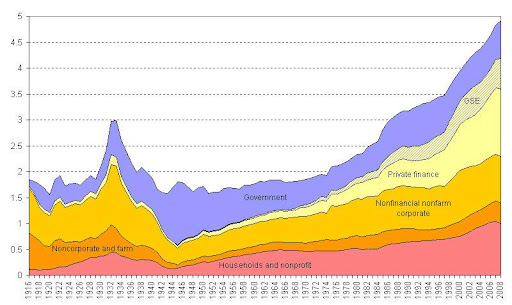
The U.S. now has the highest ratio of debt-to-GDP in its history: nearly 5. And, while much has been made of the public sector’s growing debt levels, private finance has been the leading contributor to this massive growth of indebtedness. Two other contributors are GSEs (private/public financial sector) and households.

Figure 1: Total Financial Liabilities by Sectors Relative to GDP
Sources: Historical Statistics of the United States: Millennium Edition, Historical Statistics of the United States: Colonial Times to 1970, NIPA, Flow of Funds (from 1945).

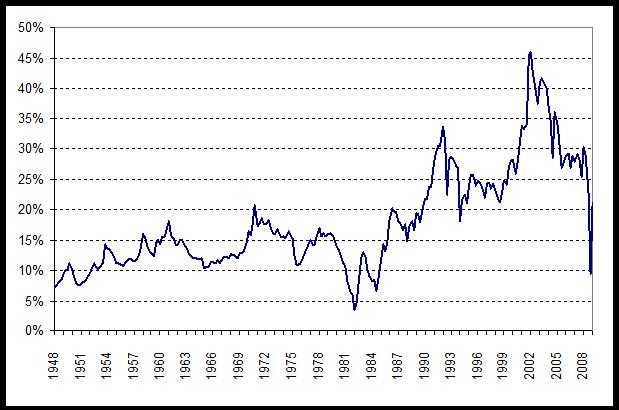
Securitization, together with internationalization of finance, has been the main driver of those tendencies, enabling the financial sector to reap large profits…until recently.

Figure 2: Proportion of Corporate Profit Received by the Financial Sector*

*Excludes Federal Reserve Banks.
Source: BEA. Tables 6.16B, 6.16C, and 6.16D. Corporate profit with inventory valuation and net of capital consumption.

Interestingly, debt levels in the 1980s rivaled those of the Great Depression, which gave a hint that the quality of indebtedness matters as much as the quantity of debt. Take mortgages for example: IO mortgages were a major problem during the Great Depression, which led to a reform of the mortgage industry toward long-term fixed, fully-amortized mortgages. Until the early/mid 2000s, IOs and other exotic mortgages were of limited proportion or non-existent, but as the quality of mortgage deteriorated so did the capacity to sustain a given level of indebtedness.

Solving the debt problem is going to take many years and radical steps (some of them on the distributive and employment sides rather than the financial side). Already financial institutions are cutting the amounts due on credit cards (sometimes in half!) if customers are willing to repay in full at once. Creditors are beginning to understand the enormous problem posed by massive indebtedness. Policymakers should take note: a sustainable economic recovery cannot take place without first allowing private sector balance sheets to recover.

The Failure of the Mainstream Model

By Stephanie Kelton

In an appearance on Meet the Press this morning, Vice President Joe Biden insisted that the president’s $787 billion stimulus package has already “saved or created” 150,000 jobs. The show’s moderator, David Gregory, challenged him on this point, noting that, at 9.4%, the unemployment rate has risen well above the 8% maximum predicted by top Obama advisors in January 2009.

Biden’s response: “We took the mainstream model.” And therein lies the problem.

For as near as I can tell, the mainstream models have been successful at just one thing: failure. They predicted that: subprime loans would not default at substantially different rates than prime loans; the riskiness of credit default swaps and other mortgage backed securities could be efficiently judged; deregulated financial markets were capable of self-policing; and so on. And they were wrong.

Even Alan Greenspan lost faith:

The essential problem is that our models – both risk models and econometric models – as complex as they have become, are still too simple to capture the full array of governing variables that drive global economic reality. . . models, as we currently employ them, are structurally deficient.”

The prediction that comes out of any macroeconomic model is, to a very large extent, driven by the assumptions that underlie it. The mainstream models tend to assume things like: efficient markets, rational expectations, infinite planning horizons, and so on. The rosier the assumptions, the rosier the predictions.

President Obama believed his advisors when they told him that the fiscal stimulus would keep the unemployment rate from rising above 8%, but their forecasts were wrong. They were wrong because their underlying assumptions turned out to be too optimistic.

It’s time to abandon the mainstream model and the rose-colored glasses that go with it.

Why We Should Abandon the Free Market

James Galbraith’s lecture at the Schwartz Center for Economic Policy Analysis at the New School in New York.

http://fora.tv/embedded_player

Why Regulation Matters

James Galbraith’s lecture at the Schwartz Center for Economic Policy Analysis at the New School in New York.

Economic Growth and Public Investment

You may check James K. Galbraith’s interesting conference paper “The Macroeconomic Considerations of a Public Investment Strategy” here.
An important point is that “contrary to popular myth, U.S. economic development has never been solely the result of private investment.”
He goes on to demystify the belief that government deficits crowd out private investment and that the US federal goverment relies on foreigners to finance its spending.

“Interest Rates. Critics assert that efforts to expand the scope of the public sector will drive up interest rates and crowd out private business investment. The accusation is particularly likely to be heard when a proposal explicitly foresees the use of the credit market, deficits, and public debt to finance the expansion.
Are these fears justified? There is a two-part answer to this question, the first related to economic theory, and the second to the specific conditions facing the United States in the world credit markets. The theory of “crowding out” is based on a common misconception of the nature of savings in our economy, namely the idea that savings are a “pool,” fixed in size, from which the public and private sectors alike draw to finance their desired rates of spending. No such pool exists. Rather, what we measure as savings is created after the fact, by the spending decisions of governments and private businesses. These decisions create income; the difference between income and consumption (the latter, strongly established by habit), is savings…We can conclude, first, that there is no direct connection between federal budget deficits or surpluses and long-term interest rates.”
Financing Abroad and the Dollar: The deficit in the external accounts is the accounting counterpart—the exact equal—of the sum of public and private sector deficits in the domestic economy.
This phenomenon is often referred to as “borrowing from foreigners to finance current consumption,” but again the shorthand is misleading. When an American purchases a Japanese car, credit is created and extended by an American bank.
Rather, a bank loan made in the United States has created a dollar asset, which subsequently has been purchased by an institution (the Bank of Japan) that has no immediate use for it and merely chooses to store it in a liquid, interest- bearing form.”

The Predator State

James K. Galbraith’s new book explained.