MMT Explained to Mums

By Paolo Rossi Barnard

Intro.

The post that follows poses as an example of how the huge complexities of MMT and its political and historical contexts could be divulged to the ordinary folks out there. We named it “MMT explained to mums”, precisely for that reason. This effort is of no small importance, since we at NEP recognize that without a growing popular support for our vision of how economies should be run, we may never gather enough steam to push MMT through the barriers of Power Politics. The actual writer of this post is Italian journalist and MMT supporter Paolo Rossi Barnard. Of course this is not definitive, and we invite both our bloggers and our readers to make comments and contributions to this essential communication effort. We all know that millions of people and families out there are needlessly suffering right now for the insanity of the present economic dogmas. They must be told that there is a life saving, job saving, even nation saving alternative to the present system; it’s called MMT and it’s authoritative, but it’s being denied to them by a tiny elite of power brokers. Ordinary folks must at least know this, because, as Noam Chomsky once remarked, “When people know of injustice, sooner or later they organize to stop it. They always did.”

MMT Explained to Mums

This could change your welfare and your kids’ like nothing before. It concerns what government could have really done for you with jobs, housing, income, schooling, health. It tells you why it never did, and how you could turn things around. It’s tremendously important today for all of us, the ordinary folks.
We are not wasting your time with ludicrous theories. What follows is authoritative, it was born of high academic research. We made it simple for you to read.

One more thing: we are not politicians, we are neither the Left nor the Right. We just believe that folks should be told what’s really wrong with the economy, which means their livelihood. Truth works with the American people.

Ask yourself: What’s the government for?

The obvious answer is to run the country, ok. Anything else? Yes, government should be there first and foremost to look after its people as youths, then workers and then seniors by providing good schooling, good jobs and good welfare whenever people lack them for any reason.This is what government ought to really be about.

Does the government do it?

No. We still have rampant unemployment, underemployment, poor health care for millions and lack of good education for scores of kids and many other ills.
Could the government do it? Can it afford it?

Yes, easily, we’ll explain why.

So, why has the government never done it?

Because private corporations, big banks and the extremely wealthy knew that if government used its monetary powers (the US dollar) to look after us, the people, they would have lost. Lost what? The bigger slice of national wealth with its privileges, and also millions of insecure workers as cheap labor for their profits. Finally, they would have lost control over politics. So they organized a web of lobbies, big media, and above all a host of economic ideas that took over government and stopped it from spending for us. This way they increased their slice of the pie, but they also prevented the pie from growing, kind of they killed the goose that lays the golden eggs, and so the general US wealth pie in the end got even smaller. It’s been happening for the last 40 years. This is no conspiracy, it’s simply the reality of Power Politics in America and elsewhere, too. We are saying to you: unemployment and lack of welfare need not have existed at all in modern America. They were used as a policy tool to prevent citizens from controlling too large a share of the national wealth and political power with the help of their government. Just think: if the majority of us are stuck in a life-long struggle for subsistence, we can’t even begin to think of ruling or controlling anything. We become class B citizens, we don’t count. We don’t count at all. Do you understand now why the powerful always told us that Big Government is bad? Sure, it’s bad for them.

Here’s what government could have done instead, what it could still do.

First, the government could employ at a living salary every single American out of work, and all those working on minimum wages. It has all the money in the world to do so, because our government owns the US dollar and it can pay any wage anywhere it wants to (simple explanation below). You may ask: wouldn’t this add to big national debt? No, not at all, simply because a larger and better paid American workforce would create a lot of new production, new infrastructure, new investment and new services, that is, more American wealth in its pockets and into the government’s coffers. It’s a government expenditure that would end up largely paying for itself and benefiting all. No need for panic about big debt.

Second, government could pay for adequate welfare for all Americans, that is to say universal health coverage, good schooling, social care for the needy and the elderly, and good pension schemes. Again, there would be no big debt in D.C., because it would again make us all better workers, better students, less needy seniors. In a nutshell: we would be an even more competitive nation that creates wealth instead of wasting it on immense social problems. And a society where a sense of common security substitutes pain and fear, which means less social ills, less family disintegration, less crime.

Sounds good, right? But does the government really have all these dollars to spend on us?

A very simple answer. Ask yourself: who gives the US government its dollars? Is it us? Can we citizens print dollars? No. Can businesses print dollars? No. Can banks print dollars? No. Citizens, businesses and banks can only use already existing dollars. Don’t be fooled: when you read of a business having made a fortune, all that’s happened in reality is that a mass of already existing dollars has simply shifted from lots of places or pockets into that business’ coffers. In some cases new dollars are created by private people, but they are always offset by some sort of equally private debt somewhere, so again no net money has come into existence. And when our government sells its bonds and someone buys them, the same applies: already existing dollars move from one place to another. So, who is it that creates new net dollars then? Only our government can. It does it at the Treasury and at the Fed. Think of it this way: government creates dollars by putting its signatures to pieces of paper (notes/bonds) or to electronic money transfers. Can it ever run out of its own signatures? Does it need to borrow them from someone else? Does it need to tax people to get back those signatures that it can just create? No, of course not. So to recap: government creates US dollars anew, never has to borrow them, cannot run out of them, doesn’t need to tax anyone to get them. And so it can use its dollars to do anything it wants, like employ all of us, educate all of us, treat all of us, look after all of us. And don’t forget: this form of government expense ends up largely paying for itself, because of the virtuous circle of new net national wealth it creates. And this requires no super taxes at all. Actually, it all works precisely in this way if the government gives us more dollars than it takes away through taxation. It also beats inflation thanks to all the new things that will be produced and as long as the government stops increasing its spending (plus dollar creation) as we get full employment.

So, you may ask: then what’s all this frenzy about national debt and the deficit?

Debt and deficits are the normal way to run an economy, they have always existed in American history and have never made us broke. Panic about them is largely a ploy concocted by the corporate elites, their economists and their big media. Remember: they had to prevent government and its citizens from acquiring too large a slice of the national wealth. So, among other things, they worked out a brilliant catch phrase: the government’s budget works just like your family’s, so to be ok the government has to earn more than it spends and never spend more than it earns. They said that just as your family debt is bad news, so is government’s. They turned this into mainstream economics through their people sitting as professors in all major universities and often as government top advisers. Sounds reasonable, right? Yes it does, so much so that we all fell for it and the government started worrying so much about debt and the deficit that it stopped the deficit spending that would have made us all live better. And the consequences were disastrous. But wait: do you remember that government creates its own dollars at will? Can any family in America do that? Of course not, period. So how can government and families have the same budget rules? Your family debt has to be repaid by you finding dollars somewhere else, usually through hard work. You don’t grow greenbacks in your garden. And if you fail to find them then you are in big trouble. So yes, you ought to be very careful about debts and deficits. None of this ever applies to the government, because as we said to get dollars it has to turn only to ITSELF and creates them out of thin air at the Treasury and the Fed. Think: if you could just create the dollars you need to pay back your debts, would you ever worry about debts and deficits? Ok, you got it. That’s precisely why all this frenzy about US government debt and deficit is just a plain lie, concocted by the corporate elite to achieve their goals. And look: the richest America we have ever known, that is, the American Dream emerging from World War II, had massive deficits and yet we became a world Super Power that spilled its wealth all over Europe as well. So much for this deficit hysteria. In fact it has been created to allow the conservatives to eliminate those social programs that benefit average Americans. You must understand that this is not a Republican vs Democrat issue – both sides have teamed up to cut programs that help you in order to favor their fat cat Wall Street friends, who think they’ll be better off if you are poorer and unemployed.

In conlcusion.

Do you realize what you have just read? Yes, unemployment and underemployment need not exist in our country. Yes, universal welfare is possible. And yes, all this would come out of government deficit spending with no problem whatsoever. Actually, in the long run it would even make America richer. Think of all the suffering that the present system creates instead, today spreading to millions of decent families all over the country. And what for? Just to ensure that some tiny super wealthy elite could control the majority of our common wealth. Outrageous.

Here’s what you can do to claim back what ought to be yours. Anyone can.

First, we can provide simple to understand primers to further explain to you why the above is truly possible, and we’ll give you all the authoritative academic sources for it in case you want them. Then the immediate thing for you to do is to challenge your Representative with a simple letter and/or email to tell him/her “My family and I are for Full Employment, Price Stability and for Good Deficits for the people, as proposed by senior economists here (NEP url). Do discuss them in Congress, it’s vital for us ordinary Americans. Otherwise you can forget our vote”.

So to recap: Americans and American families were made to suffer needlessly for decades out of greed of the few and out of ignorance of politicians, and things are getting worse by the day. It’s time to stop them. Let’s get the government to do its proper job.

How Would You Reinvent Capitalism?

The Nation put this question to a panel of sixteen activists and economic thinkers. Our own Randy Wray shared his ideas for remaking capitalism into a more stable and equitable system.

Time to panic? You Betcha.

By Stephanie Kelton

Earlier this week, President Obama talked about the weakening state of the economy, telling us that he’s not worried about a double-dip recession and that the nation should “not panic.” It’s hard to imagine a more alarming assessment at this juncture.

The recovery is faltering. Our economy is growing at annual rate of just 1.8 percent. Manufacturing just grew at its slowest pace in 20 months. More than 44 million Americans – one in seven – rely on food stamps. Employers hired only 54,000 new workers in May, the lowest number in eight months. Jobless claims increased to 427,000 in the week ended June 4. The unemployment rate rose to 9.1 percent. Nearly half of all unemployed Americans have been without work for more than 6 months. About 25% of all teenagers who are looking for work are unemployed. Eight-and-a-half million Americans are underemployed – i.e. working part-time because their hours have been cut or because they can’t find full-time work. There are, on average, 4.6 unemployed people for every 1 job opening. And even if all the open positions were filled, there would still be 10.7 million people looking for work.

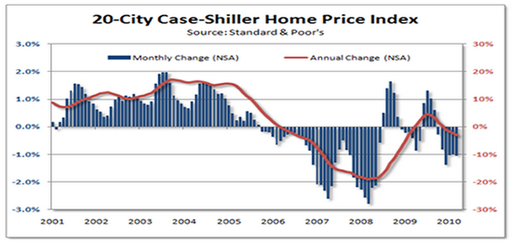
The Case-Shiller index shows that the housing market has already double-dipped.

And, because of the huge shadow inventory of yet-to-be-foreclosed homes, Robert Shiller, a co-creator of the index, thinks home prices could easily fall another 15-25% before bottoming out. If he’s right – and I suspect he is – this spells the end of the recovery. As prices continue to decline they create hidden losses elsewhere in the economy, hurting not just homeowners but the financial institutions that hold their mortgages. The list goes on and on.

These are not, as Obama said, “headwinds” that will slow the pace of our recovery. They are gale force winds that will push millions of families into poverty and thousands of business into bankruptcy.

There is a way out, but it seems unlikely that Congress and the White House will work together to do what’s necessary to turn things around.  Why?  Because a recent poll shows that 59 percent of the public disapproves of the president’s handling of the economy.  And Republicans smell blood.  They know that since WWII no president has been re-elected with unemployment above 7.2 percent, so they see Harry Hard Luck and Sally Sob Story as their best chance at reclaiming the White House in 2012.  It’s a victory the Republicans have been masterfully engineering since February 2009, when they succeeded in restricting the size and scope of the American Recovery and Reinvestment Act (ARRA).
Some of us saw this coming.  For example, Jamie Galbraith and Robert Reich warned, on a panel I organized in January 2009, that the stimulus package needed to be at least $1.3 trillion in order to create the conditions for a sustainable recovery.  Anything shy of that, they worried, would fail to sufficiently improve the economy, making Keynesian economics the subject of ridicule and scorn.
But it’s easy to see why the $787 billion package we ended up with didn’t do the trick.  Remember that the stimulus didn’t take effect all at once – it was spread out over a three-year period.  And while the left hand of the federal government was trying to rev up the economy with increased spending, the right hand of the private sector (together with state and local governments) was dutifully stomping on the breaks.  Just consider the fact that bank lending declined by $587 billion in 2009 alone – the biggest one-year drop since the 1940s.  That’s a $587 billion hole that businesses and households created just as the stimulus was rolling out the first $200 billion or so.  ARRA was the right medicine, but it was administered in the wrong dosage, and this became clear within months of its passage.

In July 2009, I wrote a post entitled, “Gift-Wrapping the White House for the GOP.” In it, I said:

“If President Obama wants a second term, he must join the growing chorus of voices calling for another stimulus and press forward with an ambitious program to create jobs and halt the foreclosure crisis.”

Two years later, both crises are still with us, and the election is just around the corner.
Meanwhile, a new Washington Post-ABC News poll shows former Massachusetts Governor Mitt Romney with a slight edge in a hypothetical race against President Obama, and Howard Dean is warning that without a marked improvement in the economy, even Sarah Palin could clobber Obama in 2012.
To avoid this, President Obama must get his economics right.  Unfortunately, he’s too busy fanning the flames of the phony debt crisis and complaining that the discouraging data is hampering the recovery because it “affects consumer confidence, and it affects business confidence.” But here’s the thing – the recovery isn’t going to be driven by a change in our mentality.  It’s going to be driven by a change in our reality.
So here’s what he needs to do – stop talking about the deficit.  It has always been his Achilles’ heel.  The US is not broke and cannot go bankrupt.  Let go of that myth, and deliver one of those jaw-dropping, awe-inspiring speeches of yesteryear.  Tell the American people that he’s calling on the Republicans to help him enact the most sweeping tax relief since Ronald Reagan was in office — a full payroll tax holiday for every employee and every employer in the nation.  Tell us that you understand that sales create jobs, and income creates sales.  Tell us that families and small businesses don’t have enough income to dig us out of the ditch we’re still in.  Tell us that you will not withhold a dime from our paychecks until cash registers across the nation are chiming and unemployment has fallen below 5 percent.  Tell us before it’s too late.

The Sector Financial Balances Model of Aggregate Demand and Austerity

By Scott Fullwiler

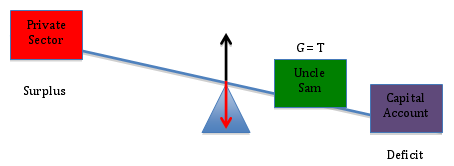
As Stephanie Kelton has recently published two excellent pieces explaining the sector balances in the context of government “belt tightening” (see here and here), a logical next step is to present this in the sector financial balances model of aggregate demand. This post will only briefly review that model before applying it to austerity policies; those desiring more complete background can find it here, and a printable version here. Posts by several others describing various aspects of the model are also linked to therein.

Continue reading

MMP BLOG #1 RESPONSES

By L. Randall Wray

We thank commentators for mentioning some of the many people who are helping to spread the word about MMT to the world, both through blogs and out there in the real world through their many contacts. We especially thank Cullen Roche (Pragcap.com), Selise at FDL, and Paolo Rossi Barnard (a reporter and documentary film maker in Italy) who were mentioned in comments this week. Paolo is right: we have to get beyond academics, beyond policymakers, and even beyond the blogosphere. Many of you out there are much better connected and more knowledgeable about these things than we are. We need your help. We need your advice. What we will do is to use NEP as a resource for networking–with other MMT blogs but also with communities. We ask for your thoughts: what is the best way (other than blogs and comments) to organize efforts to spread the word to the “real world”. We need You-tube videos and animated cartoons that can go viral; we need those of you with Twitter followers to ‘tweet’ about us; we need presentations before community groups; we need documentaries; and we need letters to the editor and op-eds in newspapers across the nation. Money also helps! (We’ll be adding a Donate button and seeking grant support soon.) Please send your thoughts.

Now on to some of the comments.

There were a couple of comments urging us to be sure to demonstrate that modern money “works” as we say it does. OK, we will do that over the coming year. But look at it this way. “Modern money” is 4000 years old, “at least”, according to Keynes. A 4000 year history shows that it “works”. Of course that depends on what you mean by “works”. But if you don’t want to define that too narrowly, I think you’d have to define modern money as a “success”–we’ve increased lifespans, improved quality of life, sent men to the moon, created literature and art–all while operating with modern money. That said, most people do not understand how the actual real world monetary system “works”. And that is why they think we are describing a new monetary regime. We are not. We are explaining how our monetary system actually works. No myths, no religion, no magic.

As I said in the Intro (Blog 1) this Primer WILL NOT present and critique the orthodox, mainstream approach. It is already in every economics textbook. It is the basis of all the conventional wisdom about the operation of the monetary system. It is wrong. But it is irrelevant to the purpose of this Primer—which is to explicate how things really work.

Now that is going to keep things largely at the theoretical level, at a general level that can be applied to specific circumstances. The USA is NOT Turkey. Both have modern money systems. But if the focus is too much on the operations in one nation, it will be hard to see how the points made apply to others. The regular pages of NEP (and Billy Blog, and many other MMT blogs) apply MMT to specific issues.

Here are some responses to more specific comments. Please remember that we will be covering such areas in detail over the next year.

(i) Where is the evidence that an economy will quantity expand rather than price expand when stimulated?

It’s always a risk, as with most any policy, that there could be a round of price increases after a fiscal stimulus, due to the institutional structure (i.e. bottlenecks) and level of aggregate demand (i.e. full employment of plant or labor). The key is to provide stimulus when it is needed, and to formulate and direct the stimulus in a manner that is least likely to cause price increases. As will be seen, we do not favor “pump priming”, old-style, Keynesian aggregate demand stimulus in most situations. We prefer targeted policy. A case in point is the job guarantee/employer of last resort program, which sets a fixed wage to COUNTER the fact that bottlenecks exist in many markets and as an alternative to traditional Keynesian pump priming precisely because of problems associated with bottlenecks.

(ii) Where is the evidence that the floating rate exchange mechanism gives you the degree of freedom required to allow MMT to work?

As discussed above, MMT explains how things really do “work” in the real world. Floating exchange rates offer more fiscal and monetary policy space. This will be explained in detail in coming months. Indeed, as discussed in the introduction, a major purpose of this Primer is to deal with the range of exchange rate regimes.

Finally, a (longish) note on comments and on this project more generally.

We hope that those who engage with us on this Primer are here because they want to learn and to help improve MMT through the creation of this Primer. We will not argue with those who want to reject it. Yes, there are alternative explanations of the operation of the monetary system. No one has to accept ours. As Paul Davidson always says, channeling Keynes, you cannot convict your opponent of error—you must convince her. People are convinced in different ways. At least one commentator says that she/he will not be convinced with theory. I have found that some people are convinced very quickly—when they are introduced to MMT they say it is like putting on a new pair of glasses. Suddenly the world becomes clear to them. Paolo Barnard (who commented) and I had many long telephone conversations. He grasped the implications immediately (and he discussed them in his comment)—he did not need the details, he was convinced by the conclusion. We then filled-in the details over the past year. Many others do not like the conclusions. They do not come on board until they’ve got all the details. Some are skeptical of “pure logic”—to them the “three balances” looks highly suspicious (why would deficits and surpluses have to balance? Why can’t we all run surpluses all the time?). Still others jump immediately to Zimbabwe hyperinflation—using their understanding of some real world event. They’ve got to be brought beyond their fears before they are open to understanding MMT. There is no “one size fits all”.

Civility. Education. That is what we are aiming for on the MMP. If you want to throw “flames” please post them to the main site.

The claim that none of the NEP people has explained MMT simply is perplexing to me. Read Stephanie’s posts, the model of clarity. In any case, that is the purpose of this MMP—to start with the basics and to build up gradually to MMT. Wait a year. If after the next 52 posts you are still convinced that the best MMT explanation can be found elsewhere, so be it.

Ditto the claim that no MMT people at NEP care anything about fraud and criminal activity. My goodness. Ask our colleague Bill Black who has spent the most time studying and exposing bankster foreclosure fraud and the role played by MERS (Hint 1: it ain’t Bill. Hint 2: surf HuffPost). Look, Michael Hudson and Bill Black are fellow travelers, working in a parallel world to our MMT world. To be sure, it is a non-Euclidean world in which parallel lines intersect. Yet, they cover some issues that are different from MMT concerns. We are thrilled, literally, that some readers find their ideas important, maybe even more important than MMT. That is why they are frequent contributors to NEP on other topics including control fraud and super imperialism. Inequality? Unemployment? Job guarantee? Poverty? Incarceration? Banker fraud? We’ve been writing about these issues, too, for decades—long before NEP, before blogs, before widespread use of the internet.

The argument that NEP folks are just academics that never pay any attention to “real folks”? Look, Stephanie, Bill and I speak to hundreds of groups per year. I cannot recall ever turning down an invitation to speak unless it conflicted with another talk—in which case I worked out an alternative date. I speak at local Perkins coffee shops. I go to old folk’s homes. I teach MMT to atheists. For heaven’s sake, Stephanie ran for public office—as a Democrat—against all odds, in Kansas! She knocked on thousands of doors. She kissed thousands of babies, and hugged hundreds of thousands of flag waving dads. Warren ran for Senate as a TeaParty Democrat, before crowds of well-armed nuts who hoped to get a glimpse of Sara Palin. (Try pushing MMT and ELR before that crowd!) We speak ALL THE TIME to nonacademic groups. The idea that we chose an easy academic path to Nobel prizes and global academic acclaim cannot be farther from the truth. Only those outside academics could possibly be fooled. You really need to see our day planners before you criticize us for lack of involvement.

Admittedly, our success could be criticized as spotty. Both Stephanie and Warren lost their elections. But all of you, every single one of you reading this blog (as well as Billy Blog) is here because we—a half dozen of us—created Modern Money Theory from the beginning. Us Pointy-Headed Academics (with a somewhat less-pointy-headed hedge fund manager). We welcome, with open arms, all the new MMT-ers. We admit our failures. No, we are not the best writers. We are not the best performers. We are not the best framers of the message. In many ways we are technically, socially, and politically inept. For the past 2 decades we used to meet once a year to count how many MMT-ers there were in the world. It took a dozen years to get beyond the fingers on one hand. We celebrated when we had to bring in the second hand and some toes to do the count. I suppose that is a measure of our incompetence. Maybe some of you could have developed and spread the ideas much more quickly than we did. We wish you would have joined up a lot earlier! We’ve had our years wandering around the wilderness.

But we learned to be thick-skinned. We’ve been called every name in the book, from Nazi to Pinko Commie. We could not be deterred. And now you are here. We won. At least, we interested somewhere around 3000 of you enough to bring you to this site (on day one of the MMP). We are glad you are with us. We want you to help us to continue to develop the theory, the message, and the strategy to get these ideas out. We are glad to pass the torch. Indeed, we must pass the torch.

So to conclude: This is a joint project. We are trying to create a primer of MMT. The project will take a year. You are a contributor, not a critic. On Mondays there will be a blog to explain a piece of the theory (to be precise, it is at most 1/52nd of the Primer). You tell us where it is unclear or just plain wrong. If you can explain it better than we can, go for it. We’ll do our best to correct the mistakes and clarify the message in the Thursday response. Of course, until we near the end, there will be a lot that still needs to be covered. Indeed, even at the end of our journey—June 2012—we might find that the Primer still has a long way to go, in which case we will continue. Maybe the journey will never end. That will depend, to a large degree, on you and your commitment to the process.

Tim Pawlenty Blurs the Distinction Between an Entrepreneur and a Rentier

By Marshall Auerback

In a private email exchange, Michael Lind of the
New America Foundation drew my attention to a recent speech by Republican Presidential candidate Tim Pawlenty. Like those of us who blog on this site, Pawlenty thinks we need to cut taxes.  But, as Jon Ward at HuffPost argued, Pawlenty’s justification for tax relief “took him into unusual — and scatological — rhetorical territory.” 


Pawlenty said that about five percent of the population belongs to the entrepreneurial class and that “if that five percent become six, seven percent, we’ve got a very bright future. And if that five percent becomes four, three, two or one percent, we’re in deep doo doo. We are in deep crap.”


He’s given away the Rentier mindset.  He talks about “entrepreneurs” but he’s really talking about rentiers.

About 10 percent of the US population is self-employed, the majority of them lawn mowers and such.  Clearly Pawlenty’s tax cuts aren’t aimed at expanding the group of self-employed lawn mowers by one or two percent of the population. He’s talking about expanding the richest few percent.

He’s talking about capitalists, not entrepreneurs.  There’s a certain overlap, but most capitalists are not entrepreneurs and vice versa.  Most capitalists are passive investors in businesses they know nothing about and most entrepreneurs are unable to fund their businesses without borrowing. 

The rentier right wants to blur this distinction, so 2-year-old Junior Moneybags, whose trust fund is earning money while he barfs on the family maid, is an “entrepreneur.”

ECB President Trichet Praised Ireland as the Model for the EU to Follow

By William K. Black

(Cross-posted with Benzinga)

This is the second in a series of articles about the ECB/EU/Euro crisis. Ireland is not like Greece. It ran a budgetary surplus during its boom. It privatized and reduced work restrictions. Its budgetary crisis would be serious because it suffered from one of the worst bubbles (relative to GDP) in history and it lacks a sovereign currency. Ireland’s budgetary crisis is crushing because its political leadership, gratuitously, decided that a nation of four million people should bail out the creditors of Irish banks even though it had no legal or moral obligation to do so and was incapable of doing so. The Irish banks’ creditors were primarily foreign, particularly foreign banks. Absent the Ireland’s failed and quixotic attempt to bail out the German banks Ireland would not be in a sovereign debt crisis.

Ireland, along with Iceland, became the Cato Institute’s Exhibits A&B for the purported success of deregulation and desupervision. European Central Bank President Trichet shared the Cato Institute’s praise for Ireland’s policies, but he came to Ireland on May 31, 2004 to make another claim – the “Celtic Tiger” proved the triumph of Ricardo over the errors of Keynes. Trichet made clear that he was an anti-regulatory supply-sider.

Structural reforms and growth, as highlighted by the Irish case

Keynote address by Jean-Claude Trichet,
President of the European Central Bank,
delivered at the Whitaker lecture organised by the Central Bank and Financial Services Authority of Ireland,
Dublin, 31 May 2004.

Trichet began his address in the traditional fashion of any polite guest – he sought to find something in common with the audience and he praised them.

“Speaking about Ireland’s EU Presidency, and noting that the outgoing President of the European Parliament, Pat Cox, is also Irish, I cannot resist mentioning with pride my own Celtic roots as a native “Breton”!”

“[T]the process of transformation that [Ireland] began over four decades ago has become a model for the millions of new citizens of the European Union. The new Member States of the EU have had to confront economic challenges whose magnitude and long-term importance are similar to those that faced Ireland when you began your work. Thanks to Ireland’s economic success, to which you devoted your life, we can be confident that economic reform works.”

Trichet cited Ireland as his definitive proof of the correctness of the two main point of his talk. The substance of these points is a staple of the stump speech of every Republican candidate for the presidency in the U.S. The first priority is to deregulate.

“[O]one has to consider the astonishing experience of Ireland, which recovered from poor economic and fiscal conditions in the mid-1980s to an impressive pace of economic activity and sound fiscal position in no more than a decade. In addition to a favourable macroeconomic environment and the benefits derived from participation in the European Union, the economic recovery was grounded on far-reaching home made structural reforms in the labour, capital and product markets.”

The second priority is to cut government spending. Ireland has done both and is the Celtic Tiger because it has followed both policies.

“In this respect, the dramatic acceleration of output in Ireland in the post 1987 period can be associated with a vigorous and successful project of fiscal consolidation starting in 1987. This programme was based on tight expenditure control via subsidy cuts, social security reform and a streamlining of the public sector and control of public expenditure.

Ireland’s experience … clearly shows how policies geared to fiscal consolidation do not necessarily entail contractionary effects on real aggregate demand and economic activity. [I]in spite of the tightening policies undertaken, the rate of growth showed a significant increase in relation to previous years. [S]ignificant budget consolidation based on spending reduction enhanced the long term fiscal sustainability and increased the policy credibility of a more favourable tax regime.

Regarding Ireland, the budget deficit was reduced from 10.1 % of GDP in 1986 to 1.7 % in 1989, while the debt ratio declined from 113 % of GDP to 100.4 % of GDP; over the same period GDP growth accelerated from 0.3 % to 6.2 %; the overall consolidation effort, as measured through the structural fiscal balance, amounted to 5.1% of GDP over these three years. In the years afterwards, Ireland continued to enjoy high rates of GDP growth and kept large structural fiscal surpluses (almost always above 5 % of GDP), thus allowing for a steady and rapid decline of the debt ratio (which reached 32.4 % of GDP in 2003).

The Irish and Danish experience brings evidence that expansionary expectation effects may dominate on the contractionary effects of a fiscal consolidation. In both cases there is a considerable evidence that the consumer boom was prompted by the wealth effects of cuts in public spending, as a signal of lower future taxes, concomitantly to the wealth effects implied by the fall in interest rates. On the supply side, a low tax environment has underpinned the pick up in economic activity in Ireland.”

His substantive introduction was that all was mostly well. “Economic and Monetary Union has been highly successful in fostering macroeconomic stability in Europe.” The euro and financial integration were unambiguously stabilizing.

“Finally much progress has been achieved in capital market reforms, not least due to the introduction of the euro. But the further integration of national capital markets towards a truly European financial market could make an even more important contribution to safeguarding against country-specific shocks. It would also result in greater availability of risk capital – particularly for innovative enterprises – and, more generally, in a reduction in financing costs for productive investments. Structural reforms in capital markets should aim to allow a more effective allocation of savings toward the most rewarding investment opportunities. Further efforts should also be made to promote foreign investment in the euro area in order to attract additional capital and promote a greater transfer of technology.”

The EU Growth and Stability Pact prevented contagion within the EU: “fiscal discipline prevents spill-over effects from one country to another in the form of higher interest rates.”

Note that Trichet framed lower interest rates as unambiguously favorable – they would prompt greater productive investments. Freer capital flows would move investable funds to their most productive uses. Indeed, he repeated this point for emphasis:

“Beyond these economic underpinnings, other considerations are worth mentioning: a fiscal policy set according to rules adds to macroeconomic stability by providing agents with expectations of a predictable economic environment; this reduces uncertainty and promotes longer term decision making, notably investment decisions, and economic growth; in addition, sound fiscal policies contribute to lower risk premia on long term interest rates and thus support more favourable financing conditions….”

Regulation played no favorable role. Trichet only non-hostile reference to it was extremely vague: “Moreover, Ireland developed a transparent regulatory framework.” In reality, Ireland had an opaque, wholly ineffective anti-regulatory framework for financial regulation.

In addition to his ode to Ireland’s deregulation and financial miracle, Trichet provided an ode to the euro.

“Moving to the second topic of my speech, i.e. fiscal policies, let me stress that we Europeans have been very bold in creating a single currency in the absence of a political federation, a federal government and a federal budget at the euro area level. Some observers were indeed arguing that without a federal budget of some significance the policy mix would be very erratic, depending on the random behaviour of the different national fiscal policies of the member countries. They were also arguing that without a federal budget it would be impossible to weather, with the help of the fiscal channel, asymmetric shocks hitting one particular member economy. In this respect, the very existence of the Stability and Growth Pact actually allows to refute these two arguments: first, the Maastricht Treaty and the Pact provide a mutual surveillance by the “peers”- i.e the Ministers of Finance – of national fiscal policies; second, by calling upon Member States to maintain their budget close to balance or in surplus over the medium term, the Pact allows the automatic stabilisers to play in full in countries facing an economic downturn, without breaching the 3 % ceiling for the deficit.”

“Bold” is one word to describe creating the euro without creating the conditions vital for weaker EU members to escape simultaneously from a sovereign debt crisis and a severe recession. Other, blunter terms come to mind. Each of the safeguards he asserted has failed in this crisis.

But Trichet had a fallback position – cut taxes and the national deficits and cause a supply-side boom. He used the term “fiscal consolidation” as a euphemism for a wave of budget cuts, particularly in entitlements such as care for retirees.

“Some people argue that fiscal consolidation is detrimental to demand and economic activity. I would maintain that wealth and expectational effects of well-designed consolidation programmes might very much reduce and possibly even outweigh the traditional Keynesian multiplier effects of fiscal policy on demand and activity. If fiscal consolidation is perceived by the private sector as a credible sign that public spending will be permanently lower in future years, households will revise upwards their expected permanent income in anticipation of lower future taxes. Therefore, current and planned consumption will also increase.

In addition, fiscal consolidation might improve long-term financing conditions by way of less demand on the savings pool (reducing crowding out) and lower risk premia on government paper. Hence, wealth effects prompted by lower nominal and real interest rates would support larger consumption. Furthermore, following more favourable financing conditions, private investment is also likely to increase.

The case for expansionary effects on the supply side, via an improved competitiveness of the economy, is also important. If fiscal consolidation can induce moderating effects on wage demand, relative unit labour costs might decrease, with positive medium-term effects on real GDP growth through a greater competitiveness of the productive sector. Such effects are buoyed if lower expected tax rates and more efficient public expenditure enhance the working incentives and the investment environment.”

If the Tea Party knew Trichet better they wouldn’t be so dismissive of the French. He didn’t use the rising tide metaphor, but he got the substance of the message – deregulation makes “everybody” better off.

“The successful implementation of structural economic and fiscal reforms requires significant and tireless efforts of explanation, pedagogy and adequate public communication. Over time, everybody will benefit from more growth, employment and opportunities. These gains from reform are often overlooked in the public debate. In fact, there is a formidable challenge to gain the support of public opinion for implementing structural reforms.”

Trichet finished off with another swing at Keynes, using Ricardo as his hurley.

“What are the implications in the current economic environment? Fiscal imbalances are quite significant in a number of EU countries with deficits and public debt ratios being too high. For these countries, there are solid economic reasons to argue that credible fiscal consolidation would boost growth in net terms, the so-called “Ricardian” effect being more important than the “Keynisian” effect. Reducing such imbalances is likely to have positive expectational effects of a more favourable tax regime and better financing conditions in the future.

Moreover, we would probably all agree that tax and spending ratios in some countries are too high and unfavourable for investment and economic dynamism. Expenditure-based fiscal consolidation and reform that would credibly reduce disincentives to work, invest and innovate could have significant confidence effects even in the short run.”

I’m eager to research whether Trichet visited Iceland and praised the “New Vikings.” Ireland proved as desirable a model for Europe as Texas proved as a model for federal deregulation of S&Ls (the Garn-St Germain Act of 1982 was modeled on Texas’ deregulation of S&Ls). It should be disturbing that our theo-classical financial leaders get things not a bit wrong but 180 degrees wrong.

Will Greece let EU Central Bankers Destroy Democracy?

By Michael Hudson

(cross-posted with CounterPunch)

The Greek bailout provides an opportunity for privatization grabs

When Greece exchanged its drachma for the euro in 2000, most voters were all for joining the Eurozone. The hope was that it would ensure stability, and that this would promote rising wages and living standards. Few saw that the stumbling point was tax policy. Greece was excluded from the eurozone the previous year as a result of failing to meet the 1992 Maastricht criteria for EU membership, limiting budget deficits to 3 percent of GDP, and government debt to 60 percent.

The euro also had other serious fiscal and monetary problems at the outset. There is little thought of wealthier EU economies helping bring less productive ones up to par, e.g. as the United States does with its depressed areas (as in the rescue of the auto industry in 2010) or when the federal government does declares a state of emergency for floods, tornados or other disruptions. As with the United States and indeed nearly all countries, EU “aid” is largely self-serving – a combination of export promotion and bailouts for debtor economies to pay banks in Europe’s main creditor nations: Germany, France and the Netherlands. The EU charter banned the European Central Bank (ECB) from financing government deficits, and prevents (indeed, “saves”) members from having to pay for the “fiscal irresponsibility” of countries running budget deficits. This “hard” tax policy was the price that lower-income countries had to sign onto when they joined the European Union.

Also unlike the United States (or almost any nation), Europe’s parliament was merely ceremonial. It had no power to set and administer EU-wide taxes. Politically, the continent remains a loose federation. Every member is expected to pay its own way. The central bank does not monetize deficits, and there is minimal federal sharing with member states. Public spending deficits – even for capital investment in infrastructure – must be financed by running into debt, at rising interest rates as countries running deficits become more risky.

This means that spending on transportation, power and other basic infrastructure that was publicly financed in North America and the leading European economies (providing services at subsidized rates) must be privatized. Prices for these services must be set high enough to cover interest and other financing charges, high salaries and bonuses, and be run for profit – indeed, for rent extraction as public regulatory authority is disabled.

This makes countries going this route less competitive. It also means they will run into debt to Germany, France and the Netherlands, causing the financial strains that now are leading to showdowns with democratically elected governments. At issue is whether Europe should succumb to centralized planning – on the right wing of the political spectrum, under the banner of “free markets” defined as economies free from public price regulation and oversight, free from consumer protection, and free from taxes on the rich.

The crisis for Greece – as for Iceland, Ireland and debt-plagued economies capped by the United States – is occurring as bank lobbyists demand that “taxpayers” pay for the bailouts of bad speculations and government debts stemming largely from tax cuts for the rich and for real estate, shifting the fiscal burden as well as the debt burden onto labor and industry. The financial sector’s growing power to achieve this tax favoritism is crippling economies, driving them further into reliance on yet more debt financing to remain solvent. Aid is conditional upon recipient countries reducing their wage levels (“internal devaluation”) and selling off public enterprises.

The tunnel vision that guides these policies is self-reinforcing. Europe, America and Japan draw their economic managers from the ranks of professionals sliding back and forth between the banks and finance ministries – what the Japanese call “descent from heaven” to the private sector where worldly rewards are greatest. It is not merely delayed payment for past service. Their government experience and contacts helps them influence the remaining public bureaucracy and lobby their equally opportunistic replacements to promote pro-financial fiscal and monetary policies – that is, to handcuff government and deter regulation and taxation of the financial sector and its real estate and monopoly clients, and to use the government’s taxing and money-creating power to provide bailouts when the inevitable financial collapse occurs as the economy shrinks below break-even levels into negative equity territory.

Regressive tax policies – shifting taxes off the rich and off property onto labor – cause budget deficits financed by public debt. When bondholders pull the plug, the resulting debt pressure forces governments to pay off debts by selling land and other public assets to private buyers (unless governments repudiate the debt or recover by restoring progressive taxation). Most such sales are done on credit. This benefits the banks by creating a loan market for the buyouts. Meanwhile, interest absorbs the earnings, depriving the government of tax revenue it formerly could have received as user fees. The tax gift to financiers is based on the bad policy of treating debt financing as a necessary cost of doing business, not as a policy choice – one that indeed is induced by the tax distortion of making interest payments tax-deductible.

Buyers borrow credit to appropriate “the commons” in the same way they bid for commercial real estate. The winner is whoever raises the largest buyout loan – by pledging the most revenue to pay the bank as interest. So the financial sector ends up with the revenue hitherto paid to governments as taxes or user fees. This is euphemized as a free market.

Promoting the financial sector at the economy’s expense

The resulting debt leveraging is not a solvable problem. It is a quandary from which economies can escape only by focusing on production and consumption rather than merely subsidizing the financial system to enable players to make money from money by inflating asset prices on free electronic keyboard credit. Austerity causes unemployment, which lowers wages and prevents labor from sharing in the surplus. It enables companies to force their employees to work overtime and harder in order to get or keep a job, but does not really raise productivity and living standards in the way envisioned a century ago. Increasing housing prices on credit – requiring larger debts for access to home ownership – is not real prosperity.

To contrast the “real” economy from the financial sector requires distinctions to be drawn between productive and unproductive credit and investment. One needs the concept of economic rent as an institutional and political return to privilege without a corresponding cost of production. Classical political economy was all about distinguishes earned from unearned income, cost-value from market price. But pro-financial lobbyists deny that any income or rentier wealth is unearned or parasitic. The national income and product accounts (NIPA) do not draw any such distinction. This blind spot is not accidental. It is the essence of post-classical economics. And it explains why Europe is so crippled.

The way in which the euro was created in 1999 reflects this shallow vision. The Maastricht fiscal and financial rules maximize the commercial loan market by preventing central banks from supplying governments (and hence, the economy) with credit to grow. Commercial banks are to be the sole source of financing budget deficits – defined to include infrastructure investment in transportation, communication, power and water. Privatization of these basic services blocks governments from supplying them at subsidized rates or freely. So roads are turned into toll roads, charging access fees that are readily monopolized. Economies are turned into sets of tollbooths, paying out their access charges as interest to creditors. These extractive rents make privatized economies high-cost. But to the financial sector that is “wealth creation.” It is enhanced by untaxing interest payments to banks and bondholders – aggravating fiscal deficits in the process, however.

The Greek budget crisis in perspective

A fiscal legacy of the colonels’ 1967-74 junta was tax evasion by the well to do. The “business-friendly” parties that followed were reluctant to tax the wealthy. A 2010 report stated that nearly a third of Greek income was undeclared, with “fewer than 15,000 Greeks declar[ing] incomes of over €100,000, despite tens of thousands living in opulent wealth on the outskirts of the capital. A new drive by the Socialists to track down swimming pool owners by deploying Google Earth was met with a virulent response as Greeks invested in fake grass, camouflage and asphalt to hide the tax liabilities from the spies in space.” [1]

As a result of the military dictatorship depressing public spending below the European norm, infrastructure needed to be rebuilt – and this required budget deficits. The only way to avoid running them would have been to make the rich pay the taxes they were supposed to. But squeezing public spending to the level that wealthy Greeks were willing to pay in taxes did not seem politically feasible. (Almost no country since the 1980s has enacted Progressive Era tax policies.) The 3% Maastricht limit on budget deficits refused to count capital spending by government as capital formation, on the ideological assumption that all government spending is deadweight waste and only private investment is productive.

The path of least resistance was to engage in fiscal deception. Wall Street bankers helped the “conservative” (that is, fiscally regressive and financially profligate) parties conceal the extent of the public debt with the kind of junk accounting that financial engineers had pioneered for Enron. And as usual when financial deception in search of fees and profits is concerned, Goldman Sachs was in the middle. In February 2010, the German magazine Der Spiegel exposed how the firm had helped Greece conceal the rise in public debt, by mortgaging assets in a convoluted derivatives deal – legal but with the covert intent of circumventing the Maastricht limitation on deficits. “Eurostat’s reporting rules don’t comprehensively record transactions involving financial derivatives,” so Greece’s obligation appeared as a cross-currency swap rather than as a debt. The government used off-balance-sheet entities and derivatives similar to what Icelandic and Irish banks later would use to indulge in fictitious debt disappearance and an illusion of financial solvency.

The reality, of course, was a virtual debt. The government was obligated to pay Wall Street billions of euros out of future airport landing fees and the national lottery as “the so-called cross currency swaps … mature, and swell the country’s already bloated deficit.” [2] Translated into straightforward terms, the deal left Greece’s public-sector budget deficit at 12 percent of GDP, four times the Maastricht limit.

Using derivatives to engineer Enron-style accounting enabled Greece to mask a debt as a market swap based on foreign currency options, to be unwound over ten to fifteen years. Goldman was paid some $300 million in fees and commissions for its aid orchestrating the 2001 scheme. “A similar deal in 2000 called Ariadne devoured the revenue that the government collected from its national lottery. Greece, however, classified those transactions as sales, not loans.” [3] JPMorgan Chase and other banks helped orchestrate similar deals across Europe, providing “cash upfront in return for government payments in the future, with those liabilities then left off the books.”

The financial sector has an interest in understating the debt burden – first, by using “mark to model” junk accounting, and second, by pretending that the debt burden can be paid without disrupting economic life. Financial spokesmen from Tim Geithner in the United States to Dominique Strauss-Kahn at the IMF claimed that the post-2008 debt crisis is merely a short-term “liquidity problem” (lack of “confidence”), not insolvency reflecting an underlying inability to pay. Banks promise that everything will be all right when the economy “returns to normal” – if only the government will buy their junk mortgages and bad loans (“sound long-term investments”) for ready cash.

The intellectual deception at work

Financial lobbyists seek to distract voters and policy makers from realizing that “normalcy” cannot be restored without wiping out the debts that have made the economy abnormal. The larger the debt burden grows, the more economy-wide austerity is required to pay debts to banks and bondholders instead of investing in capital formation and real growth.

Austerity makes the problem worse, by intensifying debt deflation. To pretend that austerity helps economies rather than destroys them, bank lobbyists claim that shrinking markets will lower wage rates and “make the economy more competitive” by “squeezing out the fat.” But the actual “fat” is the debt overhead – the interest, amortization, financial fees and penalties built into the cost of doing business, the cost of living and the cost of government.

When difficulty arises in paying debts, the path of least resistance is to provide more credit – to enable debtors to pay. This keeps the system solvent by increasing the debt overhead – seemingly an oxymoron. As financial institutions see the point approaching where debts cannot be paid, they try to get “senior creditors” – the ECB and IMF – to lend governments enough money to pay, and ideally to shift risky debts onto the government (“taxpayers”). This gets them off the books of banks and other large financial institutions that otherwise would have to take losses on Greek government bonds, Irish bank obligations bonds, etc., just as these institutions lost on their holdings of junk mortgages. The banks use the resulting breathing room to try and dump their bond holdings and bad bets on the proverbial “greater fool.”

In the end the debts cannot be paid. For the economy’s high-financial managers the problem is how to postpone defaults for as long as possible – and then to bail out, leaving governments (“taxpayers”) holding the bag, taking over the obligations of insolvent debtors (such as A.I.G. in the United States). But to do this in the face of popular opposition, it is necessary to override democratic politics. So the divestment by erstwhile financial losers requires that economic policy be taken out of the hands of elected government bodies and transferred to those of financial planners. This is how financial oligarchy replaces democracy.

Paying higher interest for higher risk, while protecting banks from losses

The role of the ECB, IMF and other financial oversight agencies has been to make sure that bankers got paid. As the past decade of fiscal laxity and deceptive accounting came to light, bankers and speculators made fortunes jacking up the interest rate that Greece had to pay for its increasing risk of default. To make sure they did not lose, bankers shifted the risk onto the European “troika” empowered to demand payment from Greek taxpayers.

Banks that lent to the public sector (at above-market interest rates reflecting the risk), they were to be bailed out at public expense. [4] Demanding that Greece not impose a “haircut” on creditors, the ECB and related EU bureaucracy demanded a better deal for European bondholders than creditors received from the Brady bonds that resolved Latin American and Third World debts in the 1980s. In an interview with the Financial Times, ECB executive board member Lorenzo Bini Smaghi insisted:

First, the Brady bonds solution was a solution for American banks, which were basically allowed not to ‘mark to market’ the restructured bonds. There was regulatory forbearance, which was possible in the 1980 but would not be possible today.

Second, the Latin American crisis was a foreign debt crisis. The main problem in the Greek crisis is Greece, its banks and its own financial system. Latin America had borrowed in dollars and the lines of credit were mainly with foreigners. Here, a large part of the debt is with Greeks. If Greece defaulted, the Greek banking system would collapse. It would then need a huge recapitalization – but where would the money come from?

Third, after default the Latin American countries still had a central bank that could print money to pay for civil servants’ wages, pensions. They did this and created inflation. So they got out [of the crisis] through inflation, depreciation and so forth. In Greece you would not have a central bank that could finance the government, and it would have to partly shut down some of its operations, like the health system.

Mr. Bini Smaghi threatened that Europe would destroy the Greek economy if it tried to scale back its debts or even stretch out maturities to reflect the ability to pay. Greece’s choice was between or anarchy. Restructuring would not benefit “the Greek people. It would entail a major economic, social and even humanitarian disaster, within Europe. Orderly implies things go smoothly, but if you wipe out the banking system, how can it be smooth?” The ECB’s “position [is] based on principle … In the euro area debts have to be repaid and countries have to be solvent. That has to be the principle of a market-based economy.” [5]

A creditor-oriented economy is not really a market-based, of course. The banks destroyed the market by their own central financial planning — using debt leverage to leave Greece with a bare choice: Either it would permit EU officials to come in and carve up its economy, selling its major tourist sites and monopolistic rent-extracting opportunities to foreign creditors in a gigantic national foreclosure movement, or it could bite the bullet and withdraw from the Eurozone. That was the deal Mr. Bini Smaghi offered: “if there are sufficient privatizations, and so forth – then the IMF can disburse and the Europeans will do their share. But the key lies in Athens, not elsewhere. The key element for the return of Greece to the market is to stop discussions about restructuring.”

One way or another, Greece would lose, he explained: “default or restructuring would not help solve the problems of the Greek economy, problems that can be solved only by adopting the kind of structural reforms and fiscal adjustment measures included in the programme. On the contrary it would push Greece into a major economic and social depression.” This leverage demanding to be paid or destroying the economy’s savings and monetary system is what central bankers call a “rescue,” or “restoring market forces.” Bankers claim that austerity will revive growth. But to accept as a realistic democratic alternative would be self-immolation.

Unless Greece signed onto this nonsense, neither the ECB nor the IMF would extend loans to save its banking system from insolvency. On May 31, 2011, Europe agreed to provide $86 billion in euros if Greece “puts off for the time being a restructuring, hard or soft, of Greece’s huge debt burden.” [6] The pretense was a “hope that in another two years Greece will be in a better position to repay its debts in full.” Anticipation of the faux rescue led the euro to rebound against foreign currencies, and European stocks to jump by 2%. Yields on Greek 10-year bonds fell to “only” a 15.7 percent distress level, down one percentage point from the previous week’s high of 16.8 percent when a Greek official made the threatening announcement that “Restructuring is off the table. For now it is all about growth, growth, growth.”

How can austerity be about growth? This idea never has worked, but the pretense was on. The EU would provide enough money for the Greek government to save bondholders from having to suffer losses. The financial sector supports heavy taxpayer expense as long as the burden does not fall on itself or its main customers in the real estate sector or the infrastructure monopolies being privatized.

The loan-for-privatization tradeoff was called “aiding Greece” rather than bailing out German, French and other bondholders. But financial investors knew better. “Since the crisis began, 60 billion euros in deposits have been withdrawn from Greek banks, about a quarter of the country’s output.” [7] These withdrawals, which were gaining momentum, were the precise size of the loan being offered!

Meanwhile, the shift of 60 billion euros off the balance sheets of banks onto the private sector threatened to raise the ratio of public debt to GDP over 150 percent. There was talk that another 100 billion euros would be needed to “socialize the losses” that otherwise would be suffered by German, French and other European bankers who had their eyes set on a windfall if heavily discounted Greek bonds were made risk-free by carving up Greece in much the same way that the Versailles Treaty did to Germany after World War I.

The Greek population certainly saw that the world was at financial war. Increasingly large crowds gathered each day to protest in Syntagma Square in front of the Parliament, much as Icelandic crowds had done earlier under similar threats by their Social Democrats to sell out the nation to European creditors. And just as Iceland’s Prime Minister Sigurdardottir held on arrogantly against public opinion, so did Greek Socialist Prime Minister George Papandreou. This prompted EU Fisheries Commissioner Maria Damanaki “to ‘speak openly’ about the dilemma facing her country,” warning: “The scenario of Greece’s exit from the euro is now on the table, as are ways to do this. Either we agree with our creditors on a programme of tough sacrifices and results … or we return to the drachma. Everything else is of secondary importance.” [8] And former Dutch Finance Minister Willem Vermeend wrote in De Telegraaf that ‘Greece should leave the euro,’ given that it will never be able to pay back its debt.” [9]

As in Iceland, the Greek austerity measures are to be put to a national referendum – with polls reporting that some 85 percent of Greeks reject the bank-bailout-cum-austerity plan. Its government is paying twice as much for credit as the Germans, despite seemingly having no foreign-exchange risk (using the euro). The upshot may be to help drive Greece out of the eurozone, not only by forcing default (the revenue is not there to pay) but by Newton’s Third Law of Political Motion: Every action creates an equal and opposite reaction. The ECB’s attempt to make Greek labor –(“taxpayers”) pay foreign bondholders is leading to pressure for outright repudiation and the domestic “I won’t pay” movement. Greece’s labor movement always has been strong, and the debt crisis is further radicalizing it.

The aim of commercial banks is to replace governments in creating money, making the economy entirely dependent on them, with public borrowing creating an enormous risk-free “market” for interest-bearing loans. It was to overcome this situation that the Bank of England was created in 1694 – to free the country from reliance on Italian and Dutch credit. Likewise the U.S. Federal Reserve, for all its limitations, was founded to enable the government to create its own money. But European banks have hog-tied their governments, replacing Parliamentary democracy with dictatorship by the ECB, which is blocked constitutionally from creating credit for governments – until German and French banks found it in their own interest for it to do so. As UMKC Professor Bill Black summarizes the situation:

A nation that gives up its sovereign currency by joining the euro gives up the three most effective means of responding to a recession. It cannot devalue its currency to make its exports more competitive. It cannot undertake an expansive monetary policy. It does not have any monetary policy and the EU periphery nations have no meaningful influence on the ECB’s monetary policies. It cannot mount an appropriately expansive fiscal policy because of the restrictions of the EU’s growth and stability pact. The pact is a double oxymoron – preventing effective counter-cyclical fiscal policies harms growth and stability throughout the Eurozone.

Financial politics are now dominated by the drive to replace debt defaults by running a fiscal surplus to pay bankers and bondholders. The financial system wants to be paid. But mathematically this is impossible, because the “magic of compound interest” outruns the economy’s ability to pay – unless central banks flood asset markets with new bubble credit, as U.S. policy has done since 2008. When debtors cannot pay, and when the banks in turn cannot pay their depositors and other counterparties, the financial system turns to the government to extract the revenue from “taxpayers” (not the financial sector itself). The policy bails out insolvent banks by plunging domestic economies into debt deflation, making taxpayers bear the cost of banks gone bad.

These financial claims are virtually a demand for tribute. And since 2010 they have been applied to the PIIGS countries. The problem is that revenue used to pay creditors is not available for spending within the economy. So investment and employment shrink, and defaults spread. Something must give, politically as well as economically as society is brought back to the “Copernican problem”: Will the “real” economy of production and consumption revolve around finance, or will financial demands for interest devour the economic surplus and begin to eat into the economy?

Technological determinists believe that technology drives. If this were so, rising productivity would have made everybody in Europe and the United States wealthy by now, rich enough to be out of debt. But there is a Chicago School inquisition insisting that today’s needless suffering is perfectly natural and even necessary to rescue economies by saving their banks and debt overhead – as if all this is the economic core, not wrapped around the core.

Meanwhile, economies are falling deeper into debt, despite rising productivity measures. The seeming riddle has been explained many times, but is so counter-intuitive that it elicits a wall of cognitive dissonance. The natural view is to think that the world shouldn’t be this way, letting credit creation load down economies with debt without financing the means to pay it off. But this imbalance is the key dynamic defining whether economies will grow or shrink.

John Kenneth Galbraith explained that banking and credit creation is so simple a principle that the mind rejects it – because it is something for nothing, the proverbial free lunch stemming from the principle of banks creating deposits by making loans. Just as nature abhors a vacuum, so most people abhor the idea that there is such a thing as a free lunch. But the financial free lunchers have taken over the political system.

They can hold onto their privilege and avert a debt write-down only as long as they can prevent widespread moral objection to the idea that the economy is all about saving creditor claims from being scaled back to the economy’s ability to pay – by claiming that the financial brake is actually the key to growth, not a free transfer payment.

The upcoming Greek referendum poses this question just as did Iceland’s earlier this spring. As Yves Smith recently commented regarding the ECB’s game of chicken as to whether Greece’s government would accept or reject its hard terms:

This is what debt slavery looks like on a national level. …

Greece looks to be on its way to be under the boot of bankers just as formerly free small Southern farmers were turned into “debtcroppers” after the US Civil War. Deflationary policies had left many with mortgage payments that were increasingly difficult to service. Many fell into “crop lien” peonage. Farmers were cash starved and pledged their crops to merchants who then acted in an abusive parental role, being given lists of goods needed to operate the farm and maintain the farmer’s family and doling out as they saw fit. The merchants not only applied interest to the loans, but further sold the goods to farmers at 30% or higher markups over cash prices. The system was operated, by design, so that the farmer’s crop would never pay him out of his debts (the merchant as the contracted buyer could pay whatever he felt like for the crop; the farmer could not market it to third parties). This debt servitude eventually led to rebellion in the form of the populist movement. [10]

One would expect a similar political movement today. And as in the late 19th century, academic economics will be mobilized to reject it. Subsidized by the financial sector, today’s economic orthodoxy finds it natural to channel productivity gains to the finance, insurance and real estate (FIRE) sector and monopolies rather than to raise wages and living standards. Neoliberal lobbyists and their academic mascots dismiss sharing productivity gains with labor as being unproductive and not conducive to “wealth creation” financial style.

Making governments pay creditors when banks run aground

At issue is not only whether bank debts should be paid by taking them onto the public balance sheet at taxpayer expense, but whether they can reasonably be paid. If they cannot be, then trying to pay them will shrink economies further, making them even less viable. Many countries already have passed this financial limit. What is now in question is a political step – whether there is a limit to how much further creditor interests can push national populations into debt-dependency. Future generations may look back on our epoch as a great Social Experiment on how far the point may be deferred at which government – or parliaments – will draw a line against taking on public liability for debts beyond any reasonable capacity to pay without drastically slashing public spending on education, health care and other basic services?

Is a government – or economy – be said to be solvent as long as it has enough land and buildings, roads, railroads, phone systems and other infrastructure to sell off to pay interest on debts mounting exponentially? Or should we think of solvency as existing under existing proportions in our mixed public/private economies? If populations can be convinced of the latter definition – as those of the former Soviet Union were, and as the ECB, EU and IMF are now demanding – then the financial sector will proceed with buyouts and foreclosures until it possesses all the assets in the world, all the hitherto public assets, corporate assets and those of individuals and partnerships.

This is what today’s financial War of All against All is about. And it is what the Greeks gathering in Syntagma Square are demonstrating about. At issue is the relationship between the financial sector and the “real” economy. From the perspective of the “real” economy, the proper role of credit – that is, debt – is to fund productive capital investment and economic growth. After all, it is out of the economic surplus that interest is to be paid. This requires a tax system and financial regulatory system to maximize the growth. But that is precisely the fiscal policy that today’s financial sector is fighting against. It demands tax-deductibility for interest, encouraging debt financing rather than equity. It has disabled truth-in-lending laws and regulation keeping prices (the interest rate and fees) in line with costs of production. And it blocks governments from having central banks to freely finance their own operations and provide economies with money.

Banks and their financial lobbyists have not shown much interest in economy-wide wellbeing. It is easier and quicker to make money by being extractive and predatory. Fraud and crime pay, if you can disable the police and regulatory agencies. So that has become the financial agenda, eagerly endorsed by academic spokesmen and media ideologues who applaud bank managers and subprime mortgage brokers, corporate raiders and their bondholders, and the new breed of privatizers, using the one-dimensional measure of how much revenue can be squeezed out and capitalized into debt service. From this neoliberal perspective, an economy’s wealth is measured by the magnitude of debt obligations – mortgages, bonds and packaged bank loans – that capitalize income and even hoped-for capital gains at the going rate of interest.

Iceland belatedly decided that it was wrong to turn over its banking to a few domestic oligarchs without any real oversight or regulation over their self-dealing. From the vantage point of economic theory, was it not madness to imagine that Adam Smith’s quip about not relying on the benevolence of the butcher, brewer or baker for their products, but on their self-interest is applicable to bankers? Their “product” is not a tangible consumption good, but interest-bearing debt. These debts are a claim on output, revenue and wealth; they do not constitute real wealth.

This is what pro-financial neoliberals fail to understand. For them, debt creation is “wealth creation” (Alan Greenspan’s favorite euphemism) when credit – that is, debt – bids up prices for property, stocks and bonds and thus enhances financial balance sheets. The “equilibrium theory” that underlies academic orthodoxy treats asset prices (financialized wealth) as reflecting a capitalization of expected income. But in today’s Bubble Economy, asset prices reflect whatever bankers will lend. Rather than being based on rational calculation, their loans are based on what investment bankers are able to package and sell to frequently gullible financial institutions. This logic leads to attempts to pay pensions out of a “wealth creating” process that runs economies into debt.

It is not hard to statistically illustrate this. There amount of debt that an economy can pay is limited by the size of its surplus, defined as corporate profits and personal income for the private sector, and net fiscal revenue paid to the public sector. But neither today’s financial theory nor global practice recognizes a capacity-to-pay constraint. So debt service has been permitted to eat into capital formation and reduce living standards – and now, to demand privatization sell-offs.

As an alternative is to such financial demands, Iceland has provided a model for what Greece may do. Responding to British and Dutch demands that its government guarantee payment of the Icesave bailout, the Althing recently asserted the principle of sovereign debt:

The preconditions for the extension of government guarantee according to this Act are:

1. That … account shall be taken of the difficult and unprecedented circumstances with which Iceland is faced with and the necessity of deciding on measures which enable it to reconstruct its financial and economic system.

This implies among other things that the contracting parties will agree to a reasoned and objective request by Iceland for a review of the agreements in accordance with their provisions.

2. That Iceland’s position as a sovereign state precludes legal process against its assets which are necessary for it to discharge in an acceptable manner its functions as a sovereign state.

Instead of imposing the kind of austerity programs that devastated Third World countries from the 1970s to the 1990s and led them to avoid the IMF like a plague, the Althing is changing the rules of the financial system. It is subordinating Iceland’s reimbursement of Britain and Holland to the ability of Iceland’s economy to pay:

In evaluating the preconditions for a review of the agreements, account shall also be taken to the position of the national economy and government finances at any given time and the prospects in this respect, with special attention being given to foreign exchange issues, exchange rate developments and the balance on current account, economic growth and changes in gross domestic product as well as developments with respect to the size of the population and job market participation.

This is the Althing proposal to settle its Icesave bank claims that Britain and the Netherlands rejected so passionately as “unthinkable.” So Iceland said, “No, take us to court.” And that is where matters stand right now.

Greece is not in court. But there is talk of a “higher law,” much as was discussed in the United States before the Civil War regarding slavery. At issue today is the financial analogue, debt peonage.

Will it be enough to change the world’s financial environment? For the first time since the 1920s (as far as I know), Iceland made the capacity-to-pay principle the explicit legal basis for international debt service. The amount to be paid is to be limited to a specific proportion of the growth in its GDP (on the admittedly tenuous assumption that this can indeed be converted into export earnings). After Iceland recovers, the Treasury offered to guarantee payment for Britain for the period 2017-2023 up to 4% of the growth of GDP after 2008, plus another 2% for the Dutch. If there is no growth in GDP, there will be no debt service. This meant that if creditors took punitive actions whose effect is to strangle Iceland’s economy, they wouldn’t get paid.

No wonder the EU bureaucracy reacted with such anger. It was a would-be slave rebellion. Returning to the applicable of Newton’s Third Law of motion to politics and economics, it was natural enough for Iceland, as the most thoroughly neoliberalized disaster area, to be the first economy to push back. The past two years have seen its status plunge from having the West’s highest living standards (debt-financed, as matters turn out) to the most deeply debt-leveraged. In such circumstances it is natural for a population and its elected officials to experience a culture shock – in this case, an awareness of the destructive ideology of neoliberal “free market” euphemisms that led to privatization of the nation’s banks and the ensuing debt binge.

The Greeks gathering in Syntagma Square seem to need no culture shock to reject their Socialist government’s cave-in to European bankers. It looks like they may follow Iceland in leading the ideological pendulum back toward a classical awareness that in practice, this rhetoric turns out to be a junk economics favorable to banks and global creditors. Interest-bearing debt is the “product” that banks sell, after all. What seemed at first blush to be “wealth creation” was more accurately debt-creation, in which banks took no responsibility for the ability to pay. The resulting crash led the financial sector to suddenly believe that it did love centralized government control after all – to the extent of demanding public-sector bailouts that would reduce indebted economies to a generation of fiscal debt peonage and the resulting economic shrinkage.

As far as I am aware, this agreement is the first since the Young Plan for Germany’s reparations debt to subordinate international debt obligations to the capacity-to-pay principle. The Althing’s proposal spells this out in clear terms as an alternative to the neoliberal idea that economies must pay willy-nilly (as Keynes would say), sacrificing their future and driving their population to emigrate in a vain attempt to pay debts that, in the end, can’t be paid but merely leave debtor economies hopelessly dependent on their creditors. In the end, democratic nations are not willing to relinquish political planning authority to an emerging financial oligarchy.

No doubt the post-Soviet countries are watching, along with Latin American, African and other sovereign debtors whose growth has been stunted by predatory austerity programs imposed by IMF, World Bank and EU neoliberals in recent decades. We should all hope that the post-Bretton Woods era is over. But it won’t be until the Greek population follows that of Iceland in saying no – and Ireland finally wakes up.

Financial Times columnist Martin Wolf writes that the eurozone “has only two options: to go forwards towards a closer union or backwards towards at least partial dissolution. … either default and partial dissolution or open-ended official support.” [11] But ECB intransigence leaves little alternative to breakup. Europe’s payments-surplus nations are waging financial war against the deficit countries. Without a common union based on mutual support within a mixed economy – one capable of checking financial aggression – the European Central Bank replaced the military high command. Its bold gamble is whether the Greeks will be as stupid as the Irish, not as smart as the Icelanders.

[1] Helena Smith, “The Greek spirit of resistance turns its guns on the IMF,” The Observer, May 9, 2010.

[2] Beat Balzli, “How Goldman Sachs Helped Greece to Mask its True Debt,” Der Spiegel, February 8, 2010. The report adds: “One time, gigantic military expenditures were left out, and another time billions in hospital debt.”

[3] Louise Story, Landon Thomas Jr. and Nelson D. Schwartz, “Wall St. Helped to Mask Debt Fueling Europe’s Crisis,” The New York Times, February 13, 2010.

[4] At the time of the spring 2010 bailout French banks held €31 billion of Greek bonds, compared to €23 billion by German banks. This helps explain why French President Nicolas Sarkozy sought to take major credit for the bailout, based on a May 7, 2010 discussions with EU Commission President José Manuel Barroso, ECB President Jean-Claude Trichet and Eurogroup President Jean-Claude Juncker.

[5] Ralph Atkins, “Transcript: Lorenzo Bini Smaghi,” Financial Times, May 30, 2011. The interview took place on May 27.

[6] Landon Thomas Jr., “New Rescue Package for Greece Takes Shape,” The New York Times, June 1, 2011.

[7] Ibid.

[8] Emma Rowley, “Greece risks ‘return to drachma,’” The Telegraph, June 1, 2011.

[9] Idris Francis, “Greece leaving the EMU: From taboo to fashionable?” Open Europe blog, June 1, 2011. (I am indebted to Paul Craig Roberts for drawing my attention to this source.)

[10] Yves Smith, “Will Greeks Defy Rape and Pillage By Barbarians Bankers? An E-Mail from Athens,” Naked Capitalism, May 30, 2011.

[11] Martin Wolf, “Intolerable choices for the eurozone,” Financial Times, June 1, 2011

Modern Money Theory: A Primer on Macroeconomics for Sovereign Monetary Systems


By L. Randall Wray

This week we begin a new feature at New Economic Perspectives—a Primer on Modern Money Theory. Each Monday we will post a relatively short piece, gradually building toward a comprehensive theory of the way that money “works” in sovereign countries. We will then collect comments through Wednesday night, and will post a response to the comments on Thursday. The comments should be directly related to that week’s blog. Since we are trying to develop an understanding of MMT, we especially encourage commentators to let us know where we have been unclear. Since we will be presenting the Primer over the course of the coming year, we will sometimes have to beg for patience—obviously we cannot present the entire theory all at once.

These blogs begin with the basics; no previous knowledge of MMT—or even of economics—is required. The blogs are sequential; each subsequent blog builds on previous blogs. The blogs will be at the level of theory, with only limited reference to specific cases, histories, and policies. That is intentional. A Primer should provide a general overview that can be adapted to specific national situations. The regular pages of NEP will continue to discuss current real world policy issues. The Primer will remain on a different plane.

What follows is a quick introduction to the background and purpose of the Primer.

MMT Primer Blog #1

In recent years an approach to macroeconomics has been developed that is called “modern money theory”. The components of the theory are not new, but the integration toward a coherent analysis is. My first attempt at a synthesis was in my 1998 book, Understanding Modern Money. That book traced the history of money as well as the history of thought undergirding the approach. It also presented the theory and examined both fiscal and monetary policy from the “modern money” point of view. Since that time, great strides have been made in applications of the theory to developing an understanding of the operational details involved. To put it simply, we have uncovered how money “works” in the modern economy. The findings have been reported in a large number of academic publications. In addition, the growth of the “blogosphere” has spread the ideas around the world. “Modern money theory” is now widely recognized as a more-or-less coherent alternative to conventional views. However, academic articles and short blogs do not provide the proper venue for a comprehensive introduction to the approach.

This primer seeks to fill the gap between formal presentations in the academic journals and the informal blogs. It will begin with the basics to build to a reasonably sophisticated understanding.

In addition, it will explicitly address another gap: the case of developing nations. The MMT approach has often been criticized for focusing too much on the case of the US, with many critics asserting that it has little or no application to the rest of the world’s nations that do not issue the international reserve currency. To be sure, that criticism is overdone because modern money theorists have applied the approach to a number of other countries, including Australia, Canada, Mexico, Brazil, and China. Still, much of the literature explicitly addresses the case of developed nations that operate with floating exchange rates. Some supporters have even argued that MMT cannot be applied to fixed exchange rate regimes. And there has been very little application of MMT to developing nations (many of which do adopt exchange rate pegs).

So this primer also fills that gap—it explicitly addresses alternative exchange rate regimes as well as the situation in developing nations. In that sense, it is a generalization of modern money theory.

Unlike my 1998 book, this primer will not revisit the history of money or the history of thought. The exposition will remain largely theoretical. I will provide a few examples, a little bit of data, and some discussion of actual real world operations. But for the most part, the discussion will remain at the theoretical level. The theory, however, is not difficult. It builds from simple macro identities to basic macroeconomics. It is designed to be accessible to those with little background in economics. Further, the primer mostly avoids criticism of the conventional approach to economics—there are many critiques already, so this primer aims instead to make a positive contribution. That helps to keep the exposition relatively short.

In this primer we will examine the macroeconomic theory that is the basis for analysing the economy as it actually exists. We begin with simple macro accounting, starting from the recognition that at the aggregate level spending equals income. We then move to a sectoral balance approach showing that the deficits of one sector must be offset by surpluses of another. We conclude by arguing that it is necessary to ensure stock-flow consistency: deficits accumulate to financial debt, surpluses accumulate to financial assets. We emphasize that all of these results apply to all nations as they follow from macroeconomic identities.

We next move to a discussion of currency regimes—ranging from fixed exchange rate systems (currency board arrangements and pegs), to managed float regimes, and finally to floating exchange rates. We can think of the possibilities as a continuum, with many developed nations toward the floating rate end of the spectrum and many developing nations toward the fixed exchange rate end.

We will examine how a government that issues its own currency spends. We first provide a general analysis that applies to all currency regimes; we then discuss the limitations placed on domestic policy as we move along the exchange rate regime continuum. It will be argued that the floating exchange rate regime provides more domestic policy space. The argument is related to the famous open economy “trilemma”—a country can choose only two of three policies: maintain an exchange rate peg, maintain an interest rate peg, and allow capital mobility. Here, however, it will be argued that a country that chooses an exchange rate target may not be able to pursue domestic policy devoted to achieving full employment with robust economic growth.

Later—-much later–we will show how the “functional finance” approach of Abba Lerner follows directly from MMT. This leads to a discussion of monetary and fiscal policy—not only what policy can do, but also what policy should do. Again, the discussion will be general because the most important goal of this Primer is to set out theory that can serve as the basis of policy formation. This Primer’s purpose is not to push any particular policy agenda. It can be used by advocates of “big government” as well as by those who favour “small government”. My own biases are well-known, but MMT itself is neutral.

As mentioned above, one major purpose of this primer is to apply the principles developed by recent research into sectoral balances and the modern money approach to the study of developing nations. The Levy Economics Institute has been at the forefront of such research, following the work of Wynne Godley and Hyman Minsky, but most of that work has focused on the situation of developed nations. Jan Kregel, in his work at UNCTAD, has used this approach in analysis of the economies of developing nations. Others at Levy have used the approach to push for implementation of job creation programs in developed and developing nations. This primer will extend these analyses, explicitly recognizing the different policy choices available to nations with alternative exchange rate regimes.

Finally, we will explore the nature of money. We will see that money cannot be a commodity, rather, it must be an IOU. Even a country that operates with a gold standard is really operating with monetary IOUs, albeit with some of those IOUs convertible on demand to a precious metal. We will show why monetary economies typically operate below capacity, with unemployed resources including labor. We will also examine the nature of credit worthiness, that is, the reason why some monetary liabilities are more acceptable than others. As my professor, the late and great Hyman Minsky used to say, “anyone can create money; the problem lies in getting it accepted”.

This series of blogs actually began as an effort to provide a basic primer on macroeconomics that can be used by home country analysts in developing nations, as an alternative to the macroeconomic textbooks that suffer from a variety of flaws. The purpose was not to critique orthodox theory but rather to make a positive contribution that maintains stock-flow consistency while also recognizing differences among alternative exchange rate regimes. Jesus Felipe at the Asian Development Bank urged me to put together a version that could be more widely circulated. At the same time, many bloggers have asked those who have written on MMT to provide a concise explication of the approach. Many professors have also asked for a textbook to use in the classroom.

This primer is designed to fulfil at least some of those requests, although a textbook for classroom use will have to wait. To keep the project manageable, I will not go deeply into operational details. That would require close analysis of specific procedures adopted in each country. This has already been done in academic papers for a few nations (as mentioned above, for the US, Australia, Canada, and Brazil, with some treatment of the cases of Mexico and China). As I am aiming for a nonspecialist audience, I am leaving those details out of the primer. What I do provide is a basic introduction to MMT that does not require a great deal of previous study of economics. I will stay free from unnecessary math or jargon. I build from what we might call “first principles” to a theory of the way money really “works”. And while it was tempting to address a wide range of policy issues and current events—especially given the global financial mess today—I will try to stay close to this mission.

I thank the MMT group that I have worked with over the past twenty years as we developed the approach together: Warren Mosler, Bill Mitchell, Jan Kregel, Stephanie Kelton, Pavlina Tcherneva, Mat Forstater, Scott Fullwiler, and Eric Tymoigne, as well as many current and former students among whom I want to recognize Joelle LeClaire, Heather Starzinsky, Daniel Conceicao, Felipe Rezende, Flavia Dantas, Yan Liang, Fadhel Kaboub, Zdravka Todorova, Shakuntala Das, Corinne Pastoret, Mike Murray, Alla Semenova and Yeva Nersisyan. Others—some of whom were initially critical of certain aspects of the approach—have also contributed to development of the theory: Charles Goodhart, Marc Lavoie, Mario Seccareccia, Michael Hudson, Alain Parguez, Rob Parenteau, Marshall Auerback, and Jamie Galbraith. Other international colleagues, including Peter Kreisler, Arturo Huerta, Claudio Sardoni, Bernard Vallegeas, and Xinhua Liu let me try out the ideas before audiences abroad. Many bloggers have helped to spread the word, including Edward Harrison, Lambert Strether, Dennis Kelleher, Rebecca Wilder, Yves Smith, Joe Firestone, Mike Norman, Tom Hickey, and the folks at New Economic Perspectives from Kansas City, Lynn Parramore at New Deal 2.0, Huffington Post, and Benzinga who posted my blogs (and above all, wearing two hats, Bill Mitchell at billyblog!). All those at CFEPs in the US and Coffee in Australia and Europe have helped to promote the ideas over the past decade. A big Thanks to all.

Enough with the preliminaries. We get started with the theory next week.

What Happens When the Government Tightens its Belt? (Part II)

By Stephanie Kelton

In a recent post, I used a simple teeter-totter diagram to show how the government’s financial balance is related to the private sector’s financial balance in a closed economy. With only two sectors – government and non-government – I showed that a government deficit necessarily implies a surplus in the private sector.

As expected, this accounting truism ruffled the feathers of a flock of readers who have been programmed to launch into an anti-government tirade at the mere mention of the public sector and to regard the dangers of deficit spending as an unimpeachable fact. And while you’re certainly entitled to your own political views, you are not, as Senator Moynihan famously said, entitled to your own facts.

Other, less impenetrable minds, agreed that the private sector’s financial position must improve as the government’s deficit increases in a closed economy, but they argued that I had not demonstrated anything meaningful because I ignored the financial flows that occur in an open economy.

I still hope to convince both groups that they are acting against their own economic interests when they support policies to balance the budget or reduce the deficit, either by raising taxes or cutting government expenditures. So let’s continue the exercise and, as promised, extend the argument to the more realistic open-economy in which we actually live.

In an open economy, income flows into and out of the domestic economy as residents and foreigners buy goods and services (exports minus imports), make and receive payments such as interest and dividends (factor income) and make net transfer payments (such as foreign aid). Each country keeps track of these payments using a balance of payments (BOP) account, which summarizes the international monetary transactions that take place between the home country and the rest of the world. The BOP has two primary components – the current account and the capital account – and we can use either one to show whether, on balance, money is flowing into or out of a country.

When we incorporate these international flows, we transform the closed-economy accounting identity I used in my previous post:

[1] Domestic Private Surplus = Government Deficit

into the open-economy accounting identity shown below:

[2] Domestic Private   =  Government  +   Current Account
Surplus                      Deficit                  Balance

or, equivalently,

[3] Domestic Private =    Government   +  Capital Account
Surplus                       Surplus                Balance

When the current account balance is positive, it means that we in the private sector (households and domestic firms) are accumulating net financial claims on foreigners. When it is negative, they are accumulating net financial claims on us. Thus, a positive current account implies a negative capital account and vice versa.

To see this in the context of the teeter-totter model, let’s initially hold the public sector’s balance constant at zero (i.e. let’s assume the government is balancing its budget so that G = T). With the government budget in balance, Uncle Sam is a “weightless” entity on the teeter-totter, so that the private sector’s financial position will simply reflect the “weight” of the capital account. Suppose, first, that the current account is in surplus (i.e. the capital account shows an equivalent deficit):

The image above depicts the benefit (to the private sector) of a current account surplus (a.k.a a capital account deficit), and it is the outcome that many of you accused me of sidestepping in my previous post. Of course, the U.S. does not have a current account surplus, so let’s address that point before moving on. (And lest anyone begin to hyperventilate, I’ll also address the fact that G ≠ T). First, the current account.

Sticking with (G = T) for the moment, we can show how a current account deficit impacts the private sector’s financial position. As the capital account moves from deficit (diagram above) into surplus (diagram below), we see that the private sector’s financial position moves from surplus into deficit.

But does this all of this hold true in the real world, or is it some kind of economic chicanery? Let’s check the facts.

Equations [2] and [3] above are not based on economic theory. They are accounting identities that always “add up” in the real world. So let’s firm up the discussion about the implications of government “belt tightening” by running through some examples using the real world data found in the table below (Hat tip to Scott Fullwilir for sharing the file. All of the data comes from the National Income and Product Accounts (NIPA) and the Flow of Funds.)

[ Click here for Sectoral Balances Data (.xlsx format) ]

Let’s begin with the data from 1998 (Q3), when the public sector deficit was just 0.01% of GDP and the current account deficit was 2.56% of GDP. Plugging these numbers into equation [2] above, the identity tells us (and the data in the table confirm) that the private sector’s balance must have been:

[2] Domestic Private Sector’s Balance = 0.01% + (-2.56% )= -2.55%

Here, we can see that the private sector’s financial position was deteriorating because it was making large (net) payments to foreigners. Because this loss of financial resources was not offset by the public sector, the private sector’s financial position deteriorated.

To see how a bigger government deficit would have improved the private sector’s financial position, let’s look at the data from 1988 (Q1). As a percent of GDP, the current account balance was 2.59%, nearly the same as before, while the government’s deficit came in at a much higher 4.2% of GDP. We can use Equation [2] to see effect of the larger budget deficit:

[2] Domestic Private Sector’s Balance = 4.2% + (-2.59%) = 1.61%

In this period, the private sector ends up with a surplus because the government’s deficit was large enough to more than offset the negative effect of the current account deficit.

Again, this is simply a property of the sectoral balance sheet identities. Whenever the government’s deficit is too small to offset a deficit in the current account, the private sector will experience a net loss. The result my ruffle your feathers, but it is an unimpeachable fact.

So let’s go back to President Obama’s comment and the reason I wrote this blog in the first place. The President said:

“[S]mall businesses and families are tightening their belts. Their government should, too.”

Wrong! When we tighten our belts, it means that we are trying to build up our savings. We do this by spending less. But spending drives our economy. Sales create jobs. So unless Obama has a secret plan to reverse three decades of current account deficits, the Government needs to loosen its belt when we tighten ours. If it doesn’t, then millions of us will lose our shirts.

** An aside: I am aware that I have said nothing about the usefulness of the spending projects, the waste and inefficiency that exists with many government programs, cronyism, inequality, etc., etc. These are legitimate and important questions, but they are not the focus of this analysis. I wrote this series of blogs to try to get people to understand the interplay between the private, public and foreign sectors’ balance sheets. Criticizing me for not addressing a myriad of other issues is like reading Old Yeller and complaining, “What about the cat? You’ve completely ignored the genus Felis!”