Replacing Economic Democracy with Financial Oligarchy

By Michael Hudson

Soon after the Socialist Party won Greece’s national elections in autumn 2009, it became apparent that the government’s finances were in a shambles. In May 2010, French President Nicolas Sarkozy took the lead in rounding up €120bn ($180 billion) from European governments to subsidize Greece’s unprogressive tax system that had led its government into debt – which Wall Street banks had helped conceal with Enron-style accounting.

The tax system operated as a siphon collecting revenue to pay the German and French banks that were buying government bonds (at rising interest risk premiums). The bankers are now moving to make this role formal, an official condition for rolling over Greek bonds as they come due, and extend maturities on the short-term financial string that Greece is now operating under. Existing bondholders are to reap a windfall if this plan succeeds. Moody’s lowered Greece’s credit rating to junk status on June 1 (to Caa1, down from B1, which was already pretty low), estimating a 50/50 likelihood of default. The downgrade serves to tighten the screws yet further on the Greek government. Regardless of what European officials do, Moody’s noted, “The increased likelihood that Greece’s supporters (the IMF, ECB and the EU Commission, together known as the “Troika”) will, at some point in the future, require the participation of private creditors in a debt restructuring as a precondition for funding support.” [1]

The conditionality for the new “reformed” loan package is that Greece must initiate a class war by raising its taxes, lowering its social spending – and even private-sector pensions – and sell off public land, tourist sites, islands, ports, water and sewer facilities. This will raise the cost of living and doing business, eroding the nation’s already limited export competitiveness. The bankers sanctimoniously depict this as a “rescue” of Greek finances.

What really were rescued a year ago, in May 2010, were the French banks that held €31 billion of Greek bonds, German banks with €23 billion, and other foreign investors. The problem was how to get the Greeks to go along. Newly elected Prime Minister George Papandreou’s Socialists seemed able to deliver their constituency along similar lines to what neoliberal Social Democrat and Labor parties throughout Europe had followed –privatizing basic infrastructure and pledging future revenue to pay the bankers.

The opportunity never had been better for pulling the financial string to grab property and tighten the fiscal screws. Bankers for their part were eager to make loans to finance buyouts of public gambling, telephones, ports and transport or similar monopoly opportunities. And for Greece’s own wealthier classes, the EU loan package would enable the country to remain within the Eurozone long enough to permit them to move their money out of the country before the point arrived at which Greece would be forced to replace the euro with the drachma and devalue it. Until such a switch to a sinking currency occurred, Greece was to follow Baltic and Irish policy of “internal devaluation,” that is, wage deflation and government spending cutbacks (except for payments to the financial sector) to lower employment and hence wage levels.

What actually is devalued in austerity programs or currency depreciation is the price of labor. That is the main domestic cost, inasmuch as there is a common world price for fuels and minerals, consumer goods, food and even credit. If wages cannot be reduced by “internal devaluation” (unemployment starting with the public sector, leading to falling wages), currency depreciation will do the trick in the end. This is how the Europe’s war of creditors against debtor countries turns into a class war. But to impose such neoliberal reform, foreign pressure is necessary to bypass domestic, democratically elected Parliaments. Not every country’s voters can be expected to be as passive in acting against their own interests as those of Latvia and Ireland.

Most of the Greek population recognizes just what has been happening as this scenario has unfolded over the past year. “Papandreou himself has admitted we had no say in the economic measures thrust upon us,” said Manolis Glezos on the left. “They were decided by the EU and IMF. We are now under foreign supervision and that raises questions about our economic, military and political independence,” [2]. On the right wing of the political spectrum, conservative leader Antonis Samaras said on May 27 as negotiations with the European troika escalated: “We don’t agree with a policy that kills the economy and destroys society. … There is only one way out for Greece, the renegotiation of the [EU/IMF] bailout deal,” [3].

But the EU creditors upped the ante: To refuse the deal, they threatened, would result in a withdrawal of funds causing a bank collapse and economic anarchy.

The Greeks refused to surrender quietly. Strikes spread from the public-sector unions to become a nationwide “I won’t pay” movement as Greeks refused to pay road tolls or other public access charges. Police and other collectors did not try to enforce collections. The emerging populist consensus prompted Luxembourg’s Prime Minister Jean-Claude Juncker to make a similar threat to that which Britain’s Gordon Brown had made to Iceland: If Greece would not knuckle under to European finance ministers, they would block IMF release of its scheduled June tranche of its loan package. This would block the government from paying foreign bankers and the vulture funds that have been buying up Greek debt at a deepening discount.

To many Greeks, this is a threat by finance ministers to shoot themselves in the foot. If there is no money to pay, foreign bondholders will suffer – as long as Greece puts its own economy first. But that is a big “if.” Socialist Prime Minister Papandreou emulated Iceland’s Social Democratic Sigurdardottir in urging a “consensus” to obey EU finance ministers. “Opposition parties reject his latest austerity package on the grounds that the belt-tightening agreed in return for a €110bn ($155bn) bail-out is choking the life out of the economy.” (Ibid.)

At issue is whether Greece, Ireland, Spain, Portugal and the rest of Europe will roll back democratic reform and move toward financial oligarchy. The financial objective is to bypass parliament by demanding a “consensus” to put foreign creditors first, above the economy at large. Parliaments are being asked to relinquish their policy-making power. The very definition of a “free market” has now become centralized planning – in the hands of central bankers. This is the new road to serfdom that financialized “free markets” are leading to: markets free for privatizers to charge monopoly prices for basic services “free” of price regulation and anti-trust regulation, “free” of limits on credit to protect debtors, and above all free of interference from elected parliaments. Prying natural monopolies in transportation, communications, lotteries and the land itself away from the public domain is called the alternative to serfdom, not the road to debt peonage and a financialized neofeudalism that looms as the new future reality. Such is the upside-down economic philosophy of our age.

Concentration of financial power in non-democratic hands is inherent in the way that Europe centralized planning in financial hands was achieved in the first place. The European Central Bank has no elected government behind it that can levy taxes. The EU constitution prevents the ECB from bailing out governments. Indeed, the IMF Articles of Agreement also block it from giving domestic fiscal support for budget deficits. “A member state may obtain IMF credits only on the condition that it has ‘a need to make the purchase because of its balance of payments or its reserve position or developments in its reserves.’ Greece, Ireland, and Portugal are certainly not short of foreign exchange reserves … The IMF is lending because of budgetary problems, and that is not what it is supposed to do. The Deutsche Bundesbank made this point very clear in its monthly report of March 2010: ‘Any financial contribution by the IMF to solve problems that do not imply a need for foreign currency – such as the direct financing of budget deficits – would be incompatible with its monetary mandate.’ IMF head Dominique Strauss-Kahn and chief economist Olivier Blanchard are leading the IMF into forbidden territory, and there is no court which can stop them,” [4].

The moral is that when it comes to bailing out bankers, rules are ignored – in order to serve the “higher justice” of saving banks and their high-finance counterparties from taking a loss. This is quite a contrast compared to IMF policy toward labor and “taxpayers.” The class war is back in business – with a vengeance, and bankers are the winners this time around.

The European Economic Community that preceded the European Union was created by a generation of leaders whose prime objective was to end the internecine warfare that tore Europe apart for a thousand years. The aim by many was to end the phenomenon of nation states themselves – on the premise that it is nations that go to war. The general expectation was that economic democracy would oppose the royalist and aristocratic mind-sets that sought glory in conquest. Domestically, economic reform was to purify European economies from the legacy of past feudal conquests of the land, of the public commons in general. The aim was to benefit the population at large. That was the reform program of classical political economy.

European integration started with trade as the path of least resistance – the Coal and Steel Community promoted by Robert Schuman in 1952, followed by the European Economic Community (EEC, the Common Market) in 1957. Customs union integration and the Common Agricultural Policy (CAP) were topped by financial integration. But without a real continental Parliament to write laws, set tax rates, protect labor’s working conditions and consumers, and control offshore banking centers, centralized planning passes by default into the hands of bankers and financial institutions. This is the effect of replacing nation states with planning by bankers. It is how democratic politics gets replaced with financial oligarchy.

Finance is a form of warfare. Like military conquest, its aim is to gain control of land, public infrastructure, and to impose tribute. This involves dictating laws to its subjects, and concentrating social as well as economic planning in centralized hands. This is what now is being done by financial means, without the cost to the aggressor of fielding an army. But the economies under attacked may be devastated as deeply by financial stringency as by military attack when it comes to demographic shrinkage, shortened life spans, emigration and capital flight.

This attack is being mounted not by nation states as such, but by a cosmopolitan financial class. Finance always has been cosmopolitan more than nationalistic – and always has sought to impose its priorities and lawmaking power over those of parliamentary democracies.

Like any monopoly or vested interest, the financial strategy seeks to block government power to regulate or tax it. From the financial vantage point, the ideal function of government is to enhance and protect finance capital and “the miracle of compound interest” that keeps fortunes multiplying exponentially, faster than the economy can grow, until they eat into the economic substance and do to the economy what predatory creditors and rentiers did to the Roman Empire.

This financial dynamic is what threatens to break up Europe today. But the financial class has gained sufficient power to turn the ideological tables and insist that what threatens European unity is national populations acting to resist the cosmopolitan claims of finance capital to impose austerity on labor. Debts that already have become unpayable are to be taken onto the public balance sheet – without a military struggle, needless to say. At least such bloodshed is now in the past. From the vantage point of the Irish and Greek populations (perhaps soon to be joined by those of Portugal and Spain), national parliamentary governments are to be mobilized to impose the terms of national surrender to financial planners. One almost can say that the ideal is to reduce parliaments to local puppet regimes serving the cosmopolitan financial class by using debt leverage to carve up what is left of the public domain that used to be called “the commons.” As such, we now are entering a post-medieval world of enclosures – an Enclosure Movement driven by financial law that overrides public and common law, against the common good.

Within Europe, financial power is concentrated in Germany, France and the Netherlands. It is their banks that held most of the bonds of the Greek government now being called on to impose austerity, and of the Irish banks that already have been bailed out by Irish taxpayers.

On Thursday, June 2, 2011, ECB President Jean-Claude Trichet spelled out the blueprint for how to establish financial oligarchy over all Europe. Appropriately, he announced his plan upon receiving the Charlemagne prize at Aachen, Germany – symbolically expressing how Europe was to be unified not on the grounds of economic peace as dreamed of by the architects of the Common Market in the 1950s, but on diametrically opposite oligarchic grounds.

At the outset of his speech [5] on “Building Europe, building institutions,” Mr. Trichet appropriately credited the European Council led by Mr. Van Rompuy for giving direction and momentum from the highest level, and the Eurogroup of finance ministers led by Mr. Juncker. Together, they formed what the popular press calls Europe’s creditor “troika.” Mr. Trichet’s speech refers to “the ‘trialogue’ between the Parliament, the Commission and the Council.”

Europe’s task, he explained, was to follow Erasmus in bringing Europe beyond its traditional “strict concept of nationhood.” The debt problem called for new “monetary policy measures – we call them ‘non standard’ decisions, strictly separated from the ‘standard’ decisions, and aimed at restoring a better transmission of our monetary policy in these abnormal market conditions.” The problem at hand is to make these conditions a new normalcy – that of paying debts, and re-defining solvency to reflect a nation’s ability to pay by selling off its public domain.

“Countries that have not lived up to the letter or the spirit of the rules have experienced difficulties,” Mr. Trichet noted. “Via contagion, these difficulties have affected other countries in EMU. Strengthening the rules to prevent unsound policies is therefore an urgent priority.” His use of the term “contagion” depicted democratic government and protection of debtors as a disease. Reminiscent of the Greek colonels’ speech that opened the famous 1969 film “Z”: to combat leftism as if it were an agricultural pest to be exterminated by proper ideological pesticide. Mr. Trichet adopted the colonels’ rhetoric. The task of the Greek Socialists evidently is to do what the colonels and their conservative successors could not do: deliver labor to irreversible economic reforms.

Arrangements are currently in place, involving financial assistance under strict conditions, fully in line with the IMF policy. I am aware that some observers have concerns about where this leads. The line between regional solidarity and individual responsibility could become blurred if the conditionality is not rigorously complied with.

In my view, it could be appropriate to foresee for the medium term two stages for countries in difficulty. This would naturally demand a change of the Treaty.

As a first stage, it is justified to provide financial assistance in the context of a strong adjustment programme. It is appropriate to give countries an opportunity to put the situation right themselves and to restore stability.

At the same time, such assistance is in the interests of the euro area as a whole, as it prevents crises spreading in a way that could cause harm to other countries.

It is of paramount importance that adjustment occurs; that countries – governments and opposition – unite behind the effort; and that contributing countries survey with great care the implementation of the programme.

But if a country is still not delivering, I think all would agree that the second stage has to be different. Would it go too far if we envisaged, at this second stage, giving euro area authorities a much deeper and authoritative say in the formation of the country’s economic policies if these go harmfully astray? A direct influence, well over and above the reinforced surveillance that is presently envisaged? … (my emphasis)

The ECB President then gave the key political premise of his reform program (if it is not a travesty to use the term “reform” for today’s counter-Enlightenment):

We can see before our eyes that membership of the EU, and even more so of EMU, introduces a new understanding in the way sovereignty is exerted. Interdependence means that countries de facto do not have complete internal authority. They can experience crises caused entirely by the unsound economic policies of others.

With a new concept of a second stage, we would change drastically the present governance based upon the dialectics of surveillance, recommendations and sanctions. In the present concept, all the decisions remain in the hands of the country concerned, even if the recommendations are not applied, and even if this attitude triggers major difficulties for other member countries. In the new concept, it would be not only possible, but in some cases compulsory, in a second stage for the European authorities – namely the Council on the basis of a proposal by the Commission, in liaison with the ECB – to take themselves decisions applicable in the economy concerned.

One way this could be imagined is for European authorities to have the right to veto some national economic policy decisions. The remit could include in particular major fiscal spending items and elements essential for the country’s competitiveness. …

By “unsound economic policies,” Mr. Trichet means not paying debts – by writing them down to the ability to pay without forfeiting land and monopolies in the public domain, and refusing to replace political and economic democracy with control by bankers. Twisting the knife into the long history of European idealism, he deceptively depicted his proposed financial coup d’état as if it were in the spirit of Jean Monnet, Robert Schuman and other liberals who promoted European integration in hope of creating a more peaceful world – one that would be more prosperous and productive, not one based on financial asset stripping.

Jean Monnet in his memoirs 35 years ago wrote: “Nobody can say today what will be the institutional framework of Europe tomorrow because the future changes, which will be fostered by today’s changes, are unpredictable.”

In this Union of tomorrow, or of the day after tomorrow, would it be too bold, in the economic field, with a single market, a single currency and a single central bank, to envisage a ministry of finance of the Union? Not necessarily a ministry of finance that administers a large federal budget. But a ministry of finance that would exert direct responsibilities in at least three domains: first, the surveillance of both fiscal policies and competitiveness policies, as well as the direct responsibilities mentioned earlier as regards countries in a “second stage” inside the euro area; second, all the typical responsibilities of the executive branches as regards the union’s integrated financial sector, so as to accompany the full integration of financial services; and third, the representation of the union confederation in international financial institutions.

Husserl concluded his lecture in a visionary way: “Europe’s existential crisis can end in only one of two ways: in its demise (…) lapsing into a hatred of the spirit and into barbarism ; or in its rebirth from the spirit of philosophy, through a heroism of reason (…)”.

As my friend Marshall Auerback quipped in response to this speech, its message is familiar enough as a description of what is happening in the United States: “This is the Republican answer in Michigan. Take over the cities in crisis run by disfavored minorities, remove their democratically elected governments from power, and use extraordinary powers to mandate austerity.” In other words, no room for any agency like that advocated by Elizabeth Warren is to exist in the EU. That is not the kind of idealistic integration toward which Mr. Trichet and the ECB aim. He is leading toward what the closing credits of the film “Z” put on the screen: The things banned by the junta include: “peace movements, strikes, labor unions, long hair on men, The Beatles, other modern and popular music (‘la musique populaire’), Sophocles, Leo Tolstoy, Aeschylus, writing that Socrates was homosexual, Eugène Ionesco, Jean-Paul Sartre, Anton Chekhov, Harold Pinter, Edward Albee, Mark Twain, Samuel Beckett, the bar association, sociology, international encyclopedias, free press, and new math. Also banned is the letter Z, which was used as a symbolic reminder that Grigoris Lambrakis and by extension the spirit of resistance lives (zi = ‘he (Lambrakis) lives’),” [6].

As the Wall Street Journal accurately summarized the political thrust of Mr. Trichet’s speech, “if a bailed-out country isn’t delivering on its fiscal-adjustment program, then a ‘second stage’ could be required, which could possibly involve ‘giving euro-area authorities a much deeper and authoritative say in the formation of the county’s economic policies …’” [7] Eurozone authorities – specifically, their financial institutions, not democratic institutions aimed at protecting labor and consumers, raising living standards and so forth – “could have ‘the right to veto some national economic-policy decisions’ under such a regime. In particular, a veto could apply for ‘major fiscal spending items and elements essential for the country’s competitiveness.’

Paraphrasing Mr. Trichet’s lugubrious query, “In this union of tomorrow … would it be too bold in the economic field … to envisage a ministry of finance for the union?” the article noted that “Such a ministry wouldn’t necessarily have a large federal budget but would be involved in surveillance and issuing vetoes, and would represent the currency bloc at international financial institutions.”

My own memory is that socialist idealism after World War II was world-weary in seeing nation states as the instruments for military warfare. This pacifist ideology came to overshadow the original socialist ideology of the late 19th century, which sought to reform governments to take law-making power, taxing power and property itself out of the hands of the classes who had possessed it ever since the Viking invasions of Europe had established feudal privilege, absentee landownership and financial control of trading monopolies and, increasingly, the banking privilege of money creation.

But somehow, as my UMKC colleague, Prof. Bill Black commented recently in the UMKC economics blog: “One of the great paradoxes is that the periphery’s generally left-wing governments adopted so enthusiastically the ECB’s ultra-right wing economic nostrums – austerity is an appropriate response to a great recession. … Why left-wing parties embrace the advice of the ultra-right wing economists whose anti-regulatory dogmas helped cause the crisis is one of the great mysteries of life. Their policies are self-destructive to the economy and suicidal politically,” [8].

Greece and Ireland have become the litmus test for whether economies will be sacrificed in attempts to pay debts that cannot be paid. An interregnum is threatened during which the road to default and permanent austerity will carve out more and more land and public enterprises from the public domain, divert more and more consumer income to pay debt service and taxes for governments to pay bondholders, and more business income to pay the bankers.

If this is not war, what is?

[1] Mark Gongloff,“Moody’s Downgrades Greece,” Wall Street Journal, June 1, 2011.

[2] Helena Smith, “The Greek spirit of resistance turns its guns on the IMF,” The Observer, May 9, 2010.

[3] Reuters, “Greece PM fails to win austerity reform backing,” Financial Times, May 28, 2011.

[4] Roland Vaubel, “Europe’s Bailout Politics,” The International Economy, Spring 2011, p. 40.

[5] “Building Europe, building institutions.” Speech by Jean-Claude Trichet, President of the ECB 
on receiving the Karlspreis 2011
 in Aachen, June 2, 2011

[6] “Z (film),” Wikipedia

[7] Tom Fairless, “Trichet Calls for Tougher Debt Intervention,” Wall Street Journal, June 2, 2011

[8] Bill Black, “Bad Cop; Crazed Cop – the IMF and the ECB,” New Economics Perspectives, May 30, 2011.

Randall Wray Interviewed on The Real News

Randall Wray was interviewed recently for The Real News. Video below.

Bad Cop; Crazed Cop – the IMF and the ECB

By William K. Black

Greetings again from Ireland. One of the many mysteries about the current crisis is why anyone listens to the IMF or anyone that supported its anti-regulatory policies. Prior to the crisis, even the IMF had begun to confess that its austerity programs made poor nations’ financial crises worse. In the lead up to the crisis the IMF was blind to the developing crises. It even praised nations like Ireland during the run up to the crisis, missing the largest bubble (relative to GDP) of any nation, an epidemic of banking control fraud, and the destruction of any pretense to effective Irish banking regulation.

Crises reveal many deficiencies and one of the most glaring was the European Central Bank (ECB). The ECB was set up, unlike the Federal Reserve, to have only one mission and one function – securing price stability through monetary policy. The Fed has three missions and three primary functions. The missions are systemic financial stability, price stability, and full employment. The functions are conducting monetary policy, serving as the lender of last resort, and acting as a financial supervisor. The crisis revealed that both dominant forms of central banking could attain their most fervent goal – near total “independence” in determining and conducting monetary policy – and fail abjectly.

The crisis revealed that the ECB’s narrow mission and function left the EU helpless to deal with a severe economic crisis. The ECB could not save Europe. Only the Fed could, and did, save Europe through currency swaps, serving as a lender of last resort (often on the basis of chimerical collateral) to major European banks, and providing liquidity backstops to myriad financial markets.

The central financial crisis caused a series of national crises in the European periphery, initially in Iceland and Latvia. Individual European nations whose creditors were most at risk joined with the IMF to “bail out” these initial failures. The “bail outs,” however, followed the old, destructive IMF playbook. Greece then slid abruptly into crisis when the new socialist government revealed that its predecessor conservative government (sometimes with the aid of God’s dragoons – Goldman Sachs) had been lying about Greece’s budget deficit for years. The bond markets were not amused and demanded far higher interest rates on Greek debt. Far higher interest rates, for a nation already in deep deficit and lacking any sovereign currency, could only create a destructive feedback cycle that would end in default. The EU’s leaders believed that the future of the euro and perhaps the EU were at risk, so they demanded that the ECB step forward to save Greece.

The ECB could not, under its long-held view of its own rules, save Greece. The ECB reinterpreted its rules to create a second mission and a second function to (belatedly) respond to the EU’s sovereign debt crisis. The ECB became a lender of last resort to euro members. (EU members that retain sovereign currencies with floating values such as the UK are not subject to any involuntary default risk. They can always pay debts denominated in their own currency.)

The ECB managed to get nearly everything wrong in its dealings with Greece. Even the IMF is distressed by the ECB’s response to the crises of the periphery. The first problem was the most understandable. The ECB took too long to respond to the Greek crisis. Delay was inevitable because the ECB did not have a “lender of last resort” program and had taken the position that it could not and should not have such a program because its sole mission and function were achieving price stability through monetary policy. Nevertheless, delay was very harmful. Greece twisted slowly in the wind, taking substantial economic damage. The ECB appeared to lack decisiveness. Speculation arose that other nations on the EU periphery would also need help from the ECB, which led to attacks on their sovereign debt issuances and damage to their budgets and economies.

The ECB compounded the problem by “aiding” Greece by making it loans. Greece’s problems included excessive debt and no sovereign currency, so the ECB’s aid deepened its debt crisis. The ECB did not give Greece grants, which is what it needed. Giving Greece real financial aid, rather than loans was a bridge too far for the ECB. Greece popped a second EU bubble. The second bubble was hyper-inflated by hot air from European politicians (particularly the French and Germans) claiming that the EU and euro were leading the member nations to ever greater political integration and, ultimately, a true “union.” Well, no. Not even close. The EU is moving in the opposite direction. As the Irish columnist David McWilliams aptly observed, it turned out that the Germans didn’t think of the Greeks like the rest of America thought of New Orleans when it was devastated by Hurricane Katrina. They weren’t fellow citizens entitled to draw on the nation’s resources to recover. The French and Germans, the leading proponents of ever greater European unity and solidarity, viewed the crisis as the Greeks’ fault and they believed that the Greeks should pay a stiff price for resolving the self-inflicted crisis.

The ECB’s third error was to “channel” IMF policies and demand that Greece – a nation is serious recession – adopt financial austerity during the recession. This, predictably, intensified a recession. The ECB insisted on the same medicine for Ireland and Portugal – and increased unemployment in both nations. Spain, which the ECB is pretending is sound, is covering up its banking crisis. By keeping its real estate values massively inflated Spain is preventing the markets from clearing. Unemployment is 20 (29% in Andalusia and 45% for you young adults). The ruling Socialist party was just crushed in a series of regional elections and will likely fall once national elections occur. Ireland’s and Portugal’s ruling parties fell. Economic stability generates political instability.

One of the great paradoxes is that the periphery’s generally left-wing governments adopted so enthusiastically the ECB’s ultra-right wing economic nostrums – austerity is an appropriate response to a great recession. Even neoclassical economists know that the ECB’s policies towards the periphery are insane. The IMF and ECB impose pro-cyclical policies that make recessions worse. Embracing theoclassical economics isn’t simply harmful to the economy, it’s also political suicide. Why left-wing parties embrace the advice of the ultra-right wing economists whose anti-regulatory dogmas helped cause the crisis is one of the great mysteries of life. Their policies are self-destructive to the economy and suicidal politically. Lemmings don’t really follow each other and jump off cliffs – that’s fiction. Left-wing European governments, however, continue to support the ultra-right wing policies that the ECB pushes even when they know those policies will harm the economy and cause the left-wing party to be crushed in the next general election. They watch the ECB’s policies fail and their sister parties lose power and then they step forward to do the same.

Fianna Fail, Ireland’s ruling party during the initial crises is only vaguely left-wing, but it won the prize for the worst response to a banking crisis in modern Europe. It remains so clueless that last I checked its website it still boasted:

“The measures we have taken have been commended by international bodies such as the European Central Bank, the European Commission, the IMF and the OECD and the approval of the international markets.”

The old, and very true, line is that there is always at least one fool in a poker game and if you cannot identify the fool within five minutes of joining the game it’s because you are the fool. Ireland has played the fool in its response to the banking and sovereign debt crises. Fianna Fail, gratuitously, turned a banking crisis into a budgetary and sovereign debt crisis and a severe recession into a economic trap that threatens to make Ireland a mini-Japan. Fianna Fail – even after it performed disastrously and was crushed in the general election – thinks it’s a good thing that the ECB and the IMF “commended” Fianna Fail’s policies. Fianna Fail would think it was a good thing if its poker rivals “commended” how well it played poker. Unfortunately, the Irish people provided Fianna Fail’s stakes in this real-world poker game with the Irish banks’ creditors, the ECB, and the IMF. Fianna Fail still thinks the ECB is Ireland’s friend. “Naïve” is inadequate as a descriptor.

These three ECB errors combined with the inherent dangers that the euro poses for the periphery. A nation that gives up its sovereign currency by joining the euro gives up the three most effective means of responding to a recession. It cannot devalue its currency to make its exports more competitive. It cannot undertake an expansive monetary policy. It does not have any monetary policy and the EU periphery nations have no meaningful influence on the ECB’s monetary policies. It cannot mount an appropriately expansive fiscal policy because of the restrictions of the EU’s growth and stability pact. The pact is a double oxymoron – preventing effective counter-cyclical fiscal policies harms growth and stability throughout the Eurozone. The additional dangers include the German desire for a very strong euro, which makes it harder for the nations of the periphery to recover through exports. Germany’s ability to export even under a strong euro makes it even harder for the periphery to export. The one area of financial sovereignty that remains for the periphery is debt, and that can easily become a severe threat because, unlike a nation with a sovereign, floating currency, a nation that uses the euro can prove The surging interest expense can cause a feedback into budgetary pressures (brought on by the recession – and aggravated by the ECB austerity) that causes recurrent crises in individual nations and, through contagion, much of the periphery.

The ECB has recently compounded these inherent problems of the euro through six additional blunders. It has ruled out debt restructuring and made the argument against restructuring one of morality. The truth is that Greece and Iceland are insolvent. They cannot repay their liabilities. Trying to make them repay their liabilities will further harm their economies and increase ultimate losses. This is why we have bankruptcy laws. It is why the U.S. has non-draconian bankruptcy laws that allow a “fresh start.” This is one of the acts of American genius. It greatly increases entrepreneurial activity by individuals and businesses. It has allowed tens of millions of Americans and tens of thousands of businesses a second chance. Keeping a nation in a grinding economic crisis for a decade is pointlessly inhumane (particularly in a continent that claims to prize European solidarity). It is also self-destructive. It harms the periphery and the core by reducing economic growth and causing a wide range of severe social problems. It is a terrible policy for those that believe in the expansion of the EU to the remaining candidate states. Allowing a fresh start by restructuring debts (a euphemism for partial default) is simply good business. The ECB was foolish to take the best option off the table and to stigmatize it as a moral failure.

The ECB then made things worse in a third way by charging Greece and Ireland too much to borrow. The ECB could have finessed the entire “default” and “morality” rhetoric by providing Greece and Ireland with extremely low interest loans repayable over an extremely long time period. This, of course, would have provided a substantial subsidy to Greece and Ireland, which is exactly what they needed (and what the core needed to escape the crisis that was largely created by the core). Instead, the ECB has charged Greece and Ireland relatively high interest rates. Combined with their recessions, budgetary crises, loss of effective sovereign means to counter the recession because they were members of the euro, and the crippling effects of the ECB’s demands for austerity, the effect of the ECB loans has been to make Greece and Ireland’s debt burdens even more unsustainable.

The ECB’s fourth blunder was blaming the crises overwhelmingly on the periphery. That is overstated in the case of Greece and absurd in Ireland’s case. Ireland ran budgetary surpluses during the height of the lead up to the crisis. It has a budgetary crisis for three reasons. The primary reason is the Irish government’s gratuitous guarantee of the Irish banks’ debts. The secondary reason is the effect of a severe recession triggered by the banking crisis and exacerbated by the ECB’s demands for austerity. The banking crisis was largely the product of accounting control fraud by leading Irish banks. I will develop that analysis in future columns. The tertiary reason is the cost of repaying the ECB and IMF debt. Foreign banks played a dominant role in funding the Irish banking crisis and some of the fraudulent Irish banks. Foreign creditors, particularly foreign banks, were the leading beneficiaries of the insane decision by Fianna Fail to have the Irish people guarantee the Irish banks’ debts to these creditors. The ECB “bailout” of Ireland is in truth primarily a bailout of non-Irish creditors of Irish banks. Those non-Irish creditors are overwhelmingly financial institutions and disproportionately German financial institutions. I trust the reasons why Prime Minister Merkel has continued to support the “Irish bailout” despite the political damage it causes her party is now clear – the “Irish bailout” could more aptly be termed the “German bank bailout.”

The ECB should have explained these realities whenever it discussed the Irish crisis. What should have happened in Ireland, at the minimum, is that the four large, insolvent banks should have been treated as insolvent banks, which was the reality. Bank debts represent contracts. The contract that the Irish banks’ lenders entered into with the banks had these basic terms.

  1. We recognize that the loans we make to the Irish banks are not protected by deposit insurance except to the extent we make actual deposits in amounts less than or equal to the deposit insurance limit. (It is important to understand that several of the largest Irish banks were exceptional in how few insured deposits they had.)
  2. As to insured deposits, the contract was that Ireland, in the event the bank failed, would repay us the full amount of our deposit up to the insurance limit. In return, as insured depositors we accepted a lower interest rate from the banks because deposit insurance reduced our risk of loss if the bank failed.
  3. To the extent that we lend money to the bank other than through insured deposits we are at greater risk of loss if the bank fails so we are compensated for that risk by receiving a higher rate of interest than do insured depositors. If the bank fails we only get repaid a portion of our debts. That portion depends on how insolvent the banks prove to be. If the banks’ losses on assets are 60% (roughly the loss rate at the worst three Irish banks), then we will receive under 40 cents on the euro (because the administrative expenses of receivership will reduce the pro rata recovery of unsecured creditors). The recovery rate for general creditors becomes even smaller when the bank has secured creditors or other creditors with higher priorities (which can include depositors in the U.S. context). The Irish banks’ general creditor, therefore, already received compensation in the form of higher yield that they deemed adequate recompense for the taking the risk of catastrophic loss in the event the bank failed. To pay general creditors in full when the bank is deeply insolvent is to provide them with a windfall – and to create perverse incentives that would further erode “private market discipline” and make future crises more likely and more severe. The Irish banks’ creditors were supposed to suffer catastrophic losses when the banks failed – that was the deal they made and they decided that the extra yield was sufficient. No one made the creditors loan to the Irish banks. The creditors voluntarily did so to make a lot of euros.
  4. To the extent that we lent money to Irish banks on a subordinated basis the deal we made was that we would be wiped out entirely if the bank became insolvent. Indeed, that is why subordinated debt is allowed to be treated as tier II capital under the Basel accords. Again, neoclassical economists have claimed that subordinated (“sub”) debt provides the ideal form of capital because it self-selects for financially sophisticated lenders who have superb incentives and ability to provide effective private market discipline precisely because they know they will lose everything if the bank becomes insolvent. In practice, sub debt never provides effective private market discipline, but neoclassical economists cannot admit that. Neoclassical economists, therefore, argue that bailing out sub debt creates perverse incentives and makes future crises more likely and more destructive. Ireland provided a governmental guarantee that covered even the great bulk of the sub debt. (One potentially confusing term from the U.S. perspective used in Ireland is “senior debt.” Irish reports on their banks use this term to refer to general creditors’ claims that have no special priority. They are “senior” only relative to sub debt, not other general creditors.)

The overall impact of all of this is that if the ECB insists on talking in terms of morality and honoring contracts the uninsured creditors should have been the ones to bear the overwhelming bulk of the losses caused by the Irish banks’ insolvency. That’s what their contracts provided. Instead, they are reaping a massive windfall at the direct expense of the Irish people.

I must mention in passing a new analysis by Goldman Sachs related to this issue that is so exceptionally bad that it demands response.

State default would wipe out Ireland’s banks

Goldman figures show banks would take €12bn hit

By Nick Webb
Sunday May 29 2011

“IRISH banks would be all but wiped out if the Government was to default or restructure the State’s borrowings because of their vast holdings of Irish bonds and sovereign debt.

Bank of Ireland and Allied Irish Bank could face loses of as much as €11.4bn if a major haircut was part of any deal, according to a new report from Goldman Sachs, which has been obtained by the Sunday Independent.”

The only thing that these figures on Irish bond holdings demonstrate (which Goldman misses entirely) is what I have been explaining. The Irish government gratuitously bailed out massively insolvent Irish banks. The direct beneficiaries of this bailout included many foreign creditors, particularly banks, and more particularly German banks. The Irish government, because it lacks a sovereign currency and because it has guaranteed these massive debts, is short of euros. The Irish government, therefore, gave the banks Irish bonds. The Irish banks already had some Irish bonds in portfolio. Irish bonds have large market losses because Ireland is insolvent and if it follows the ECB’s austerity dictates it will become more insolvent. (Eurozone bank stress tests excluded sovereign debt risks because they were designed not to be very stressful.)

The title of the article, therefore, is misleading. Ireland’s insolvent banks were “wiped out” years ago when they made epic bad and fraudulent loans. Ireland is insolvent and it does not have a sovereign currency; it cannot afford to convert currently its sovereign debt held by its banks into euros. Ireland’s problem, therefore, is not the consequences of defaulting, but the consequences of failing to default.

Goldman is doubly wrong about a debt default causing the failure of the banks. I’ve explained why this claim reverses causality. One, it was the failure of the banks and the insane guarantee that caused the budgetary and sovereign debt crisis and the greatly increased “funding” of the banks with Irish bonds. It was the failure of the banks and the guarantee that made Ireland insolvent and (absent real aid from the EU) makes some form of Irish default inevitable.

Two, an Irish debt default would not cause the banks to fail (assuming counterfactually that they hadn’t already failed). If Ireland leaves the euro and reestablishes a floating, sovereign currency the Irish banks’ holdings of Irish bonds will be irrelevant. The fact that AIB and the Bank of Ireland hold Irish debt does not impose any net cost on the Irish government of repudiating debt. Ireland, should it find it desirable, can simply provide AIB and the Bank of Ireland with new Irish bonds or with the new, sovereign Irish currency. The only real issue is whether, and to what extent, it makes sense for the Irish government to subsidize AIB and the Bank of Ireland and what it should receive in return for such aid.

The fifth EU blunder has not been limited to the ECB. A series of EU representatives and parliamentarians of individual nation states have decided to demonize the periphery and to “suggest” that the periphery act in a manner designed to humiliate the nations, impair their sovereignty, and create intense enmity towards the core nations. Greece has been told to sell it islands and beaches. This has led to media speculation that it is being asked to sell its national archeological treasures. Prominent representatives of the core nations regularly deride the purported national character flaws of the periphery. The ECB strategy for the recovery of the periphery is for those nations to engage in a “race to the bottom” of wages to “restore competitiveness.” The core has consigned the periphery to a second track – and their track is the road to Bangladeshi salaries.

The sixth EU blunder is to threaten not only the periphery but other EU and transnational institutions. The ECB, last week, threatened to cut off all credit to the periphery if Greece entered into a debt restructuring deal brokered by the G-8 or any similar group. The ECB, the least democratic institution in the EU system, seeks to arrogate to itself unprecedented power over EU member nations when they are in crisis. This will produce riots, mass protests, and the return of anarchism in many parts of Europe. The one thing that the citizens of the core and the periphery share is the conviction that “the other” is acting wretchedly and in contravention of ideals underlying the formation and expansion of the EU. Neither the core nor the periphery understands the others’ perspective. The ECB has no idea how much rage it has created in the periphery and the passionate divisions it is creating among Europeans. If the ECB is not curbed it will destroy the European project. The ultimate irony is that it will be the Germans and French who dominate the ECB and represent the two nations that have been the strongest proponents of an ever closer union, who will fracture the union unless they give up their theoclassical dogmas.

(picture source: http://blog.brentbrown.com)

What Happens When the Government Tightens its Belt?

By Stephanie Kelton

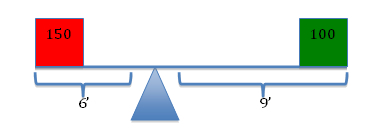
Imagine two people sitting on opposite ends of a 15-foot teeter-totter. The laws of physics dictate that the seesaw will balance if the product of the first mass (w1) and its distance (d1) from the fulcrum (i.e. the balancing point) is equal to the product of the other mass (w2) and its distance (d2) from the fulcrum. Thus, the physicist can show that the teeter-totter will be in balance when the fulcrum is placed 6 feet from the end holding a 150lb person and 9 feet from the end holding a 100lb person. Moreover, the laws of physics ensure that an imbalance will arise if the mass or the relative position of one of the people is changed.

The laws of accounting allow us to demonstrate that similarly powerful concepts apply to the science of economics. Beginning with the simple identity for GDP in a closed economy, we have:

[1]   Y = C + I + G, where:

Y = GDP = National Income
C = Aggregate Consumption Expenditure
I = Aggregate Investment Expenditure
G = Aggregate Government Expenditure

For economists, this is as obvious as stating that a linear foot is the sum of 12 sequential inches. It simply recognizes that the total amount of money spent buying newly produced goods and services will yield an equivalent income to the sellers of these products. Thus, it demonstrates that expenditures are a source of income.

Once earned, income can be allocated in one of three ways. At the end of the day, all income (Y) will be spent (C), saved (S) or used in payment of taxes (T):

[2]   Y = C + S + T

Since they are equivalent expressions for Y, we can set equation [1] equal to equation [2], giving us:

C + I + G = C + S + T

Or, after canceling (C) from both sides and moving terms around:

[3]   (S – I) = (G – T)

Equation [3] shows that there is a direct relationship between what’s happening in the private sector (S – I) and what’s happening in the public sector (G – T). But it is not the one that Pete Peterson, Erskin Bowles, or President Obama would have you believe. And I want you to understand why they are wrong.


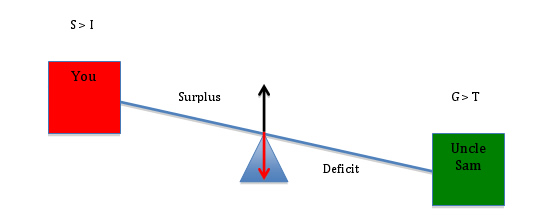
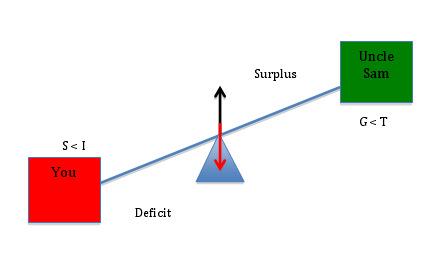
To understand the argument, imagine that you and Uncle Sam are sitting on opposite ends of a teeter-totter. You represent the private sector, and your financial status is given by (S – I). Your budget can be in balance (S = I), in deficit (S < I) or in surplus (S > I). When your financial status is positive (S > I), you are net saving. When your financial status is negative (S < I), you are net borrowing. Uncle Sam’s financial status is equal to (G – T), and, like yours, his budget may be balanced (G = T), in deficit (G > T) or in surplus (G < T). When you interact, only three outcomes are possible.

First, it is conceivable that (S = I) and (G = T) so that (S – I) = 0 and (G – T) = 0. When this condition holds, the teeter-totter will level off with each of you experiencing a balanced budget.


In the above scenario, the government is balancing its receipts (T) and expenditures (G), and you are balancing your savings and investment spending. There is no net gain/loss.

But suppose the government begins to spend more than it collects in taxes (i.e. G > T). How will Uncle Sam’s deficit affect your position on the teeter-totter? The answer is as straightforward as increasing the mass of the person on the right-hand side of the seesaw. As Uncle Sam’s financial position turns negative, your financial position turns positive.


This should make intuitive as well as mathematical sense, because when Uncle Sam runs a deficit, you receive more financial assets than you lose through taxation. Put simply, Uncle Sam’s deficit lifts you into a surplus position. Moreover, bigger deficits mean bigger surpluses for you.

Finally, let’s see what happens when Uncle Sam tightens his belt. Suppose, for example, that we were able to duplicate the much-coveted surpluses of 1999-2001. What would (and did!) happen to the private sector’s financial position?


Because the economy’s financial flows are a closed system – every payment must come from somewhere and end up somewhere – one sector’s surplus is always the other sector’s deficit. As the government “tightens” its belt, it “lightens” its load on the teeter-totter, shifting the relative burden onto you.

This is not rocket science, but it appears to befuddle scores of educated people, including President Obama, who said, “small businesses and families are tightening their belts. Their government should, too.” This kind of rhetoric may temporarily boost his approval ratings, but the policy itself will undermine the efforts of the very families and small businesses that are trying to improve their financial positions.

* I’ll be back with a second installment that shows what happens when we ‘open’ the economy to take into account the foreign sector (and the relevant financial flows). Many of us have been working with financial balance equations for years (see herefor references), so the current effort is nothing new. I am merely trying to make the arguments more accessible by changing the way they are presented.

Breakup of the euro? Is Iceland’s rejection of financial bullying a model for Greece and Ireland?

By Michael Hudson

Last month Iceland voted against submitting to British and Dutch demands that it compensate their national bank insurance agencies for bailing out their own domestic Icesave depositors. This was the second vote against settlement (by a ratio of 3:2), and Icelandic support for membership in the Eurozone has fallen to just 30 percent. The feeling is that European politics are being run for the benefit of bankers, not the social democracy that Iceland imagined was the guiding philosophy – as indeed it was when the European Economic Community (Common Market) was formed in 1957.

By permitting Britain and the Netherlands to blackball Iceland to pay for the mistakes of Gordon Brown and his Dutch counterparts, Europe has made Icelandic membership conditional upon imposing financial austerity and poverty on the population – all to pay money that legally it does not owe. The problem is to find an honest court willing to enforce Europe’s own banking laws placing responsibility where it legally lies.

The reason why the EU has fought so hard to make Iceland’s government take responsibility for Icesave debts is what creditors call “contagion.” Ireland and Greece are faced with much larger debts. Europe’s creditor “troika” – the European Central Bank (ECB), European Commission and the IMF – view debt write-downs and progressive taxation to protect their domestic economies as a communicable disease.

Like Greece, Ireland asked for debt relief so that its government would not be forced to slash spending in the face of deepening recession. “The Irish press reported that EU officials ‘hit the roof’ when Irish negotiators talked of broader burden-sharing. The European Central Bank is afraid that any such move would cause instant contagion through the debt markets of southern Europe,” wrote one journalist, warning that the cost of taking reckless public debt onto the national balance sheet threatened to bankrupt the economy [1]. Europe – in effect, German and Dutch banks – refused to let the government scale back the debts it had taken on (except to smaller and less politically influential depositors). “The comments came just as the EU authorities were ruling out investor ‘haircuts’ in Ireland, making this a condition for the country’s €85bn (£72bn) loan package. Dublin has imposed 80 percent haircuts on the junior debt of Anglo Irish Bank but has not extended this to senior debt, viewed as sacrosanct.”

At issue from Europe’s vantage point – at least that of its bankers – is a broad principle: Governments should run their economies on behalf of banks and bondholders. They should bail out at least the senior creditors of banks that fail (that is, the big institutional investors and gamblers) and pay these debts and public debts by selling off enterprises, shifting the tax burden onto labor. To balance their budgets they are to cut back spending programs, lower public employment and wages, and charge more for public services, from medical care to education.

This austerity program (“financial rescue”) has come to a head just one year after Greece was advanced $155 billion bailout package in May 2010. Displeased at how slowly the nation has moved to carve up its economy, the ECB has told Greece to start privatizing up to $70 billion by 2015. The sell-offs are to be headed by prime tourist real estate and the remaining government stakes in the national gambling monopoly OPAP, the Postbank, the Athens and Thessaloniki ports, the Thessaloniki Water and Sewer Company and the telephone monopoly. Jean-Claude Juncker, Luxembourg’s Prime Minister and chairman of the Eurozone’s group of finance ministers, warned that only if Greece agreed to start selling off assets (“consolidating its budget”) would the EU agree to stretch out loan maturities for Greek debt and “save” it from default [2].

The problem is that privatization and regressive tax shifts raise the cost of living and doing business. This makes economies less competitive, and hence even less able to pay debts that are accruing interest, leading toward a larger ultimate default. But turning debtor economies into a set of tollbooths to sell off remains the predatory textbook financial response.

Financial power is to achieving what military conquest did in times past. Pretending to make indebted economies more competitive, the actual aim is to squeeze out enough payments so that bondholders (and indeed, voters) will not be obliged to confront the reality that many debts are unpayable except at the price of making the economy too debt-ridden, too regressively tax-ridden and too burdened with rising privatized infrastructure charges to be competitive.

Cutting back public spending and regressive tax shifts dry up capital investment and productivity. Such economies are run like companies taken over by debt-leveraged raiders on credit, who downsize and outsource their labor force so as to squeeze out enough revenue to pay their own creditors – who take what they can and run. The tactic attack of this financial attack is no longer overt military force as in days of yore, but something less costly because its victims submit more voluntarily.

But the intended financial victims are fighting back. The attackers are not losing their armies and manpower, but their balance sheets are threatened – and hence their own webs of solvency with which they sought to entrap their prey. Greek labor unions (especially in the public enterprises being privatized), the ruling Socialist Party and leading minority parties rejected the radical sacrifices being demanded by Eurozone officials.

The bankers’ response was to insist that Greece respond to its wave of strikes and popular protest by suspending party politics and economic democracy. Financial planning be placed above party politics, and demanded “cross-party agreement on any overhaul of the bail-out.” “The government and the opposition should declare jointly that they commit to the reform agreements with the EU,” Mr. Juncker explained to Der Spiegel.

Criticizing Prime Minister George Papandreou’s delay at starting the sale of state assets, Europe’s financial planners proposed a national privatization agency to act as a face-saving “temporary” intermediary. The idea is to transfer revenue from these assets to foreign creditors – and to pledge its public assets as collateral to be forfeited in case of default in payments to government bondholders. Suggesting that the government “set up an agency to privatize state assets” along the lines of the German Treuhandanstalt that sold off East German enterprises in the 1990s,” Mr. Juncker thought that “Greece could gain more from privatizations than the €50 billion ($71 billion) it has estimated,” [3].

European bankers have their eye on the sale as much as $400 billion of Greek assets – enough to pay off all the government debt. Failing payment, the ECB threatened not to accept Greek government bonds as collateral. This would prevent Greek banks from doing business, wrecking its financial system and paralyzing the economy. This threat was supposed to make privatization “democratically” approved – followed by breaking union power and lowering wages (“internal devaluation”). “Jan Kees de Jager, Dutch finance minister, has proposed that any more loans to Greece should come with collateral arrangements, in which European state lenders would take over Greek assets in the event of a sovereign default,” [4]

And default will become pressing whenever the ECB may choose to pull the plug. It is inevitable, given the debt corner into which governments have recklessly deregulated the banks and cut property taxes and progressive income taxes.

The ECB makes governments unable to finance their spending by central banks of their own

Introduction of the euro in 1999 explicitly prevented the ECB or any national central bank from financing government deficits. This means that no nation has a central bank able to do what those of Britain and the United States were created to do: monetize credit to domestic banks and for public spending generally. The public sector has been made dependent on commercial banks and bondholders. This is a bonanza for them, rolling back three centuries of attempts to create a mixed economy financially and industrially, by privatizing the credit creation monopoly as well as capital investment in the infrastructure monopolies now being pushed onto the sales block for bidders – on credit, with the winner being the one who promises to pay out the most interest to bankers to absorb the access fees (“economic rent”) that can be extracted.

Politics is being financialized while economies are being privatized. The financial strategy was to remove economic planning from democratically elected representatives, centralizing it in the hands of financial managers. What Benito Mussolini called “corporatism” in the 1920s (to give it its polite name) is now being achieved by Europe’s large banks and financial institutions – ironically (but I suppose inevitably) under the euphemism of “free market economics.” It is the financial counterpart to Hayek’s Road to Serfdom – central planning by Wall Street, the City of London and Frankfurt, not Washington.

Language is adopting itself to reflect the economic and political transformation (surrender?) now underway. Central bank “independence” is euphemized as the “hallmark of democracy,” not the victory of oligarchy. The task of such rhetoric is to divert attention from the fact that the financial sector aims not to “free” markets, but to centralize control in the hands of financial managers. Their logic is to subject economies to austerity and even depression, sell off public land and enterprises, and reduce living standards in the face of a sharply increasing concentration of wealth at the top of the economic pyramid. The idea is to slash government employment, lowering public-sector salaries to lead private sector wages downward, while cutting back social services.

Latvia is cited as the model success story. Its government slashed employment and public sector wages fell by 30 percent in 2009-10. Private-sector wages followed the decline. This was applauded as a “success story” and “accepting reality” – despite accelerating emigration. So now, the government has put forth a “balanced budget amendment,” to go with its flat tax on labor (some 59 percent, with only a 1 percent tax on real estate). Former U.S. neoliberal presidential candidate Steve Forbes would find it an economic paradise.

The internal contradiction (as Marxists would say) is that the existing mass of interest-bearing debt must grow as it receives interest that is re-invested to earn yet more interest. This is the “magic” of compound interest. The problem is that its payment diverts revenue away from the circular flow between production and consumption. Say’s Law says that payments by producers (to employees and producers of capital goods) must be spent, in the aggregate, on buying the products that labor and tangible capital produce. Otherwise there is a market glut and business shrinks – with the financial sector’s network of debt claims bearing the brunt.

The financial overhead intrudes into this circular flow. Income spent to pay creditors is not spent on goods and services. It is re-invested in new loans, or on stocks and bonds (assets in the form of financial and property claims on the economy), or on “gambling” (“casino capitalism,” derivatives, the international carry trade – that is, exchange-rate and interest-rate arbitrage) and other financial claims that are independent of the production-and-consumption economy. So as financial assets accrue interest – bolstered by new credit creation on computer keyboards by commercial banks and central banks – the financial rake-off from the “real” economy increases.

The idea of paying debts regardless of social cost is backed by mathematical models as complex as those used by physicists designing atomic reactors. But they have a basic flaw simple enough for a grade-school math student to understand: They assume that economies can pay debts growing exponentially at a higher rate than production or exports are growing. Only by ignoring the ability to pay – by creating an economic surplus over break-even levels – can one believe that debt leveraging can produce enough financial “balance sheet” gains to pay banks, pension funds and other financial institutions that recycle their interest into new loans. Financial engineering is expected to usher in a postindustrial society that makes money from money (or rather, from credit) via rising asset prices for real estate, stocks and bonds.

It all seems much easier than earning profit from tangible investment to produce and market goods and services, because banks can fuel asset-price inflation simply by creating credit electronically on their computer keyboards. Until 2008 many families throughout the world saw the price of their home rise by more than they earned in an entire year. This cut out the troublesome M-C-M’ cycle (using capital to produce commodities to sell at a profit), by M-M’ (buying real estate or assets already in place, or stocks and bonds already issued, and waiting for the central bank to inflate their prices by lowering interest rates and untaxing wealth so that high income investors can increase their demand for property and financial securities).

The problem is that credit is debt, and debt must be paid – with interest. And when an economy pays interest, less revenue is left over to spend on goods and services. So markets shrink, sales decline, profits fall, and there is less cash flow to pay interest and dividends. Unemployment spreads, rents fall, mortgage-holders default, and real estate is thrown onto the market at falling prices.

When asset prices crash, these debts remain in place. As the Bubble Economy turns into a nightmare, politicians are taking private (and often fraudulent) bank losses onto the public balance sheet. This is dividing European politics and even threatening to break up the Eurozone.

Breakup of the Eurozone?

Third World countries from the 1960s through 1990s were told to devalue in order to reduce labor’s purchasing power and hence imports of food, fuel and other consumer goods. But Eurozone members are locked into the euro. This leaves only the option of “internal devaluation” – lowering wage rates as an alternative to scaling back payments to creditors atop Europe’s economic pyramid.

Latvia is cited as the model success story. Its government slashed employment and public sector wages fell by 30 percent in 2009-10. Private-sector wages followed the decline. This was applauded as a “success story” and “accepting reality.” So now, the government has put forth a “balanced budget amendment,” to go with its flat tax on labor (some 59 percent, with only a 1 percent tax on real estate). Former U.S. neoliberal presidential candidate Steve Forbes would find it an economic paradise.

So “Saving the euro” is a euphemism for governments saving the financial class – and with it a debt dynamic that is nearing its end regardless of what they do. The aim is for euro-debts to Germany, the Netherlands, France and financial institutions (now joined by vulture funds) to preserve their value. (No haircuts for them). The price is to be paid by labor and industry.

Government authority is to lose most of all. Just as the public domain is to be carved up and sold to pay creditors, economic policy is being taken out of the hands of democratically elected representatives and placed in the hands of the ECB, European Commission and IMF. The latter is playing “good cop” for the time being, to the ECB’s “bad cop.” But all financial institutions are willing to see Spain’s unemployment rate rise to 20%, much as in the Baltics, with nearly twice as high an unemployment rate among recent school graduates. As William Nassau Senior is reported to have said when told that a million Irishmen had died in the potato famine: “It is not enough!”

How much austerity is “enough” – for more than the short run? “Helping Greece remain solvent” means, in practice, helping it avoid taxing wealth (“too rich to pay” is the new corollary to “too big to fail”) and roll back wages while obliging labor to pay more in taxes while the government (“taxpayers,” a.k.a. workers) sells off public land and enterprises to bail out foreign banks and bondholders while slashing its social spending, industrial subsidies and infrastructure investment.

One Greek friend in my age bracket has said that his private pension (from a computing company) was slashed by the government. And when his son went to collect his own unemployment check, it was cut in half, on the ground that his parents allegedly had the money to support them. The price of the house they bought a few years ago has plunged. They tell me that they are no more eager to remain part of the Eurozone than the Icelandic voters showed themselves last month.

The strikes continue. Anger is rising. When incoming IMF head Christine Lagarde was French trade minister, she suggested that: “France had to revamp its labor code. Labor unions and fellow ministers balked, and Ms. Lagarde backtracked, saying she had expressed a personal opinion,” [5]. This opinion is about to become official policy – from the IMF that was acting as “good cop” to the ECB’s “bad cop.”

I suppose that all that really is needed is for people to understand just what dynamics are at work that make these attempts to pay in vain. Creditors know that the game is up. All they can do is take as much as they can, as long as they can, pay themselves bonuses that are “free” from recapture by public prosecutors, and run to their offshore banking centers.

[1] Ambrose Evans-Pritchard, “Iceland offers risky temptation for Ireland as recession ends,” The Telegraph, December 8, 2010.

[2] Bernd Radowitz and Geoffrey T. Smith, “Juncker Calls for Greek Privatization Agency,” Wall Street Journal, May 23, 2011, based on Juncker’s earlier interview in Der Spiegel magazine.

[3] Ibid.

[4] Peter Spiegel, “Greek assets could go to ‘fund of experts’,” Financial Times, May 24, 2011, Dimitris Kontogiannis, Kerin Hope and Joshua Chaffin, “Greece to sell stakes in state-owned groups,” Financial Times, May 24, 2011, and Alkman Granitsas, “Greece Speeds Up Plans to Sell Off State-Held Assets,” Wall Street Journal, May 24, 2011.

[5] Alessandra Galloni and David Gauthier-Villars, “France’s Lagarde Seeks IMF’s Top Job,” Wall Street Journal, May 26, 2011.

This article is an excerpt from Prof. Hudson’s work in progress, “Debts that Can’t be Paid, Won’t Be,” to be published later this year.

To Save the Euro, Germany Has To Quit the Eurozone

By Marshall Auerback

When the euro was launched, leading German politicians used to argue, with evident relish (and much to the chagrin of the British in particular), that monetary union would eventually require political union. The Greek crisis was precisely the sort of event that was expected to force the pace. But, faced with a defining crisis, Ms Merkel’s government is avoiding airy talk of political union – preferring instead to force harsh economic medicine down the throats of the reluctant Greeks, Irish, Portuguese and Spanish electorates. This is becoming both economically and politically unsustainable. If the objective is to save the currency union, perhaps policy makers are looking at this the wrong way around. In the end, paradoxically, to save the European Monetary Union, the least disruptive way forward would be for the Germans, not the periphery countries, to leave.

One major reason why political, and social, unification is so important is that it provides conditions under which the adjustment mechanism, to being uncompetitive, is facilitated. Labour mobility is much greater within, than between, countries. Cross-regional fiscal transfers help to smooth the adjustment process. Social and national unity makes break-away policies almost unthinkable and hence provides the cement to keep the discipline of adjustment in place.

None of the above are, as yet, strongly anchored in the euro-zone. Nor are they likely to be in the current context in which any moves toward a broader supranational fiscal structure continue to be resisted by the Germans, who perceive this as a backdoor mechanism for yet more bailouts of their “profligate” Mediterranean European “partners”.

And yet some sort of broader fiscal expansion is becoming increasingly necessary if the euro project is to be sustained. From a standard Keynesian perspective, shrinking a fiscal deficit is virtually synonymous with shrinking economic growth. Keynesians emphasize the prevalence of multiplier effects. Cuts in government spending and hikes in taxes are expected to reduce incomes and spending in the private economy. If the fiscal consolidation is ambitious enough, it can deliver an outright recession.

At the time the euro was launched, there was much hopeful talk that a surge in trade and investment between the euro zone nations would create a truly unified European economy, in which national levels of productivity and consumption would converge on each other. It was also assumed – or perhaps just hoped – that the euro would create political convergence. Once Europeans were using the same notes and coins, they would feel how much they had in common, develop shared loyalties and deepen their political union.

The designers of the single currency were hoping for a third form of convergence, between elite and popular opinion. They knew that in certain crucial countries, in particular Germany, the public did not share the political elite’s enthusiasm for the creation of the euro. But they hoped that, in time, ordinary people would embrace the new single European currency. This has clearly not been reflected by the reality. Crudely speaking, the markets today are calculating that governments lack the shared political commitment to underwrite the stability of the single currency.

The main disadvantage of adopting a currency union in the absence of a fully fledged political union is that it limits the ability of the constituent regions (countries) to adjust to an (asymmetric) shock by using domestic fiscal policy to mitigate the deflationary impact of this shock, as well as eliminating the ability to deploy exchange rate adjustments to do so. The European Monetary Union doesn’t work and without a federal fiscal redistribution mechanism it will never be able to deliver prosperity. Every time an asymmetric demand shock hits the Eurozone, the weaker nations will fail. Trying to impose fiscal rules and austerity onto the EMU monetary system just makes matters worse.

The fiscal austerity that accompanied the period of transition into the EMU as governments struggled to reach the entry criteria established under the SGP manifest now as persistently high unemployment and rising underemployment; vaporising social safety nets; decaying public infrastructure and rising political extremism.

Some 10 years after the introduction of the EMU, these problems are increasing rather than decreasing, as the proponents of the system claimed. Already, Greece has disappointed and requires more EU financing than the $150 billion that seemed more than enough a year ago. Despite the very great weakness in the Irish economy, its fiscal deficit still remains at 15% of GDP. The Portuguese finance minister has conceded that the Portuguese economy will contract 2% this year and 2% next year, and these forecasts tend to be optimistic. Portugal’s real GDP was still growing at a 1% pace versus a year ago, but the sequential contraction in the final quarter of 2010 also places that growth path in question (and in fact Portugal’s policy makers have shifted to a forecast of a 2% real GDP recession in 2011 and 2012). No surprise, then, that Portugal is joining Greece and Ireland in seeking loan assistance from the EFSF. Italy’s real GDP growth was the strongest versus a year ago at 1.5%, but the pace of growth was slipping by year end, and Moody’s has recently threatened the country with a debt downgrade.

And then there is Spain: As Rob Parenteau has noted recently (“Spain under Strain”), Spain’s recovery through the end of 2010 was primarily a consumer led advance, yet the fundamentals for consumer spending were hardly favorable. The tumble in retail sales growth that began late last year appears to have accelerated to the downside through March of this year. Higher taxes, plus the onset of the global consumption tax, have put the squeeze on consumer spending. The GCT also makes it more difficult for Spain to improve its current account balance. Investors and policy makers are fixated on reducing the fiscal deficit without considering what that requires for the financial balances of other sectors. The fact of the matter is that Spain has tended to run a chronic current account deficit, not a chronic fiscal deficit. The fiscal deficit is to a great extent just an artifact of the sharp reversal in private sector deficit spending that arrived once Spain’s housing boom went bust and the GFC hit. Private sector debt/income ratios are multiples of the government’s, yet all eyes are on containing the public debt/income ratio. Some earnest efforts at restructuring are underway, and early results may be showing up favorably in capital goods production, but unless more heroic efforts are taken to improve the rate of reinvestment of corporate profits in Spain’s economy, growth shortfalls may indeed lead to a destabilizing cycle at a time when the unemployment rate already tops 21%.. This in turn could knock the euro off its perch as expansionary fiscal consolidations become elusive across the eurozone periphery. Investors do not appear to fully appreciate the challenge Spain faces in maintaining an expansionary fiscal consolidation.

With three of the five peripheral nations contracting in the final quarter of 2010, and a fourth decelerating markedly, the elusiveness of an expansionary fiscal consolidation in the eurozone periphery is becoming all too evident. That is entirely consistent with the view that the cards may be stacked against an outcome which allows the periphery countries to grow their way out of trouble.

Of course, this wasn’t an issue prior to the creation of the EMU, during which each of the member states were sovereign in their own currencies and had their own central banks. That means they were not revenue-constrained and could conduct fiscal policy and monetary policy in a co-ordinated way to best serve the socio-economic interests of their citizens.

The German political class in particular seems incapable of recognizing this basic fact, as they continue to view this as a problem defined in terms of lax government fiscal discipline. Chancellor Angela Merkel’s interpretation of the woes of the Eurozone, for example, focus on what she claims are the problems of “excessive public debt”:

“We now have a clear crisis of indebtedness. But let me tell you, there is no crisis of the euro as such. This is a debt crisis. Let me say this very clearly again. The euro is our currency. And it is much more than just a currency. It is the embodiment of Europe today. Should the euro fail, Europe will fail. We are going to defend the euro …”

Which is tantamount to ignoring the real issue: There is no public debt crisis without the Euro. Japan has a public debt to GDP ratio at a level some 2.5 times bigger than the euro zone, yet there is no solvency crisis in Japan. The only reason the euro has hitherto survived to this point is because the ECB has stepped in as the “missing” fiscal agent and keeping the bond markets at bay. As the ECB’s bond purchases have wound down, however, the crisis has intensified, because the ECB remains the only entity in the EMU which has currency sovereignty and can “fiscally fund” member state deficits permanently. Given the central bank’s political resistance to continuing these purchases (largely supported by the Germans) the underlying logic of the monetary system will continue to ensure these on-going crises will spread across the union.

This in turn has led to discussions that the weaker constituents of the euro zone – notably, Greece and Ireland – undertake debt restructuring. Christian Noyer of the ECB recently set out the rationale as to why the central bank opposes such restructuring:

“If we restructure Greek debt, that means Greece defaults.”

“And what are the consequences of a default? The banks with the most Greek bonds are Greek banks. The Greek banks themselves will be badly damaged. When the banking system is stricken, what do you have to do to prevent the financing of the economy from collapsing? You have to recapitalize the banks. Who will recapitalize the Greek banking system? The Greek state.”

“That means the Greek state will gain nothing. It will invest in the banking sector everything that it has gained in the restructuring.”

“Next there are the Greek insurers and pension funds” who will be hurt. “That means it will weigh on the Greek population’s savings, which could cause a drop in consumer spending and Greek growth will take a hit. This counters the Greek recovery.”

“Then, what else is there in terms of Greek creditors? There’s the European public sector, European governments and the central banks. This is directly tapping the European taxpayer.”

“If we make European states pay, the mechanism of European financing will stop immediately. The states will not continue putting their taxpayers’ money on the line when their loans have just been cleaned out, when they’re taking losses on the money they’re lending. So that’s the end of support from other European states.”

“And for the central banks, what happens? Greek debt will become debt that is no longer worth anything. It’s no longer debt that can be considered as sufficiently safe for operations in the Euro System. That means by definition that to restructure is to become ineligible as collateral. If it’s ineligible, then it means a large part of what the Greek banks bring as collateral for refinancing can no longer be used. That means the Greek banking system can no longer be financed.”

“The next day what happens? Greece needs to find investors because the Greek state won’t move from deficit to surplus overnight. As long as it doesn’t have a primary surplus, the Greek state needs to borrow. International investors, that small group that remains, have just been restructured. It’s not the next day they’ll come back with financing.”

“The Euro System won’t refinance. The European states won’t finance. The IMF won’t go there alone. No one will finance the Greek state in coming years. That means the meltdown of the Greek economy. This is a horror story. That’s why we’re against a restructuring.”

Perhaps we’re looking at this the wrong way around: Given the continued German aversion to more broadly-based pan European style fiscal programs, which its populace continues to see as nothing but bailouts for lazy Mediterranean free-loaders, there is another way to solve the euro crisis.

Let Germany leave the euro zone.

Let’s leave aside the politics for a moment as there are many who believe that a German exit from the euro zone in effect means the end of the euro because a number of other countries would leave.

So consider this exercise solely from an economic context: The likely result of a German exit would be a huge surge in the value of the newly reconstituted DM. In effect, then, everybody devalues against the economic powerhouse which is Germany and the onus for fiscal reflation is now placed on the most recalcitrant member of the European Union. Germany will likely have to bail out its banks, but this is more politically palatable than, say, bailing out the Greek banks (at least from the perspective of the German populace).

To be sure, this will not come without some cost to Germany: Germany will probably save its banking system at the expense of destroying its export base. The newly reconfigured DM will soar against the euro and become the ultimate safe haven currency. This will mitigate the write-down impact of the inevitable haircuts on euro-denominated debt, because the euro (assuming it is retained by the remaining euro zone countries) will fall dramatically. Even if the euro itself vaporizes, the Germans simply will pay back debt in the old currencies, likely fractions of their previous value. And the German populace would likely find it far more palatable to be bailing out its own banks (as it did during the reunification period), as opposed to spending German taxpayer funds to recapitalize the banking systems of a bunch of Mediterranean “profligates”.

By the same token,, a fall in Germany’s external surplus means a large increase in the budget deficit (unless the private sector begins to expand rapidly, which is doubtful under the scenario described above), so Germany will find itself experiencing much larger budget deficits. In the current German situation, although the country runs a large current account surplus, it is insufficient to offset a high private sector predisposition to save (which means there is some deficit). But the current account surplus does allow for a smaller budget deficit than its so-called “profligate” Mediterranean neighbors, whilst still facilitating the private domestic sector’s desire to net save. As we have argued before, it is the “profligacy” of Germany’s Mediterranean trading partners, which has allowed it to rack up huge current account surpluses, and therefore run smaller budget deficits than the likes of the so-called PIIGS countries.

Once divorce from the euro is complete, Germany will regain its fiscal freedom. This is itself something the Germans should celebrate, providing their government takes advantage of their newfound fiscal freedom. Remember, once it returns to the Deutsche Mark (DM), Germany becomes the issuer, as opposed to the user of a currency, as is the case under the euro, and is fully sovereign in respect of its fiscal and monetary policy. Consequently, the German government can offset the external shock by running large government budget deficits, which will add new net financial assets to the system (adding to non government savings) available to the private sector. Germany might well decide not to adopt this course of action, given its historic resistance to aggressive fiscal policy, but it will no longer be bound by any of the institutional constraints inherent in the European Monetary Union.

In the meantime, the rest of the euro zone gets a huge boost to competitiveness via a (likely) substantial fall in the euro against the newly reconstituted DM. Also, the resultant potential instability means that the ECB would likely have to stand ready to backstop all of the bonds to prevent this from becoming a fully-fledged crisis, but it would encounter less political resistance to doing so, given the absence of a restraining German voice in the European Monetary Union.

It seems like an odd way to consider the problem, but the paradox of the current situation suggests that an exit from the euro zone of its strongest member, rather than its weakest links, might well be the optimal means of saving the euro, in the absence of a fully fledged return to separate national currencies.

In Praise of Sorkin’s Praise of Lowenstein’s Praise of Financial CEOs

By William K. Black

Roger Lowenstein has just taken the brave step of praising the failure to prosecute elite financial managers for fraud as a demonstration of the greatness of America. Lowenstein declares (1) that Blankfein was right – Goldman really was doing “God’s work,” (2) virtually no financial elites committed crimes, (3) any crimes they may have committed were trivial and played no material role in causing the crisis, (4) those that wish to hold fraudulent elites accountable for their crimes are (a) financially illiterate, (b) paranoid conspiracy theorists equivalent to those claiming the U.S. attacked the twin towers on 9/11, (c) a threat to our democracy and constitutional rights, and (d) engaged in “punishing profit,” (5) the prosecutors who refuse to bring criminal charges where they find elite frauds are the heroes safeguarding our democracy and constitutional rights, (6) the FBI is conducting a “serious” investigation of the elite financial frauds (despite points one through four above), and (7) the crisis was caused by “society” – because we’re all guilty no one should be held accountable – except those paranoids who want to destroy America’s greatness by prosecuting financial CEOs on fraud charges.

Wall Street: Not Guilty (May 12, 2011)

Lowenstein’s former colleague at the New York Times, Andrew Ross Sorkin, twittered that Lowenstein was “courageous” and “probably right.”

I join Lowenstein and Sorkin in denouncing the demagogues that denounce America’s financial CEOs for fraud and corruption and those that denounce our economic system for cronyism. My research has detected the ravings of two of the worst examples of this form of parasite. Two of the nation’s leading financial commentators have filled their books and columns with demagogic attacks on the productive class. Here are some of one’s vicious assaults on America’s CEOs and capitalist system.

“[Vast] pay-offs for failed executives exposed [American capitalism] as a fraud at its uppermost reaches.”

The author goes on to describe how senior corporate officials routinely engage in accounting fraud to make “the number” and maximize their bonuses. He stresses the complicity of the outside auditors and banks in aiding accounting control fraud. He claims that at investment banks: “the system was designed for cronyism” (emphasis in original). Indeed, he offers a comprehensive account of the criminogenic environment that creates the incentive and ability to engage in fraud with impunity. The author claims that the officers that control accounting frauds like Adelphia successfully manipulate banks by creating conflicts of interest because they believe that doing so will make it more likely that banks will fund their frauds – and he charges that our most elite banks are eager to be suborned and to turn a blind eye to the underlying fraud.

“The repeal of the Glass-Steagall Act, a Depression-era banking law, had paved the way for commercial banks like Citibank and Bank of America to get into the more lucrative business of underwriting. Adelphia’s Brown shrewdly exploited the banks’ greed. In a memo to bankers early in 2000, which cordially began, ”I hope your New Year is off to a great start,” Brown pitched the co-borrowing idea and pointedly observed, ”All of the lead managers and co-managers of each of these credit facilities are expected to have an opportunity to play a meaningful role in . . . public security offerings.”

In others words, if the banks lent the Rigases/Adelphia money, then Adelphia would spill some gravy onto their investment-banking divisions. When the bankers saw that, their mouths watered. This was exactly the sort of conflict that Glass-Steagall had been intended to prevent. The banks went for it. From 1999 to 2001, three banking syndicates, led by Bank of America, Bank of Montreal and Wachovia Bank, allowed the Rigases/Adelphia to borrow a total of $5.6 billion, a staggering sum. Citigroup, J.P. Morgan, Deutsche Bank and scores of other banks participated.
Anyone looking for mere gaps in the Chinese wall is missing the larger point: banks weren’t trying to separate departments but to integrate them. That was the whole reason they had lobbied for Glass-Steagall’s repeal. Thus, the banks would send teams of 8 or 10 investment bankers and commercial bankers — no distinction was evident, according to Tim Rigas — to Adelphia pitching every financial service under the sun.

Bank of America’s securities unit was so proud of the way it combined its services, which it referred to as ”delivering the one-stop shop,” that it produced a case study for interns in 2001 on how the technique had worked with a particular client. The client was Adelphia. Page after page describes how Bank of America had devised ”an integrated financing solution” for Adelphia, including underwritings, strategic advice, supportive (i.e., positive) research from its analyst and co-borrowing debt. Apparently, the only time Bank of America did not have an integrated approach to Adelphia was when it added up the debt that was disclosed in Adelphia prospectuses.”

The author stresses the negative effects of changes in the law that made it harder to bring civil suits against accounting fraud and the anti-regulatory agenda of industry. In the 1990s:

“Fueling the permissive climate, the Justice Department showed little interest in prosecuting cases of accounting fraud, which was not considered a major problem. These developments gave executives, accountants, and corporate lawyers a general sense that the risk to themselves had diminished. Veteran investors detected a new swagger in the executive suite.”

This is precisely the kind of attack on the Justice Department that Lowenstein decries. It is, of course, inconceivable that the Bush administration would have proven even more opposed to regulating and prosecuting elite white-collar criminals than the Clinton administration.

The author also attacks the private sector. Neoclassical economists have long assured us that fraud is impossible in the securities markets because creditors and investors exercise effective “private market discipline.” Private market discipline is the core function essential to efficient markets and capitalism, but the author claims that private market discipline has become so perverse that the supposed sources of discipline actually aid what criminologists call “accounting control frauds.”

“However badly the Rigases behaved, they were helped along the way by lenders and investment bankers, auditors, lawyers, analysts — just about anyone whose job it should have been to protect the public. And this is what truly distinguishes the latter stages of the last bull market: not that a handful of executives got greedy but that the safeguards supposedly built into our financial culture stopped functioning.”

The author writes that the Rigases involved facts so egregious that any honest lender should have refused to lend to them.

“Even to people familiar with Wall Street scandal, the central detail of this one remains astonishing. Somehow, the Rigases persuaded a network of commercial banks to lend to them more than $3 billion that not only the family, but also Adelphia, a public company with public shareholders, would be liable for repaying. The money was used, in large part, to buy Adelphia securities, which subsequently lost most of their value, as well as to make payments on stock the family had bought on margin. It was also used as a sort of A.T.M. to finance extravagances of the Rigases both small and not so small.”

“[I]nvestment banks floated billions of dollars of securities to the public with detailed descriptions of Adelphia’s finances that somehow neglected to mention the extra $3 billion of indebtedness. Even the S.E.C. was aware that Adelphia and the Rigas family each let the other borrow on its own credit, an unusual arrangement that, by its very nature, was vulnerable to abuse. But the S.E.C. apparently never investigated it.”

“And now that the stock market is back in the pink, a collective amnesia has settled over Wall Street, which takes comfort from the notion that the system essentially worked. The only problem is, it didn’t.”

The author claims that capitalism has become corrupt because of our elites’ power and class advantages.

[“T]he larger truth is that plenty of people were in a position to have blown a whistle and didn’t, for the simple reason that Wall Street during the 90’s operated like a grander version of Coudersport, a place where big fish had license to do as they pleased. ”The failed gatekeeper is a lesson you take away from all of these cases,” says Steve Thel, a Fordham University law professor who specializes in security fraud. ”Auditors who didn’t want to lose a client, bankers who were doing a ton of deals — there was a sense in our society that people who have a lot of money are supposed to have it.””

The same author has written about the major role that fraud played in the current crisis.

[World Savings’] “loan applications [were] so rife with fraud, that the quality of their book was as suspect as WaMu’s.

The author went on to complain about lenders

“Peddl[ing] these mortgages with a willful disregard, bordering on fraud, for whether their customers could repay them.”

Indeed, the author’s logic compels the view that the loans were on the wrong side of the fraud “border.” As the author describes the lenders, loans, and rating agencies that drove the crisis, the lenders knew that the borrowers could not repay the loans and the credit rating agencies willfully failed to determine whether the loans could be repaid because they would not have liked the answer had they inquired. The author doesn’t conclude that the loans are fraudulent because his analytics are so weak, but the facts he provides are damning. The context is that a rating agency, Moody’s, permitted him to examine an exemplar of a mortgage-backed security (MBS) (whose identity was disguised from the author and referred to as “XYZ”) collateralized by nonprime loans that it rated in 2006. The author notes that all of the loans backing the MBS were subprime – the lenders knew they were loaning money to borrowers with serious credit deficiencies. The author reports that this was only one aspect of why the loans’ were exceptionally likely to default.

Moody’s learned that almost half of these borrowers — 43 percent — did not provide written verification of their incomes.

By 2006, Credit Suisse estimated that half of all loans called “subprime” were also “liar’s loans.” The author does not note that the mortgage banking industry’s own anti-fraud experts reported that the incidence of fraud in liar’s loans is roughly 90 percent. The author also fails to note that investigators found that it was overwhelmingly the lenders and their agents, i.e., the loan brokers, who put the lies in liar’s loans. Instead, he reported that Moody’s: “reject[ed] the notion that they should have been more vigilant. Instead, they lay the blame on the mortgage holders who turned out to be deadbeats, many of whom lied to obtain their loans.” The author is also naïve in accepting Moody’s explanation that:

“Nearly half of the borrowers, however, took out a simultaneous second loan. Most often, their two loans added up to all of their property’s presumed resale value, which meant the borrowers had not a cent of equity.”

This is naïve because the author has, elsewhere, noted that Washington Mutual’s loans were “rife with fraud.” Andre Cuomo, when he was New York’s Attorney General, found that WaMu kept a blacklist of appraisers – and that one got on the list by refusing to inflate appraisals. No honest lender would ever inflate appraisals, but doing so optimizes accounting control fraud. Only the lenders and their agents, not the borrowers, can cause widespread inflation of appraisals. This means that the borrowers on liar’s loans commonly had negative equity in their homes from the day they purchased the house – they overpaid for the homes. The lenders and their agents, by inflating the appraisals, deceived less sophisticated borrowers about the value of their homes and placed them in a position where they were highly likely to lose the home and their very limited savings. The lenders and their agents’ primary reason for inflating the appraisal was to lower the reported loan-to-value (LTV) ratio. By falsely reporting a lower LTV ratio the lenders increased the ease of securing “AAA” ratings from a rating agency and the premium they could receive by selling the loan.

The author’s naïve acceptance of Moody’s claims continues in his explanation of why the rating agencies gave ludicrously inflated ratings to MBS “backed” largely by fraudulent loans structured to have exceptionally high default rates.

“Moody’s did not have access to the individual loan files, much less did it communicate with the borrowers or try to verify the information they provided in their loan applications. “We aren’t loan officers,” Claire Robinson, a 20-year veteran who is in charge of asset-backed finance for Moody’s, told me.”

In the frenetic, deal-happy climate of 2006, the Moody’s analyst had only a single day to process the credit data from the bank. The analyst wasn’t evaluating the mortgages but, rather, the bonds issued by the investment vehicle created to house them.

The first clause is absurd. Moody’s did have “access to the individual loan files.” The claim that Moody’s was rating the bonds, not the underlying assets, is absurd. The bond derives its value (and risks) from the underlying mortgages. The only way to reliably evaluate the credit risk of a nonprime MBS was to review a sample of the loans. The author concedes that all Moody’s had to do to get access to the underlying mortgages was to say it would not rate securities unless it could sample loan quality.

“The agencies have blamed the large incidence of fraud, but then they could have demanded verification of the mortgage data or refused to rate securities where the data were not provided. That was, after all, their mandate. This is what they pledge for the future. Moody’s, S.&P. and Fitch say that they are tightening procedures — they will demand more data and more verification and will subject their analysts to more outside checks. None of this, however, will remove the conflict of interest in the issuer-pays model.”

The only reliable way to determine the credit risk of mortgage loans is to review a sample of the loans. Fitch finally did so, in November 2007 (a non-random date – the secondary market in nonprime loans had collapsed and there were no more fees to be received by inflating credit ratings). Fitch reported:

“Fitch’s analysts conducted an independent analysis of these files with the benefit of the full origination and servicing files. The result of the analysis was disconcerting at best, as there was the appearance of fraud or misrepresentation in almost every file.

[F]raud was not only present, but, in most cases, could have been identified with adequate underwriting, quality control and fraud prevention tools prior to the loan funding. Fitch believes that this targeted sampling of files was sufficient to determine that inadequate underwriting controls and, therefore, fraud is a factor in the defaults and losses on recent vintage pools.”

Fitch also explained why these forms of mortgage fraud combine with “layered risk” to cause severe losses.

“For example, for an origination program that relies on owner occupancy to offset other risk factors, a borrower fraudulently stating its intent to occupy will dramatically alter the probability of the loan defaulting. When this scenario happens with a borrower who purchased the property as a short-term investment, based on the anticipation that the value would increase, the layering of risk is greatly multiplied. If the same borrower also misrepresented his income, and cannot afford to pay the loan unless he successfully sells the property, the loan will almost certainly default and result in a loss, as there is no type of loss mitigation, including modification, which can rectify these issues.”

Note that Fitch, like Moody’s, places the onus for fraud solely on the borrowers rather than the rating agencies’ customers. This is understandable, but false. Because the author naively assumes that Moody’s could not review a sample of loans so that they could determine their credit risk the author does not ask the central analytical question – why did the rating agencies consistently refuse to sample the asset quality of nonprime loans that were known to be pervasively fraudulent. If the rating agencies had reviewed a sample of the loans we know what they would have found – exactly what Fitch found. That would have made it impossible to rate the securities above a “C” rating – virtually certain to default. The author explains the rating agencies’ perverse incentives to give the desired “AAA” rating.

“A deal the size of XYZ can bring Moody’s $200,000 and more for complicated deals. And the banks pay only if Moody’s delivers the desired rating.”

The author does not understand the logic of facts he reports, but those facts explain why the rating agencies adopted the financial version of “don’t ask; don’t tell.” The one thing they could never do was actually review the credit risk of the securities they were rating. If they looked, they would document the endemic fraud and never get paid. If even a few rating agencies reported that fraud was endemic among liar’s loans the entire secondary market in nonprime loans would have collapsed and the rating agencies’ most lucrative source of fees would have disappeared.

Their profits surged, Moody’s in particular: it went public, saw its stock increase sixfold and its earnings grow by 900 percent.

The author disagrees sharply with Lowenstein. He believes that the lenders and rating agencies saw the “classic signs” of a bubble before the bubble collapsed. The author, however, again displays naiveté about ARMs.

“Three-quarters of the borrowers had adjustable-rate mortgages, or ARMs — “teaser” loans on which the interest rate could be raised in short order. Since subprime borrowers cannot afford higher rates, they would need to refinance soon. This is a classic sign of a bubble — lending on the belief, or the hope, that new money will bail out the old.”

The author neglects two critical aspects of “teaser” ARMs. First, the lenders “qualified” borrowers on the basis of their purported ability to repay the initial – far lower – “teaser” interest rate. An honest lender would not do so because it would ensure extreme default rates. Second, the very low rates delayed the defaults, optimizing and extending accounting fraud. The facts that the author report are not “classic signs of a bubble” but rather classic signs of accounting control fraud.

While the author does not use the phrase, the facts he report demonstrate that the investment and commercial banks that created the nonprime securities deliberately and successfully generated a Gresham’s dynamic (bad ethics drives good ethics out of the marketplace) among the rating agencies by “shopping” their business to the least ethical rating agency.

“But in structured finance, a handful of banks return again and again, paying much bigger fees. Tom McGuire, the Jesuit theologian who ran Moody’s through the mid-’90s, says this arrangement is unhealthy. If Moody’s and a client bank don’t see eye to eye, the bank can either tweak the numbers or try its luck with a competitor like S.&P., a process known as “ratings shopping.”

And it seems to have helped the banks get better ratings. Mason, of Drexel University, compared default rates for corporate bonds rated Baa with those of similarly rated collateralized debt obligations until 2005 (before the bubble burst). Mason found that the C.D.O.’s defaulted eight times as often. One interpretation of the data is that Moody’s was far less discerning when the client was a Wall Street securitizer.”

The author reports that Moody’s created an absurd empirical methodology to justify claiming that pervasively fraudulent loans would have only minimal defaults. “Nonetheless, its credit-rating model continued to envision rising home values.” As long as home loans increased forever the borrowers could simply refinance their loans. The industry saying is: “a rolling loan gathers no loss.”

Sorkin, who so courageously championed Lowenstein’s column denying the existence of fraudulent lending and sales on nonprime securities and praising the “serious” prosecutions of fraudulent lenders, should turn his wrath to another author who has taken the opposite position. This author has been very harsh in his critique of the Department of Justice, complaining:

“If the government spent half the time trying to ferret out fraud at major companies that it does tracking pump-and-dump schemes, we might have been able to stop the financial crisis, or at least we’d have a fighting chance at stopping the next one.”

The same author has disparaged Attorney General Holder’s announcement that the Department of Justice has made such investigations a top priority, as evidenced by “Operation Broken Trust.”

[A]fter you get past the pandering sound bites, a question comes to mind: is anyone in the corner offices of Wall Street’s biggest firms or corporate America’s biggest companies paying any attention to Mr. Holder’s “strong message”?

Of course not. (I actually called some chief executives after Mr. Holder’s news conference, and not one had heard of Operation Broken Trust.)

That’s because in the two years since the peak of the financial crisis, the government has not brought one criminal case against a big-time corporate official of any sort.

Instead, inexplicably, prosecutors are busy chasing small-timers: penny-stock frauds, a husband-and-wife team charged in an insider trading case and mini-Ponzi schemes.

This is the first of a multi-part response to Lowenstein’s column. The remaining columns will address why control fraud drove the current crisis and respond to Lowenstein’s strawman arguments. The sources of the quotations used in this column, from Messrs. Lowenstein and Sorkin, are provided below.

SOURCES

Roger Lowenstein, The End of Wall Street (2010); Origins of the Crash: the Great Bubble and its Undoing (2004); Origins of the Crash: the Great Bubble and its Undoing (2004).
http://www.nytimes.com/2004/02/01/magazine/the-company-they-kept.html?src=pm

The Company They Kept
By Roger Lowenstein
Published: February 01, 2004

http://www.nytimes.com/2008/04/27/magazine/27Credit-t.html
April 27, 2008

Triple-A Failure
By ROGER LOWENSTEIN
The Ratings Game

http://dealbook.nytimes.com/2010/12/06/pulling-back-the-curtain-on-fraud-inquiries/
DECEMBER 6, 2010, 8:59 PM
Pulling Back the Curtain on Fraud Inquiries
By ANDREW ROSS SORKIN

Bill Black is an associate professor of economics and law at the University of Missouri-Kansas City. He is a white-collar criminologist, a former senior financial regulator, a serial whistle blower, and the author of The Best Way to Rob a Bank is to Own One. He blogs primarily on the UMKC’s economics department’s blog: NewEconomicPerspectives. Bloomberg recently solicited a column from him on the role of fraud in the crisis.

He also discussed the role of fraud in the crisis extensively with Harry Shearer on Le Show.

Bill’s SSRN author’s page is:
http://papers.ssrn.com/sol3/cf_dev/AbsByAuth.cfm?per_id=658251

Mitch Daniels Uses Benefit-Cost Analysis to Teach his Daughter Ethics

By William K. Black

(Cross-posted with Benzinga.com)

This is the fourth and final article in a series of pieces discussing the claim by a Cato scholar at CIFA’s recent meeting in Monaco that formal benefit-cost tests by economists were essential to prevent regulatory excess. The second column focused on a speech in 2001 by Mitch Daniels, then President Bush’s Office of Management and Budget (OMB) director to the Competitive Enterprise Institute (CEI).

Mitchell E. Daniels, Jr., Competitive Enterprise Institute Speech, 05/22/2002

Daniels is the nation’s leading proponent of benefit-cost tests, and the purpose of his speech was to advance arguments in favor of OMB economists’ use of benefit-cost tests to block the adoption of regulations. The column discussed Daniel’s use of a “mistress metaphor” to explain why economists’ formal benefit-cost tests are vital.

Continue reading

Mitch Daniels Fails to use Benefit-Cost Tests when they demonstrate an Inconvenient Truth

By William K. Black

(Cross-posted with Benzinga.com)

This is the third article in a series of pieces discussing the claim by a Cato scholar at CIFA’s recent meeting in Monaco that formal benefit-cost tests by economists were essential to prevent regulatory excess. The second column focused on a portion of a speech in 2002 by Mitch Daniels, then President Bush’s Office of Management and Budget (OMB) director to the Competitive Enterprise Institute (CEI). Daniels is the nation’s leading proponent of benefit-cost tests, and the purpose of his speech was to advance arguments in favor of OMB economists’ use of benefit-cost tests to block the adoption of regulations. The second column discussed Daniel’s use of a “mistress metaphor” to explain why economists’ formal benefit-cost tests are vital. This column focuses on Daniels’ dismissal of benefit-cost analysis when it demonstrates an inconvenient truth.

A word about Daniels’ host is in order to understand the raucous laughter his misogynist memes about how wives should not object to their husbands taking a mistress produced among his audience. The CEI is a group funded by the usual anti-regulatory firms. CEI’s mission is to oppose regulation. I wrote in my first column of the embarrassing spectacle of theoclassical economists (with a track record of getting economics disastrously wrong) trying to become amateur climatologists denying global climate change. CEI, largely funded by Exxon, and acting through a non-scientist (much less a climatologist) exemplifies this embarrassment. What’s particularly humorous is that CEI decries “junk science.” What I didn’t learn until researching the context of Daniels’ speech to CEI is that he too is an amateur climatologist.

Daniels relies primarily on Michael Crichton, a deceased science fiction writer who was not a climatologist or related scientist, as his authority for the assertion that global climate change is a fiction, or unrelated to human activity, or desirable, or whatever is the next desperate dodge of science. On May 30, 2009, Governor Daniels gave the commencement address at Rose-Hulman, a superb school emphasizing math and science in Indiana. The address contains the usual, and in the case of Rose-Hulman, fully justified odes to the need for scientists to bring their expertise to bear on scientific problems that “our politicians” do not understand. The address even has an ode to benefit-cost studies – just before a politician (Daniels) who lacks any scientific expertise and does not “understand” complex scientific issues declares that it takes “courage” for him to deny global climate change even though he lacks any scientific basis for his denial. And he wants the grads to know that he is really, really upset that people criticize him for his theocratic, non-scientific rejection of climatologists’ research findings. He asserts that the scientists, writing in their area of expertise, are from “Hollywood” and are “Ayatollah[s].” Well no, actually, but then Daniels had just warned his audience that politicians do not understand scientific issues and are want, in the inimitable words of Senator Kyl to make claims about their opponents that are “not intended to be a factual statement.” Or, as Daniels put it in his address: “When I say these things, that’s just one more politician spouting off.”

“The issues that now face our country often require a technical understanding, or a grasp of statistics, or cost-benefit analysis, or an appreciation of the scientific method with which the general public is not equipped, and which our politicians neither understand nor particularly want to.

Let’s take just one example. A relentless project has inundated Americans for years with the demand that we must drastically reduce the carbon dioxide we emit as a society. It is asserted that the earth is warming; that this warming would have negative rather than positive consequences; that the warming is man-made rather than natural; that radical changes in the American economy can make a material difference in this phenomenon….

Although there are scientists, and scientific studies, that are deeply skeptical of all these claims, they are rarely heard in what passes for public debate. The debate, so far, has been dominated by “experts” from the University of Hollywood and the P.C. Institute of Technology.

Joining this discussion will require more than technical competence; it will take courage, too. In what has become less a scientific than a theological argument, anyone raising a contrary viewpoint or even a challenging question is often subjected to vicious personal criticism. Any dissident voice is likely to be the target of a fatwa issued by one Ayatollah or another of the climate change theocracy, branding the dissenter as a “denier” for refusing to bow down to the “scientific consensus.””

One can see from this address why CEI was a totally safe venue for Daniels. But what happened to benefit-cost analysis in Daniels’ discussion of global climate change? The benefits of controlling global climate change, according to what even Daniels’ concedes in his speech is a consensus of climatologists, are exceptionally large. Daniels could argue that the costs of limiting global climate change exceed those benefits, but that is not what he argued in his commencement address. (For good reason, he would be hard pressed to demonstrate that the costs exceeded the benefits.) Instead, he argues that we should disregard the experts’ consensus because doing so is congenial with Daniels’ anti-governmental ideology. If the OMB economists can pick and chose their science whenever there is any scientific dispute – even where there is a scientific consensus – then benefit-cost tests become a sham designed to hide the fact that their anti-regulatory ideology. Mitch Daniels abandoned sound benefit-cost analysis on global climate change because it would have demonstrated an inconvenient truth – government intervention is essential to restrict global climate change.

Mitch Daniels’ ode to learning to treasure your husband’s mistress

By William K. Black

Cead mile failte romhat – one hundred thousand greetings to you from Dublin. My UMKC economics department colleague and I are presenting ideas on how Ireland could respond to its banking, budget, and financial crises.

This is the second part of my series of articles on benefit-cost analysis, prompted by a discussion at CIFA’s recent ninth annual meeting in Monaco. This part focuses on the logic employed by the nation’s leading advocate of requiring benefit-cost tests before allowing any regulatory actions. Governor Daniels (R. Indiana) previously served as President Bush’s Director of the Office of Management and Budget (OMB). In 2002, OMB Director Daniels explained to a Competitive Enterprise Institute (CEI) audience why formal benefit-cost analyses by OMB mirrored “everyday life.”

“We need to remind people, that cost benefit analysis is part of everyday life. Perhaps you’ve heard of the couple out dining one evening, when a lovely, much younger lady passed by the table and visibly winked at the husband. His wife, not missing a thing, said, “Who was that?” After some hemming and hawing, he finally confesses: it’s his mistress. She said, “That’s it! I always feared and suspected. It’s over, I want a divorce.” “Now dear, not so fast. You [do] realize if that happens, no more diamonds on your birthday, fewer of those shopping trips to New York, what about the country club charge account?” About that time, another couple passed by and she said, “Isn’t that your friend Jim from the office?” He said, “Yes.” “Well who’s that young woman with him?” “Well, that’s Jim’s mistress.” She says, “Aha! Ours is prettier.” [laughter]”

http://www.whitehouse.gov/omb/speeches_cei_regulatory052202
Mitchell E. Daniels, Jr., Competitive Enterprise Institute Speech, 05/22/2002

Again, one cannot compete with unintentional self-parody. Daniels chose a metaphor to defend benefit-cost tests that lays bare many of the worst aspects of formal benefit-cost tests by economists. Daniels delights in his tale of how an unfaithful, rich, powerful, and older man cheats on his wife, humiliates her in public, and essentially prostitutes his wife and his mistress. Perhaps the worst aspect – and here Daniels is simultaneously acute and clueless – is the wife’s use of the word “ours.” When elites use their dominant power to exploit and corrupt less powerful people they also seek to impose a false construct on their victims that makes them appear to be beneficiaries rather than victims. The macho male meme is that his domineering control of his wife’s life and decisions constitutes “protecting” his wife. She is supposed to perceive and express a debt of gratitude rather than resentment to her oppressor.

The wife in Daniels’ ode to benefit-cost tests is not looking for a “three-way.” She gains nothing from the mistress except the humiliation of having the affair rubbed publicly in her face. Her husband is not interested in her. She is simply useful to his career in certain social roles. He wants to avoid an expensive divorce that might hurt his social standing. He is willing to cheat on the woman with whom he has exchanged the most sacred vows and shared the closest relationship. He is someone who makes it clear he cares only about his pleasure — shareholders, creditors, and customers are simply suckers to be looted. His wife may well know about how he cheated them and the IRS. Elite husbands that cheat have special reasons to fear the fury of a woman scorned, deceived, humiliated, and divorced. So what is this “ours” nonsense? The “lovely, much younger woman” is her husband’s mistress. The husband’s complete degradation of his wife occurs if he can use his power and wealth to cause her to come to view the “lovely, much younger woman” as “our” mistress.

Daniels’ decision to use this degrading illustration as his exemplar of benefit-cost analysis is also unintentionally revealing about absurd applications of such analyses in which they create the illusion of rational decision-making but recurrently produce tragedy. First, why did the wife have only two choices – accede to the husband’s taking of a mistress or seek a divorce that would cause her a dramatic loss of wealth? The husband could have ended his affair or he could have agreed to a divorce in which he provided her with far greater support. She could have remained married but taken a lover. (Would the husband have viewed him as “our” lover?) OMB economists can frame the alternatives considered (and excluded) to secure the result of the benefit-cost “test” that they desire. Second, for most women, the critical factors that they would weigh in deciding how to respond to learning that their husband had taken a mistress would be impossible to quantify. Do they have kids? What will be the effects of the divorce on them? Would the harm to the kids be reduced if they were older? Does she want to try to save the marriage? How probable is it that he will end the affair and become faithful to her? Does she love him? Can she live and her children live independently without his income and assets?

Assume that the wife is initially so desirous of continuing to avoid the end of: “diamonds on your birthday, fewer of those shopping trips to New York, [and] … the country club charge account?” that she decides not to divorce him. How long can this last? As the husband and mistress become even more open about their sexual relationship, and as the mistress increasingly receives the jewels and shopping trips and maxes out the country club charge account – will the wife view the relationship as a “net benefit” and the mistress as “ours”? As she is progressively humiliated in front of her children, relatives, and friends by the relationship will she view the relationship as a net benefit? I think virtually all of us believe that the scenario that Daniels’ sets up as the optimal decision derived from benefit-cost analysis will end badly and harm her and kids severely. In the end, economic benefits and costs are rarely as important as human views of love, respect, and dignity. Formal benefit-cost tests run by economists are typically driven by the economic benefits and costs rather than the aspects of life more important to humans. This creates a systematic bias that makes benefit-cost tests more likely than not to produce the wrong answer as to net benefits.

Next week’s column explores Daniel’s application of benefit-cost analysis to science, morality, consumer protection regulation, and the financial crisis.