William K. Black interviewed by Ian Masters on KPFK FM-90.7 – Los Angeles

William K. Black was interviewed by Ian Masters on KPFK FM-90.7 – Los Angeles. Click here to listen to the full interview. You can also listen to the full program.

Background Briefing with Ian Masters:
 

We begin by discussing the continued uncertainty about financial stability in the Eurozone, and the European Central Bank’s ability to weather the accumulating debt burden of Greece, Ireland, Portugal, Spain and Italy. William K. Black, the former litigation director of the Federal Home Loan Bank Board, who investigated the Savings and Loan disaster of the 1980’s, joins us to assess the exposure of German banks and how much they are hiding bad loans.

Pavlina Tcherneva on KPFK FM-90.7 – Los Angeles

Pavlina Tcherneva was interviewed by Ian Masters on KPFK FM-90.7 – Los Angeles. To listen to the interview click here.

Background Briefing with Ian Masters:

“we look into the state of economic literacy in the United States following the debt-ceiling debacle and the S&P debt-rating agency’s repudiation of the deal that has set off financial tremors around the globe. Research scholar at the Levy Economics Institute, Pavlina Tcherneva joins us to see if any lessons were learned from a brazen act of stupidity that has the nation’s self-inflicted financial wound getting worse as those responsible blame everyone but themselves.”

BLOG #10 RESPONSES: ACCOUNTING FOR MONEY FLOWS

L. RANDALL WRAY

Thanks for comments. I am cutting off the responses early, and will keep this short, because I am in Euroland and preparing to fly back.

Let me quickly respond to the six people who commented, and then provide a short answer to the homework question.

Neil: One imposed constraint is that banks can refuse instructions to make transfers, including transfers ordered by government that has abandoned its fiat money.

Answer: OK for individuals the bank might refuse in two cases: apparent fraud or insufficient funds. We certainly applaud any bank that refuses to shift funds out of our account if it suspects fraud! We are not quite so happy when it refuses to clear a check in the case of an overdraft, because we get charged fees. But, OK, so far. In the case of government, I’m not quite so willing to go along with your suggestion, for two reasons. First, I do not really like the term fiat money and do not know what it is supposed to mean. I use the term sovereign currency. As I will discuss in coming weeks, there are different sovereign currency regimes—from fixed to floating rates. A sovereign’s currency is, on my definition, sovereign. There are constraints on sovereign spending, including those self imposed. It could instruct its bank (the central bank) NOT to make payments when its deposits are insufficient. It might even instruct the CB to impose fees for insufficient funds! Beyond that I am not quite sure what point you are making. Even if the sovereign government did not have a “fiat currency” (whatever that means) it could decapitate any central bankers that bounced checks. This might become more clear soon.

Had ‘Nuff: Money of account can be replaced by medium of exchange; domestic currency should include demand deposits; government IOUs are not debt; currency tax.
Answer: Think of it this way: Money of account is the measure (foot, yard, inch), medium of exchange is the thing being measured (shoe, arm, earlobe). Domestic currency is the government’s IOU; demand deposits are bank IOUs—so in my view we should not mix them. They are issued by quite different entities. An IOU is a debt, so government IOUs are debts. Not sure what point you are trying to make. 
Now, why would I disagree with JKH, who claims reserves should not be included in a definition of currency? Reserves, Federal Reserve Notes (our green paper money), Treasury notes (yes, Treasury has issued paper money, too), and Treasury coins are all IOUs issued by government (either Fed or Treasury), and all commit Uncle Sam. Fed losses come out of the Treasury. If Fed goes insolvent (which it might!), Treasury will cover the losses and recapitalize it.

Functionally there is one difference in that Reserves can only be held by banks; the rest can be held by you and me. But reserves are perfectly substitutable for all the others. So why do some resist recognizing this? They want to maintain the fiction that the Fed is not part of government. Sorry, Charley, it is. Plain and simple, it is a legal creature of Congress. Finally, I have no idea what a currency tax is.

James: Treasury’s account at the Fed is not counted as money supply but rather is a Fed IOU; but Treasury spending reduces its deposit at the Fed thus taxes do “pay for” Treasury spending.

Answer: Well, I do not see how. When you pay your taxes, you draw down your bank demand deposit. A private bank credits the Treasury’s account at the bank. BUT THE TREASURY CANNOT WRITE A CHECK ON THAT. There is no way the Treasury can “spend” your tax payment. It can only write checks on its account at the Fed, and you do not have an account at the Fed. You cannot deliver to the Treasury what it needs to spend. You might say I am being picky. I say I am being precise.

Hepion: Banks keep their money at the Fed; where does the Fed store it; and who manufactures it?

Answer: The Fed hides it in caves in Kansas City. Send a self-addressed and stamped envelope with $5000 in unmarked bills to me, and I will send you a secret treasure map with an X marking the spot.

Seriously: banks don’t keep money at the Fed, indeed, banks do not have any money. Willie Sutton (google him) was wrong. Don’t bother robbing banks, because that is NOT where the money is. Banks have an electronic account at the Fed—numbers on a harddrive. I suppose the harddrive is made in China. No other manufacturing is involved. In addition, banks have a very small amount of “vault cash” in their vaults. Believe me, not worth robbing. If you really want to rob banks, do what my colleague Bill Black says: the best way to rob a bank is to own one. Then you simply credit your own bank account with bonuses. Where will you get the millions of dollars to credit your account once you own a bank? Keystrokes.

Marley: How does Fed buy back Treasuries?

Answer: You are well on your way to getting this right. Fed credits private bank (selling the Treasuries) with Fed’s own IOU, bank reserves. Fed holds the bonds as assets, offset by reserves as liabilities. So in the end, although Fed cannot buy the bonds directly from the Treasury, it buys them from banks.

Adam: (Long post…I won’t repeat it)

Answer: By Jove, he’s got it! Excellent. Grade = A.

Homework Assignment: where does the electronic “scoreboard” money come from or go to? Think of the football game, or bowling. Where do the points “come from” when you score a touchdown or knock down a pin? Where do they go at the end of the game when we clear the score board? Well, they are just “key strokes”—electronic pulses that light up the LED when points are scored, and we stop sending the pulses to turn off the LEDs. That’s all there is to it. Keystrokes.

Follow up homework? Can Government run out of keystrokes?

Poverty, Joblessness, and the Job Guarantee

By Pavlina R. Tcherneva

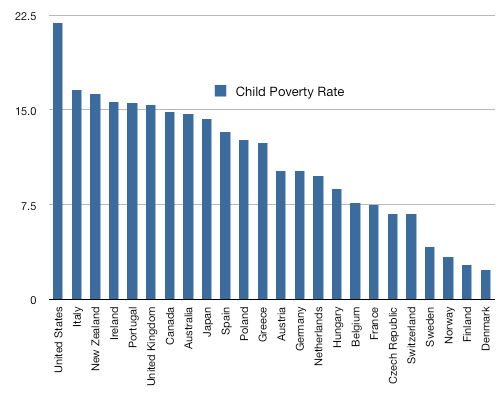
A recent report on the State of America’s Children revealed distressing statistics. More than 1 in 5 children live in poverty in the U.S., by far the most impoverished age group in the nation. Between 2008 and 2009 child poverty jumped 10%, the single largest annual jump in the data’s history. While the U.S. is the wealthiest nation in the world in terms of GDP (and # of billionaires), it ranks last in relative child poverty among all industrialized nations.

source: http://yglesias.thinkprogress.org/


Overall we have 46.3 million people in poverty in the U.S. (the largest number in the postwar era), which is 14.3% of the total population—a percentage that has been trending up since 2000.

The European Central Bank Rises above the Law and its Principles

By William K. Black

The European Central Bank (ECB), at the insistence of Germany’s government, was created with a single mission – price stability. Its mono-mission represented an explicit rejection of the U.S. Federal Reserve’s dual mission of price stability and full employment. The usual explanation for this choice is German’s phobia about inflation arising from the searing experience of hyper-inflation during the Weimar Republic. The hyper-inflation discredited the Republic and is often blamed for Hitler’s electoral successes. One must be cautious about this explanation, however, for the demands of the German public did not drive the creation of the ECB. The creation of the euro required the creation of the ECB. Polls showed that had the German public’s policy views prevailed, Germany would have rejected adoption of the euro by a wide margin. German businesses, particularly its banks, pushed Germany to adopt the euro and they made sure that the German public was not permitted to vote on the creation of the euro and Germany’s adoption of the euro.

German banks did not trust Italy and demanded that the EC’s sole mission be preventing inflation (more precisely, any inflation above roughly 0.5 percent annually.) The ECB was to be run strictly along the lines of German Central Bank’s holy war against inflation. Implementing the ECB’s exclusive focus on stopping inflation created a political tension with France, Germany’s partner in running the EU. France successfully demanded that the first head of the ECB serve only half his term and be succeeded by a French official. Germany’s obsession with avoiding even modest inflation, however, was shared by many senior EU central bankers so regardless of nationality, ECB senior bankers have acted as if they were conservative German central bankers.

The ECB praised its mono-mission and asserted its superiority over the U.S. model. The mono-mission was the perfect accompaniment for the rising cult of theoclassical economics. The active use of fiscal policy to counter recessions was anathema, a tool of the Keynesian devil. The ECB’s theoclassical dogma was clear and proud: (1) democratic governments have perverse incentives to seek to lower unemployment, (2) which create an inflationary policy bias, which (3) can only be countered by a rigorously independent central bank, with (4) a mono-mission set by statute which rested exclusively on preventing inflation regardless of its short-term effect on unemployment, and (5) a belief that ending inflation would automatically minimize long-term unemployment.

In essence, the ECB declared that inflation causes recessions and that wage increases drive inflation. The ECB dogma on unemployment was internally inconsistent. The ECB (mostly) believed in a Phillip’s Curve – that reducing unemployment inevitably increased inflation and that a fanatic devotion to maintaining price stability maximized employment.

The problem, as a number of economists pointed out when the euro was being created, was that these ECB policies, together with the severe constraints (even in a recession) of the EU’s “growth and stability” pact, would inherently lead to a crisis when the EU faced a severe recession. Economic critics of the euro pointed out that the nasty scenario would be a recession that was far more severe in the periphery because ECB policies would be set by the German-French core with minimal policy input from the periphery. The core would demand austerity, which would lock the periphery, unable to devalue given their adoption of the euro and unable to adopt effective counter-cyclical fiscal policies due to the EU’s oxymoronic “growth and stability” pact, in a severe recession and expose the periphery to attacks on its debt. Nations that adopt the euro give up their fiscal and monetary sovereignty. The theory of the euro and the ECB was to let the people of the periphery twist slowly in the wind in the event of a serious recession.

The ECB was actually proud of this policy of indifference to the suffering of the periphery’s residents. The ECB reveled in its insistence on what might be called “tough love” for the never-to-be-trusted southern periphery. The inhumanity of the ECB’s mono-mission was intended. The unintended consequences of the ECB’s mono-mission, however, threatened the survival of the euro and the ECB. Indeed, the unintended consequences exposed the grave limits of the German and French devotion to creating an “ever closer European union.” The Great Recession revealed that the Germans and French did not really feel that they were part of a European nation dealing with fellow countrymen and women who were in need. No, they were being asked to bail out indolent Greeks, shiftless Irish, and easy-to-ignore Portuguese. The willingness of Germany’s leaders to bail out the periphery has almost nothing to do with EU solidarity and everything to do with bailing out German banks through a “below the radar” mechanism.

The ECB inherently must perform effectively four missions if the euro is to avoid causing repeated crises and, eventually, collapse. In addition to fighting severe inflation, the ECB must (1) minimize unemployment, (2) serve as a lender of last resort to member nations and banks, and (3) serve as a “regulatory cop on the beat” to prevent the epidemics of accounting control fraud in EU banks that hyper-inflated financial bubbles, rendered most of the EU’s largest banks insolvent, and caused the financial crises that shut down hundreds of financial markets and drove the Great Recession. The ECB, however, is not permitted to serve these other three missions under is mono-mission statute. It remains true however, that the prospect of being hung in a fortnight (or less) focuses central bankers’ minds most wondrously. The ECB has repeatedly risen above its theoclassical principles and the law governing its mission. Necessity has forced the ECB to adopt the lender of last resort function and (in economic substance regardless of the nominal structure) bail out banks and member nations.

The ECB remains indifferent, however, to the periphery’s unemployment. Indeed, the ECB’s demand for what our CIA refers to as “draconian” austerity programs (in Ireland), is the principal cause of increasing unemployment in much of the periphery. The ECB’s pro-cyclical policies are economically illiterate and will generate recurrent economic and political crises in the periphery that will soon bring to political power some of the most odious extremists in the EU. If the ECB continues its pro-cyclical policies it will produce a lost decade in the periphery and cause some nations to withdraw from the euro.

The ECB remains blind to the fact that it must ensure effective financial regulation, particularly of the systemically dangerous institutions (SDIs), if the euro and the ECB are to be effective. Accounting control frauds drove the crises in several European nations. Those crises imperiled the EU, the ECB, and the euro. The regulators must stop the “Gresham’s” dynamic that causes bad ethics to drive good ethics out of the financial markets. EU financial regulation suffered from what the authors of the book Guaranteed to Fail (Princeton 2011) call the “race to the bottom.” This perverse race towards anti-regulatory policies, another form of a Gresham’s dynamic, was decisive throughout the EU. Anti-regulators cannot break the Gresham’s dynamics that accounting control frauds create that lead to hyper-inflated financial bubbles and endemic fraud. Individual nation states cannot break the Gresham’s dynamic. They can divert the frauds to other nations by serving as the “regulatory cops on the beat,” but they cannot safeguard the EU. Only the ECB is in a position to provide that effective regulation and break the Gresham’s dynamic throughout the EU.

The ECB has, as predicted, risen above its principles and the mono-mission that the ECB championed. Its mono-mission imperiled the ECB’s ability to respond to the (not-so) sovereign debt crisis of the periphery and the European banks’ private and public debt crises. The ECB needs to rise above its principles and law to reduce the severe unemployment and economic suffering caused by the current crisis and become an effective regulatory “cop on the beat” to prevent or at least sharply limit future crises.

MMP Post #10 — Keeping Track of Stocks and Flows: The Money of Account

Stocks and flows are denominated in the national money of account. In previous weeks we examined the definitions of stocks and flows, as well as the relations between the two. (It might be helpful if you quickly review the previous discussion on stocks and flows, and the relation between the two: flows accumulate to stocks.) Financial stocks and financial flows are denominated in the national money of account. In this blog we will go through the details of keeping track of stocks and flows in the money of account. That will also lead us into a discussion of the relation between “money” and “spending”—how do we “pay for” things?
As discussed in the past two weeks, the money of account is almost always the domestic currency—the money of account chosen by the government. In some cases, however, the accounts can be kept in a foreign currency. For the purposes of this blog we will ignore that complication—all the record keeping discussed here will be presumed to take place in a single national unit of account. Let us begin with the case of an employee earning wages.
 While working, the employee earns a flow of wages denominated in a money of account accumulating a monetary claim on the employer. On payday, the employer eliminates the obligation by providing a paycheck that is a liability of the employer’s bank. Again, that is denominated in the national money of account.
If desired, the worker can cash the check at her bank, receiving the government’s currency—again an IOU, but this time a debt of the government. Alternatively, the check can be deposited in the worker’s bank, leaving the worker with an IOU of her bank, denominated in the money of account.
Wage income that is not used for consumption purchases represents a flow of saving, accumulated as a stock of wealth. The saving can be held as a bank deposit, that is, as financial wealth (the bank’s liability).
When it comes time to pay taxes, the worker writes a check to the treasury, which then debits the reserves of the worker’s bank. Reserves are just a special form of government currency used by banks to make payments to one another and to the government. Like all currency, reserves are the government’s IOU.
So, when taxes are paid, the taxpayer’s tax liability to the government is eliminated. At the same time, the government’s IOU that takes the form of bank reserves is also eliminated. The tax payment reduces the worker’s financial wealth because her bank deposit is debited by the amount of the tax payment.
We can conceive of a flow of taxes imposed on workers, for example, as an obligation to pay ten percent of hourly wages to government. A liability to government accumulates over the weeks as wages are earned, which is a claim on the worker’s wealth. The tax liability, measured in the money of account, is eliminated when taxes are paid by reducing the worker’s financial wealth (debiting deposits also measured in the money of account) and the bank’s reserves are simultaneously debited by government.
At the same time, the government’s asset (the tax liability owed by the worker) is eliminated when taxes are paid, and the government’s liability (the reserves held by private banks) is also eliminated.
Sometimes it is useful to compare these flows to water flowing in a river, that gets accumulated as a stock behind a dam. However, it is important to understand that these monetary stocks and flows are conceptually nothing more than accounting entries, measured in the money of account. Unlike water  flowing in a stream, or held in a reservoir behind a dam, the money that is flowing or accumulating does not need to have any physical presence beyond ink on paper or electrical charges on a computer hard-drive.
Indeed, in the modern economy, wages can be directly credited to a bank account, and taxes can be paid without use of checks by debiting accounts directly. We can easily imagine doing away with coins and paper notes as well as check books, with all payments made through electronic entries on computer hard-drives.
All financial wealth could similarly be accounted for without use of paper. Indeed, most payments and most financial wealth are already nothing more than electronic entries, always denominated in a national money of account. A payment leads to an electronic debit of the account of the payer, and a credit to the account of the payee—all recorded using electrical charges.
The financial system as electronic scoreboard. The modern financial system is nothing but an elaborate system of record-keeping, a sort of financial scoring of the game of life in a capitalist economy.
For those who are familiar with the sport of American football, financial scoring can be compared with the sport’s scoreboard. When a team scores a touchdown, the official scorer awards points, and electronic pulses are sent to the appropriate combination of LEDs so that the scoreboard will show the number six. As the game progresses, point totals are adjusted for each team.
The points have no real physical presence, they simply reflect a record of the performance of each team according to the rules of the game. They are not “backed” by anything, although they are valuable because the team that accumulates the most points is deemed the “winner”—perhaps rewarded with fame and fortune.
Further, sometimes points are taken away after review by officials determines that rules were broken and that penalties should be assessed. The points that are taken away don’t really go anywhere—they simply disappear as the scorekeeper deducts them from the score.
Similarly, in the game of life, earned income leads to “points” credited to the “score” that is kept by financial institutions. Unlike the game of football, in the game of life, every “point” that is awarded to one player is deducted from the “score” of another—either reducing the payer’s assets or increasing her liabilities.
Accountants in the game of life are very careful to ensure that financial accounts always balance. The payment of wages leads to a debit of the employer’s “score” at the bank, and a credit to the employee’s “score”, but at the same time, the wage payment eliminates the employer’s implicit obligation to pay accrued wages as well as the employee’s legal claim to wages.
So, while the game of life is a bit more complicated than the football game, the idea that record keeping in terms of money is a lot like record keeping in terms of points can help us to remember that money is not a “thing” but rather is a unit of account in which we keep track of all the debits and credits—or, “points”.
Your homework assignment (should you choose to accept it): Think about government spending and taxing in terms of those scoreboard electronic entries. When government “spends money”, where does it come from? When we pay taxes, where does the “money” go? In what sense does the government “spend the money it receives in tax payments?”

More Bad Beer From S&Ps David Beers


By Marshall Auerback
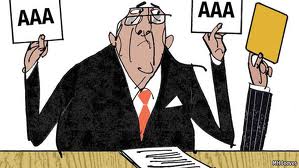
Like the horrible aftertaste that comes from throwing up the contents of one’s stomach after a night of binge drinking, the ratings agencies have reared their ugly heads again. David Beers, head of S&P’s government debt rating unit, announced Friday night that S&P has downgraded the U.S. credit rating for the first time, from AAA to AA. It’s a sham: S&P’s whole analytical framework reflects ignorance about modern money. If the US government, Treasury, and the Federal Reserve, capitulate to this outrageous act of economic extortion, it will effectively be sanctioning a beer hall putsch by the rentier class. 


Justifying its decision, Standard and Poor said “political brinkmanship” in the debate over the debt had made the U.S. government’s ability to manage its finances “less stable, less effective and less predictable.” It said the bipartisan agreement reached this week to find at least $2.1 trillion in budget savings “fell short” of what was necessary to tame the nation’s debt over time and predicted that leaders would not be likely to achieve more savings in the future.

“It’s always possible the rating will come back, but we don’t think it’s coming back anytime soon,” said Beers.

Of course, the response from Treasury was equally inane:

“A judgment flawed by a $2 trillion error speaks for itself,” a Treasury spokesman said last Friday.
 
$2 trillion, $4 trillion, who cares if the S&P is math-challenged?  It’s irrelevant!  The notion that the US can arbitrarily summon up the ability to register $4 trillion in “savings” demanded by Standard & Poor as the price for upholding America’s AAA rating is nonsensical, as it ignores the impact that the withdrawal of income will have on the overall economy and, by extension, the size of the government deficits that the ratings agencies regularly decry. An ex post outcome is never guaranteed by an ex ante action undertaken by government.  In other words, it’s not a number that can be controlled by the actions of political hacks in DC, so it’s truly pointless debating whether S&P screwed up on its calculations or not. And in their ideological zeal to demonize public debt and budget deficits, all of the ratings agencies are by definition relying on more private sector debt to drive growth, given that this is the only way to replace the government spending withdrawn. How did that work out for us in the last decade?

Treasury would have been on stronger ground if it had simply pointed out the sterling historic track record of the ratings agencies. Recall how well the S&P (along with Moody’s and Fitch) covered themselves with glory during the housing bubble, rating toxic subprime junk as AAA rated paper. Not only were the agencies politically corrupted by virtue of their incestuous ties to Wall Street, but criminally incompetent as well.  Yves Smith of Naked Capitalism gives a perfect illustration of the latter:

The biggest proof of criminal incompetence was their downgrades of RMBS versus CDOs made pretty much entirely of the same RMBS. They started downgrading RMBS en masse in July 2007. They didn’t start marking down CDOs until six month later, and the process took another six months. Yet it should have been impossible to downgrade the RMBS and not the CDOs at the same time. The downgrades were based on the failures of the underlying loans. You can’t have it show up in one product and not the other.

And S&P continues to screw up MBS ratings in the wake of heightened scrutiny (see here).
Credit ratings are based on ability to pay and willingness to pay.  And, as Alan Greenspan explained in 1997, a sovereign issuer always has the ability to pay:

[A] government cannot become insolvent with respect to obligations in its own currency. A fiat money system, like the ones we have today, can produce such claims without limit.  

Whether it chooses to make those payments is another matter.  But that’s a matter of politics, not economics. 


To be fair to Mr. Beers, his agency did specifically cite the political brinkmanship of a number of US Congressmen, who seemed far too inclined to contemplate the option of default as a means of securing greater spending cuts on the part of the US government. But that wasn’t the full story. S&P placed particular emphasis on the size of the cuts, implicitly suggesting that larger cuts would have superseded the political questions. That’s intellectual dishonesty at its worst.

Here are a few questions the S&P ought to have considered before it issued its debt downgrade:
Is government spending so high that it is competing with private sector spending plans? Certainly not – substantial amounts of plant and equipment remain idle, unemployment remains at depression like levels, and there is ample capacity for firms to expand if they want to do so. Businesses, however, are constrained by inadequate demand for their output, a phenomenon which would become even worse if the US were to follow the prescribed level of cuts advocated by S&P to retain its AAA rating with these economic blackmailers.  That is a real cost (and it also drives those “horrible” government deficits higher, as tax revenues plunge and social welfare expenditures via the automatic stabilizers rise).

Is government issuing so much debt that it is causing interest rates to skyrocket? Not in the slightest. Rates have actually gone NEGATIVE in term yields under 12 months over the past few weeks (so much for the notion that the end of QE2 would drive rates sky-high).  We have a deflation problem, not inflation. Widespread austerity of the sort now advocated by the S&P is destroying economic growth and the claims by politicians and economists that we would enjoy a “fiscal contraction expansion” if only the government stopped “crowding out” the private sector are now being revealed as bogus propaganda.   And the political dysfunction that Mr. Beers describes could have easily been avoided through a number of options, which would not have left the country in the hands of irrational deficit terrorists.  As Joe Firestone notes:

Treasury can cease issuing long-term bonds, and sell only three-month bonds. Three-month bond interest rates are generally controlled by overnight rates for bank reserves, and overnight rates can be driven down to near zero by flooding the banks with excess reserves. That’s basically how the Japanese keep their bond interest rates near zero, and that’s how we can do the same.

Firestone is right: A sovereign government like the US only sells securities in order to drain excess reserves to hit its interest rate target. It could always choose to simply leave excess reserves in the banking system, in which case the overnight rate would fall toward whatever rate the central bank offers to pay commercial banks for excess overnight reserves.

Even with our existing legal constraints (predicated on a now non-existent gold standard system in which we are forced to sell bonds before Treasury spends), Treasury/Fed have other tools to counteract the alleged effect of this downgrade.  Mr. Bernanke can simply call up the NY Fed and gives Mr. Dudley instructions to buy all the 10-year UST on offer to keep the US 10 year at, say 2.5%. It is an open market operation, which the Fed performs all the time. And the banks cannot lend out these reserves, so it’s not inflationary (see here for more explanation). Then, as Rob Parenteau and I have noted before, every time some so-called “bond market vigilante” tries to push it above 2.5% by shorting Treasuries, the Fed can slam their face into the concrete by having the open market desk buy the hell out of UST until the 10 year yield is back to 2.5%. Burn Fido enough times, yank his chain enough times, and like the Dog Whisperer, he gets it and stops.

Think this can’t be done if the ratings agencies downgrade the US?

Japan is a perfect illustration of how little these downgrades impact borrowing rates for a sovereign government (thanks to Bill Mitchell):  In November 1998, the day after the Japanese Government announced a large-scale fiscal stimulus to its ailing economy, Moody’s Investors Service began the first of a series of downgradings of the Japanese Government’s yen-denominated bonds, by taking the Aaa (triple A) rating away. The next major Moody’s downgrade occurred on September 8, 2000.


Then, in December 2001, Moody’s further downgraded the Japan Governments yen-denominated bond rating to Aa3 from Aa2. On May 31, 2002, Moody’s Investors Service cut Japan’s long-term credit rating by a further two grades to A2, or below that given to Botswana, Chile and Hungary.  This at a time when the Japanese economy was then almost 1,000 times the size of Botswana’s, had the world’s largest foreign reserves, $446 billion; the world’s largest domestic savings, $11.4 trillion; and about $1 trillion in overseas investments.


In a statement at the time, Moody’s said that its decision “reflects the conclusion that the Japanese government’s current and anticipated economic policies will be insufficient to prevent continued deterioration in Japan’s domestic debt position … Japan’s general government indebtedness, however measured, will approach levels unprecedented in the postwar era in the developed world, and as such Japan will be entering ‘uncharted territory’.”


“Uncharted territory” – well, the last time anybody looked, the Japanese government was still comfortably issuing 10-year government debt at around 1%. That Japan’s debt is largely domestically held is irrelevant: the denomination of the debt, NOT the debt holder is the key consideration. 
There are only two sectors to issue bonds to, the domestic private and international. US and Japan are on opposite ends of the spectrum, with the US issuing a lot to the latter (though still more domestically in fact), and Japan issuing a lot to the former. The interesting thing is that this hasn’t mattered at all in the determination of rates–the key difference affecting relative interest rates between the US/Japan and, say, the periphery countries of the euro zone, has been the nature of the monetary system–the US/Japan are currency issuers under flexible foreign exchange, whilst the member states of the European Monetary Union are not.  As Scott Fullwiler indicated to me in a recent email exchange, “For the former, rates follow monetary policy; for the latter, rates follow markets’ perceptions of default risk. This is why for the former credit rating downgrades are complete monetary non-events, like QE. Note further that if the int’l sector were to stop buying US debt, this just means that the US trade balance improves and the breakdown of government debt sales starts to look more like Japan’s.”


To argue otherwise is to ignore the actual causation of the transaction, which is that China exports something to the US in exchange for dollars, and then that money goes into their checking account at the Federal Reserve. It’s called a reserve account because it’s the Federal Reserve, and they give it a fancy name. But in reality it is a checking account, just like you or I use. Now China has 3 choices with what they can do with the money in their checking account. They could spend it and buy real assets in the US, which would be great for our economy, or they can put it into another currency (say, euros), in which case the dollar declines, which enhances our export position, or they can put it in another account at the Federal Reserve called a Treasury security, which is nothing more than a savings account. In other words, the bond purchase, if it occurs, comes at the end of the transaction and actually ‘funds’ nothing.

Economist Warren Mosler has noted on numerous occasions that China and others buy US Treasury securities primarily to support the dollar versus their own currencies, and thereby drive exports to the US, and not because they are looking for safe investments per se. That is, it’s a consequence of their drive for ‘competitiveness’ and their desire to net save in US dollars. It takes two to tango. And with no Treasury securities China would be forced to buy state debt, corporate debt, euro debt (say, Greek bonds?), equities, etc. which is highly problematic for them for a variety of reasons.

A final question for Mr. Beers: Is government spending so high that the dollar is crashing in international exchange markets? No. Certainly the dollar has its ups and downs — we’ve got a floating exchange rate and it is supposed to go up and down.   So let’s assume that our dollar falls because China no longer wishes to net save in greenbacks. In fact, this has been occurring over the past several months and the bond market has gone up during this period.  If this were to go on long enough, the ultimate impact would be that our external balances improve significantly (as does the likely desire of foreigners to accumulate cheap US assets via FDI), because our exports increase, which means the current account deficit goes down and less bonds are available for China to ‘fund’ us”.


Now that’s not the way I would go as a growth strategy, as it entails a “race to the bottom” as far as wages go.  Moreover, if budget deficits are not allowed to grow large enough to enable private domestic agents reduce their overall debt levels, then the economy will remain mired in its stagnant state. With austerity being pursued everywhere it is a fool’s hope to think that net exports are going to swing enough to save the day. But from a straight sectoral balances point of view, IF we did export more, these increased exports would mitigate the ability of countries like Japan or China to net save in our currency.  By definition, this would also correspondingly reduce their holdings in US Treasuries.

Floating rates float. This is not synonymous with economic and financial degeneracy, as our economic moralists, or the gold bugs seem to imply. Over the past 10 years, the Australian dollar has fluctuated between 50 cents to $1.08 against the greenback.  The last time I looked Australia was still surviving and thriving. One can also consider the more extreme case of Russia in 1998, during which its entire financial system imploded and the ruble lost two thirds of its external value against the dollar.  Yet the currency itself did not “evaporate” and the ruble remains Russia’s currency unit of account today.

It is questionable how much of this deficit austerianism is ideological and how much is really a misunderstanding (an “innocent fraud” in the words of John Kenneth Galbraith). Governments around the world have been led to believe that they need to issue bonds and collect taxes to finance government spending, and that good policies should be judged by their ability to enforce fiscal austerity. Mainstream economists and ratings agencies such as S&P have guided policymakers into imposing artificial constraints on fiscal policy and government finances, such as issuing bonds when running deficits, debt ceilings, forbidding the central bank to directly buy treasury debt, allowing the markets to set interest rates on government bonds, etc.  While last Friday’s downgrade per se probably won’t do much, if anything, to interest rates, growth, and employment, ratings agencies like the S&P reinforce the current deflationary state of affairs because their perverse rating actions simply reinforce efforts for further substantial deficit reduction and a balanced budget amendment. Ironically, if the siren songs of “sound finance” are followed, we will get exactly the outcome now predicted by the likes of Michelle Bachmann:  the US WILL become like Greece.

Paul McCulley on Bloomberg on Minsky, Liquidity Traps, Euro, and Fiscal Policy

Limited Time Offer

Become our 200th follower on Twitter @deficitowl and receive free access to the New Economic Perspectives blog and some of the best tweet’n in town.

Why Won’t Progressives Act Like Progressives?

By Stephanie Kelton


Paul Krugman just addressed a plea from Cullen Roche, who implored him to throw his considerable weight behind a proposal for a payroll tax cut to help bolster the fledging recovery.  Krugman doesn’t really take a position for or against the proposal but instead suggests that it is DOA because the GOP doesn’t support it. Well WTF?

Is this really what it’s come to?  Experts in the field — even those with a Nobel Prize — can’t stand up for what they believe in unless they consider it politically feasible? An extension of the payroll tax cut — or, far better, a full payroll tax holiday (a 0% withholding for employers and employees) should have been a key component of the stimulus from the beginning.  But the deficit doves (the most high-profile progressives out there) never supported it.  Had they advocated such a policy, there’s a good chance the economy would be on sound footing by now.  But they did not, and impatient voters delivered the House to the GOP.  Now Social Security — along with Medicare and Medicaid — will be sacrificed at the alter of the deficit hawks.

Many of us called for a full (0% deduction) payroll tax holiday (employer AND employee) more than 2 years ago, but the beltway “progressives” all fought against it, preferring instead to accept the conservative frame that these programs face long-term solvency problems that can be “fixed” by chipping away at the very programs they claim to be defending.

I agreed (here) with Professor Krugman’s point about the politics of a payroll tax  — Republicans will do whatever they can to prevent the economy from improving before Nov. 2012. But it is the President’s job to call them out — publicly — and make them explain why they are opposed to reducing/eliminating this regressive (and anti-business) tax.
——-

Oh, and S&P just downgraded the US.  BFD.