The Case Against the Ratings Agencies

By Michael Hudson
(Cross-posted from Counterpunch.org)

In today’s looming confrontation the ratings agencies are playing the political role of “enforcer” as the gatekeepers to credit, to put pressure on Iceland, Greece and even the United States to pursue creditor-oriented policies that lead inevitably to financial crises. These crises in turn force debtor governments to sell off their assets under distress conditions. In pursuing this guard-dog service to the world’s bankers, the ratings agencies are escalating a political strategy they have long been refined over a generation in the corrupt arena of local U.S. politics.
Why ratings agencies use public selloffs rather than sound tax policy: The Kucinich Case Study
In 1936, as part of the New Deal’s reform of America’s financial markets, regulators forbid banks and institutional money managers to buy securities deemed “speculative” by “recognized rating manuals.” Insurance companies, pension funds and mutual funds subject to public regulation are required to “take into account” the views of the credit ratings agencies, providing them with a government-sanctioned monopoly. These agencies make their money by offering their “opinions” (for which they have never been legally liable) as to the payment prospects of various grades of security, from AAA (as secure government debt, the top rating because governments always can print the money to pay) down to various depths of junk.

Moody’s, Standard and Poor’s and Fitch focus mainly on stocks and on corporate, state and local bond issues. They make money twice off the same transaction when cities and states balance their budgets by spinning off public enterprises into new corporate entities issuing new bonds and stocks. This business incentive gives the ratings agencies an antipathy to governments that finance themselves on a pay-as-you-go basis (as Adam Smith endorsed) by raising taxes on real estate and other property, income or sales taxes instead of borrowing to cover their spending. The effect of this inherent bias is not to give an opinion about what is economically best for a locality, but rather what makes the most profit for themselves.

Localities are pressured when their rising debt levels lead to a financial stringency. Banks pull back their credit lines, and urge cities and states to pay down their debts by selling off their most viable public enterprises. Offering opinions on this practice has become a big business for the ratings agencies. So it is understandable why their business model opposes policies – and political candidates – that support the idea of basing public financing on taxation rather than by borrowing. This self-interest colors their “opinions.”

If this seems too cynical an explanation for today’s ratings agencies self-serving views, there are sufficient examples going back over thirty years to illustrate their unethical behavior. The first and most notorious case occurred in Cleveland, Ohio, after Dennis Kucinich was elected mayor in 1977. The ratings agencies had been giving the city good marks despite the fact that it had been using bond funds improperly for general operating purposes to cover its budget shortfalls by borrowing, leaving Cleveland with $14.5 million owed to the banks on open short-term credit lines.

Cleveland had a potential cash cow in Municipal Light, which its Progressive Era mayor Tom Johnson had created in 1907 as one of America’s first publicly owned power utilities. It provided the electricity to light Cleveland’s streets and other public uses, as well as providing power to private users. Meanwhile, banks and their leading local clients were heavily invested in Muni Light’s privately owned competitor, the Cleveland Electric Illuminating Company. Members of the Cleveland Trust sat on CEI’s board and wielded a strong influence on the city council to try and take it over. In a series of moves that city officials, the U.S. Senate and regulatory agencies found to be improper (popular usage would say criminal),[1] CEI caused a series of disruptions in service and worked with the banks and ratings agencies to try and force the city to sell it the utility. Banks for their part had their eye on financing a public buyout – and hoped to pressure the city into selling, threatening to pull the plug on its credit lines if it did not surrender Muni Light.
It was to block this privatization that Mr. Kucinich ran for mayor. To free the city from being liable to financial pressure from its vested interests – above all from the banks and private utilities – he sought to put the city’s finances on a sound footing by raising taxes. This threatened to slow borrowing from the banks (thereby shrinking the business of ratings agencies as well), while freeing Cleveland from the pressures that have risen across the United States for cities to start selling off their public enterprises, especially since the 1980s as tax-cutting politicians have left them deeper in debt.

The banks and ratings agencies told Mayor Kucinich that they would back his political career and even hinted financing a run for the governorship if he played ball with them and agreed to sell the electric utility. When he balked, the banks said that they could not renew credit lines to a city that was so reluctant to balance its books by privatizing its most profitable enterprises. This threat was like a credit-card company suddenly demanding payment of the full balance from a customer, saying that if it were not paid, the sheriff would come in and seize property to sell off (usually on credit extended to customers of the bankers).
The ratings agencies chimed in and threatened to downgrade Cleveland’s credit rating if the city did not privatize its utility. The financial tactic was to offer the carrot of corrupting the mayor politically, while using the threat of forcing the city into financial crisis and raising its interest rates. If the economy did not pay higher utility charges as a result of privatization, it would have to pay higher interest.
But standing on principle, the mayor refused to sell the utility, and voters elected to keep Muni light public by a 2-to-1 margin in a referendum. They proceeded to pay down the city’s debt by raising its income-tax rate in order to avoid paying higher rates for privatized electricity. Their choice was thoroughly in line with Book V of Adam Smith’s Wealth of Nations provides a perspective on how borrowing ends up with a proliferation of taxes to pay the interest. This makes the private sector pay higher prices for its basic needs that Cleveland Mayor Tom Johnson and other Progressive Era leaders a century ago sought to socialize in order to lower the cost of living and doing business in the United States.

The bankers’ alliance with the Cleveland’s wealthy would-be power monopoly led it to be the first U.S. city to default since the Great Depression as the state of Ohio forced it into fiscal receivership in 1979. The banks used the crisis to make an easy gain in buying up bond anticipation notes that were sold under distress conditions exacerbated by the ratings agencies. The banks helped fund Mayor Kucinich’s opponent in the 1979 mayoral race.

But in saving Muni Light he had saved voters hundreds of millions of dollars that the privatizers would have built into their electric rates to cover higher interest charges and financial fees, dividends to stockholders, and exorbitant salaries and stock options. In due course voters came to recognize Mr. Kucinich’s achievement have sent him to Congress since 1997. As for Mini Light’s privately owned rival, the Cleveland Electric Illuminating Company, it achieved notoriety for being primarily responsible for the northeastern United States power blackout in 2003 that left 50 million people without electricity.

The moral is that the ratings agencies’ criterion was simply what was best for the banks, not for the debtor economy issuing the bonds. They were eager to upgrade Cleveland’s credit ratings for doing something injurious – first, borrowing from the banks rather than covering their budget by raising property and income taxes; and second, raising the cost of doing business by selling Muni Light. They threatened to downgrade the city for acting to protect its economic interest and trying to keep its cost of living and doing business low.
The tactics by banks and credit rating agencies have been successful most easily in cities and states that have fallen deeply into debt dependency. The aim is to carve up national assets, by doing to Washington what they sought to do in Cleveland and other cities over the past generation. Similar pressure is being exerted on the international level on Greece and other countries. Ratings agencies act as political “enforcers” to knee-cap economies that refrain from privatization sell-offs to solve debt problems recognized by the markets before the ratings agencies acknowledge the bad financial mode that they endorse for self-serving business reasons.
Why ratings agencies oppose public checks against financial fraud

The danger posed by ratings agencies in pressing the global economy to a race into debt and privatization recently became even more blatant in their drive to give more leeway to abusive financial behavior by banks and underwriters. Former Congressional staffer Matt Stoller cites an example provided by Josh Rosner and Gretchen Morgenson in Reckless Endangerment regarding their support of creditor rights to engage in predatory lending and outright fraud.[2] On January 12, 2003, the state of Georgia passed strong anti-fraud laws drafted by consumer advocates. Four days later, Standard & Poor announced that if Georgia passed anti-fraud penalties for corrupt mortgage brokers and lenders, packaging including such debts could not be given AAA ratings.

Because of the state’s new Fair Lending Act, S&P said that it would no longer allow mortgage loans originated in Georgia to be placed in mortgage securities that it rated. Moody’s and Fitch soon followed with similar warnings.

 It was a critical blow. S&P’s move meant Georgia lenders would have no access to the securitization money machine; they would either have to keep the loans they made on their own books, or sell them one by one to other institutions. In turn, they made it clear to the public that there would be fewer mortgages funded, dashing “the dream” of homeownership.
The message was that only bank loans free of legal threat against dishonest behavior were deemed legally risk-free for buyers of securities backed by predatory or fraudulent mortgages. The risk in question was that state agencies would reduce or even nullify payments being extracted by crooked real estate brokers, appraisers and bankers. As Rosner and Morgenson summarize:

Standard & Poor’s said it was taking action because the new law created liability for any institution that participated in a securitization containing a loan that might be considered predatory. If a Wall Street firm purchased loans that ran afoul of the law and placed them in a mortgage pool, the firm could be liable under the law. Ditto for investors who bought into the pools. “Transaction parties in securitizations, including depositors, issuers and servicers, might all be subject to penalties for violations under the Georgia Fair Lending Act,” S&P’s press release explained.
The ratings agencies’ logic is that bondholders will not be able to collect if public entities prosecute financial fraud involved in packaging deceptive mortgage packages and bonds. It is a basic principle of law that receivers or other buyers of stolen property must forfeit it, and the asset returned to the victim. So prosecuting fraud is a threat to the buyer – much as an art collector who bought a stolen painting must give it back, regardless of how much money has been paid to the fence or intermediate art dealer. The ratings agencies do not want this principle to be followed in the financial markets.

We have fallen into quite a muddle when ratings agencies take the position that packaged mortgages can receive AAA ratings only from states that do not protect consumers and debtors against mortgage fraud and predatory finance. The logic is that giving courts the right to prosecute fraud threatens the viability of creditor claims endorses a race to the bottom. If honesty and viable credit were the objective of ratings agencies, they would give AAA ratings only to states whose courts deterred lenders from engaging in the kind of fraud that has ended up destroying the securitized mortgage binge since September 2008. But protecting the interests of savers or bank customers – and hence even the viability of securitized mortgage packages – is not the task with which ratings agencies are charged.

Masquerading as objective think tanks and research organizations, the ratings agencies act as lobbyists for banks and underwriters by endorsing a race to the bottom – into debt, privatization sell-offs and an erosion of consumer rights and control over fraud. “S&P was aggressively killing mortgage servicing regulation and rules to prevent fraudulent or predatory mortgage lending,” Stoller concludes. “Naomi Klein wrote about S&P and Moody’s being used by Canadian bankers in the early 1990s to threaten a downgrade of that country unless unemployment insurance and health care were slashed.”

The basic conundrum is that anything that interferes with the arbitrary creditor power to make money by trickery, exploitation and outright fraud threatens the collectability of claims. The banks and ratings agencies have wielded this power with such intransigence that they have corrupted the financial system into junk mortgage lending, junk bonds to finance corporate raiders, and computerized gambles in “casino capitalism.” What then is the logic in giving these agencies a public monopoly to impose their “opinions” on behalf of their paying clients, blackballing policies that the financial sector opposes – rulings that institutional investors are legally obliged to obey?
Threats to downgrade the U.S. and other national economies to force pro-financial policies

At the point where claims for payment prove self-destructive, creditors move to their fallback position. Plan B is to foreclose, taking possession of the property of debtors. In the case of public debt, governments are told to privatize the public domain – with banks creating the credit for their customers to buy these assets, typically under fire-sale distress conditions that leave room for capital gains and other financial rake-offs. In cases where foreclosure and forced sell-offs are not able to make creditors whole (as when the economy breaks down), Plan C is for governments simply to bail out the banks, taking bad bank debts and other obligations onto the public balance sheet for taxpayers to make good on.

Standard and Poor’s threat to downgrade of U.S. Treasury bonds from AAA to AA+ would exacerbate the problem if it actually discouraged purchasers from buying these bonds. But on the Monday on August 8, following their Friday evening downgrade, Treasury borrowing rates fell, with short-term T-bills actually in negative territory. That meant that investors had to lose a small margin simply to keep their money safe. So S&P’s opinions are as ineffectual as being a useful guide to markets as they are as a guide to promote good economic policy.

But S&P’s intent was not really to affect the marketability of Treasury bonds. It was a political stunt to promote the idea that the solution to today’s budget deficit is to pursue economic austerity. The message is that President Obama should roll back Social Security and Medicare entitlements so as to free more money for more subsidies, bailouts and tax cuts for the top of the steepening wealth pyramid. Neoliberal Harvard economics professor Robert Barro made this point explicitly in a Wall Street Journal op-ed. Calling the S&P downgrade a “wake-up call” to deal with the budget deficit, he outlined the financial sector’s preferred solution: a vicious class war against labor to reduce living standards and further polarize the U.S. economy between creditors and debtors by shifting taxes off financial speculation and property onto employees and consumers.

 First, make structural reforms to the main entitlement programs, starting with increases in ages of eligibility and a shift to an economically appropriate indexing formula. Second, lower the structure of marginal tax rates in the individual income tax. Third, in the spirit of Reagan’s 1986 tax reform, pay for the rate cuts by gradually phasing out the main tax-expenditure items, including preferences for home-mortgage interest, state and local income taxes, and employee fringe benefits—not to mention eliminating ethanol subsidies. Fourth, permanently eliminate corporate and estate taxes, levies that are inefficient and raise little money. Fifth, introduce a broad-based expenditure tax, such as a value-added tax (VAT), with a rate around 10%.[3]
Bank lobbyist Anders Aslund of the Peterson Institute of International Finance jumped onto the bandwagon by applauding Latvia’s economic disaster (a 20 percent plunge in GDP, 30 percent reduction of public-sector salaries and accelerating emigration as a success story for other European countries to follow. As they say, one can’t make this up.

As the main advocate and ultimate beneficiary of privatization, the financial sector directs debtor economies to sell off their public property and cut social services – while increasing taxes on employees. Populations living in such economies call them hell and seek to emigrate to find work or simply to flee their debts. What else should someone call surging poverty, death rates and alcoholism while a few grow rich? The ratings agencies today are like the IMF in the 1970s and ‘80s. Countries that do not agree sell off their public domain (and give tax deductibility to the interest payments of buyers-on-credit, providing multinationals with income-tax exemption on their takings from the monopolies being privatized) are treated as outlaws and isolated Cuba- or Iran-style.

Such austerity plans are a failed economic model, but the financial sector has managed to gain even as economies are carved up. Their “Plan B” is foreclosure, extending to the national scale. By the 1980s, creditor-planned economies in Third World debtor countries had reached the limit of their credit-worthiness. Under World Bank coordination, a vast market in national infrastructure spending for creditor-nation bank debt, bonds and exports. The projects being financed on credit were mainly to facilitate exports and provide electric power for foreign investments. After Mexico announced its insolvency in 1982 when it no longer could afford to service foreign-currency debt, where were creditors to turn?

Their solution was to use the debt crisis as a lever to start financing these same infrastructure projects all over again, now that most were largely paid for. This time, what was being financed was not new construction, but private-sector buyouts of property that had been financed by the World Bank and its allied consortia of international bankers. There is talk of the U.S. Government selling off its national parks and other real estate, national highways and infrastructure, perhaps the oil reserve, postal service and so forth.

S&P’s “opinion” was treated seriously enough by John Kerry, the 2004 Democratic Presidential nominee, as a warning that America should “get its house in order.” Despite the fact that on page 4 of its 8-page explanation of why it downgraded Treasury bonds, S&P’s stated: “We have changed our assumption on this because the majority of Republicans in Congress continue to resist any measure that would raise revenues, a position we believe Congress reinforced by passing the act,” was one of the three senators appointed to the commission under the debt-ceiling agreement. He chimed in to endorse the S&P action as a helpful nudge for the country to deal with its “entitlements” program – as if Social Security and FICA withholding were a kind of welfare, not actual savings put in by labor, to be wiped out as the government empties its coffers to bail out Wall Street’s high rollers.

No less a financial publication than the Wall Street Journal has come to the conclusion that “in a perfect world, S&P wouldn’t exist. And neither would its rivals Moody’s Investors Service and Fitch Ratings Ltd. At least not in their current roles as global judges and juries of corporate and government bonds.”[4] As its financial editor Francesco Guerrera wrote quite eloquently in the aftermath of S&P’s bold threat to downgrade the U.S. Treasury’s credit rating: “The historic decision taken by S&P on Aug. 5 is the culmination of 75 years of policy mistakes that ended up delegating a key regulatory function to three for-profit entities.”

The behavior of leading banks and ratings agencies Cleveland and other similar cases – of promising to give good ratings to states, counties and cities that agree to pay off short-term bank debt by selling off their crown jewels – is not ostensibly criminal under the law (except when their hit men actually succeed in assassination). But the ratings agencies have made an compact with crooks to endorse only public borrowers that agree to pursue such policies and not to prosecute financial fraud.

To acquiescence in such economically destructive financial behavior is the opposite of fiscal responsibility. Cutting federal taxes and Social Security payments to obtain a more positive S&P “opinion” would give banks an ability to “pull the plug” and force privatization and anti-labor austerity plans by refraining from rolling over the U.S. debt – and cutting taxes Tea-Party style rather than funding spending by taxation on a pay-as-you-go-basis.

The present meltdown of the euro provides an object lesson for why policy-making never should be left to central bankers, because their mentality is pro-creditor. Otherwise they would not have the political reliability demanded by the financial sector that has captured the central bank, Treasury and regulatory agencies to gain veto power over who is appointed. Given their preference for debt deflation of the “real” economy – while trying to inflate asset prices by promoting the banks’ product (debt creation) – central bank and Treasury solutions tend to aggravate economic downturns. This is self-destructive because today’s major problem blocking recovery is over-indebtedness.


[1] See http://en.wikipedia.org/wiki/Cleveland_Public_Power, as well as http://en.wikipedia.org/wiki/Dennis_Kucinich. The financial ploy included hiring a Mafia hit man to shoot Mr. Kucinich at a parade – which he fortunately did not attend. For Mr. Kucinich’s own narrative of these events, see “Kucinich and Muny Light – Battle with the Banks,” truthdig.com, December 15, 2008, also available at http://www.dailypaul.com/76343/kucinich-and-muny-light-battle-with-the-banks.
[3] Robert Barro, “How to Get That AAA Rating Back,” Wall Street Journal, August 8, 2011.
[4] Francesco Guerrera, “Here’s How to Rejigger the U.S. Credit-Rating System,” Wall Street Journal, August 16, 2011.

ARE WE APPROACHING THE ENDGAME FOR THE EURO?


By Marshall Auerback

Forget about the S&P downgrade, which has had ZERO impact on the global equity markets. The downgrade was supposed to mean that it would be more likely that the US government would not be able to pay its debt than previously assumed. IF the markets took this warning seriously, then they would have attached a higher risk premium to US government bonds. Of course, the opposite occurred. US bonds soared in price. In other words, investors, both here and abroad, voted with money as loudly as possible that they view the US government debt as a very safe haven in a time of financial turmoil

So if it wasn’t the S&P downgrade which caused this downward cascade in the global equity markets, then what was it? By far, the most important factor currently driving the market’s bear trends is Europe or, more specifically, the future of the euro and the European Monetary Union. Systemic risk has migrated across the Atlantic to the euro zone.

 And after yesterday’s joke of a summit between German Chancellor Merkel and French President Nicolas Sarkozy, it appears yet again that Europe’s policy makers have comprehensively blown it. Their persistent reluctance to get ahead of the looming systemic ticking bomb at the heart of the euro project has reached the point where it is likely to doom the euro’s existence. Their repeated “rescue plans” (and equally fatuous statements about new committees and “euro solidarity) can no longer mask the central problem, which is that countries with very different economies are yoked to the same currency in the absence of a fiscal transfer union which would otherwise facilitate growth, not ongoing economic depression and political turmoil.

Rather than attempting to stave off a double-dip recession by easing fiscal and monetary policy, the European Central Bank (ECB) has gone careening off in the opposite direction. The euro project is consequently being turned into a Hooverian instrument of economic torture from sado-monetarists, such as Jean-Claude Trichet, who see each bailout as a way for irresponsible nations to offload their liabilities onto their fitter neighbors, rather than considering the flawed institutional structures which created the need for these stop-gap measures in the first place. Interest rates have been raised, and member states have been forced into self-defeating austerity programmes which, by destroying growth, have made underlying debt dynamics even worse. It is hard to imagine a more tragic and self-defeating type of policy mix. It is 1937 writ large.


How long will voters in rich countries stand for this? Perhaps not much longer as the Germans in particular appear to have no stomach to withstand the costs required to save the currency union. So what is this problem at the heart of the euro project?


 Let’s go back to first principles: it is important to recognize the difference between sovereign and non-sovereign currencies. A government with a non-sovereign currency, issuing debts either in foreign currency or in domestic currency pegged to foreign currency (or to a precious metal, such as gold), faces solvency risk. However, a government that spends by using its own floating and non-convertible currency cannot be forced into default, unless they willingly choose to do so (such as the US Congress almost prepared to contemplate during its recent debt ceiling negotiations). It is why a country like Japan can run government debt-to-GDP ratios that are more than twice as high as the “high debt” PIIGS, while enjoying extremely low interest rates on sovereign debt. A nation operating with its own currency can always spend by crediting bank accounts, and that includes spending on interest. Thus, there is no default risk in terms of a capacity to pay (as opposed to political WILLINGNESS to pay).


But as has been noted by many critics of the common currency project, the relation of member countries to the European Monetary Union (EMU) is more similar to the relation of the treasuries of member states of the United States to the Fed than it is of the US Treasury to the Fed. A country like Ireland is more like New York within the EMU than a sovereign state. This means it has little domestic policy space to use monetary or fiscal policy to deal with crisis. The upshot has been that in the face of the first large negative demand shock to hit the region, the nation states have quickly found they cannot use fiscal policy in a responsible way to protect its economy from rising unemployment and collapsing income. In a normal federation, the national government can always ensure the solvency of the constituent parts via fiscal transfers. In the legal design of the EMU, there is no such role specified and attempts by the member states to cushion the demand collapse quickly raised the ire of the Euro elites with the ECB leading the charge to impose austerity on errant governments.


In the US, states have no power to create currency; in this circumstance, taxes really do ‘finance’ state spending and states really do have to borrow (sell bonds to the markets) in order to spend in excess of tax receipts. Purchasers of state bonds do worry about the creditworthiness of states, and the ability of American states to run deficits depends at least in part on the perception of creditworthiness. While it is certainly true that an individual state can always fall back on US government help when required (although the recent experience of the debt ceiling negotiations makes that assumption less secure), it is not so clear that the individual countries in the euro zone are as fortunate. Functionally, each nation state operates the way individual American states do, but with ONLY individual state treasuries.

The euro dilemma, then, is somewhat akin to the Latin American dilemma, such as countries like Argentina regularly experienced during the time that they operated currency pegs. Given the institutional constraints, deficit spending in effect requires borrowing in a “foreign currency”, according to the dictates of private markets and the nation states are externally constrained. That’s why Ireland and Latvia are in a mess and suffer from solvency issues. It’s also why California suffers from a solvency issue or Italy or Spain. Not the US or Japan, which explains why the latter has been able to borrow money at around 1% for the past two decades, despite a public debt to GDP ratio about twice the US or the euro zone.

At this juncture, however, there isn’t enough time to create a “United States of Europe”, which is why the ECB has resumed its bond buying operations to put a floor on the bonds and alleviate concerns about the solvency issues of the individual nation states. The ECB has received a lot of criticism for this. In one sense, the criticisms are legitimate: The ECB is in effect playing a “fiscal role” for which they are ill-suited. They buy time by buying the bonds. But the bond buying attacks the symptoms, rather than the underlying problems. And it’s fundamentally undemocratic: In taking up this role – by way of the ad hoc bailouts and secondary bond market purchases the ECB has become a sort of fiscal tsar unanswerable to any national electorate.


The hope is that by backstopping the bonds, the ECB can persuade the markets that countries like Italy and Greece are not insolvent and that the markets will resume funding them. Clearly, with credit spreads blowing out again, this has proved to be a fatuous hope because the scale of the purchases have not been large enough to be credible, especially now that the contagion is spreading into core countries such as France. Europeans still have to get the institutional arrangements right and the ECB, as the sole issuer of euros, is the only instrument that today can play this role, albeit imperfectly, but there is a better way.

Immediate relief can be provided by the ECB, which should be directed to create and distribute several trillion euros across all euro zone nations on a per capita basis. This would not constitute a “bailout” as such as Germany (with the largest per capita economy) would be the largest recipient. Each individual eurozone nation would be allowed to use this emergency relief as it sees fit. Greece might choose to purchase some of its outstanding public debt; others might choose fiscal stimulus packages. While this might sound much like the current bail-out, in which the ECB buys government bonds in the secondary markets from banks (assuming the risk of a default by Greece, for example), the emergency package outlined here (first proposed by Warren Mosler) would be under the discretion of the individual nations.

Hence, the ECB would finance current government operations if national governments chose that course of action. And if they found that a country was abusing the privilege (for example, Greece being deficient in tax collection), it could withhold the payments until compliance was achieved. In effect, the sanction would be more credible as it would constitute the ECB withholding carrots, rather than beating up fiscally stressed countries with a stick and seeking compliance with a country already in dire economic straits. More significantly, the revenue sharing proposal would address the contagion impact, as the ECB could continue the distributions to other countries, even as it punished the “recalcitrant problem children”.


We emphasise that this does not address the problem of deficient aggregate demand, but does address the solvency issue, which is the main systemic threat to the euro zone right now (indeed, to the entire global economy). By persuading the markets that most of the euro zone is creditworthy, the risk of the markets shutting these countries down diminishes considerably. As these countries fund themselves on credible terms in the private markets, they can begin to grow again.


Of course, putting the problem in this context and putting out a figure that has a trillion euro handle on it, makes it harder to believe that it will be politically palatable to the ECB or its stronger creditor nations such as Germany. Which is why we think that our earlier suggestion might be the more likely endgame:


“The likely result of a German exit would be a huge surge in the value of the newly reconstituted DM. In effect, then, everybody devalues against the economic powerhouse which is Germany and the onus for fiscal reflation is now placed on the most recalcitrant member of the European Union. Germany will likely have to bail out its banks, but this is more politically palatable than, say, bailing out the Greek banks (at least from the perspective of the German populace).”


The question remains: do the Germans ultimately quit the euro to save Germany or do they take the view that their fate is too intertwined with the common currency and that departure imposes an even greater economic and political cost.

 If the latter, the Germans have to be made to understand that core problem at the heart of the euro zone is NOT a problem of “Mediterranean profligacy”. Many people, particularly in Germany, express the view that the Italian, Greek or Portuguese governments (and by association their people) are to blame for this crisis – accessing cheap loans from Northern European banks, not paying enough taxes, not working hard enough, etc (this also seems to be a common view amongst readers of this blog).


One thing is clear from the remarks that continue to emanate from Europe’s main policy makers. They do not understand basic accounting identities. They fail to see any kind of relationship between their own export model and their trading partners.


For example, it is ironic (and more than a touch hypocritical) that Germany chastises its neighbors, like Greece, or its trading partners like the U.S., for their “profligacy”, but relies on these countries “living beyond their means” to produce a trade surplus that allows its own government to run smaller budget deficits.


It’s even more extreme within the euro zone in the context of the global economy. The European Monetary Union bloc as a whole runs an approximately balanced current account with the rest of the world. Hence, within Euroland it is a zero-sum game: one nation’s current account surplus is offset by a deficit run by a neighbor. And given triple constraints — an inability to devalue the euro, a global downturn, and the most dominant partner within the bloc, Germany, committed to running its own trade surpluses — it seems quite unlikely that poor, suffering nations like Greece or Ireland could move toward a current account surplus and thereby help to reduce its own government “profligacy”.


 What about the issue of laziness, corruption, poor tax collection, all of the charges usually hurled against the so-called “PIIGS” countries? To this we would simply ask, even if the “Club Med” countries are lazy and don’t pay taxes, why did this crisis come now? As Bill Mitchell has noted these countries didn’t just become “lazy” when they joined the EMU. Why didn’t, say, the Italian government face insolvency prior to joining the EMU? The point is that it might be sensible if the Italian government could get the high income earners to pay more tax and it might be sensible to raise productivity but, as Mitchell has argued, none of these things are intrinsic to their crisis.


No, the problem is the Euro and it is a shared problem across the Euro zone. And this is what is beginning to dawn on the markets, as the contagion spreads from the periphery into the core.


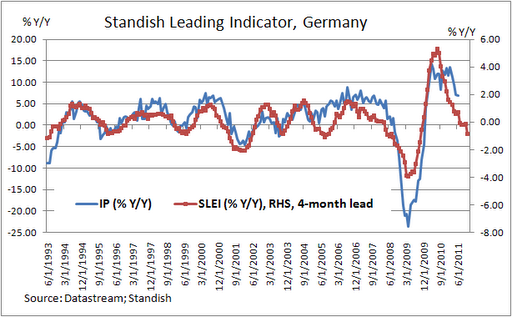
Consider the chart constructed by the economist, Rebecca Braeu, of Standish Management:


The red line refers to Germany’s leading economic indicators – order books, exports, etc., and point to dramatically slower growth in the months ahead. Germany is in effect also a passenger on the Titanic, as Italian Finance Minister Guilio Tremonti recently noted. It might be in the first-class cabin, rather than steerage (or Irish stowaways, as the Germans no doubt view the former “Celtic Tiger”), but when the boat hits the iceberg, all passengers are affected.


Until now, the Eurocrats have either remained in denial about the mounting stress fractures within the system, or forced weaker countries to impose even greater fiscal austerity on their suffering populations, which has exacerbated the problems further. And there has been a complete lack of consistency of principle. When larger countries such as Germany and France routinely violated spending limits a few years ago, this was conveniently ignored (or papered over), in contrast to the vituperative criticism now being hurled at the Mediterranean profligates. The EU’s repeated tendency to make ad hoc improvisations of EMU’s treaty provisions, rather than engaging in the hard job of reforming its flawed arrangements, are a function of a silly ideology which is neither grounded in political reality, nor economic logic. As a result, a political firestorm, which completely undermines the euro’s credibility, is potentially in the offing.


And to judge from the flaccid statement that accompanied the conclusion of the Merkel-Sarkozy summit yesterday, it appears that even at this late stage, policy makers don’t get it, or just cannot summon up the political will for the huge conceptual leap forward required to save the euro. The Germans are paralysed politically and things are moving too fast for their policy makers to respond quickly. And their political leadership has neither leveled with the electorate in regard to the magnitude of the problem, nor the costs associated with ongoing punishments of the profligates. Whenever a German political leader opens his/her mouth it is to announce bad news, like the recent statement by German Finance Minister Wolfgang Schauble that the German government was opposed to any increase in the EFSF’s resources, or the creation of a euro bond, even though such a move is essential for the medium-term stabilisation of financial markets!


At this juncture, then, it seems more likely that the Germans will try to save themselves by pulling out of the euro zone (and then they recapitalise their own banks, as they did following German reunification). They take the Benelux countries with them (which have already closely converged with Germany’s economy) and have a “Greater DM” bloc and buy the rest of Europe on the cheap with their newly reconstituted DMs.


The Club Med, such as Greece, Italy, and Spain countries are saved because the euro plunges and they get to export their way out of this. The euro becomes a soft currency country again and these countries go back to living with higher inflation, higher exports and probably a generally more comfortable way of life.


Interestingly enough, the country which really gets screwed in this type of environment is France which is neither a true “Club Med” economy, but has yet to undertake many of the structural reforms of its German counterpart which it is seeking to emulate. Its economy is more akin to that of Italy, but should it seek to become part of the “greater DM bloc”, then its industrial base will likely face a huge competitive threat from Italy.

 In any case, there appear to be no happy outcomes here (although as my friend, Tom Ferguson always reminds me, “If you want to have a happy ending, go see a Disney film”). We appear to be entering most dangerous time for Europe since World War II.

MMT AND ALTERNATIVE EXCHANGE RATE REGIMES: RESPONSES TO MMP BLOG #11

Thanks for comments. Let me stick to the topic: MMT and alternative exchange rate regimes. At one end we have fixed exchange rates—with the currency pegged to gold or to a foreign currency. At the other we have floating rates. No one seemed to question my (obvious) claim that floating rates provide more domestic policy space, in general. Other than that, what are the advantages and disadvantages?

Well the belief is that fixed rates provide more certainty—you know what the dollar will be worth relative to the pound. That makes it easier to write (nonhedged) contracts. However, the uncertainty is shifted to the ability of government to maintain the peg. That is especially problematic in the post-Bretton Woods era in which countries that peg are essentially “going it alone”.

Many also (paradoxically) believe that fixed exchange rates reduce the chance of speculative attacks. That is counterfactual as well as counterintuitive. Remember the pound? George Soros brought it down and supposedly made a billion dollars in a day betting the UK could not defend the fix. Would you rather short a currency that is fixed, or one that floats minute by minute? In which of those two cases could you make a billion a day? Would you rather try to hit a moving target, or one that is stationary?

Now it is true that daily fluctuation of pegged rates might be nil for long periods of time, in contrast to floating rates that might vary all the time. But when pegged rates do move, they can generate currency crises because when the peg is broken, that is equivalent to a default. If I promise to you to convert my dollar IOUs to a foreign currency (or gold) at a fixed rate, and then I tell you that I’ll only give you half the promised amount of foreign currency, I have just defaulted. That causes havoc in markets.

So, yes, fixed rates can in some cases provide greater certainty—until they are abandoned. To ensure the fixed rate will be maintained, the country will need access to substantial foreign currency reserves. A country like China or Taiwan today can provide a believable promise of conversion at fixed exchange rates. Most nations cannot.

How do these countries obtain the foreign exchange reserves? For the most part, they run current account surpluses (selling goods and services abroad, or earning factor incomes in foreign currency) or they borrow them. How do those reserves end up at government? Because the exporters who earn—let us say—US Dollars need to cover their own domestic expenses in the domestic currency. The central bank offers exchange services to its banks—they need domestic currency reserves. The central bank creates domestic currency reserves and buys the foreign currency reserves. The central bank then typically exchanges Dollar reserves at the Fed for Treasuries. It wants to earn interest. That is why there is a very close link between US current account deficits and foreign accumulation of Treasuries. It is not that foreigners are “lending” to the US government so that it can deficit spend. Rather, the US current account allows foreigners to earn Dollars, and they want to earn interest on safe Treasuries.

What about the IMF articles mentioned that require a country to accept its own currency in exchange for Special Drawing Rights or the seller’s own currency? Does that mean that all signatories have abandoned their floating rate currency? Have they lost domestic policy space? Are they then open to speculative attacks, as if they were on a fixed exchange rate system?

First it is important to note that this is a self-imposed constraint. Governments have adopted a wide variety of these. The US government for example has a self-imposed debt limit. We just went through a huge debate about raising it. Clearly, markets did not force that on the US. Similarly, the IMF Articles of Agreement were adopted—not forced by any kind of market forces or logic.

And in practice, they have no material impact on domestic policy space. Let us say the Chinese decide to submit Dollars to the US to demand payment in RMB. Has the US pegged to RMB? No. It will provide RMB at the current exchange rate. Will this pose an affordability problem? No. Assume the US runs out of RMB. It then goes to foreign exchange markets and uses Dollars to buy RMB at the current exchange rate. Will it run out of Dollars? No. It creates as many Dollars as necessary to buy as many RMBs as it needs.  It can meet all demands as they come due.

Now, the great fear is that this will cause the Dollar to depreciate (the RMB to appreciate). So here’s the fear of our deficit hysterians: China might submit $2 trillion in US currency (reserves and Treasuries), demanding RMB, causing the Dollar to collapse. Really? That is what China wants? What happens to Chinese sales to the US? What happens to the value of Dollar assets held by China? Do you really believe China would do this?

China wants to sell some of its output to the US; if the Dollar collapses, it says “bye bye” to sales. It already holds substantial Dollar reserves. If the Dollar collapses, it is stuck holding an asset that falls in value. Now, in truth, no central bank needs to worry about that. So what if it holds worthless assets. (Just ask the Fed—it bought up toxic waste assets that really have no value at all, in order to save the banksters on Wall Street. That is a topic for another day.) But the Chinese do seem to worry about that—indeed, that is why they keep telling the US to maintain the dollar’s value, or else! (Or else what? Well, nothing. It is a lot like holding a gun to your head and demanding ransom before you blow your brains out. Again, a topic for another time.) The point is that the hyperventilator’s scenario is just not plausible. Current external holders of the Dollar have no interest in seeing it collapse.

Further, so far as I can tell, the Articles are designed to allow countries facing their own payment problems to submit their foreign currency holdings to obtain SDRs (or to drain their own currency out of foreign exchange markets—to stabilize the value of their own currency). The purpose of the Articles is NOT to support speculative attacks—but to protect countries from speculative attacks. If China ever did attempt to crash the dollar in the manner imagined by some hysterians, I suspect the Articles would be set aside until the attack ended. In other words, the Articles were adopted to help stabilize international financial markets, not to enhance destabilizing forces.

If you think about the Bretton Woods standard, the Articles imposed discipline. The Dollar was pegged to gold, and all other nations pegged to the Dollar. The Articles forced each nation to carefully manage foreign currency reserves (meaning Dollars) to ensure they could convert on a fixed exchange rate to Dollars. If too much of a country’s domestic currency was held externally, a fear would grow that it could not maintain the peg to the Dollar; foreign holders could present the currency and demand Dollars. With the Dollar and most other important currencies floating, the Articles do not impose discipline on them. But foreign holders can use the Articles to stabilize their own currencies.

There was a question about Russia’s default that Scott Fullwiler answered (directing readers to Warren Mosler’s piece). But then the question was “why” did Russia choose to default. As best I can determine (and I am no expert although I happened to be in the room when Warren was on the phone during the crisis) it was a political decision. We cannot completely ignore politics. Yes, Congress could have decided not to raise the debt limit. We appeared to be quite close. There was no good economic reason to do it—but politics can lead to some crazy results.

We will deal later with the question asking why money MUST be an IOU.

If you liked Sheila Bair you would have loved Ed Gray and Tim Ryan – Part 3

By William K. Black

(Cross-posted with Benzinga.com)

This is the third part in a series discussing financial regulation. Sheila Bair, FDIC Chair, has justly reserved praise for her service. Her willingness to support meaningful regulation distressed the Obama administration (and would have enraged the Bush administration). Without in any way diminishing her accomplishments it is important to understand that regulation has become so pathetic that Bair’s actions seem to be the zenith of regulatory vigor. We live in a time when even progressives have given up on regulation. Effective financial regulation is not only possible but essential if we are to avoid suffering recurrent, intensifying financial crises. We need to insist that regardless of the party in power the financial regulatory professionals are supported in accomplishing their prime mission – serving as the regulatory “cops on the beat.” Only regulatory cops on the beat can break the “Gresham’s dynamic” that accounting control fraud causes that can produce fraud epidemics, hyper-inflate bubbles, and cause financial crises. This installment shows how vigorous and effective regulation can be.


My first two installments explained how Federal Home Loan Bank Board Chairman Ed Gray reregulated the S&L industry over near total opposition and saved the nation $1 trillion by preventing a financial crisis. Gray realized that the central problem had become frauds led by CEOs (what we now call “control fraud”). He made the agency’s two top priorities the closure of the control frauds and their prosecution. Under Gray, the agency created a formal criminal referral process and hired top supervisors with a reputation for courage, competence, and vigor to attaining those priorities.

The Reagan administration’s cynical secret deal with Speaker of the House Jim Wright to not reappoint Gray as Chairman when his term ended on June 30, 1987 led to the appointment of M. Danny Wall (Senator Garn’s top aide). Wall had, as Garn’s aide, advised Gray to give in to Wright’s “request” that we fire our most prestigious and important supervisor, Joe Selby. Gray had personally recruited Selby to supervise Texas S&Ls, the largest hunting ground of the control frauds. Wall immediately sought to reverse many of Gray’s policies. He publicly took “credit” for forcing Selby to resign. He removed our (the Federal Home Loan Bank of San Francisco’s (FHLBSF) jurisdiction over Lincoln Savings because we continued to insist that it should be taken over. Wall was terrified by Charles Keating’s political power, which included the five U.S. Senators that became known as the “Keating Five” after they unsuccessfully sought to intimate us at the April 9, 1987 meeting, and Wright. Wall’s staff refused to forward our referrals to the enforcement agencies against the largest S&L in the nation. He stated that, “by definition,” we did not place Texas S&Ls in receivership, and he took credit for reducing the number of enforcement actions. Wall’s self-description was that he was a “child of the Senate” and his actions demonstrated the accuracy of his admission.

Enforcement had long been the Bank Board’s weakest link. I referred to it as “the land of the invertebrates.” Left to its own devices, it had always been a serious barrier to regulatory effectiveness. How bad was it – the lawyers representing fraudulent S&Ls actively sought to get our enforcement lawyers in the room when discussing supervisory problems. Our enforcement director was so clueless that she thought this was a good thing.

When the first President Bush took office he faced a dilemma in determining the regulatory response to the S&L debacle. As Reagan’s Vice President, Bush Chaired the administration’s financial deregulation task force. He was, therefore, as culpable as anyone in the nation for the deregulation and desupervision that made the S&L industry a criminogenic environment. We now know from document obtained through discovery from Lincoln Savings that Keating’s lobbyists viewed VP Bush’s offices as containing strong supporters of Keating and Gray’s fiercest critics. Bush also owed Wall a large political debt. Wall’s nickname on the Hill was “M. Danny Isuzu.” (Isuzu was running commercials then featuring a car salesman who was an obvious, inveterate liar.) The central lie that Wall was spreading in 1988 in the run-up to the election was that there was no S&L crisis and no need for federal funds. This lie was of significant benefit to Bush’s candidacy.

Bush also knew, however, that Wall was a disaster. Bush’s response to the dilemma was politically astute. He immediately ordered that the Bank Board would no longer run any receiverships but would instead appoint the FDIC as its receiver for any new failed S&Ls. He framed the FIRREA bill that terminated FSLIC and transferred the S&L insurance function to the FDIC. Both of these actions enraged Wall. The FIRREA bill, however, did something extraordinary for Wall. It appointed him as head of the successor agency (the Office of Thrift Supervision (OTS)) without the advice and consent of the Senate. Bush was warned in advance that this act could be held to be unconstitutional. The Senate Banking Committee was delighted not to hold hearings. Its chairman and ranking Democrat were members of the Keating Five and the ranking Republican, Garn, was co-sponsor of the Garn-St Germain Act of 1982 (the key deregulation bill) and Wall’s great patron. Senate confirmation hearings would have been intensely embarrassing to the new Bush administration, Wall, and the Senate Banking committee’s most powerful members.

FIRREA became law, Wall was appointed head of OTS by statute without the Senate’s advice and consent, and a federal court declared Wall’s appointment unconstitutional. The key development, however, was that Henry B. Gonzalez became Chairman of the House Financial Services Committee and began holding hearings on Wall’s regulatory failures at Lincoln Savings. Gonzalez’ actions were brave. Four of the five members of the Keating Five were Democrats. Many of Gonzalez’ Democratic senior colleagues were enraged that Gonzalez would hold hearings that were certain to embarrass the Keating Five.

Gonzalez’ series of hearings led to our powerful testimony explaining in detail Wall’s refusal to take action against Keating. Wall used the enforcement director as his attack dog to respond by attacking the FHLBSF and Gray – and to claim that Keating was the victim. Bush eventually responded by indicating that he no longer had confidence in Wall and Wall was forced to resign. His resignation was reported on December 5, 1989. Bush nominated Timothy Ryan to head the OTS and gave him a simple mandate – find the most prominent S&L frauds and take them down in the most public fashion to show that there was a new sheriff in town.

Our testimony also led to the resignation of the agency’s top supervisor, Mr. Dochow, who returned to a relatively low level supervisory position in our most obscure office – Seattle. Dochow was notorious because of his support for Wall’s cowardly caving in to Keating’s political pressure.

Ryan came into office shortly after we had provided a graphic example of how effective regulation could be. Pinnacle West, MeraBank’s holding company, had signed a net worth maintenance agreement as a condition of acquiring MeraBank. MeraBank was deeply insolvent, which meant that Pinnacle West was on the hook for many hundreds of millions of dollars. Pinnacle West’s lawyers came up with a clever means of evading the net worth maintenance agreement. They would dividend to their shareholders Pinnacle West’s ownership of MeraBank. The net worth maintenance agreement only obligated entities that “controlled” MeraBank to maintain MeraBank’s net worth, and because Pinnacle West’s shareholders were diverse there would be no one remaining (after the dividend) who owned a controlling interest in MeraBank.

There were only three problems to the clever scheme. First, there was a mechanical problem. As part of the deal in which Pinnacle West acquired 100% of MeraBank, the parties agreed that MeraBank would issue a single share certificate representing that 100% ownership to Pinnacle West. Pinnacle West’s lawyers thought they had a straight forward answer to the mechanical problem – MeraBank would issue hundreds of thousands of individual share certificates to Pinnacle West and Pinnacle West would dividend them to its shareholders.

That lawyerly solution to the mechanical problem, however, ran into the second and third problems. The second problem was the FHLBSF. After he removed the FHLBSF’s jurisdiction over Lincoln Savings, Wall’s effort to cover up its insolvency and frauds were blown up by courageous examiners from the California Department of Savings and Loan and several other Federal Home Loan Banks (special kudos to the FHLB Chicago staff). Wall realized that he was faced with a disaster on multiple dimensions and that he had to stop his jihad against the FHLBSF. That meant that he could no longer block us from taking vigorous regulatory actions, e.g., against Pinnacle West.

The third problem was that it would be a naked violation of their fiduciary duties for MeraBank’s board of directors to vote to issue additional shares. Pinnacle West’s primary asset was the net worth maintenance agreement. Voting to effectively remove that agreement would violate the duty of care. If the MeraBank directors who were also Pinnacle West officers voted to effectively destroy the net worth maintenance agreement that would violate the duty of loyalty (because of their crippling conflict of interest) and the duty of care. The FHLBSF’s senior staff flew to Arizona to address the MeraBank board of directors meeting to make this explicit to each director. In the trade in the U.S., this is known as a “come to Jesus” meeting. The MeraBank directors promptly decided that there was no way to issue the additional share certificates.

The FHLBSF then took the lead in negotiating an agreement that released Pinnacle West from its net worth maintenance agreement – in return for a $450 million payment. (Note: the enforceability of net worth maintenance agreements had never been litigated and our commercial ability to recover even if we were successful in establishing that enforceability was unclear. Pinnacle West, on a stand-alone basis, was insolvent. The net asset value of the holding company was tied up in its Arizona public utility and it was unlikely that the Arizona Public Utility Commission would approve a massive increase in electrical rates in order to provide funds to Pinnacle West so that Pinnacle West could pay the federal insurance fund a billion dollars. In sum, there were good litigation reasons for us to settle instead of suing.) Pinnacle agreed to the $450 million deal and OTS approved the settlement on December 7, 1989 (Pearl Harbor’s anniversary and the same day that President Bush announced his acceptance of Wall’s resignation.

The Pinnacle West deal confirmed Ryan’s view that OTS could accomplish great things if it were vigorous. He recruited Harris Weinstein, an accomplished, senior litigation partner at one of the nation’s most prestigious firms as his Chief Counsel. Among their first acts were to make clear that they supported fully the FHLBSF’s vigorous approach to regulation. (Most FHLB’s shared that same approach, but openly embracing us signaled that Wall’s jihad against the FHLBSF was over. Weinstein proved adept as a manger. He did not fire or criticize the enforcement director. He simply removed her monopoly over enforcement. OTS established three regional enforcement bodies headed by its most vigorous personnel and parallel enforcement bodies in Washington. The supervisors were permitted to use whichever enforcers they found most effective. The former litigation director left the agency for private practice.

The OTS took actions against the most elite control frauds on four fronts: regulation, civil actions, administrative enforcement actions, and support for criminal prosecutions. It closed the remaining frauds, virtually all of which had collapsed due to Gray’s rule restricting growth. (For a Ponzi scheme, growth is life.) More impressively, the West Region of OTS (staffed by supervisory personnel from the FHLBSF), killed through normal supervision the growing practice in Orange County, California of making “liar’s” loans and imprudent subprime loans. Michael Patriarca, personally recruited by Gray to crack down on the Western frauds, led the West Region’s crackdown. The effort was so successful that the leading nonprime S&L lender, Roland Arnall, gave up his federal charter (and federal deposit insurance) in order to escape our jurisdiction. Arnall created Ameriquest, a mortgage banker, to take advantage of a regulatory “black hole.” Arnall’s leading competitors also came from the S&L industry, e.g., the Jedinaks, who we “removed and prohibited” from the federally-insured financial industry through an enforcement action.

Ryan and Weinstein were exceptionally effective in prompting effective enforcement actions. In interpreting the magnitude of the increase in enforcement actions in 1990 over 1989 one must recall that the administration did not select Ryan until March 1990. Ryan then had to go through a bitterly contested Senate investigation and vote to secure appointment. Ryan’s selection of Weinstein became public on May 9, 1990. It, of course, took Weinstein months to create the parallel enforcement structure that I described and staff it.

In 1989, the agency issued 34 cease and desist (C&D) orders. In 1990, agency issued 63 C&Ds. In 1989, the agency issued 47 removal and prohibition (R&P) orders, in 1990 it issued 78. In 1990, the agency used its new grant of enforcement powers (via FIRREA) to issue 26 civil money penalties (CMPs). In 1989, the agency entered into 260 formal agreements, in 1990 that number rose to 347. The cliché “hit the ground running” applies to Ryan and Weinstein. In 1991, the agency completed 868 enforcement actions and in 1992 it completed 667 actions. Ryan announced his intent to resign on November 9, 1992.

In addition to the dramatic increase in the number of enforcement actions one must take into account that the actions brought under Ryan and Weinstein were far more major than the actions brought under Wall. Ryan and Weinstein went after the most elite, politically connected frauds to demonstrate that no one was above the law. The classic proof was the agency’s enforcement action against President Bush’s son, Neil. The enforcement action antagonized the Bush family. William Seidman’s (then, FDIC chair), book about his governmental service recounts how a senior White House staffer got the bright idea of convincing the FDIC to take over the case from the OTS so that the FDIC could kill the action. He called the FDIC’s general counsel to propose the idea. The general counsel, being a bear of very little brain, went to Seidman with the proposal. Seidman told him the idea was insane and not to get involved with it. The general counsel, being a bear with very little brain and soul, called the OTS to pitch the idea. Ryan made sure that the OTS filed an ethics complaint. The OTS went ahead and issued the enforcement order. (In truth, the order was a slap on the wrist – but royalty doesn’t think it should be slapped by peons.) From that day on, Ryan’s chances for advancement under President Bush were dead.

“But Mr. Ryan said that there were occasions when his decisions bore personal, as well as political, repercussions. He said some former political associates, whom he would not identify, had stopped talking to him after the Office of Thrift Supervision had decided to censure Neil Bush, the President’s son, for his role as a director of the Silverado Banking, Savings and Loan Association of Denver, one of the largest failures on record.

“Because of Neil Bush, I was persona non grata,” Mr. Ryan said. “At first I think it was because they did not want to influence me, and afterward I don’t know why they did not talk to me.””

http://www.nytimes.com/1992/11/09/business/regulator-of-s-l-s-resigns.html?src=pm

Regulator Of S.& L.’s Resigns
By STEPHEN LABATON
Published: November 09, 1992

The amazing aspect of the Bush administration’s response to the OTS enforcement action against Neil Bush is that it never became a scandal. In the current era, it would lead to an immediate demand for impeachment.

Weinstein made most of the legal community enraged when he brought an enforcement action against one of Keating’s primary law firms and “froze” its assets. “Froze” is an inaccurate description, but the one the bar used. Weinstein also moved to invoke the “fraud crime” exception to the ability to withhold the production of documents on the grounds of attorney client privilege. The law firm settled and its insurer made a major payout.

The agency’s and the Resolution Trust Corporation’s (RTC’s) civil suits were equally vigorous and effective. They produced billions of dollars in recoveries, often from what were then known as the “Big 8” audit firms. The lawsuits, of course, enraged the auditors.

On the criminal prosecution front, Ryan and Weinstein returned to Gray’s policy of making the support of criminal investigations and prosecutions a top agency priority. The agency met with the Department of Justice (DOJ) to create a formal prioritization of these cases – the “Top 100.” The dirty 100 were overwhelmingly S&Ls, as opposed to individuals, so this prioritization led to the prosecution of over 500 of the most elite and destructive criminals. The agency made well over 10,000 criminal referrals. Our criminal referral specialists liaised constantly with the FBI to get feedback on how to prepare the most useful referrals and trained our staff to produce superb referrals. (In modern management jargon, we really engaged in “continuous improvement.” Our criminal referrals were often 20 to 30 pages in length with two to three hundred pages of attachments. The referrals provided the detailed road map explaining the fraud and providing the key documents. The agency “detailed” a significant number of examiners to the FBI to serve as internal experts during the investigations (for the lawyers: this allowed them access to “6 (e)” grand jury materials). (The FHLBSF had pioneered an even more selfless approach – it paid the salary of an AUSA in Los Angeles dedicated to prosecuting S&L frauds. He did not, of course, answer to the FHLBSF.) Agency officials trained agency personnel, FBI agents, and AUSAs on detecting, investigating, and prosecuting elite financial frauds. We also served as free expert witnesses for the AUSAs in cases that came to trial. The results were spectacular. The conviction rate in S&L cases designated as “major” by DOJ was roughly 90 percent – against many of the top criminal defense lawyers in the world. We secured over 1000 felony convictions in “major” cases, and by prioritizing the “Top 100” we ensured that we acted against each of the worst frauds.

In 1993, the new Clinton administration moved DOJ resources to refocus on health care fraud. That may have been a correct prioritization of DOJ resources given out success against the worst S&L frauds, but it does mean that our 1000 convictions represents only a portion of fraud identified in our criminal referrals.

By the time Ryan and Weinstein left governmental service the S&L industry was cleansed of major frauds. The “liar’s” loans lenders had been driven out of the industry. The OTS criminal referral process was superb.

In the current crisis, President Bush (the Second) appointed “Chainsaw” Gilleran as OTS director – providing the crisis’ iconic image. Gilleran is holding a chain saw and standing next to the nation’s three leading bank lobbyists and the FDIC’s Vice-Chair, who are holding pruning shears. They are poised and posed over a pile of regulations. To make the imagery clear, the regulations are tied up in elaborate red tape. The image makes clear Gilleran’s and the FDIC’s intention to slash through all regulation. (Mission Accomplished!) Naturally, the anti-regulators were so proud of this image that they featured it the FDIC’s 2003 annual report.

The OTS leaders decided that the key to destroying regulation was to bring back to power the nation’s most notorious professional regulator – Dochow (of Keating infamy). Dochow rode Washington Mutual (WaMu) (based in Seattle) back to power. WaMu was a great “success” because it engaged in a variant of the accounting control fraud that made Keating infamous, but Dochow was not one to learn from his mistakes. The OTS leadership then used Dochow to convince Countrywide to convert its charter and become an S&L in order to avoid a potential enforcement by the somnolent Office of the Comptroller of the Currency (OCC). Dochow finally had to be asked to leave when he was caught agreeing to allow IndyMac (which, like WaMu, specialized in making “liar’s” loans) to backdate documents to inflate its financial “strength.”

So, how many criminal referrals did OTS make in current crisis? Zero – during what the FBI aptly described in September 2004 as an “epidemic” of mortgage fraud that the FBI aptly predicted would cause a financial “crisis” if it were not contained. Gray, Patriarca, Ryan, and Weinstein were all available to the second President Bush (and Obama) to use their expertise, integrity, and vigor to clean up the Stygian stables of the fraudulent and systemically dangerous institutions (SDIs) that drove this crisis. They are all available now, as are many of the people that helped these leaders clean up the industry. Patriarca and Ryan are young enough to serve as full time regulatory leaders. To my knowledge, the Bush II and Obama administrations have not drawn on the expertise of any of these leaders or their principal lieutenants who led the successful struggle against prior epidemics of accounting control fraud to implement an effective response to this crisis.

What would it take for the Geithners and Holders of the world to admit that allowing control fraud to occur with impunity is insane and that they should learn from people with a track record of success, integrity, and courage? Geithner, like “M.Danny Isuzu Wall,” is still pretending that he “resolved” the crisis at virtually no cost and kvetching that the world doesn’t applaud his genius. Like the Wizard of Oz, he demands that we: “ignore the man behind the screen,” i.e., the man holding the liar’s loans at Fannie and Freddie that will cause hundreds of billions of dollars of losses, the man at the Fed with hundreds of billions of dollars of losses on fraudulent mortgage paper pledged to Fed (which the Fed will eventually dump on Fannie and Freddie – which is to say, the Treasury), and the men holding the hundreds of billions of dollars of unrecognized losses among the SDIs. Geithner’s con has only fooled one person. Unfortunately, the man that fell for the Geithner con is President Obama, he of the infamous “man crush” for the admitted tax evader he appointed to be in charge of our nation’s tax collection.

One of our proudest moments at OTS (under Ryan and Weinstein) was issuing an R&P against Lee Henkel – one of the presidential appointees that ran our predecessor agency. President Reagan, at the behest of one of his leading contributors (Charles Keating), made Henkel a “recess” appointment to run the Federal Home Loan Bank Board. Henkel served as Keating’s “mole” at the agency. He resigned after I blew the whistle on him as part of a deal with the FBI to drop its criminal investigation of him. The OTS, however, made sure he would not come back to harm the public by issuing a removal and prohibition from federally insured depositories. If only Sheila Bair had possessed the nerve to remove and prohibit Geithner’s Treasury minions that he recruited from the fraudulent SDIs…. Sigh, one can dream.

By volume, Part 3 of my column has focused on enforcement, civil suits, and prosecutions. It is vital to keep in mind that these are after the fact remedies. It is vastly more important for financial regulators to understand accounting control fraud mechanisms and patterns so that they can identify and take regulatory action that will prevent the crisis. Patriarca’s actions to end liar’s loans in by Orange County S&Ls (taken while Ryan was Director) are a classic example of how successful a regulator can be when it understands the need to function as a “cop on the beat” and prevent the Gresham’s dynamics that drive fraud epidemics. The same actions show one of the important lessons of regulation. No one builds a bank vault and then puts an unguarded and unlocked hole in it, but our anti-regulators constantly seek to achieve the equivalent by creating financial regulatory systems that are designed to fail. The Fed had unique authority under HOEPA to close all of these regulatory black holes. Alan Greenspan and Ben Bernanke refused to do so. If Gray, Ryan, Patriarca, or Weinstein had been in charge there would have been no epidemic of mortgage fraud, no crisis at Fannie and Freddie, no overall financial crisis, and no Great Recession. (I’m not suggesting they had the power to end recessions and business cycles.)

We see the consequences of what happens when, during the last three administrations, we did not care to send the very best into the ranks of regulatory leadership. There were times during the Civil War in which thousands of men’s lives were thrown away because their senior officers were incompetent political hacks. Why do we routinely send incompetent political hacks and the equivalent of “flat earth” anti-regulatory ideologues to be our regulatory leaders and then blame “regulation” for the disaster? Even the Soviets figured out that one of the secrets of success was to “never reinforce failure.” We promote our failures and give them presidential medals. The high priests of theoclassical economics and their law and economics acolytes will always fail as regulators. They are trained to create and worship intensely criminogenic environments.

I do not know whether you, the reader, has focused on the politics of the leaders I have been praising. Gray and Ryan are Republicans. I worked for years with Patriarca and Weinstein and do not know their political affiliation. It never mattered to us. We despise the elite frauds and their professional and political toadies regardless of their party.

William K. Black on Speculation and the European Debt Crisis

TODAY ON MODERN MONEY PRIMER

Wray explains the implications of exchange rate regimes for Modern Money Theory:

Floating vs fixed exchange rate regimes. The previous blogs were quite general and apply to all countries that use a domestic currency. It does not matter whether these currencies are pegged to a foreign currency or to a precious metal, or whether they are freely floating—the principles are the same. In this blog we will examine the implications of exchange regimes for our analysis.

Read the full post at MMP#11: MODERN MONEY THEORY AND ALTERNATIVE EXCHANGE RATE REGIMES

MMP BLOG #11: MODERN MONEY THEORY AND ALTERNATIVE EXCHANGE RATE REGIMES

L. RANDALL WRAY

Floating vs fixed exchange rate regimes. The previous blogs were quite general and apply to all countries that use a domestic currency. It does not matter whether these currencies are pegged to a foreign currency or to a precious metal, or whether they are freely floating—the principles are the same. In this blog we will examine the implications of exchange regimes for our analysis.

Let us deal with the case of governments that do not promise to convert their currencies on demand into precious metals or anything else. When a $5 note is presented to the US Treasury, it can be used to pay taxes or it can be exchanged for five $1 notes (or for some combination of notes and coins to total $5)—but the US government will not convert it to anything else.
Further, the US government does not promise to maintain the exchange rate of US Dollars at any particular level. We can designate the US Dollar as an example of a sovereign currency that is nonconvertible, and we can say that the US operates with a floating exchange rate. Examples of such currencies include the US Dollar, the Australian Dollar, the Canadian Dollar, the UK Pound, the Japanese Yen, the Turkish Lira, the Mexican Peso, the Argentinean Peso, and so on.
In the following sections we will distinguish between these sovereign nonconvertible floating currencies and currencies that are convertible at fixed exchange rates.
The gold standard and fixed exchange rates. A century ago, many nations operated with a gold standard in which the country not only promised to redeem its currency for gold, but also promised to make this redemption at a fixed exchange rate.
An example of a fixed exchange rate is a promise to convert thirty-five US Dollars to one ounce of gold. For many years, this was indeed the official US exchange rate. Other nations also adopted fixed exchange rates, pegging the value of their currency either to gold or, after WWII, to the US Dollar.
For example, the official exchange rate for the UK Pound was $2.80 US. In other words, the government of the UK would provide $2.80 (US currency) for each UK Pound presented for conversion. With an international fixed exchange rate system, each currency will be fixed in value relative to all other currencies in the system.

In order to make good on its promises to convert its currency at fixed exchange rates, the UK had to keep a reserve of foreign currencies (and/or gold). If a lot of UK Pounds were presented for conversion, the UK’s reserves of foreign currency could be depleted rapidly.
There were a number of actions that could be taken by the UK government to avoid running out of foreign currency reserves, but none of them was very pleasant. We will save most of the details for a later discussion. The choice mostly boiled down to three types of actions: a) depreciate the Pound; b) borrow foreign currency reserves; or c) deflate the economy.
In the first case, the government changes the conversion ratio to, say, $1.40 (US currency) per UK Pound. In this manner it effectively doubles its reserve because it only has to provide half as much foreign currency in exchange for the Pound. Unfortunately, such a move by the UK government could reduce confidence in the UK government and in its currency, which could actually increase the demands for redemption of Pounds.
In the second case, the government borrows foreign currencies to meet demanded conversions. This requires willing lenders, and puts the UK into debt on which interest has to be paid. For example, it could borrow US Dollars but then it would be committed to paying interest in Dollars—a currency it cannot issue.
Finally, the government can try to deflate, or slow, the economy. There are a number of policies that can be used to slow an economy—but the idea behind them is that slower economic growth in the UK will reduce imports of goods and services relative to exports. This will allow the UK to run a surplus budget on its foreign account, accumulating foreign currency reserves.
The advantage is that the UK obtains foreign currency without going into debt. The disadvantage, however, is that domestic economic growth is lower, which usually results in lower employment and higher unemployment.
Note that a deflation of the economy can work in conjunction with a currency depreciation to create a net export surplus. This is because a currency depreciation makes domestic output cheap for foreigners (they deliver less of their own currency per UK Pound) while foreign output is more expensive for British residents (it takes more Pounds to buy something denominated in a foreign currency).
Hence, the UK might use a combination of all three policies to meet the demand for conversions while increasing its holding of Dollars and other foreign currencies.
Floating exchange rates. However, since the early 1970s, the US, as well as most developed nations, has operated on a floating exchange rate system, in which the government does not promise to convert the dollar.
Of course, it is easy to convert the US dollar or any other major currency at private banks and at kiosks in international airports. Currency exchanges do these conversions at the current exchange rate set in international markets (less fees charged for the transactions). These exchange rates change day-by-day, or even minute-by-minute, fluctuating to match demand (from those trying to obtain dollars) and supply (from those offering dollars for other currencies).
The determination of exchange rates in a floating exchange rate system is exceedingly complex. The international value of the dollar might be influenced by such factors as the demand for US assets, the US trade balance, US interest rates relative to those in the rest of the world, US inflation, and US growth relative to that in the rest of the world. So many factors are involved that no model has yet been developed that can reliably predict movements of exchange rates.
What is important for our analysis, however, is that on a floating exchange rate, a government does not need to fear that it will run out of foreign currency reserves (or gold reserves) for the simple reason that it does not convert its domestic currency to foreign currency at a fixed exchange rate. Indeed, the government does not have to promise to make any conversions at all.
In practice, governments operating with floating exchange rates do hold foreign currency reserves, and they do offer currency exchange services for the convenience of their financial institutions. However, the conversions are done at current market exchange rates, rather than to keep the exchange rate from moving.
Governments can also intervene into currency exchange markets to try to nudge the exchange rate in the desired direction. They also will use macroeconomic policy (including monetary and fiscal policy) in an attempt to affect exchange rates. Sometimes this works, and sometimes it does not.
The point is that on a floating exchange rate, attempts to influence exchange rates are discretionary.  By contrast, with a fixed exchange rate, government must use policy to try to keep the exchange rate from moving. The floating exchange rate ensures that the government has greater freedom to pursue other goals—such as maintenance of full employment, sufficient economic growth, and price stability.
As we continue this discussion in coming weeks, we will argue that a floating currency provides more policy space—the ability to use domestic fiscal and monetary policy to achieve policy goals. By contrast, a fixed exchange rate reduces policy space. That does not necessarily mean that a government with a fixed exchange rate cannot pursue domestic policy. It depends. One important factor will be whether it can accumulate sufficient foreign currency (or gold) to defend its currency.
Next week, however, we will take a brief diversion to examine so-called commodity money. The fixed exchange rate based on a gold standard has been a reality in relatively recent times. And during much of the past two millennia, governments issued coins with silver and gold content. Many equate these with “commodity money”—a monetary system supposedly based on precious metal, indeed, one in which money derives value from embodied gold or silver.
We will come to a surprising conclusion, however. Even coins made of gold and silver are really IOUs stamped on metal. They are not examples of commodity money. They are sovereign currencies.
I can already hear the teeth of our resident Austrian gold bugs rattling so hard their fillings threaten to shake loose.

Anti “MMT Types” Memes Migrate to Stage II


One of the famous statements attributed to Mahatma Gandhi is that opposition to new, powerful ideas goes through three stages.  First, they ignore you.  Then they attack you.  Then you win.  Modern Monetary Theory (MMT) has reached the second stage.  It has, on the same day, been attacked by Paul Krugman and John Carney (CNBC.com’s “senior editor”) in their unrelated columns. 

The attacks are particularly interesting because they share two characteristics.  They independently use the meme “MMT types” to disparage their opponents and they do not engage the accuracy of MMT theory.  The CNBC commentator dismisses MMT because he fears that if members of  Congress understood how monetary operations worked they would be tempted to support government programs.  The CNBC commentator has an intense ideological opposition to government programs, so he opposes MMT.  Note that he opposes MMT because it is substantively correct.  That is the oddest objection to a theory that I have seen presented.


CNBC’s hostility to MMT was predictable and its commentator was playing by modern journalistic rules with no pretense to academic objectivity.  Krugman’s disparaging dismissal of “MMT types” based on a straw man argument that he falsely ascribes to MMT is far more embarrassing because he is a globally prominent academic.

I am not an “MMT type.”  MMT is a macroeconomic theory.  I teach courses in microeconomics, law, regulation, finance, and criminology at the University of Missouri-Kansas City (and previously at the LBJ School of Public Affairs at the University of Texas at Austin).  I’m still trying to get past the first stage (being ignored) with Krugman.  He cited one of my columns favorably in his blog in which I recounted ECB President Trichet’s 2004 speech in Ireland urging new EU nations to use Ireland as their economic model.  My work explains how accounting control frauds drive our recurrent, intensifying crises and what policies create the criminogenic environments that produce fraud epidemics and hyper-inflate financial bubbles.  Criminological research findings would add considerable support and new insights to Krugman.  Scores of economists now cite our work, but Krugman still shares the characteristic reluctance of economists to use the “f” word (fraud) to describe frauds.    


UMKC’s economic department has a storied reputation going back over a half century.  It is one of the few remaining “heterodox” economics departments in America.  “Heterodox” is not a euphemism for Marxist and it is not an oxymoron describing a department filled with intellectual clones.  UMKC’s economics department is also cheerfully interdisciplinary.  They welcome the research insights of other fields such as criminology and law.  White-collar criminological theories about “control fraud” have shown far greater predictive strength than neoclassical and “modern finance” models.  White-collar criminologists falsified the efficient markets hypothesis 25 years before the hypothesis was created. 

As Jim Sturgeon, the chair of the economics department puts it: “UMKC, the place that got it right; and probably will again.”  I love Jim’s use of “probably.”  It is so wonderfully and appropriately Midwestern.  Our students are taught both the neoclassical canon and critiques of that canon.  The neoclassical model and “modern finance theory” have failed and are in their paradigmatic death throes.  Unfortunately, their dogmas will likely persist for decades and cause several more crises.  UMKC doctoral students have proven extremely successful in finding academic positions because of their broader training.  As heterodox economists, we are a tiny minority, but we punch way above our weight class.  (If you are interested in studying in an economics graduate program that is reality-based please contact us.)    
 
My closest colleagues at UMKC include Randy Wray and Stephanie Kelton and my closest colleague at U. Texas was Jamie Galbraith.  Wray is the nation’s leading MMT theorist.  (Bill Mitchell of the University of Newcastle and Wray are the best known academic developers of MMT.)  Wray was one of Minsky’s grad students and has continued to develop Minsky’s famous work on the paradox of financial stability leading to instability.  Jamie Galbraith has several specialties; including MMT.  Kelton is a younger colleague whose dissertation on government finance spawned two classic works on MMT, and the New Economics Perspectives blog — now a major player — was her creation.  I have been privileged to see each of these colleagues present on the subject of MMT in the U.S. and in several other nations and I have read Wray and Galbraith’s congressional testimony on MMT and read other academic and policy articles that they have authored. 

Mat Forstater is a colleague who is an active MMT scholar.  Mat runs our Center for Full Employment and Price Stability (CFEPS) and is particularly active in developing programs to use the government as the employer of last resort (ELR).  Warren Mosler, a hedge fund manager and leading MMT theorist, provided the primary funding for CFEPS and many of our grad students.    

Wray, Galbraith, Kelton, Forstater, and Mitchell are serious academics by anyone’s standards.  Mosler’s knowledge of actual monetary operations is legendary.  They present at major economic conferences, often as prominently featured speakers.  They are open to criticism and they engage in civilized dialogue with their critics.  One of the odd aspects of MMT is that none of the scholars who developed the theory likes the phrase “Modern Monetary Theory.”  Indeed, they do not like any of the three words in the term.  “Modern” is something of an internal joke among MMT theorists because Keynes observed that the state theory of money described events that arose over 4,000 years ago. 

MMT is a rich theory in that it is built from diverse supporting strands pursued independently that were eventually woven together to form a far stronger intellectual fabric.  The heart of MMT is not a “theory.”  It is a description of reality as opposed to an idealized theory with simplifying assumptions.  It turns out that the description of monetary operations we were taught in conventional macro courses is inaccurate in several important areas.  MMT theorists cite the statements of central bankers (even Alan Greenspan) that demonstrate that their actual operations accord with MMT’s description of those operations.  If Krugman believes that the heart of MMT – the description of actual monetary operations – is incorrect he should explain what he believes is incorrect.  He has never suggested that MMT’s description is inaccurate.  MMT has found increasing popularity among financial market participants precisely because they know that it is an accurate description of actual monetary operations. 

MMT is also woven with strands drawn from research of monetary and macroeconomic history.  One component of this historical research has refuted the conventional “just so” story of the creation of monetary systems.  MMT shows the closeness of the relationship between the sovereign and the monetary system.  MMT research shows that it was normal for the U.S. government to be in deficit and normal for the U.S. government to be in debt.  These deficits have not led to hyperinflation in the United States.  Historical research shows that the age of the gold standard was not a golden era.  The gold standard caused recurrent crises in many nations.  MMT research shows that when President Roosevelt listened to his conventional economic advisors in 1937 and attempted to balance the budget the result was to throw the U.S. back into the depths of the Great Depression.  MMT research has shown that the extremely uncommon periods in which the U.S. runs a material budget surplus are typically followed quickly by serious recessions.  Wray, Galbraith, and Kelton are appropriately cautious in concluding that this historical pattern demonstrates that the surpluses caused the recessions.  They do, however, offer a credible explanation of why budget surpluses could lead to recessions.  Again, if Krugman has specific disagreements with these findings about monetary and macroeconomic history my colleagues will be delighted to discuss the merits.  As we will see, Krugman is one of the scholars whose historical research has confirmed and extended these findings.  

The leading MMT scholars have been among the strongest spokespersons predicting that the proposed U.S. stimulus program would prove far too small and explaining why the budget deficit is a consequence of Great Recession, why vigorous counter-cyclical fiscal policies are essential to our recovery, why austerity would worsen the recession and increase budget deficits, why our focus needs to be on restoring full employment (the MMT scholars are strong supporters of government ELR programs), and why these policies are not inflationary in the current circumstances.  Krugman acknowledges that he agrees with each of these conclusions.             
        
Regular readers of comments will notice a continual stream of criticism from MMT (modern monetary theory) types, who insist that deficits are never a problem as long as you have your own currency. I really don’t want to get into that fight right now, because for the time being the MMT people and yours truly are on the same side of the policy debate. Right now it really doesn’t matter at all whether the United States issues zero-interest short-term debt or simply prints zero-interest dollar bills, and concern about crowding out is just bad economics.

Krugman agrees that the MMT scholars are correct except as to one matter: “MMT … types … insist that deficits are never a problem as long as you have your own currency.”  That is a straw man argument.  I can personally attest that Wray, Galbraith, and Kelton do not argue that “deficits are never a problem.”  MMT explains the economic circumstances in which “deficits are … a problem.”  I am unaware of any MMT scholar who asserts that “deficits are never a problem” for a nation with a sovereign currency.  It is not uncommon for academics to misunderstand an academic literature that they have not read.  I invite Krugman to read the academic MMT literature and critique it substantively.


Three aspects of Krugman’s dismissal of “MMT types” strike me as unworthy of him.  The term “MMT types” is deliberately ad hominem.  Using the term to belittle and dismiss scholars such as Wray, Galbraith, and Kelton is unwarranted and diminishes Krugman. 


The “stream of criticism” of Krugman from supporters of MMT is largely driven by his repeated straw man assertions that MMT predicts that “deficits are never a problem as long as you have your own currency.”  Krugman then attacks the straw man he created by arguing that that because deficits mattered in France after World War I (one of the subjects of his dissertation) he has refuted MMT’s (non) prediction that deficits never matter.  MMT supporters have repeatedly explained to Krugman that MMT does not predict that “deficits are never a problem as long as you have your own currency.”  Wray, Galbraith, and Kelton have emphasized that MMT predicts the circumstances in which deficits can cause problems.  World War I was fought largely on French soil, destroying and allocating real resources to the imperative of national defense.  France went off, then on, then off the gold standard.  Yes, France followed policies, in dreadful circumstances, that sometimes produced serious financial instability – as MMT would predict. 


Making a dismissive straw man assertion once is a common error.  Ascribing the same straw man assertion to “MMT types” after he had been warned repeatedly that his assertion was false evinces a serious flaw.


The final aspect of Krugman’s response that is so disturbing is his claim that he is the victim of “harass[ment]” by “MMTers.”

Now, all of this is remote right now. And notice too that France in the 1920s stabilized with debt of 140 percent of GDP — far higher than the numbers that are supposed to terrify us now. So none of this is relevant to the current policy debate.
But since the MMTers seem to have decided to harass those of us who want stronger action now but think there really is a long-run fiscal issue, I needed to put this out there.

This passage is odd on several different levels.  He asserts that MMT predicts that deficits never matters.  MMT supporters point out to him that he has erred – MMT theory predicts the circumstances in which deficits can cause severe problems.  Krugman does not respond: “thank you, I am delighted to learn that MMT does not make such a prediction.”  Instead, Krugman repeats the straw man assertion that he knows to be false.  He gets called on it – again.  He now plays the victim card: “MMTers … harass” him when he writes about MMT.  Critiques of what we write are valuable, particularly when we commit error.  There is nothing better for an academic than being saved from error by a commenter’s correction.  Krugman is both a journalist and a scholar, so he should take special joy in receiving vigorous critiques from readers of his New York Times column. 


The passage is also bizarre with regard to the substance of this argument about MMT.  Recall what I have explained about MMT scholars’ historical findings.  While MMT theory explains why severe deficits could indeed cause problems, historical research shows that nations with sovereign currencies are far less vulnerable to deficit levels than the deficit hawks assert should “terrify us.”  Deficit hawks’ primary strategy is to create what criminology and sociology call a “moral panic” (think “Reefer Madness”, the “crisis” of “illegal immigrants”, and the plague of “voter fraud” led by ACORN).  As the term implies, the goal is to moralize the issue and generate a panic that makes immediate action imperative to save the Republic.  Anyone who opposes immediate action is immoral and disloyal to the Republic.  Government deficits are generally not a “moral” matter.  Governments are not like private households.  Deficits are “just business.”  They may be good for the economy or bad for the economy.  Given the roughly 25 million Americans who want to be fully employed and cannot find such jobs, it would be far easier to craft a moral argument in favor of a larger federal budget deficit during the current economic crisis than a moral case for consigning millions more to unemployment – which is what “balancing the budget” would do.  MMT scholars are the “owls” in the debate between the deficit hawks and doves (Krugman is a dove).  MMT scholars seek to alert the public to the deliberate generation of a moral panic.  President Obama has appointed (think Simpson-Bowles) leaders of the campaign to create a moral panic.  Krugman has decried this, but he seems to believe that we have an inherent budgetary (as opposed to cost containment) crisis in health care.  I will respond to the roots of the rise in health care costs in a later column.  Hint:  I will often cite Krugman.     
  
Krugman’s historical research into France’s deficits for his dissertation is part of the academic literature supporting MMT.  He found that France “stabilized” “with debt of 140 percent of GDP – far higher than the numbers that are supposed to terrify us now.”  An MMT theorist could not have said it better.  The nature and magnitude of the deficit can cause a problem, but the deficit hawks and the deficit doves are both allowing current U.S. deficits that are far lower than France ran to “terrify us now.”  Like Krugman, in his dissertation, Wray, Galbraith, and Kelton’s research findings refute the claim that the current U.S. deficits are too large and should terrify us.  Once one strips away Krugman’s straw man misconception about MMT (“deficits are never a problem”) one is left with Krugman agreeing entirely with MMT scholars on substance with regard to current policies.  I believe that he would also agree with me that the hawks are deliberately generating a moral panic for political and ideological purposes and that it is essential that economists fight this panic and show that the policies its proponents advocate would be disastrous for the nation.  Indeed, I believe that Krugman would agree that this has been the thrust of dozens of his columns. 


Now, if I could only find him a way to get him to read the research on accounting control fraud…. 


*Bill Black is an Associate Professor of Economics and Law at UMKC.  He is a former senior financial regulator, a white-collar criminologist, and the author of The Best Way to Rob a Bank is to Own One.  

Interview with Randy Wray, Regarding the Next Crisis (Part 2)

(cross-posted with Mecpoc.org)
The following is Part Two of an interview with Randy Wray on the Global Crisis and the extent of the possibility of another crisis. It was conducted by students Inigo Garcia, Fahd Arnouk, and James Jasper, at Franklin College Switzerland for Mecpoc. (4 May 2011)

Mecpoc: In your writings, you argue that losing the monetary and fiscal independence that currency sovereignty gives would prevent a country from pursuing certain policies such as full employment. How big of a problem is the fact that the countries that are part of the Economic and Monetary Union in Europe are no longer sovereign? Is this really going to affect the future of the European Union? Is there a way out of it?
Randy Wray (RW): As early as 1996, I was writing on the EU, and stating that this is a system designed to fail. The system will fail. The fundamental problem is that the countries are not sovereign and that they have adopted foreign currencies. The ECB always has the ability to create euros, but it is prohibited from buying the government debt of each individual country, and so you couldn’t use the normal procedure used in any sovereign country where the central bank either directly buys sovereign debt or it has an arrangement, like we do in the United States, where the Treasury first sells the debt to a private bank and then the Fed buys it from a private bank. So it is just a little more round about, but it has exactly the same impact of creating dollar reserves as well as deposits in the Treasury’s account that it can use for fiscal policy.

The ECB was prohibited to this, so you always had a constraint on the individual countries that they can only get euros by borrowing or exporting, but you cannot all be exporters. So some countries will be the exporters and some are the importers, and in net, this does not create euros. You could borrow euros from another country—for example from the net exporting countries, so that relieves the constraint a bit by not being completely constrained to exports. But that just means that if you are a net importer, you are going to be increasing your debts, external debts, to other European countries and eventually you are going to have to adjust your trade, or you are going to get shut-off, downgraded. It couldn’t last.

Then, the crisis hits, and the ECB starts providing loans in euros and creates new ways to finance individual country’s foreign debt–trying to prevent default or even worse downgrades of the debt, which the market wouldn’t buy either.

Is there a way out? Sure. And it is not hard at all to come up with solutions that are economically viable. One would be that you just allow the ECB to provide funding for individual countries, and they could do it directly. The ECB can start buying government debt, or they can do it indirectly by proving loans of reserves to central banks or private banks so that they can buy the debt.
Another is that you do it through fiscal policy, and that would be to increase the size of the budget of the European Parliament. Right now they have a budget of less than 1 percent of GDP for Europe versus our Congress that has over 20 percent of U.S. GDP to play with. And in the US they redistribute it among the states, so we have fiscal transfers to the poor states. If the European Parliament had a budget of 15 percent of GDP it probably would be enough to solve all the financial problems in Europe. With 15 percent of GDP they can target Greece, Portugal, Ireland, and so on by providing fiscal transfers to them. That would solve the problem.
Either one of those. But politically I don’t think either of these is possible, that is the problem.

Mecpoc: Neither options are politically feasible under the existing rules of the Euro zone, correct?

RW: Correct, you would have to change the constitution to do it through the ECB, so that is the problem. I don’t think it is a secret: the ECB is completely run by Germany. And Germany would never allow the ECB to do this, and for the other one there is an even less political possibility because probably every country in Europe would be against it. Why? Because they still want to be independent, they want to have independent fiscal policy. It is not likely that they are going to give that much power to the European Parliament, so that is the problem.
Mecpoc: It took a Civil War in the United States…
RW: Yes, and from the beginning we always had more power in Washington than you have given. And it took the Civil War, but it also took the Great Depression—during which the Federal government budget grew from 3% of GDP toward the current 20% (of course it hit 50% in WWII).
Mecpoc: Let’s look at the problem of Spain, for example, where unemployment is over 20 percent. How can a country with those levels of unemployment have a future in terms of economic well being within the European Union? Portugal and Greece are smaller economies, but would the measures you just talked about be sufficient to solve the “Spanish problem?”
RW: No there is no future with such high unemployment. And it probably will get worse. If Spain were the only country that had problems then there would be some hope. But Spain isn’t the only one, so there are only a few strong economies in Europe. The strongest, Germany, relies on exporting, so it is a mercantilist country, and mercantilist countries impoverish other countries. But failure of the other countries will kill Germany too, so it is self-defeating even for Germany. The problem is that Spain can compete only by becoming much poorer than it is. So this would work, but the problem is that you have many other countries that will pursue the same strategy. They are going to become poor at least as fast as Spain does, so that won’t work.
Mecpoc: German exporters impoverish the other countries financially, but they impoverish themselves by exporting the real goods.
RW: That is true! And they always have to watch out. Let’s say that their workers are the most productive and the best trained, but at some relative wage German manufacturers would rather be located in Spain. So if you get Spanish wages low enough, German wages have to come down. So that is why it won’t work. And the Germans are willing to use austerity in Germany if they have to in order to keep their trade advantage, so there is no possible solution.
Mecpoc: And what role do you see China playing in all of this? Is China the same type of mercantilist as Germany?
RW: I think they are in a much different situation because Germany is a rich country already highly developed. China was a very poor country and still has relative poverty for the majority of the population compared to European living standards. I wouldn’t say that what China is doing is illegitimate at all; they are following a normal development path. The normal development path is that for a while you export, and there are some reasons why they do that.

One is that if they don’t have to produce products that compete in world markets, they don’t have any competitive reason to produce good products. So they learn how to produce good products by competingthey have to export high quality commodities produced to world standards. Also, a lot of Chinese exports are very low value added. Much of the high value production is done outside China, and then sent to China. It is pretty misleading to say that Chinese are taking away manufacturing jobs as for the most part it is not true. They are adding a little bit at the end of the production process and learning something about producing high quality goods, so that they can produce some for their domestic population. Maybe not all, but most countries follow that same development path.

At some point, China does have to switch over. I have been to China talking to Chinese, and I think they universally recognize that. They are rapidly increasing consumption domestically, and they will move to much higher domestic consumption and much lower investment and exports as a percent of total GDP. And they are doing it: living standards are rising extremely fast in China and you can’t do that without having consumption.

The second reason why they did it is that they saw what happened in the other Asian countries. If you don’t have huge dollar reserves, you get attacked. So they wanted to accumulate a lot of dollar reserves to make sure that they can control their currency. That brings in the US charge that they are currency manipulators, and again, I think that is extremely unfair. Most countries, almost all countries, pegged their currencies until Bretton Woods fell apart, so how can you blame a country for pegging their currency when you did it too? Within Europe, all of the nations in the EMU have pegged currencies. And many Asian countries peg their currencies to the dollar, so what China is doing is not unusual at all. It is very common even today and it was almost universal a few decades ago. Why are they doing it? Because this is consistent with trying to develop your export market as you develop. To secure stable development you try to maintain the value of your currency.

China is not likely to open up its capital markets, as they saw what happened to Asian and Latin American countries with open capital markets. As a result, they are probably not going to do it. And the financial crisis only confirmed what they believed, so they are thankful that they didn’t allow this to go on. So the pegged exchange rate is reasonably easy for them to maintain, and it is going to be very hard for anyone to attack them. They’ve got capital controls and they have huge dollar reserves. They won’t use their dollar reserves for a long time. They probably will become net importers in a reasonably short amount of time as they increase domestic consumption, so they need the dollar reserves for a while.

Mecpoc: Can China however be viewed as an efficient economic system given its political corruption and the amount of bad loans that exist? While China is developing very successfully as you mentioned, are these factors, such as the political corruption, going to prevent China from continuing their development path? If so, what can they do to prevent them?
RW: I think the concept of efficiency is overused and almost always wrong. I don’t think that out in the real world where you have unemployed or underemployed resources, the notion of efficiency applies. I think that is irrelevant. It only matters once you reach full employment of all resources—then it is legitimate to worry about using them more efficiently.

Regarding the banks, on conventional accounting, they are massively insolvent. Does it make any difference? No, it makes absolutely no difference. They are completely stable, there will be no financial crisis in China. Why? Because banks will be backed up by the government. The government uses the banks as a fiscal tool, it has nothing to do with normal banking. It is a fiscal tool so that the Chinese government doesn’t have a budget deficit. So what the banks do—and they are mostly government banks–is to make loans that they know are going to be bad, but it doesn’t matter, because it is spending, it is not really lending. The finance is mostly public infrastructure and universities, so it is achieving a public purpose I wouldargue that is efficient. All you have to do is go to China and look at the trains, at the universities which are like cities. That is where the bad loans are, the bad loans are paying to build magnificent universities. So what?

They could have just allocated the funds and built a university. We should look at this as fiscal spending. The debt will be written off, and the buildings will remain.

Now, there is a legacy of bad loans to the state-owned enterprises, which were uncompetitive so when China opened up there was no way that these state-owned enterprises were going to compete with modern manufacturing. They’ve got all of those loans on the books, but many of those were closed, and gradually all of these are going to be closed down, and you are going to be stuck with bad loans. But again, that is not a problem– the government is going to bail the banks out.

There could be one danger, and that is the real estate boom. They have a huge real estate boom, maybe it is a bubble. The equity is pretty high so it is not like they are borrowing 100 percent, they are borrowing 60 percent. The homeowners have a lot of equity and for the most part they are living in the homes. The prices are probably going to come down but they can drop a lot before the people get in trouble. The Chinese in those situations in cities have secure financial positions as they have relative high income and very low costs. A college professor in a major city in China lives much better than a college professor in a major city in the United States; their standard of living is much higher. It is hard to believe, but it is true. They make $400 a month but they have few expenses, and $400 goes a long way in China.

Mecpoc: Since you discussed corruption in China, would you mind making one last comment on frauds and corruption in Wall Street?
RW: It is very much worse. The worst corruption in the world is on Wall Street. People talk about the corruption in Latin America or Africa or China, but it is nothing compared to what is going on. The biggest scandal in human history without any question at all; the whole thing is fraud, everything they do is fraud.

Yes there is corruption in China, and the further you get away from Beijing the worse it is, but the corruption, at least what I hear when I talk to Chinese, comes from the fact that the government owns the land and local governments sell the land to get the revenue. That is a major source of finance for local governments, from the sale of land to developers. Whenever developers play a big role, there is always corruption. That is true in the United States too–the whole savings and loans crisis was caused by developers and the link between developers and politicians. Because then you favor a particular developer, so they have massive corruption whenever developers and politicians get together.

But what is the purpose of it? It is to get the land developed, largely homes, and then to provide financing to the local government (from the sale of the land), and so they are favoring individual developers who become massively rich, but comparing that to Goldman Sachs, the consequences of the corruption is completely different. Think about it: the fraud perpetrated by Wall Street is kicking millions of Americans out of their homes, destroying financial wealth, jobs, families, and neighborhoods. The relatively minor corruption in China is generating economic development, building homes and putting people into them.

Mecpoc: Thank you for your time Dr. Wray.

L. Randall Wray interviewed by Ian Masters on KPFK FM-90.7 – Los Angeles

L. Randall Wray was interviewed by Ian Masters on KPFK FM-90.7 – Los Angeles. Click here to listen to the full interview. You can also listen to the full program.


Background Briefing with Ian Masters:

Economist Randall Wray joins us for a macro-economic analysis of adverse economic trends at home and abroad amid dire predictions of a double-dip recession in the U.S. and defaults in Europe. We will try to connect the dots to see if we are indeed at a Smoot-Hawley moment where the Congress, instead of reversing economic decline, has accelerated it.