Debt Deflation on the Rise

Michael Hudson on Bonnie Faulkner’s Guns & Butter.

Listen Here

“Without consumption, markets are going to shrink. Companies won’t invest, stores will close, “for rent” signs will spread on the main streets and local tax revenues will fall. Companies will lay off their employees and the economy will shrink more. Why aren’t economists talking about these effects of debt deflation, which are becoming the distinguishing phenomenon of our time? They advocate giving more money to the banks, hoping that somehow everything will be okay, as if the banks would lend out the money to fund new production and employment. Mainstream economics and political leaders in both parties are failing to ask why the banks are using these giveaways to speculate abroad, pay their managers bonuses and high salaries or to pay dividends rather than to lend to small businesses or do other things to actually get the economy moving again. This phenomenon cannot be explained without seeing that debt service is siphoning off revenue into the financial sector, which is not recycling it back into the production-and-consumption economy.”

Read more

Say W-h-a-a-a-t?

Below are some of the wildest,boldest, and most surprising stories we ran across this week. Thanks toall who shared their favorites.  Keep them coming! This is a weeklyseries, so we’ll be back with more next Friday.

This piecefrom Forbes Magazine argues against Keynesian demand management and in favor of deflation as a cure for our ailing economy. The rationale?  Straight from the 19th century — Say’s Law of Markets.  The author argues:  “Right now there’slots of demand for Apple iPads and Amazon Kindles and Google Android phones, say, or for Katy Perry and Bruno Mars downloads. Lady Gaga’s “fame-monster” microeconomy thrives, needing no artificial boost. Even Britney Spears is back, with Ke$ha and Nicki Minaj.  Buton the other hand, there seem to be too many houses, Chevy Volts, BlackBerrys and Rihanna tour dates. Still, there is no general glut; everything has some market-clearing price. Instead there is relative overproduction in particular sectors to which pricesmust adjust.For housing and labor, say, to recover, some prices and wages must fall.  But policymakers face political difficulties by permitting prices to fall to the market-clearing levels that enable recovery. Nearly all policytries instead to hold prices at unsustainable levels and create still more “demand” in defiance of Say.”  

I hope his readers will remember that falling wages and asset prices didn’t help markets reach “equilibrium” during the Great Depression. Indeed,it made made conditions much worse.


Robert Reich, former secretary of labor under President Clinton, continues to make a strong case for infrastructure investment (the wise Homer in him), pointing out that, “unemployment in America remains sky-high” and “the nation’s infrastructure is crumbling.” But then, things go wrong. He says, “now connect the dots. Anyone with half a brain will see this is the ideal time to borrow money from the rest of the world to put Americans to work rebuilding the nation’s infrastructure.” As any MMTer knows, the US doesn’t need to “borrow money from the rest of the world to put Americans to work.” The government is the source of our money. It spends by crediting bank accounts. It is not revenue constrained.


US Congressman Dennis Kucinich (D-Ohio) has introduced legislationmodelled on a the kind of Job Guarantee (JG) or Employer of Last Resort (ELR) proposal that MMTers have been advocating for more than a decade. Unfortunately, the bill also advances the American Monetary Institute’s wrong-headed plan to fundamentally change the nature of our monetary system. The problem with the Kucinich legislation is that it views the JG as an employment creation scheme rather than a mechanism to promote macroeconomic stability (I.e. Full employmentand price stability).  As MMTers have explained, the JG buffer provides the nominal (price) anchor, and it is perfectly compatible with the monetary system we have in place right now.


In a recent post, Paul Krugman lashed out at Larry Kotlikoff for “dismissing Keynesian economics based on what they think they heard somebody say” instead of  taking “even a minute to see what those people have actuallybeen saying.” What’s Krugman’s beef?  Well, Kotlikoff misrepresented Jamie Galbraith and Paul Krugman, saying that, as Keynesians, they believe that unemployment exists because wages are too high, and thata decline in wages would increase employment.  Krugman points out that Jamie has “never claimed that a fall in wages would create jobs — nor can I see how anyone familiar with his work could imagine that this was his position.”  It reminded us of  some of Krguman’scritiques of MMT, especially the one in which he wrongly accused Jamie Galbraith (whom he considers a leading proponent of MMT) of taking the position that “deficits are never a problem.”  We hope that Professor Krugman remains interested in MMT and that he takes his own adviceand responds to what we’ve “actually been saying” and not some caricature of what others have said about us.

For the handful of readers who haven’t already seen this, here’s a BBC interview with market trader Alessio Rastani. We found it shocking, not because of its content but because of its candor.

Some shocking statsabout America’s food stamp recipients.  Whites make up the largest share of food stamp households, 70% have no earned income, 94% are US born citizens, etc.
What’s it like to work in one of Amazon’s warehouses in the USA?  Story here.

Real vs. Financial Accounting: Responses to Blog #17

Ok this week we are detailing the difference between real and financial—both flows and stocks. Let me provide answers on seven points, and (sorry) postpone for a couple of days an answer to the eighth (which I have not had time to go through).

Q1 (Neil): What about a reserve currency? What about insufficient real investment—especially to deal with the extra demand of ELR?

A: All the real and financial accounting applies to any nation, any currency. No difference. But, OK, might be worthwhile to have a blog devoted to the international reserve currency. Will do.

On adopting ELR and capacity. Look, my belief is that capitalists are not (too) stupid. If there is demand, they will try to meet it. There can be bottlenecks, but those are temporary. We do not need to prod them to invest. If there are sales prospects they will add capacity. On ELR (a topic we have not covered yet), we increase employment and probably demand for consumer goods. By Okun’s law, reducing the unemployment rate by one percentage point raises output by three percentage points (GDP). The ratio could be considerably less for ELR. Note that conventional estimates of a universal ELR program are that wages and other costs would be about 1% of GDP, so by Okun’s law, reducing unemployment by 10 percentage points or so the extra output generated would be far more than enough (up to 30 percentage points of GDP, although probably less) to satisfy the demand. But—we’ll do this later.

Q2: (Tom): Doesn’t childcare (etc) increase value added as women (etc) are released to higher value work? And Austrians argue only real assets, not financial assets, constitute “the economy”.

A: Agreed on the first point, but “efficiency” is vastly overrated—see below. The second, Austrian, point might be OK as a prescription, but certainly not as a description of the real world (a point Dave makes, too). This is a “monetary production economy” where satisfying consumer demand (providing “utils”, raising living standards, reproducing labor power—whatever you want to call it) occurs only by coincidence. What matters is monetary profits. All the more important when Wall Street runs the economy.

Q3: (Geerussell): Does government need to tax all activity, including production for own use?

A: No. We need a broad-based tax that is hard to avoid. Cubic foot of dwelling space, or perhaps cubic inches of cranial space, will do it. (Everyone needs shelter and a brain.)That will drive money, allowing government to move resources to the public purpose.

Q4: (Rvm) Does MMT apply to communist society?

A: In theory, socialist society still uses money to motivate production, hence to move resources to public purpose. So, yes, taxes drive money and money motivates labor. From each according to ability to each according to contribution. In communist society, in theory, you no longer need money to motivate activity. From each according to ability to each according to need. No taxes, no money.

Q5: (Dave): Is drop-out hippiedom the future?

A: Well, a lot of people thought that back in 1965. We’re still waiting. Note, I do think that “slow” and “local” food is a good thing, with proper caveats.

Q6: (Forrest) Again, a question on efficiency vs independent food production.

A: Briefly, efficiency is vastly overrated as an overriding goal, and it often (maybe always) conflicts with sustainability. Without getting overly tree-huggy about this, if using a few more workers in agriculture instead of poisonous petrochemicals can help to save the globe, let’s give up some efficiency. It is not like we’ve run out of labor. And if we go a bit wonky, the economic definition of efficiency is only well-defined in a general equilibrium model with continuous full employment. That ain’t our real world. Most of the time we have massive amounts of unemployed resources, so putting them to work increases output without sacrificing any efficiency, no matter how inefficient the production process.

Q7: (Joe & Larry—I sure wish it had been Moe&Larry!): Money is the way to shift real production; money is not real stuff, but moves it.

A: Mostly agreed—from the perspective of government. Government creates a money of account, issues IOUs denominated in it, and imposes a tax to move real resources to the public sector to accomplish the public purpose (as it sees it). Unfortunately, in a capitalist economy, the captains of industry that control a huge portion of production do not see it that way. All they really care about is money.

Q8: (Mattay): Accounting example.

A: Sorry—will try to answer soon.

The Solyndra Loans as Liar’s Loans

By William K. Black
(Cross-posted from Benzinga.com)

This column comments on Joe Nocera’s September 23, 2011 column entitled: The Phony Solyndra Scandal

Nocera’s column compares the statements of Solyndra’s controlling managers to Dick Fuld’s statements to the public about Lehman’s conditions and asserts with minimal explanation that neither could have been criminal. I have testified before the House Financial Services Committee at some length as to why Lehman was a “control fraud” so I disagree with Nocera. Lehman engaged in extensive accounting and securities fraud and caused massive losses by selling endemically fraudulent liar’s loans to the secondary market. It Soyndra’s controlling managers made false disclosures analogous to those made or permitted to go uncorrected by Fuld, then they too face a serious risk of criminal prosecution – it we ever replace Attorney General Holder with a prosecutor.

I also write to explain why Nocera is wrong to absolve the White House from scandal in the Solyndra matter. Nocera argues that it is inherently highly risky for the government to lend to companies the market will not loan to because their “green” projects are extremely risky commercial projects. He concludes that it is inevitable that many such loans will fail and that such failures do not demonstrate that the federally subsidized loan program for green energy companies is flawed. He concludes by warning that China dominates solar panel manufacture and that China will be the winner if the Republicans cut funding for the green energy programs.

Nocera is correct that the subsidized program is extremely risky. He identifies two of the risks. First, the technology developed may prove unmarketable. Second, entry by competitors may be so robust that the price of the relevant products (e.g., solar panels) suffer a “stunning collapse” and cause the U.S. Treasury-financed firm to fail even if the development of improved technology is modestly successful. 

There are obvious economic arguments against Nocera’s play of the Red Menace card. China heavily subsidizes solar panel manufacturing. Other nations (including the U.S.) subsidize solar panel manufacturing. Solar panels are still a specialty application that is not cost-effective in general usage absent public subsidies. The subsidies to the purchasers are not large enough to develop a market that has kept pace with the tremendous growth of solar panel production. The result has been a glut of solar panel production and a sharp drop in solar panel prices. In sum, the Chinese government is taking the very large financial risks of developing a new technology and the financial losses that come from selling us the solar panels at a low and sharply falling price that is inadequate to defray the costs of production and the risks of new product development. Nocera states that China has provide a $30 billion subsidy to solar panel producers purchasers, which has helped produce a glut of solar panels and caused a “stunning collapse” in their “market” price. That means that the great bulk of the Chinese subsidy has flowed to purchasers of solar panels, including Americans. Even if the Chinese develop a solar panel technology that is cost effective in general residential and commercial real estate usage there is no assurance that the Chinese government or public will find the production subsidies desirable. China may lose its solar panel production lead to a lower-cost producer or a higher quality producer. Other nations’ producers may be less than vigorous in enforcing the intellectual property rights of the Chinese producers, allowing domestic competitors to skip the large risks and costs of the research and development stage.

This column, however, generally emphasizes financial regulation, and there are reasons to use the word “scandal” to describe the administration’s treatment of its regulators in the Solyndra loan. Here is Nocera’s defense of the administration’s behavior:

 “Undoubtedly, the Solyndra “scandal” will draw a little blood: there are some embarrassing e-mails showing the White House pushing to get the deal done quickly so it could tout Solyndra’s green jobs as part of the stimulus package.

But if we could just stop playing gotcha for a second, we might realize that federal loan programs — especially loans for innovative energy technologies — virtually require the government to take risks the private sector won’t take. Indeed, risk-taking is what these programs are all about. Sometimes, the risks pay off. Other times, they don’t. It’s not a taxpayer ripoff if you don’t bat 1.000; on the contrary, a zero failure rate likely means that the program is too risk-averse. Thus, the real question the Solyndra case poses is this: Are the potential successes significant enough to negate the inevitable failures?”

Nocera’s effort to minimize the administration’s misconduct and his misstatements about risk are interrelated and they reprise the mistakes that the Bush administration made in its assault on financial regulation that led to the ongoing financial crisis. Life does not reward all risks. The quintessential risk that it does not reward in lending is failing to underwrite. A lender that fails to underwrite prudently is taking a severe risk, for the failure causes “adverse selection.” Lenders that make large loans (e.g., mortgages or loans to solar panel manufacturers) under conditions of adverse selection have a “negative expected value” – they are gambling against the house. Lenders that make loans with a negative expected value will suffer severe losses.

We are still suffering from a crisis driven by CEOs of lenders who deliberately destroyed essential underwriting in order to maximize the accounting control fraud “recipe” that I have explained many times. The result was “liar’s” loans. By 2006, roughly half of loans called “subprime” were also liar’s loans. Approximately one-third of U.S. mortgage loans made in 2006 were liar’s loans and the fraud incidence in studies of liar’s loans is 90 percent. Liar’s loans caused staggering direct losses and hyper-inflated and extended the residential real estate bubble, driving the Great Recession.

So the “real question” is not the one Nocera framed. The real question is why a lender (the U.S. government in this case) would gratuitously fail to underwrite a loan properly. The fact that the type of loan was inherently extremely risky makes it imperative that the lender engage is superb underwriting. The Obama administration, and Nocera, have failed to learn the most obvious and costly lesson of the ongoing U.S. crisis – liar’s loans cause catastrophic losses and failures and are “an open invitation to fraudsters” (quoting MIRA’s 2006 report to the members of the Mortgage Bankers Association).

Nocera does not explain what is embarrassing about the Obama emails. The government’s professional loan underwriters were worried about lending to Solyndra. They were warning the administration that they had not been able to complete the professional underwriting essential to making loans prudently. The Obama administration officials did not respond by backing their professional regulators. The administration did not stress that it was essential that the loan be approved only after it passed a rigorous underwriting process. The administration responded to the efforts of its professionals to protect the government from loss by abusing the regulators and pressuring them to approve the loans without completing the underwriting. The administration thought it was fine to make a liar’s loan to Solyndra. 

The administration exposed the government to a gratuitous risk of loss of hundreds of millions of dollars in order to achieve an overarching priority – they wanted a presidential photo op. If that isn’t a scandal, if Nocera thinks it is merely business as usual, then our failure to hold Dick Fuld, President Obama, and a host of other elites to a higher standard of accountability is the scandal that will generate repeated scandal.

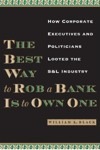
Bill Black is the author of The Best Way to Rob a Bank is to Own One and an associate professor of economics and law at the University of Missouri-Kansas City. He spent years working on regulatory policy and fraud prevention as Executive Director of the Institute for Fraud Prevention, Litigation Director of the Federal Home Loan Bank Board and Deputy Director of the National Commission on Financial Institution Reform, Recovery and Enforcement, among other positions.


Bill writes a column for Benzinga every Monday. His other academic articles, congressional testimony, and musings about the financial crisis can be found at his Social Science Research Network author page and at the blog New Economic Perspectives.

MMT in the Upper Midwest

Readers in the Rochester (Minn.), Waterloo (Iowa), and La Crosse (Wis.) area can attend a public lecture by Stephanie Kelton on Wednesday, September 28 at Luther College in Decorah, Iowa.  Stephanie’s talk is at 7:00 p.m. in the Center for Faith and Life Recital Hall.  For more information, visit the Luther College website.  http://www.luther.edu/publiclife/

Today’s Modern Money Primer

Last week we received a well-thought-out query, which is pasted below in its entirety (although I removed the author’s name to respect privacy). I think the author raises points that are sufficiently important that we should take another unplanned diversion this week. This is the great thing about running the Primer this way as I can see where I’ve failed to adequately explain something. I had thought the distinction between real and financial (nominal) was clear—but obviously it was not.

At this point you might want to skip down to the bottom of this post to read the query. I will summarize the main point later, but I expect that many of you would agree with the author—so go ahead and read it first. Then we’ll get to the response.

Ok, let me try to explain this as clearly as possible.

MMP Blog #17: Accounting for Real Versus Financial (or Nominal)

By L. Randall Wray

Last week we took a quick diversion into Euroland, which is crashing as we speak. Obviously, we went much too quickly to really give a good analysis of her problems. I urge readers to look at the front pages of NEP for timely pieces. Since this is a Primer, we want it to be more like a textbook. If Euroland completely disintegrates before next summer, I’ll add another section to do a post mortem on the misguided experiment in separating nations from their currencies. There are only very limited circumstances in which that can work—and Europe is not one of them.

Last week we received a well-thought-out query, which is pasted below in its entirety (although I removed the author’s name to respect privacy). I think the author raises points that are sufficiently important that we should take another unplanned diversion this week. This is the great thing about running the Primer this way as I can see where I’ve failed to adequately explain something. I had thought the distinction between real and financial (nominal) was clear—but obviously it was not.

At this point you might want to skip down to the bottom of this post to read the query. I will summarize the main point later, but I expect that many of you would agree with the author—so go ahead and read it first. Then we’ll get to the response.

Ok, let me try to explain this as clearly as possible.

Continue reading

Marshall Auerback on Ireland’s Vincent Browne Show

Click to watch Marshall Auerback discuss the Euro on Tonight with Vincent Browne, one of Ireland’s leading talk shows.

Say W-h-a-a-a-t?

Below are some of the wildest,boldest, and most surprising stories we ran across this week. Thanks toall who shared their favorites.  Keep them coming! This is a weeklyseries, so we’ll be back with more next Friday.


The following quote comes to us from famed economist Oliver Blanchard, IFM chief economist, Tuesday, September 20, 2011.  He said:  “What is needed to sustain growth is that households and firms increase their demand as fiscal deficits are being rolled back,” said Oliver Blanchard, IMF chief economist, on Tuesday. “What we observe is that this is not going well.”

Sarah Palin — yes,the momma grizzly herself — makes some shockingly insightful remarks about crony capitalism and the dangers of mixing money and politics.  “This is not the capitalism of free men and freemarkets, of innovation and hard work and ethics, of sacrifice and of risk,” shesaid of the crony variety. She added: “It’s the collusion of big government andbig business and big finance to the detriment of all the rest — to the littleguys.”

The former Democraticgovernor of Michigan played the austerity game.  Now she admits that herpolicies just made matters worse — and only the federal government can turn thetide.  “Everything that is hitting the country hit Michigan first,”Ms. Granholm said in an interview, reflecting on eight years in office in whichthe state’s economic crisis overshadowed all else. Her response to the crisis,she said, was to cut spending, cut government jobs, cut taxes – the veryapproach now being promoted elsewhere, particularly after Republican victoriesin statehouses around the country in 2010.  

“We tried all of those prescriptions,too,” said Ms. Granholm, whose final term ended with the start of thisyear. “We did everything that people would want us to do, and yet itdidn’t work.”  “I think thereare ways to stop it but it can only happen with a partnership with the federalgovernment, because individual states simply do not have the tools to competeagainst China or the globe.”

In a piece published on Monday, September 19, 2011,  Dean Baker lent some credence to Rick Perry’s insane argument about Social Security:  “The way in which Social Security is ostensibly similar to a Ponzi scheme is that it depends on new workers in the future to meet obligations that it incurs today. This also happens to be true of any debt issued by either the government or the private sector.”

Two guys walk into abar.  The other one — a corpse — gets dragged in by his mates.  Story here.

Should Congress Raise the Payroll Tax When the Economy Recovers?

By Stephanie Kelton

Dean Baker has just written another piece on Social Security. Dean and I have always disagreed at some fundamental level on the best way to run opposition against those that are committed to weakening and ultimately destroying this vital program. Thus, while Dean and the MMTers are on the same philosophical team (we all want to preserve the program), we run our offence using very different strategical play books.

When it comes to Social Security, MMTers have taken many pages out of Robert Eisner’s play book. To my mind, no economist has been a more honest and forceful defender of the program. (Eisner was Professor Emeritus at Northwestern University and one of Bill Clinton’s friends and former teachers. He passed away in 2010.)  In my favourite piece on the subject, Eisner said:

The notion that Social Security faces bankruptcy begins with a fundamental misconception, that payment of benefits somehow depends upon the OASDI (Old Age and Survivors and Disability Insurance) trust funds. The trust funds are merely accounting entities….

…Our payroll taxes or “contributions” go directly to the United States Treasury. Our benefit checks come from the Treasury-and those receiving them can verify on those checks that the payer is the Treasury of the United States, and not any trust fund. Social Security payments are an obligation under law of the U.S. government. Our government and its Treasury will not,indeed cannot, go bankrupt. As Federal Reserve Chairman Alan Greenspan has recently put it, “[A] government cannot become insolvent with respect to obligations in its own currency.”

Baker’s latest piece is interesting because it shows that he has at least one foot in the Eisner door. He says:

While there is nothing in prin­ci­ple wrong with fi­nanc­ing So­cial Se­cu­rity in part out of gen­eral rev­enue for two or three years in the mid­dle of a se­vere eco­nomic down­turn, the ques­tion is what will hap­pen when the economy recovers enough that we no longer need this tax cut as stim­u­lus. In prin­ci­ple the tax should sim­ply re­vert to its nor­mal level.

When the economy recovers, Baker is worried that Congress will lack the political will to raise payroll tax rates, leaving the program vulnerable. He says:

If the Social Security tax were not re­stored to its for­mer level, then we could in prin­ci­ple con­tinue to make up the dif­fer­ence from gen­eral rev­enue. How­ever, there cer­tainly is no agree­ment that this will be done. Since its in­cep­tion, So­cial Se­cu­rity has been fi­nanced from the des­ig­nated pay­roll tax. This tax has been used to sus­tain the trust fund, which is in prin­ci­ple sep­a­rate from the rest of the bud­get.

Okay, there is a bit of MMT in here — the government could always make up the difference from general revenue — but the rest of the argument breaks sharply from Eisner, who explained that the perceived funding of Social Security through a dedicated payroll tax is nothing more than a useful myth.

Baker accepts that myth, arguing that as long as Congress has the guts to return the payroll tax to its original rate after the recovery takes hold, then the Trust Fund “would be suf­fi­cient to keep the pro­gram fully funded through the year 2038 and more than 80 per­cent funded through the rest of the century.”

To ensure that this happens, Baker proposes:

[A] very sim­ple way around this po­ten­tial prob­lem. If we want to give a tax cut to work­ers equal to 3.1 per­cent of wages, as Pres­i­dent Obama has pro­posed, along with a sim­i­lar cut to some em­ploy­ers, we can just write that into the law with­out any ref­er­ence to So­cial Se­cu­rity.

In other words, the tax cut would take the form of a tax credit that is paid out to work­ers and firms in ex­actly the amounts that Pres­i­dent Obama pro­posed. How­ever this credit would have no con­nec­tion what­so­ever to the So­cial Se­cu­rity tax, which con­tin­ues to get col­lected at its nor­mal rate.

MMTers would argue against this. Indeed, we have argued in favour of a more generous payroll tax cut — i.e. reducing FICA withholdings to zero for employees and the employers — and we would prefer to keep it that way so that the entire program is overtly, and permanently, funded out of general revenue.  Baker has vehemently opposed our policy recommendation, arguing that it would make the program vulnerable to attack if it lacked a dedicated source of funding.  So Baker wants to make sure the Trust Fund is “there” in order to protect Social Security from attack.

Here’s how Eisner dealt with the same problem:

Expenditures alleged to be related to trust funds are often less than their income-witness the highway and airport  funds as well Social Security. There is no particular  reason they cannot be more. The accountants can just as well declare the bottom line of the funds’ accounts negative as positive – and the Treasury can go on making whatever outlays are prescribed by law. The Treasury  can pay out all that Social Security provides while the accountants declare the funds more and more in the red. 

For those concerned, nevertheless, about the “solvency” of the trust funds, there are simple, painless remedies for this accounting problem….why not award balances in the Trust Funds, instead of the current 5.9 percent interest rate on long-term government bonds, [a] higher return… [for] it was not God but Congress and the Treasury that determined the interest rate to be credited on the non-negotiable Treasury notes of the fund balances.”

So Congress could simply agree to credit the Trust Funds at 10, 25, 40, 100, or 500 percent, making the entire “problem” go away. At 100 percent interest, even the most pessimistic CBO official would have to give the fund a clean bill of health, and future retirees could get 100 percent of the benefits they have been promised.

Which solution should progressives advocate?  Baker’s tit-for-tat replacement tax that promises to preserve Social Security in its current state — able to pay just 80 percent of promised benefits to future retirees?  Eisner’s tongue-in-cheek remedy that artificially pumps up the size of the Trust Fund to astronomical proportions in order to placate the accountants?  Or the MMT solution that advocates a straightforward payment of promised benefits to all future retirees?