Predicting the Euro’s Demise: To Those Who Got it Right, We Salute You!

By Mitch Green

To many of the world’s most highly-regarded economists, the Eurozone’s meltdown has come as a major surprise.  Committed to the belief that One Market needs One Money, most economists expected the Euro to serve as an important complement to Europe’s integration.  But, as Cullen Roche at Pragmatic Capitalism has pointed out, those who recognized how the monetary systems actually work saw the writing on the wall, as the seeds of the Euro’s own destruction were unwittingly put in place right from the beginning. Wynne Godley was the first to point out that the unprecedented divorce between the Eurozone governments’ monetary and fiscal powers would place its members in a fragile position and render them powerless in the face of a crisis.  It was a warning that Cullen suggested might amount to “the greatest prediction of the last 20 years.”  Similar praise came just last week from John Cassidy of The New Yorker magazine, who dedicated an entire piece to Godley’s insights, calling him “The Man Who Saw Through the Euro.”

Continue reading

The Virgin Crisis: Systematically Ignoring Fraud as a Systemic Risk

By William K. Black
(Cross-posted from Benzinga)

One of the most revealing thingsabout this crisis is the unwillingness to investigate whether “accountingcontrol fraud” was a major contributor to the crisis.  The refusal to even consider a major role forfraud is facially bizarre.  The bankingexpert James Pierce found that fraud by senior insiders was, historically, theleading cause of major bank failures in the United States.  The national commission that investigated thecause of the S&L debacle found:

“Thetypical large failure [grew] at an extremely rapid rate, achieving highconcentrations of assets in risky ventures…. [E]very accounting trick availablewas used…. Evidence of fraud was invariably present as was the ability of theoperators to “milk” the organization” (NCFIRRE 1993)  

Two of the nation’s topeconomists’ study of the S&L debacle led them to conclude that the S&Lregulators were correct – financial deregulation could be dangerouslycriminogenic.  That understanding wouldallow us to avoid similar future crises. 

“Neitherthe public nor economists foresaw that [S&L deregulation was] bound toproduce looting.  Nor, unaware of theconcept, could they have known how serious it would be.  Thus the regulators in the field whounderstood what was happening from the beginning found lukewarm support, atbest, for their cause. Now we know better. If we learn from experience, history need not repeat itself” (GeorgeAkerlof & Paul Romer.  “Looting: theEconomic Underworld of Bankruptcy for Profit.” 1993: 60).

The epidemic of accounting controlfraud that drove the second phase of the S&L debacle (the first phase wascaused by interest rate risk) was followed by an epidemic of accounting controlfraud that produced the Enron era frauds. 

The FBI warned in September 2004that there was an “epidemic” of mortgage fraud and predicted that it wouldcause a financial “crisis” if it were not contained.  The mortgage banking industry’s ownanti-fraud experts reported in writing to nearly every mortgage lender in 2006that:

“Stated income and reduced documentation loans speedup the approval process, but they are open invitations to fraudsters.”  “When the stated incomes were compared to theIRS figures: [90%] of the stated incomes were exaggerated by 5% or more.[A]lmost 60% were exaggerated by more than 50%. [T]he stated income loandeserves the nickname used by many in the industry, the ‘liar’s loan’” (MARI2006).

Weknow that accounting control fraud is itself criminogenic – fraud begetsfraud.  The fraudulent CEOs deliberatelycreate the perverse incentives that that suborn inside and outside employeesand professionals.  We have known forfour decades how these perverse incentives produce endemic fraud by generatinga “Gresham’s” dynamic in which bad ethics drives good ethics out of the marketplace.

“[D]ishonest dealings tend to drive honest dealingsout of the market. The cost of dishonesty, therefore, lies not only in theamount by which the purchaser is cheated; the cost also must include the lossincurred from driving legitimate business out of existence.”  George Akerlof (1970).

Akerlofnoted this dynamic in his seminal article on markets for “lemons,” which led tothe award of the Nobel Prize in Economics in 2001.  It is the giants of economics who haveconfirmed what the S&L regulators and criminologists observed when wesystematically “autopsied” each S&L failure to investigate its causes.  Modern executive compensation has madeaccounting control fraud vastly more criminogenic than it once was asinvestigators of the current crisis have confirmed.

“Over the last several years, the subprime markethas created a race to the bottom in which unethical actors have been handsomelyrewarded for their misdeeds and ethical actors have lost market share…. Themarket incentives rewarded irresponsible lending and made it more difficult forresponsible lenders to compete.”  Miller,T. J. (August 14, 2007).  Iowa AG.

Liar’s loans offer what we call asuperb “natural experiment.”  No honestmortgage lender would make a liar’s loan because such loans have a sharplynegative expected value.  Notunderwriting creates intense “adverse selection.”  We know that it was overwhelmingly thelenders and their agents that put the lies in liar’s loans and the lenderscreated the perverse compensation incentives that led their agents to lie aboutthe borrowers’ income and to inflate appraisals.  We know that appraisal fraud was endemic andonly agents and their lenders can commit widespread appraisal fraud.  Iowa Attorney General Miller’s investigationsfound:

“[Manyoriginators invent] non-existent occupations or income sources, or simplyinflat[e] income totals to support loan applications. Importantly, ourinvestigations have found that most stated income fraud occurs at thesuggestion and direction of the loan originator, not the consumer.”

New York Attorney General (nowGovernor) Cuomo’s investigations revealed that Washington Mutual (one of theleaders in making liar’s loans) developed a blacklist of appraisers – whorefused to inflate appraisals.  No honestmortgage lender would ever inflate an appraisal or permit widespread appraisalinflation by its agents.  Surveys ofappraisers confirm that there was widespread pressure by nonprime lenders andtheir agents to inflate appraisals.

We also know that the firms thatmade and purchased liar’s loans followed the respective accounting controlfraud “recipes” that maximize fictional short-term reported income, executivecompensation, and (real) losses.  Thoserecipes have four ingredients: 
  1.  Growlike crazy
  2.  Bymaking (or purchasing) poor quality loans at a premium yield
  3.  Whileemploying extreme leverage, and
  4.  Providingonly grossly inadequate allowances for loan and lease losses (ALLL) against thelosses inherent in making or purchasing liars loans


Firms that follow these recipesare not “gamblers” and they are not taking “risks.”  Akerlof & Romer, the S&L regulators,and criminologists recognize that this recipe provides a “sure thing.”  The exceptional (albeit fictional) income,real bonuses, and real losses are all sure things for accounting controlfrauds.

Liar’s loans are superb“ammunition” for accounting control frauds because they (and appraisal fraud)allow the fraudulent mortgage lenders and their agents to attain the unholyfraud trinity: (1) the lender can charge a substantial premium yield, (2) on aloan that appears to relatively lowerrisk because the lender has inflated the borrowers’ income and the appraisal,while (3) eliminating the incriminating evidence of fraud that realunderwriting of the borrowers’ income and salary would normally place in theloan files.  The government did notrequire any entity to make or purchase liar’s loans (and that includes Fannieand Freddie).  The states and the federalgovernment frequently criticized liar’s loans. Fannie and Freddie purchased liar’s loans for the same reasons thatMerrill, Lehman, Bear Stearns, etc. acquired liar’s loans – they wereaccounting control frauds and liar’s loans (and CDOs backed by liar’s loans)were the best available ammunition for maximizing their fictional reportedincome and real bonuses. 

Liar’s loans were large enough tohyper-inflate the bubble and drive the crisis. They increased massively from 2003-2007.

“[B]etween2003 and 2006 … subprime and Alt-A [loans grew] 94 and 340 percent,respectively.

Thehigher levels of originations after 2003 were largely sustained by the growthof the nonprime (both the subprime and Alt-A) segment of the mortgage market.”  “Alt-A: The Forgotten Segment of the MortgageMarket” (Federal Reserve Bank ofSt. Louis 2010).
     
The growth of liar’s loans wasactually far greater than the extraordinary rate that the St. Louis Fed studyindicated.  Their error was assuming that“subprime” and “alt-a” (one of the many misleading euphemisms for liar’s loans)were dichotomous.  Credit Suisse’s early2007 study of nonprime lending reported that roughly half of all loans called“subprime” were also “liar’s” loans and that roughly one-third of home loansmade in 2006 were liar’s loans.  Thatfact has four critical implications for this subject.  The growth of liar’s loans was dramaticallylarger than the already extraordinary 340% in three years reported by the St.Louis Fed because, by 2006, half of the loans the study labeled as “subprime”were also liar’s loans.  Because loansthe study classified as “subprime” started out the period studied (2003) as amuch larger category than liar’s loans the actual percentage increase in liar’sloans from 2003-2006 is over 500%.  Thefirst critical implication is that it was the tremendous growth in liar’s loansthat caused the bubble to hyper-inflate and delayed its collapse. 

The role of accounting controlfraud epidemics in causing bubbles to hyper-inflate and persist is anotherreason that accounting control fraud is often criminogenic.  When such frauds cluster they are likely todrive serious bubbles.  Inflating bubblesoptimize the fraud recipes for borrowers and purchasers of the bad loans bygreatly delaying the onset of loss recognition. The saying in the trade is that “a rolling loan gathers no loss.”  One can simply refinance the bad loans todelay the loss recognition and book new fee and interest “income.”  When entry is easy (and entry into becoming amortgage broker was exceptionally easy), an industry becomes even morecriminogenic.    

Second, liar’s loans (and CDOs“backed” by liar’s loans) were large enough to cause extreme losses.  Millions of liar’s loans were made and thoseloans caused catastrophic losses because they hyper-inflated the bubble,because they were endemically fraudulent, because the borrower was typicallyinduced by the lenders’ frauds to acquire a home they could not afford topurchase, and because the appraisals were frequently inflated.  Do the math: roughly one-third of home loans made in 2006 were liar’s loans and theincidence of fraud in such loans was 90%. We are talking about an annual fraud rate of over one million mortgageloans from 2005 until the market for liar’s loans collapsed in mid-2007. 

Third, the industry massivelyincreased its origination and purchase of liar’s loans after the FBI warned of the developing fraud “epidemic” andpredicted it would cause a crisis and then massively increased its originationand purchase of liar’s loans after the industry’s own anti-fraud experts warnedthat such loans were endemically fraudulent and would cause severe losses.  Again, this provides a natural experiment toevaluate why Fannie, Freddie, et alia, originated and purchased theseloans.  It wasn’t because “thegovernment” compelled them to do so. They did so because they were accounting control frauds.

Fourth, the industry increasinglymade the worst conceivable loans that maximized fictional short-term income andreal compensation and losses.  Making (orpurchasing) liar’s loans that are also subprime loans means that the originatoris making (or the purchaser is buying) a loan that is endemically fraudulent toa borrower who has known, serious credit problems.  It’s actually worse than that because lendersalso increasingly added “layered” risks (no downpayments and negativeamortization) in order to optimize accounting fraud.  Negative amortization reduces the borrowers’short-term interest rates, delaying delinquencies and defaults (but producingfar greater losses).  Again, thisstrategy maximizes fictional income and real losses.  Honest home lenders and purchasers of homeloans would not act in this fashion because the loans must cause catastrophiclosses.

To sum it up, the known facts ofthis crisis refute the rival theories that the lenders/purchasersoriginated/bought endemically fraudulent liar’s loans because (a) “thegovernment” made them (or Fannie and Freddie) do so, or (b) because they weretrying to maximize profits by taking “extreme tail” (i.e., an exceptionallyunlikely risk).  The risk that a liar’shome loan will default is exceptionally high, not exceptionally low.  The known facts of the crisis are consistentwith accounting control frauds using liar’s loans (in the United States) astheir “ammunition of choice” in accordance with the conventional fraud “recipe”used that caused prior U.S. crises. 

It is bizarre that in suchcircumstances the automatic assumption of the Bush and Obama administrationshas been that fraud isn’t even worth investigating or considering in connectionwith the crisis.  It is as if millions ofliar’s loans purchased and resold as CDOs largely by systemically dangerous institutionsare an inconvenient distraction from campaign fundraising efforts.  Instead, we have the myth of the virgincrisis unsullied by accounting control fraud. Indeed, contrary to theory, experience, and reality, the Department ofJustice has invented the faith-based fiction that looting cannot occur. 

“BenjaminWagner, a U.S. Attorney who is actively prosecuting mortgage fraud cases inSacramento, Calif., points out that banks lose money when a loan turns out tobe fraudulent. “It doesn’t make any sense to me that they would be deliberatelydefrauding themselves,” Wagner said.”

Wagner’s statement isembarrassing.  He conflates “they”(referring to the CEO) and “themselves” (referring to the bank).  It makes perfect sense for the CEO to lootthe bank.  Looting is a “sure thing” guaranteedto make the CEO wealthy.  “Looting”destroys the bank (that’s the “bankruptcy” part of Akerlof & Romer’s title)but it produces the “profit” for the CEO. It is the deliberate making of masses of bad loans at premium yieldsthat allows the CEO to profit by looting the bank.  When the top prosecutor in an epicenter ofaccounting control fraud defines the most destructive form of financial crimeout of existence he allows elite fraud to occur with impunity.   

As embarrassing as Wagner’s statement is, however,it cannot compete on this dimension with that of his boss, Attorney GeneralHolder.  I was appalled when I reviewedhis testimony before the Financial Crisis Inquiry Commission (FCIC).  Chairman Angelides asked Holder to explainthe actions the Department of Justice (DOJ) took in response to the FBI’swarning in September 2004 that mortgage fraud was “epidemic” and its predictionthat if the fraud epidemic were not contained it would cause a financial“crisis.”  Holder testified:  “I’m not familiar myself with that [FBI]statement.”  The DOJ’s (the FBI is partof DOJ) preeminent contribution with respect to this crisis was the FBI’s 2004warning to the nation (in open House testimony picked up by the national media.  For none of Holder’s senior staffers whoprepped him for his testimony to know about the FBI testimony requires thatthey know nothing about the department’s most important and (potentially)useful act.  That depth of ignorancecould not exist if his senior aides cared the least about the financial crisisand made it even a minor priority to understand, investigate, and prosecute thefrauds that drove the crisis. Because Holder was testifying in January 14,2010, the failure of anyone from Holder on down in his prep team to know aboutthe FBI’s warnings also requires that all of them failed to read any of therelevant criminology literature or even the media and blogosphere.

In addition to claiming that the DOJ’s response tothe developing crisis under President Bush was superb, Holder implicitly tookthe position that (without any investigation or analysis) fraud could not anddid not pose any systemic economic risk. Implicitly, he claimed that only economists had the expertise tocontribute to understanding the causes of the crisis.  If you don’t investigate; you don’tfind.  If you don’t understand“accounting control fraud” you cannot understand why we have recurrent,intensifying financial crises.  If Holderthinks we should take our policy advice from Larry Summers and Bob Rubin,leading authors’ of the crisis, then he has abdicated his responsibilities tothe source of the problem.       

 “Now let mestate at the outset what role the Department plays and does not play inaddressing these challenges” [record fraud in investment banking andsecurities].

“The Department of Justice investigates andprosecutes federal crimes.…”

 “As a generalmatter we do not have the expertise nor is it part of our mission to opine onthe systemic causes of the financial crisis. Rather the Justice Department’s resources are focused on investigatingand prosecuting crime.  It is within thiscontext that I am pleased to offer my testimony and to contribute to your vitalreview.”  

Two aspects of Holder’s testimony were preposterous,dishonest, and dangerous.

“I’m proud that we have put in place a lawenforcement response to the financial crisis that is and will continue to be isaggressive, comprehensive, and well-coordinated.”

DOJ has obtained ten convictions of senior insidersof mortgage lenders (all from one obscure mortgage bank) v. over 1000 felonyconvictions in the S&L debacle.  DOJhas not conducted an investigation worthy of the name of any of the largestaccounting control frauds.  DOJ isactively opposing investigating the systemically dangerous institutions (SDIs).

Holder’s most disingenuous and dangerous sentence,however, was this one:

“Our efforts to fight economic crime are a vitalcomponent of our broader strategy, a strategy that seeks to foster confidencein our financial system, integrity in our markets, and prosperity for theAmerican people.”


Yes, the “confidencefairy” ruled at DOJ.  It is the rationalenow for DOJ’s disgraceful efforts to achieve immunity for the SDIs’ endemicfrauds.  The confidence fairy trumped andtraduced “integrity in our markets” and “prosperity for the Americanpeople.”  Prosperity is reserved for theSDIs and their senior managers – the one percent.


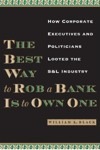
Bill Black is the author of The Best Way to Rob a Bank is to Own One and an associate professor of economics and law at the University of Missouri-Kansas City. He spent years working on regulatory policy and fraud prevention as Executive Director of the Institute for Fraud Prevention, Litigation Director of the Federal Home Loan Bank Board and Deputy Director of the National Commission on Financial Institution Reform, Recovery and Enforcement, among other positions.

Did Dodd-Frank Act End “Too Big To Fail”?

By Robert E. Prasch

Since the triumphal passage of the Dodd-Frank Wall Street Regulation and Consumer Protection Act on 21st of July 2010, we have been told repeatedly that the United States would “never again” be confronted with a “choice” between bailing out a large insolvent financial institution “or else.” If so, this means that one of the most pernicious and damaging features of capitalism has been forever solved. Were we convinced that the 111th Congress and the Obama Administration had actually achieved this, all right-minded persons would surely exclaim, “What a gift to the country, what a gift to humanity!” Yet, it is evident that few of us are doing that. Is the problem in ourselves? Are American voters hopeless ingrates? Or, is it that our suspicions are well-grounded?


With the emergence of Occupy Wall Street only a year before the 2012 elections, the prospects and promise of the Dodd-Frank Act is – as it should be — pivotal to our assessment of the record of this Congress and Administration. As such, let us take a moment to contemplate the specifics of the much-vaunted process that – we are told – will ensure the most important promise of Dodd-Frank – the anticipation and prevention of another fantastically costly bailout. The recent and very public troubles of Bank of America suggest that a test may be coming soon. If Dodd-Frank works as advertised, BofA’s pending failure should not cost the public a cent – and that certainly is good news, is it not? 

To assess this core claim of Dodd-Frank, let us contemplate the specifics of the process that will — we have been told — successfully identify, take over, and resolve large systemically important financial institutions before they fail. To reiterate, we have been told that firms fitting this description can and will be taken over before they are insolvent, and especially before the problem becomes a charge on the public purse. As this process is best understood by an example, let us begin by supposing that one of the nation’s largest systemically important bank holding companies (BHC) is in trouble (although it could be any financial institution designated previously as systemically important). Let us further suppose that this BHC – as so many do — relies upon short-term borrowing in the markets to support a highly-leveraged portfolio of speculative, risky, and now-troubled assets. To keep it real, let us suppose that few of these assets can be traded and thereby “priced” in open or competitive markets. It is, of course, unnecessary to point out that when traders and senior managers put together these deals they greatly enriched themselves. But, they have long since cashed their bonus checks, so the problem now belongs to the bank – and potentially the public.

Today, the BHC’s stock price is falling, credit default swap premiums on its assets and the debt it issues are rising, and counter-parties are demanding ever-greater collateral to provide short-term financing. Many money-managers who have had long-standing lending relationships with this bank are refusing to provide further financing at any price, and large clients are beginning to withdraw their funds and move their accounts. Stated bluntly, the future of this firm is bleak and the situation is worsening at an accelerating pace.

What happens now? The bank’s first defense is — as always — a flat-out denial that they are in trouble. But such protests are unlikely to convince its peers, big-time money managers, or other savvy counter-parties or players. In the nineteenth century, it used to be said that if a lady had to publically defend her reputation, it was too late. Times may have changed in these matters, but for financial institutions this old adage remains true. A need to publically proclaim its solvency can — and should — be taken as prima facie evidence that a bank either is, or is about to be, insolvent. Let us, then, suppose that the situation continues to worsen for our hypothetical firm.

The bank’s second step is to highlight its internal audit, along with the clean bill of health it has received from its highly reputable outside accountants and lawyers. Wall Street will not be convinced. Why? Because they know that these audits are readily and routinely rigged through “creative accounting.” To illustrate this point, I have my classes guess how many quarterly earnings statements showed losses at New Century Financial before its massive collapse in March 2007. The answer, dear reader, is zero. The process by which one goes from being a high-flying and highly-profitable darling of financial innovation to catastrophic bankruptcy without ever passing through an unprofitable quarter is, I will submit, “complicated.” Indeed, the SEC also thought that it was “complicated” and brought a suit. Unfortunately, this suit was settled for essentially a pittance – a “lesson” not lost on other Wall Street players and those who are obliged to interact with them. Least this case be considered a singular event, I remind them that S&P gave Lehman Brothers an “A” rating until weeks before its collapse. Similar examples abound throughout this and earlier crises.

Third, an upsurge of campaign “donations” from the troubled BHC will ensure that at a substantial portion – if not a majority — of Congresspersons will avidly assent to the firm’s own assessment of its condition and prospects (Let us note that if it is indeed insolvent, these donations and other lobbying and public relations expenses are de facto additions to the federal debt). Although the reasoning and arguments then presented to the public by these august tribunes of the people might be embarrassingly shallow, we can be sure that they will lean on the political appointees heading the regulatory agencies to take “a broad interpretation” of the situation. Simultaneously, the bank’s senior compliance and legal advisors, who in all likelihood are former senior staff at the regulatory agencies to which it answers, will contact their old colleagues to argue and reargue the bank’s version of its financial condition. They will emphasize its singularly sunny prospects for future success.

Let me digress by observing that it will not escape the attention of those who staff the government’s regulatory agencies that their former colleagues have moved into substantially higher tax brackets and much tonier neighborhoods. To that end, perhaps we should allow our regulators to indulge in a moment of wistfulness. After all, in the aftermath of such reunions it is only human to feel somewhat conscious of one’s own comparably modest socio-economic status. If our public servants are at all like most people, they might pause to consider a career move… But such ruminations are beside the point. Or are they?

Let us suppose that our regulators remain stalwart, undaunted, resolute, and unmoved by such considerations. They are good people, professionals who readily eschew fantastic opportunities to remain faithful public servants. Nevertheless, as a consequence of the bank’s previous moves, Congress is in an uproar, the White House is worried, and Wall Street has closed ranks behind the bank (the latter are sufficiently intertwined with its fortunes that they stand to take large losses). Outside of the halls of power, think-tank “experts,” television “opinion leaders,” newspaper reporters, and editorialists are running unfavorable stories about the supposed “anti-market” bias of regulators, etc. Meanwhile, the regulators, if they are doing their job properly, are not conducting interviews or discussing the story with the media. Consequently, their side of the story – and only they have access to the bank’s balance sheet – is underrepresented in the press. Moreover, those few newspapers running stories that suggest that the bank’s problems may be real will be accused of being irresponsible or anti-business. They may even have been – quietly — threatened with lawsuits claiming libel. We should recall that even spurious lawsuits can be expensive for most daily or weekly newspapers.

As the disinformation campaign moves into high gear, the regulators must get the Board of Directors of the FDIC to vote that this bank is on the brink of collapse and for that reason should be taken over quickly, before it becomes insolvent and thereby a public charge. This Board, let us recollect, is made up of three permanent members serving six year terms in addition to the head of the Office of the Comptroller of the Currency and the head of the Office of Thrift Supervision, who both serve in ex officio status. All of them are appointed by the President with Senate approval and no more than three of the five of them may be from the same political party. Stated simply, the Board may represent a variety of views, but we can be confident that the largest financial institutions have had an opportunity to carefully vet all of the participants in the discussion. After all, few administrations or senators have the stomach to fight the nation’s most powerful industry over what — to the public — may appear to be relatively obscure bureaucratic appointments. However, to give credit where it is due, over the last five years the FDIC is one of the few agencies to have shown some life in regulatory matters. One reason may be the personalities involved. Another may be that it is their funds that are used to cover depositors’ accounts and, for that reason, they are the agency left “holding the bag” in the event of a catastrophic failure.

Supposing that the FDIC has decided that this bank must be resolved, the next to vote is the Federal Stability Oversight Council (FSOC). This group is Chaired by the Secretary of the Treasury and its nine other voting members include the Chairman of the Federal Reserve Board, the Chair of the Commodity Futures Trading Corporation, the Comptroller of the Currency, the Chair of the Securities and Exchange Commission, etc. Each and every one of these individuals took their positions only after a Presidential appointment and a Senate hearing. Once again, banker views were fully present and accounted for. In short, these are people known in Wall Street/D.C. circles for their “sound views” — that is to say long-standing sympathy toward politically prominent banks, bankers, and related financial institutions. In many if not most instances, they were themselves formerly bankers or worked in law or accounting firms catering to the financial sector. This characterization also describes the bulk of their deputies. The final step is to formerly notify and advise the President of the FSOC’s decision. While lawyers and others who have examined Frank-Dodd have not agreed as to whether the President has the authority to override a vote of the FSOC, it is difficult to imagine that these several senior appointees would have allowed the process to advance this far without White House approval.

Now, let us recall that all of the above will occur as the large financial institution in question is in the throes of a rapid and accelerating downward spiral – yet it is supposed to be completed even as the firm remains – if just barely – solvent. While the Feds might try to keep their deliberations a secret, it is hard to imagine that financial markets will long remain in the dark about them. For that reason, the bank in question will find that it must post ever-greater collateral to retain the short-term financing it requires to operate. Credit Default Swaps will soar, ratings agencies might decide to (belatedly) issue a downgrade on the firm’s debt, and the bank will struggle to place its commercial paper or otherwise raise funds. Consequently, it will become increasingly dependent upon the Fed’s Discount Lending facility, which means that that latter institution stands to be even more embarrassed by the pending failure, and for that reason inclined to postpone the resolution of this bank.

Since the passage of Dodd-Frank a year ago, I have attended multiple conferences in a variety of locations in the United States and Canada. At each of them, I have informally polled a range of colleagues studying monetary and financial economics to find out if they believed that the above process has any chance of working as described. I specifically ask them if they believe that the FDIC and FSOC could (1) identify a pending failure some time before it becomes insolvent, and then (2) organize the regulatory and political will to take over a massive, interconnected, and politically powerful institution, and (3) navigate the process of arriving at a decision in a time frame sufficiently short to avoid a massive run on the institution, a run that could readily spread to similar institutions and to those firms dependent upon them. Let us recall that the prevention of just such a run is the primary task of financial regulation. To date, I have not found a single individual who believes that it will work.

For myself, I will continue to accept the view of Vermont Senator Bernie Sanders (I-VT), that “If an institution is too big to fail, it is too big to exist.” Despite what we were told, alternatives to Frank-Dodd do, and did, exist. For example, on November 6th 2009, Senator Sanders introduced legislation that would give the Secretary of the Treasury 90 days to report to the Senate with a list of commercial banks, investment banks, hedge funds, insurance companies, and other financial institutions that were “Too Big To Fail” (TBTF). The Secretary would then be granted a year from the date of that report to break them up. Sanders’ bill was not taken up.

Later, Senators Sharrod Brown (D-OH) and Ted Kaufman (D-DE) actually got a bill called the SAFE Banking Act of 2010 to the Senate floor. It would have imposed binding leverage and liability limits on bank holding companies and financial institutions, thereby effectively breaking up the largest of them. This bill was opposed by most Republicans and leading Senate Democrats (including Senators C. Dodd (CT), D. Feinstein (CA), J. Kerry, and both Senators from New York and New Jersey). The White House and the Treasury Department were also opposed. Unsurprisingly, it failed by a vote of 61-33 on June 17th, 2010 despite attracting the support of three Republicans. Senator Judd Gregg (R-NH), whose “centrist” views had once moved the Obama Administration to nominate him for Secretary of Commerce, summarized the sentiments of those voting against this act, “I don’t understand this Brown-Kaufman Amendment. Basically, what it says is if you’re successful … you’re going to break them up? I mean, where does this stop?”

Alternatives to Frank-Dodd’s cumbersome resolution authority clearly exist, and continue to exist. The key is prevention – do not allow individual banks to become so large or so leveraged as to threaten the system (while the system itself can be a source of risk, that is a separate issue). The problem was and remains a lack of political will on the part of both political parties. On the matter of Too Big To Fail, Occupy Wall Street and the broader American public are themselves asking, “Where does this stop?” Good question, maybe the Senator from New Hampshire, one of his colleagues from the Democratic Party, or someone from the Treasury or the White House will deign to let us know. 

Robert E. Prasch is Professor of Economics at Middlebury College where he teaches courses on Monetary Theory and Policy, Macroeconomics, the History of Economic Thought, and American Economic History. His latest book is How Markets Work: Supply, Demand and the ‘Real World’ (Edward Elgar, 2008).

MMP Blog #23: The Debate About Debt Limits (US Case)


This week we will look at a “special case”, and one that preoccupied Washington recently.As we know, governments spend by keystrokes that they can never run out of–asovereign government that issues its own currency through keystrokes can neverface a financial constraint. However, it can choose to “tie its hands behindits back” by imposing rules and procedures that limit its keystrokes. It could,for example, simply impose a limit of “100 keystrokes per year”. It couldrequire the Treasury Secretary to climb Mount Everest or to seek approval fromterrestrial or extra-terrestrial gods before he is allowed to enter akeystroke. It could require a solar eclipse or similar “miracle” beforegovernment is allowed to credit a balance sheet.

We shouldnot be fooled by such self-imposed constraints. We should be able to seethrough them to understand that since they are imposed by government on itself,they can be removed. Unfortunately, virtually all economists and policymakerscome to see such self-imposed constraints as “natural”, something to neverviolate. Today we will look at the US “debt limit” that consumed policy makersin the US last summer—and will likely be visited again.

Before weproceed, let me acknowledge that I’ve promised our wonky readers some balancesheets and a detailed treatment of internal operating procedures used by theFed and Treasury to get around the self-imposed constraints. I have notforgotten. That is a matter for a later post.

In theUnited States Congress establishes a federal government debt limit. When theoutstanding quantity of federal government debt approaches that limit Congressmust approve expansion of the limit. Note that this debt limit is establishedby policy, not by markets—that is, Congressional action is required byCongress’s own rules, and not by market pressure. Hence, it is not a questionof whether the US government could sell more bonds, or even over the interestrate it would pay on the debt it sells.

In the aftermath of the Global FinancialCollapse of 2007, the US budget deficit increased (mostly due to loss of taxrevenue, as discussed in a previous blog). Predictably, the amount of debtoutstanding grew to the limit, and so each year Congress has had to increasethe limit.

This blogwill look at current procedures to see if there is an alternative to increasingthe limit—while allowing the Treasury to continue to spend. We examined most ofthe details of the operating procedures in a previous blog; in this blog weextend that understanding to come up with an alternative procedure. We will usethe distinction between High Powered Money (Federal Reserve Notes, Reserves,and Treasury Coins) and Treasury Debt (bills and bonds)—only Treasury Debt isincluded in the debt limits, although we know that all of these are governmentIOUs.

So let ussee how we can untie Uncle Sam’s purse strings while living with current debtlimits. It is actually a relatively easy thing to do, requiring only a modestchange of procedure.

First weneed to review how things usually work. Congress (with the President’ssignature) approves a budget that authorizes spending. Treasury then eithercuts a check or directly credits a recipient’s bank account. While the USConstitution vests in Congress the power to create money, in practice theTreasury uses the US central bank, the Fed, to handle its payments. Currentprocedure is for the Treasury to hold deposits in its account at the Fed forthe purposes of making payments. Hence, when it cuts a check or credits aprivate bank account, the Treasury’s deposit at the Fed is debited.

TheTreasury tries to maintain a deposit of $5 billion at the close of each day.Taxes paid to the Treasury are first held in deposit accounts it has withspecial private banks. When it wants to replenish its deposit at the Fed,Treasury moves deposits from these banks. Obviously there are twocomplications: first, tax receipts bunch around tax due dates; and, second, theTreasury normally runs an annual budget deficit—more than a trillion Dollars in2011. That means Treasury’s account at the Fed is frequently short.

To obtain deposits, the Treasury sells bonds(of various maturities). The easiest thing to do would be to sell them directlyto the Fed, which would credit the Treasury’s demand deposit at the Fed, offseton the Fed’s balance sheet by the Treasury’s debt. Effectively, that is whatany bank does—it makes a loan to you by holding your IOU while crediting yourdemand deposit so that you can spend.

But currentprocedures prohibit the Fed from buying treasuries from the Treasury (with somesmall exceptions); instead it must buy treasuries from anyone except theTreasury. That is a strange prohibition to put on a sovereign issuer of thecurrency, if you think about it, but it has a long history that we will notexplore in this box. It is believed that this prevents the Fed from simply“printing money” to “finance” budget deficits so large as to cause highinflation–as if Congressional budget authority (and threatened Presidentialveto) is not enough to constrain federal government spending sufficiently thatit does not take the US down the path toward hyperinflation.

So,instead, the Treasury sells the Treasuries (bills and bonds) to private banks,which create deposits for the Treasury that it can then move over to itsdeposit at the Fed. And then the Fed buys treasuries from the private banks toreplenish the reserves they lose when the Treasury moves the deposits. Got that?The Fed ends up with the treasuries, and the Treasury ends up with the demanddeposits in its account at the Fed—which is what it wanted all along, but isprohibited from doing directly. The Treasury then cuts the checks and makes itspayments. Deposits are credited to accounts at private banks, whichsimultaneously are credited with reserves by the Fed.

In normaltimes banks would find themselves with more reserves than desired so offer themin the overnight Fed Funds market. This tends to push the Fed Funds rate belowthe Fed’s target, triggering an open market sale of treasuries to drain theexcess reserves. The treasuries go back off the Fed’s balance sheet and intothe banking sector. (With the Global Financial Crisis, the Fed changedoperating procedure somewhat—it began to pay interest on reserves, and adopted“Quantitative Easing” that purposely leaves excess reserves in the bankingsystem. That is a topic for another blog.)

And that iswhere the debt gridlock problem bites. Treasuries held by banks, households,firms, and foreigners are counted as government debt (and nongovernment wealththrough accounting identities!) and thus subject to the imposed debt ceiling.Bank reserves, by contrast, are not counted as government debt. (One solution isto just stop the open market sales of treasuries in order to leave the reservesin the banking system. That is essentially what Bernanke’s Quantitative Easing2 does: the Fed is buying hundreds of billions of treasuries to inject reservesback into banks—the reserves that were drained by selling the treasuries tobanks in the first place.) So we are getting treasuries back onto the Fed’sbalance sheet, and yet gridlock remains because there are still too manyTreasuries off the Fed’s balance sheet.

Here is aproposal to change procedures in a way that eliminates the need to raise debtlimits. When Uncle Sam needs to spend and finds his cupboard bare, he canreplenish his demand deposit at the Fed by issuing a nonmarketable “warrant” tobe held by the Fed as an asset. With the full faith and credit of Uncle Samstanding behind it, the warrant is a risk-free asset to balance the Fed’saccounts. The warrant is just an internal IOU—from one branch of government toanother—really not anything more than internal record keeping. If desired,Congress can mandate a low, fixed interest rate to be earned by the Fed on itsholdings of these warrants (to be deducted against the excess profits itnormally turns over to the Treasury at the end of each year). In return, the Fedwould credit the Treasury’s deposit account to enable government to spend. Whenthe Treasury spends, its account is debited, and the private bank that receivesa deposit would have its reserves at the Fed credited.

From theFed’s perspective it ends up with the Treasury’s warrant as an asset and bankreserves as its liability. The Treasury is able to spend as authorized byCongress, and its deficit is matched by warrants issued to the Fed. Congresswould mandate that these warrants would be excluded from debt limits since theyare nothing but a record of one branch of government (the Fed) owning claims onanother branch (the Treasury). The Fed’s asset is matched by the Treasury’swarrant—so they net out.
AndCongress would not need to increase the debt limit when a crisis hits thatresults in growing budget deficits.

Thisproposal just shows how silly it is to tie the Treasury’s hands behind its backthrough imposing debt limits. We already require that a budget is approvedbefore Treasury can spend. That constraint is necessary to imposeaccountability over the Treasury. But once a budget is approved, why on earthwould we want to prevent the Treasury from keystroking the necessary balancesheet entries in accordance with Congress’s approved spending?

Thebudgeting procedure should take into account projections of the evolution ofmacroeconomic variables like GDP, unemployment, and inflation. It should try toensure that government keystroking will not be excessive, stoking inflation. Itis certainly possibly that Congress might guess wrong—and might want to reviseits spending plan in light of developments. Or, it can build in automaticstabilizers to lower spending or raise taxes if inflation is fuelled. But itmakes no sense to approve a spending path and then to arbitrarily refuse tokeystroke spending simply because an arbitrary debt limit is reached.

Wall Street vs. Greece: G20 Opens as Greek PM Pushes for Referendum on Bailout and Austerity Measures

Michael Hudson  “Polls report that 66 percent of the Greeks do want to stay in the eurozone. They want to stay in the euro. So, by trying to rephrase the question in a way that will get a “Yes” vote, they avoid asking the really important question: Do you Greeks want to push yourselves into a decade of depression and impose austerity? Do you vote to sell off the public domain, sell off the Athenian water supply, sell off your islands, sell off your mineral rights in the sea, sell off even the Parthenon—do you want to do that so that French banks and American bond insurers will not lose money?”

Do Harvard’s Econ Students Have a Point?

By Stephanie Kelton

 
Two days ago, a group of students at Harvard University submitted the following letter to their econ prof — Greg Mankiw – just before they got up and walked out of his introductory econ class.  In the letter,  Professor Mankiw’s students say, “If Harvard fails to equip its students with a broad and critical understanding of economics, their actions are likely to harm the global financial system. The last five years of economic turmoil have been proof enough of this.”
 
These students are clearly aware of the harm that economist scan do when they’re employing faulty models that rest on faith-based (theoclassical) assumptions to dispense policy advice in the real world.  See, for example:
 

Illegal Alien Guts Cause Republican Strategist to Worship Junk Economics for the One Percent

 
Aasif Mandvi’s interview of Noelle Nikpour,Republican Strategist, was broadcast on Wednesday, October 26, 2011.  Mandvi is an intrepid Daily Show investigative reporter. Ms. Nikpour, while vigorously wagging her finger, warned of a wave ofjunk science.
 
“Scientists arescamming the American people right and left for their own financial gain.”
 
“I think every Americanif they really thought about it would have a gut feeling that some of thesenumbers that the scientists are putting out are not right.” 
 
Her statements represented a sea change inRepublican Strategist strategy.  Byrelying on our gut feelings we are, as any Republican Strategist speaker onscience knows, relying on alien microflora to make our decisions.  Many Democrats are weak on protecting ournation from such alien invasions and call such microflora “undocumented,” butRepublican Strategists have the courage to call a phage a phage – these areillegal alien microflora.
 
Your gut is overwhelmingly populated by a mass(around three pounds) of illegal aliens. The microflora are literally non-human. They began to enter your body when you were a fetus – and RepublicanStrategists are fetuses’ most impassioned champions.  Your gut microflora first entered your bodyfrom your mother.  If she breast fed youshe reinforced the alien invasion of your innocent body.  It is no surprise that treacherous liberalslike Jamie Lee Curtis are pushing women to purchase yoghourts filled with“active cultures” designed to make the illegal alien microflora that rule ourguts more fruitful so they will multiply even more quickly.  The illegal alien microflora in our gutsalready outnumber our human cells by a factor of ten – and Jamie Lee Curtiswants them to go on an orgy of reproduction – much of it worse than homesexual– asexual alien reproduction in the gut of God’s vessel.  It is the dread mitosis in God’s eye. 

Many Evangelical Republican Strategists findthemselves in a dilemma with regard to this illegal placental border crossingand the subsequent maternal invasion by lactation.  Republican Strategists are great believers inmothers, but Southern Baptist Republican Strategists are taught to believe thatit is against God’s plan for a woman to ever have power over a man.  Republican Strategists counsel us to make ourdecisions based on illegal alien microflora that gained a foothold in ourhelpless bodily temples due to our mothers. When secular Republican Strategists urge us be guided by our guts we aregiving maternal microflora dominion over men. We may think we are men, and ordained to rule our households, churches,and nations, but our guts were all originally colonized alien maternalmultiflora.  Women’s sinful nature didnot end with the apple.  Our treacherousmothers infected us with invasive alien multiflora even before birth.  Indeed, our mothers are so insidious thatthey infect our guts with maternal multiflora that fool us into believing thatwe were created to rule and do rule – while we are actually dominated by andsubordinate to the maternal microflora that rule our guts and make ourdecisions.     
 
I have consulted my alien gut microflora, and theyhave led me to predict that liberal traitors are providing aid and comfort toour alien masters by pushing energy bars upon our innocent children.  Our alien masters are using our mothers tobetray our very humanity even at the cellular level.  Mitochondria, according to scientists’ aliengut microflora, are cell organelles that are the product of an alien invasionhundreds of millions of years ago.  Thesefifth columnists invaded not only our bodies but our very cells.  They stowed away in us before we were“us.”  Scientists’ alien gut mitochondriatell them that the creatures (probably bacteria) that eventually co-evolved toform mitochondria invaded far back in the evolving origin of species andcreated the Eukaryotes.  Scientists’ alien gut microflora are soskewed toward scamming that they believe in evolution.  Fortunately, Southern Baptists’ alienmicroflora cause them to reject such scams and have faith in a “young earth.”
 
Mitochondria are so despicable that they createtheir own DNA.  Illegal aliens, ofcourse, are adept at forging citizenship documents.  Worse, this inhuman DNA comes solely from ourmothers.  Our traitorous mothers areagain infecting us with alien organelles. Mitochondria are now the OPEC of broad swaths of life forms – they havea strangle hold on our energy supply. Republican Strategists should start a national movement for energyindependence and to reassert the security of our cross-species barrier(border).  What is our ATP doing in theirorganelles?  We need a no tolerancepolicy against mitochondria.  No amnestyfor alien organelles!  We can reassertenergy independence and reassert control over our precious bodily fluids bydrilling into every cell and expelling their alien organelles.  Drill baby drill!   
 
Republican Strategists should also begin a mass(bowel) movement to cleanse themselves of illegal alien gut microflora.  Ignore the snide scientists who predict thatthe strategy won’t work, but will make it easier for the Strategists to inserttheir heads up their favored orifice.
 
Scientists’ alien gut microflora and organelles tellthem that the alien microflora help our guts and that the mitochondria areessential to life.  Our guts’ alienmicroflora tell us that this is a typical “scientific” scam. 
 
The illegal alien microflora dominating my gut havedriven me to ask this question to Republican Strategists: why don’t your gutsever cause you to question the theories, findings, and policies that emergefrom the guts of theoclassical economists? Daniel Fischel and Judge Frank Easterbrook write in their 1991 treatiseabout the corporate law that   “a ruleagainst fraud is not an essential or … an important ingredient of securitiesmarkets.”   Why doesn’t your gut lead youto reject such tripe?  They publishedtheir treatise after Fischel applyied this theory in the real world as anexpert for three of the worst “control frauds” and produced disastrousconclusions and policy recommendations. The treatise does not mention those failures.  Doesn’t that make your guts queasy?  

Responses to Blog #22: Bonds, Reserves and Savings

Sorry am traveling, so the Blog has had a bit of a vacation.Must be brief today:
Q1: What about Ellen Brown?

A: I like the idea of public banking. Not a topic for today.Do not completely agree with her view of Fed.

Q2: What encourages a bank to lend money?

A: Most important: a profit opportunity to lend to aborrower likely to service her debt. Hint: has nothing to do with reserves.

Q3: At what point does borrowing at discount window push updiscount rate?

A: Never. This is not about quantity, it is about price.Central bank sets the rate at the discount window, so rate rises only whencentral bank decides to increase it.

Q4: Why does Japan have low bond rates?

A: Because BofJapan wants low rates. Set the overnight rateat zero, keep it there for a generation, and just like magic markets price in azero cost of overnight funds! You could just as well have asked why the USA hadnear zero bond rates throughout WWII in spite of budget deficits that would causea Greek to blush.

Q5: Many say rest of world funds the US trade and budgetdeficits.

A: And they be wrong. Dazed and confused. Where did everydollar the Chinese have come from?

Q6: Convince Bill Gross and we win the lottery.

A: Right. Note how well PIMCO did before Paul left PIMCO,and how poorly it is doing now. Paul and his rabbit understood MMT (more orless).

Q7: Isn’t treasury mandated to sell bonds equal to itsdeficit and to have funds in its account at the central bank before cuttingchecks?

A: Yes, true of many treasuries around the world. Goodexample of a government willing to tie its hands behind its back. Topic forlater blog. It is a specific case, not the general case. But, yes important butwe will see it makes no difference.

Q8: Banks create deposits out of thin air?

A: Yes when they make loans.

Q9: Deposit multiplier story: banks lend their excessreserves and through the magic of a multiplier money is created by a multiple.

A: Pure textbook fantasy. No, doesn’t work that way.

Q10: What would happen if reserves were discretionary?

A: Central bank has given up interest ratetarget, lets checks bounce, and bank checks don’t clear at par, so paymentssystem breaks down.

Bill Black: Jobs Now, Stop The Foreclosures, Jail The Banksters

Corruption and Crony Capitalism Kill

By William K. Black

The recent Turkish earthquake, as with its modern predecessors, has shown that the witches’ brew that crony capitalism produces is a leading cause of death and severe injury. Control fraud, the use of a seemingly legitimate entity by those that control it to defraud, exists in all three major sectors – private, public, and non-profit. Crony capitalism typically involves the interaction of public and private sector control fraud. I have written primarily about accounting control frauds, which are property crimes of mass destruction. Anti-customer, anti-public, and anti-employee control frauds can all cause mass casualties. Earthquakes and the tsunamis they produce can kill hundreds of thousands of people. Government programs have been exceptionally successful in reducing the loss of life from natural disasters. Early warnings, evacuation routes, barriers, and training can greatly reduce the losses caused by tsunamis. Seismic building codes, if properly enforced, can reduce direct deaths from earthquakes to exceptionally low levels even in severe seismic events. The saying is: earthquakes don’t kill people; collapsing structures do.