Timmy-Gate: Did Geithner Help Hide Lehman’s Fraud?

Timmy-Gate Takes a Turn For The Worse: Did Geithner Help Lehman Hide Accounting Tricks?

By L. Randall Wray

Just when you thought that nothing could stink more than Timothy Geithner’s handling of the AIG bailout, a new report details how Geithner’s New York Fed allowed Lehman Brothers to use an accounting gimmick to hide debt. The report, which runs to 2200 pages, was released by Anton Valukas, the court-appointed examiner. It actually makes the AIG bailout look tame by comparison. It is now crystal clear why Geithner’s Treasury as well as Bernanke’s Fed refuse to allow any light to shine on the massive cover-up underway.
Recall that the New York Fed arranged for AIG to pay one hundred cents on the dollar on bad debts to its counterparties—benefiting Goldman Sachs and a handful of other favored Wall Street firms. (see here) The purported reason is that Geithner so feared any negative repercussions resulting from debt write-downs that he wanted Uncle Sam to make sure that Wall Street banks could not lose on bad bets. Now we find that Geithner’s NYFed supported Lehman’s efforts to conceal the extent of its problems. (see here) Not only did the NYFed fail to blow the whistle on flagrant accounting tricks, it also helped to hide Lehman’s illiquid assets on the Fed’s balance sheet to make its position look better. Note that the NY Fed had increased its supervision to the point that it was going over Lehman’s books daily; further, it continued to take trash off the books of Lehman right up to the bitter end, helping to perpetuate the fraud that was designed to maintain the pretense that Lehman was not massively insolvent. (see here)

Geithner told Congress that he has never been a regulator. (see here) That is a quite honest assessment of his job performance, although it is completely inaccurate as a description of his duties as President of the NYFed. Apparently, Geithner has never met an accounting gimmick that he does not like, if it appears to improve the reported finances of a Wall Street firm. We will leave to the side his own checkered past as a taxpayer, although one might question the wisdom of appointing someone who is apparently insufficiently skilled to file accurate tax returns to a position as our nation’s chief tax collector. What is far more troubling is that he now heads the Treaury—which means that he is not only responsible for managing two regulatory units (the FDIC and OCC), but also that he has got hold of the government’s purse strings. How many more billions or trillions will he commit to a futile effort to help Wall Street avoid its losses?
Geithner has denied that he played any direct role in the AIG bail-out—a somewhat implausible claim given that he was the President of the NYFed and given that this was a monumental and unprecedented action to funnel government funds to AIG’s counterparties. He may try to deny involvement in the Lehman deals. (Again, this is implausible. Lehman executives claimed they “gave full and complete financial information to government agencies”, and that the government never raised significant objections or directed that Lehman take any corrective action. In fairness, the SEC also overlooked any problems at Lehman. (see here) But here is what is so astounding about the gimmicks: Lehman used “Repo 105” to temporarily move liabilities off its balance sheet—essentially pretending to sell them although it promised to immediately buy them back. The abuse was so flagrant that no US law firm would sign off on the practice, fearing that creditors and stockholders would have grounds for lawsuits on the basis that this caused a “material misrepresentation” of Lehman’s financial statements. (see here) The court-appointed examiner hired to look into the failure of Lehman found “materially misleading” accounting and “actionable balance sheet manipulation.” (here) But just as Arthur Andersen had signed off on Enron’s scams, Ernst & Young found no problem with Lehman. (here)
In short, this was an Enron-style, go directly to jail and do not pass go, sort of fraud. Lehman’s had been using this trick since 2001. (here) It looked fine to Timmy’s Fed, which extended loans allowing Lehman to flip bad assets onto the Fed’s balance sheet to keep the fraud going.
More generally, this revelation drives home three related points. First, the scandal is on-going and it is huge. President Obama must hold Geithner accountable. He must determine what did Geithner know, and when did he know it. All internal documents and emails related to the AIG bailout and the attempt to keep Lehman afloat need to be released. Further, Obama must ask what has Geithner done to favor his clients on Wall Street? It now looks like even the Fed BOG, not just the NYFed, is involved in the cover-up. It is in the interest of the Obama administration to come clean. It is hard to believe that it does not already have sufficient cause to fire Geithner. In terms of dollar costs to the government, this is surely the biggest scandal in US history. It terms of sheer sleaze does it rank with Watergate? I suppose that depends on whether you believe that political hit lists and spying that had no real impact on the outcome of an election is as bad as a wholesale handing-over of government and the economy to Wall Street.
What did Timmy know, and when did he know it?
Point number two. Lehman used an innovation, “Repo 105” to hide debt. The whole Greek debt fiasco was caused by Goldman, et. al., who helped hide government debt. (here and here) Whether legal or illegal, Wall Street has for many years been producing financial instruments designed to mislead shareholders, creditors, and regulators about the true financial position of its clients. Note that Lehman’s counterparties in this fraud included JP Morgan and Citigroup (who actually precipitated Lehman’s final failure when they finally called in their loans). It always takes at least three to tango: the firm that wants to hide debt, the counterparty that temporarily takes it off their books, and the accounting firm that provides the kiss of approval.
Worse, after aiding and abetting such deception, Goldman and other Wall Street institutions then place bets (using another nefarious innovation, credit default swaps) against their clients, wagering that they will not be able to service the debts—which are greater than the market believes them to be. Does that sound something like insider trading? How can regulators permit such actions?
What did Timmy know, and when did he know it?
Third point. To the extent that debt is hidden, financial institution balance sheets present an overly rosy picture—of course, that is the purpose of the financial “innovations”. Enron did it; AIG did it; Lehman did it. What about Bank of America, Citi, JP Morgan, Wells Fargo and Goldman? We now know that the New York Fed subjected Lehman to three wimpy “stress tests”, all of which it failed. Timmy’s Fed then allowed Lehman to construct its own sure-to-pass “stress” test. (We know, of course, that the test was absolutely meaningless because, well, Lehman passed the test and then immediately failed spectacularly. Timmy then let the biggest banks run their own stress tests, which they (surprise, surprise) managed to pass.
What did Timmy know, and when did he know it?
As our all-time favorite Fed Chairman Alan Greenspan liked to put it, “history shows” that when financial institutions pass their own stress tests, they are actually massively insolvent. There is no reason to believe that this time will be different. Mike Konczal reports that there is every reason to believe the biggest banks are hiding huge losses on second liens. (here) These are second mortgages or home equity loans that amount to about $1 trillion of which almost half are held by the top four banks. Since the first principal of a mortgage is paid first, it is likely that much of the second liens are worthless. Yet banks are carrying these on their books at 86 to 87 percent of face value—which was necessary to allow them to pass the stress tests. Konczal shows that at a more reasonable loss rate of 40% to 60%, the four largest banks would have “an extra $150 billion hole in the balance sheet”. I won’t go into the policy conundrum implied for President Obama’s plan for principal reduction to help homeowners (the banks will not allow renegotiation of underwater mortgages because that would force them to recognize losses on the second liens).
Of greater importance is the recognition that all of the big banks are probably insolvent. Another financial crisis is nearly certain to hit in coming months—probably before summer. The belief that together Geithner and Bernanke have resolved the crisis and that they have put the economy on a path to recovery will be exposed as wishful thinking. In the bigger scheme of things, this is only 1931. We have a long way to go before bank assets (and nonbank debts) are written down sufficiently to allow a real recovery. In other words, a Minsky-Fisher debt deflation is still in the cards.

Interview with Randall Wray about Greece’s Debt Crisis

See below Prof. L Randall Wray’s interview for the Greek newspaper (Eleftherotypia) about Greece’s debt crisis.

By Chronis Polychroniou
*This is an english translation of the greek publication.

1.Goldman Sachs created financial instruments to hide European government debt and Greece is one of its first victims in the eurozone. In a recent article of yours, co-written with Marshall Auerback, you argue that Wall Street firms should not only be held accountable for such practices, but war should be declared on them. How can a small nation like Greece declare war on Wall Street’s financial institutions?

Wray: Of course the best strategy would be a coordinated investigation by all Euro member nations to get to the bottom of the financial manipulation perpetrated by these institutions on European soil. As we said, investigators should invade the offices and secure all files, internal memos, and emails. This is the only way to find out which laws have been broken and to prosecute guilty parties. In our article we focused on recent revelations about Goldman, but it is likely that other behemoth financial institutions, including some European banks, have engaged in similar practices.

Beyond that, it is important to send a message to these institutions that “business as usual” will not be permitted any longer. It is no stretch to say that the fate of European Union is in question. These institutions are testing whether they can bring down Greece. If they are permitted to do so, there is absolutely no doubt that they will set their sights on the next victim—Portugal, Italy, or Spain. It is not just that they helped to hide debt. They are placing bets on default, driving up credit default swap (CDS) prices, inducing credit down-grades, and hence raising finance costs. None of the Euro nations would be able to survive this onslaught—not even Germany.

This is why we have used the term “war” to describe the nature of this conflict. No country should sit idly by and allow financial institutions to bring it down. If Greece cannot secure the support of other Euro nations, it will have to unilaterally declare war on those institutions operating on its soil—those actively engaged in undermining its economy.

1.Why isn’t the Obama administration doing something about Wall street’s manipulation and destruction of the world’s economies?

Wray: That is of course a difficult question to answer because it is not possible to get inside the heads of administration officials. We can only look at this from the outside, and from the outside it stinks of scandal. I am beginning to think that this will go down in history as one of the worst scandals the US has ever seen. The triggering event will be seen as the AIG bailout—in which the NYFed led by Timothy Geithner gave billions of dollars to AIG that it funneled to counterparties like Goldman to pay off CDSs at one hundred cents on the dollar. There was and is absolutely no justification for that action. But far worse is the cover-up, in which the Fed and Treasury are still engaged. It is always the cover-up that brings down administrations. This one looks like it ranks with a Watergate cover-up. I repeat that we do not have the facts, so the appearances might be incorrect. But that is all the more reason for the Obama administration to come clean. It must release all internal documents, and all emails, and account for every dollar spent. It must name names and it must then prosecute all fraud—even if that goes right to the top of the Treasury and Fed.

2.How do you explain the hysteria against Greece by major European financial newspapers?

Wray: There is of course always some sensationalism in the press. And Greece looks on the surface like an easy victim. And there is some residual belief that “Mediterranean nations” need more discipline (I have lived in Italy and am aware that even some Italians welcomed the Euro on the belief that it would discipline their own government). But leaving all that to the side, this story of Greece has elements that are sure to grab the attention of the press. A “profligate” government that spends well beyond its means. Shady backroom deals with huge Wall Street firms who help to hide debt and deceive the public as well as the rest of Euroland. And then a turn-coat Goldman that bets against its client (a normal practice at Goldman). The government now proposes austerity, and the population predictably reacts against cuts to pay and services. Civil unrest always makes headlines.

I think there is probably also a fear that they may be next. When bullies beat up a hapless child on the schoolyard, a crowd circles and cheers them on—in the fear that one of them might be next. I repeat, no Euro country is safe. So there is no doubt some perversity in the financial press’s attack on Greece, a sort of marveling at how easy it is to bring down a nation and an uneasy recognition that a similar fate awaits their own.

Greece’s real problem is the set up of the Euro, it is not due to failings of national character. In a sense, the arbitrary unfairness of this is what makes the story so much more exciting for the press.

3.What’s your assessment of the Greek government’s fiscal austerity program?

Wray: It will fail. Austerity eliminates any possibility of growth, imposes deflationary pressures, reduces tax revenues, and results in a growing budget deficit. An estimated 40% of Greece’s GDP is already unrecorded, and more activity will go underground to escape taxes. Add to the mix the fact that with the major exception of China, the entire globe is in deep recession that is likely to last many years. That means there is no hope for Greece to export its way out of this predicament. Wages are falling all across Euroland (13 out of 24 nations had falling wages last year, and more will this year), so no matter how much pressure the government can put on wages, it will not be able to significantly lower wages relative to European wages. Some have remarked that Greece is the next Latvia—which is trying to use austerity to become the lowest cost country. It will not work—it is a competitive race to the bottom. No one wins such a race.

4.Aside from Greece seceding from the EE and defaulting on its euro debt, what other options may have been available to the government other than the austere fiscal measures it introduced last week?

Wray: Seceding is, I think, a last resort. It would be quite costly. If Greece does secede then of course it should default on its debt and reinstate its own sovereign currency. In the short run it will be painful; in the long run it would be the correct strategy only if there is no hope for changing fiscal arrangements in Euroland.
Some have argued that stronger Euro nations might bail out Greece. I do not think that will happen, for reasons discussed above. Greece is only the first victim. The stronger nations might take over Greece’s debt, but then they would need to take over Portugal’s, then Italy’s, then Spain’s. That is not possible as markets would then attack Germany and France.

So here is the best course of action. The ECB will purchase government debt of all Euro member nations with a view to settling markets, bringing down risk spreads, and reducing interest payments by governments. It will also provide an emergency package of fiscal stimulus equal to one trillion euros distributed among all Euro nations on a per capita basis. Individual governments will decide how to spend the euros. Finally, the configuration of Euroland will be changed to increase the fiscal authority of the European Parliament, to provide funding equal to ten or fifteen percent of Euroland GDP (up from less than 1% today). Some of this funding would be managed from the center, but most would be distributed among member nations.
This would help to resolve the main problem faced by Euronations—and the real cause of Greece’s current crisis. The set-up was flawed from the very beginning. The individual nations gave up sovereign fiscal power when they joined the Euro. All of the focus has been on setting up the ECB, and surrender of monetary policy to the center. This was a neoliberal policy—to put economic power in the hands of an independent authority whose one mission was to fight inflation. But there was never a countervailing fiscal authority, responsible for maintaining full employment and robust economic growth. Individual nations could not really fill the gap, because markets would punish deficits—just as they are now doing to Greece. It is time to throw out the neoliberal agenda and to reformulate the union along more sensible lines.

Professor William Black on PBS’ Newshour

WARNING: The US is Heading Toward Crony Capitalism

Dr. Black’s lecture Why Elite Frauds Cause Recurrent, Intensifying Economic, Political and Moral Crises at Lewis and Clark.
http://vimeo.com/moogaloop.swf?clip_id=10239575&server=vimeo.com&show_title=1&show_byline=1&show_portrait=0&color=&fullscreen=1

Steinhardt Lecture 2010 at Lewis & Clark College presents Dr. William Black from The Resource Lab on Vimeo.

Marshall Auerback responds to the Deficit “Hysteria”

Watch the video here.  

“Bill Black’s Top Ten Ways to Crack Down on Corporate Financial Crime”

by Corporate Crime Reporter*

Ninety-five percent of criminologists study blue collar crime.
Five percent study white collar crime.
Of the tiny minority who study white collar crime, ninety five percent focus on the individuals who rip off the corporation.
We are left with a small handful of criminologists – think Edwin Sutherland, John Braithwaite, Gil Geis – who have studied or are studying – corporate crime.
That would be crime by the corporation.
Bill Black is one of the most prominent of those living corporate criminologists.

His specialty – control fraud.

Control fraud is when the CEO of a company uses the corporation as a weapon to commit fraud.

Bill Black is a lawyer and former federal bank regulator.

He’s the author of the corporate crime classic – The Best Way to Rob a Bank is to Own One: How Corporate Executives and Politicians Looted the S&L Industry (University of Texas Press, 2005.)

Black says there are steps we can take as a society to control corporate crime – in particular financial crime.

In an interview with Corporate Crime Reporter last week, Black laid out his top ten.

Number ten: Hire 1,000 FBI agents.

Pass legislation (HR 3995) introduced by Congresswoman Marcy Kaptur that would fund the hiring of 1,000 FBI agents to investigate white collar crime.

Number nine: Appoint a chief criminologist at each of the financial regulatory agencies.

“Each agency needs someone who understands white collar crime,” Black said. “If you don’t understand fraud schemes, if you don’t understand how accounting is used to run these scams, you will always have a disaster in the making.”

Number eight: Fix executive compensation.

Black would tie executive bonuses to long term corporate performance.

Number seven: Target the top 100 corporate criminals.

“We need to do a top 100 priority list – the way it was done in the savings and loan crisis,” Black said. “The FBI, the Justice Department and the regulatory agencies got together and put together a list of top 100 companies to target. There was a recognition that these were control frauds. The top executives were using seemingly legitimate savings and loans as their weapons of fraud. And that is why any serious look will tell you the same thing about this most recent crisis as well. The criminal justice referral process has collapsed at the agencies.”

Number six: Regulate first.

“When you desupervise or deregulate an industry, in fact you are decriminalizing control fraud. The regulators are the ones who make the bulk of these cases. I’m not saying they can do it alone. In the current crisis, the FBI had no meaningful support from the regulators. You have regulators denying they were regulators and saying that there could be no fraud because the rating agencies were handing out high ratings. That kind of naivete is ideologically driven. You will not have effective prosecution with that kind of regulatory regime.”

Number five: Bust up the FBI partnership with the Mortgage Bankers Association.

“Now we have the FBI standing with what it calls its partners – the Mortgage Bankers Association,” Black said. “But the Mortgage Bankers Association – that’s the trade association of the perps. So, the FBI is partnering with the perps.”

“The result is – we have seen zero prosecutions of the specialty non-prime lenders that caused the crisis,” Black said. “The mortgage bankers are going to position themselves as the victims. This has been so successful that the FBI now has a mantra. They are saying there are two kinds of mortgage fraud. Fraud for profit and fraud for housing. And neither of them is control fraud. They have effectively said – control fraud is impossible. Even though it was the entire story behind the savings and loan crisis, the Enron wave, and the creation of the most recent housing bubble.”

Number four: Get rid of Ben Bernanke as chair of the Fed. Replace him with Nobel prize winner Joseph Stiglitz.

“Ben Bernanke should not have been reappointed as head of the Fed,” Black said. “He was the most senior regulator. And he was an utter failure. Under President Bush, he was President of the Council of Economic Advisors. So, he was a failure as a regulator. And he was a failure as an economist.”

Number three: Get rid of too big to fail.

There are about 20 banks that have assets of $100 billion or more. They are considered too big to fail. “You do three things,” Black says. “First, you stop them from growing. Second, you shrink them (to below $20 billion in assets.) You create the tax and regulatory incentives where they have to shrink below the level where they pose a systemic risk. And third, you regulate them much more intensively while they are in the process of moving from a systemically dangerous institution to a more leaner, smaller, more efficient, less dangerous institution.”

Number two: Create a consumer financial protection agency headed by Harvard Law School professor Elizabeth Warren.

“The sine qua non for success as a regulator is independence,” Black says. “So, it’s a very bad sign that Congress is moving away from an independent regulator.”

“As we speak, news is breaking that they are moving away from housing the regulator at the Treasury Department. Now they are talking about putting it at the Federal Reserve. The Fed is an independent regulator. Unfortunately, it’s an independent anti-regulator. I called putting it at the Treasury a sick joke. Putting it at the Fed is also a sick joke. They are both recipes for failure.”

Number one: Fire Treasury Secretary Timothy Geithner, Office of Thrift Supervision chief John Bowman, Fed chief regulator Patrick Parkinson, and Office of the Comptroller of the Currency Chief John Dugan.

“Tim Geithner was testifying before Congress a couple of years ago,” Black said. “And in response to a question from Ron Paul (R-Texas), Geithner said – ‘I have to stop you right there – I’ve never been a regulator.’ Well, that’s true. But you are not supposed to admit it.”

“Can you imagine. This is the President of the New York Fed, testifying about the greatest failure in banking in the history of the nation. And he is so completely out of it – the mindset of capture is so complete, that he says – I’ve never been a regulator. This is the ultimate capture. You don’t even think of yourself as a regulator.”
“Ben Bernanke in October 2009 appointed Patrick Parkinson as the top supervisor at the Fed,” Black said. “He’s the guy who, under Alan Greenspan, led the Fed charge against Brooksley Born when she wanted to regulate credit default swaps.”

“Patrick Parkinson, on behalf of the Fed, testified that credit default swaps should be left completely deregulated.”

“The reasons? If we regulate them, they will flee to the city of London. We should be so lucky, of course.”

“And two, fraud can’t happen in credit default swaps, because the participants are so sophisticated. This is the most astonishingly naive model of white collar crime by people who know nothing about white collar crime and don’t study it at all.”

“John Dugan’s sole priority and all of his passion as OCC director has been pre-empting state efforts to protect us from predatory lenders,” Black said.
“And John Bowman should be fired,” Black said. “The OTS got in bed with the industry most openly.”

*This article originally appeared on CommonDreams.org

It Takes Two to Tango: Look At The Numerator and Denominator

By Marshall Auerback

A new book by Kenneth Rogoff and Carmen Reinhart, “This Time It’s Different: Eight Centuries of Financial Follies“, has occasioned much comment in the press and blogosphere (see here and here).

The book purports to show that once the gross debt to GDP ratio crosses the threshold of 90%, economic growth slows dramatically.

But that’s too simplistic: Debt to GDP is a ratio and the ratio value is a function of both the numerator and denominator. The ratio can rise as a function of either an increase in debt or a decrease in GDP. So to blindly take a number, say, 90% debt to GDP as Rogoff and Reinhart have done in their recent work, is unduly simplistic. It appears that they looked at the ratio, assumed that its rise was due to an increase in debt, and then looked at GDP growth from that period forward assuming that weakness was caused by debt instead of that the rise in the ratio was caused by economic weakness. In other words, they have the causation backwards: Deficits go up as growth slows due to the automatic counter cyclical stabilizers.They don’t cause the slow down, etc.

As Randy Wray and Yeva Nersisyan have noted in a yet unpublished work, after the Second World War, the debt ratio came down rather rapidly-mostly not due to budget surpluses and debt retirement but rather due to rapid growth that raised the denominator of the debt ratio. By contrast, slower economic growth post 1973, accompanied by budget deficits, led to slow growth of the debt ratio until the Clinton boom (that saw growth return nearly to golden age rates) and budget surpluses lowered the ratio.

From 1991 through 2001 the growth of government debt had been falling and since then rising most recently at a faster pace. The raw data comes courtesy of the St. Louis Fed: http://research.stlouisfed.org/fred2/
(and attached spreadsheet).

The Ratio of the rates of change of Debt / GDP is rising faster than the change in Debt indicating that both the increase in Debt and the fall in GDP are contributing to a rising Debt / GDP ratio. For policy makers who obsess about a rising Debt / GDP ratio, they fail to understand that austerity measures that cut GDP growth will cause a rise in the Debt to GDP ratio. Basically, it boils down to this simple observation: it is foolish, dangerous, and thoroughly counterproductive to treat fiscal balances in isolation. In particular, setting a fiscal deficit to GDP target equal to expected long run real GDP growth in order to hold public debt/GDP ratios at a completely arbitrary (indeed, literally pulled out of thin air) public debt to GDP ratio without for a moment considering what the means for the feasible range of current account and domestic private sector financial balance is utterly nonsensensical.

It is crucial that investors and policy makers recognize and learn to think coherently about the connectedness of the financial balances before they demand what is being currently called fiscal sustainability. As it turns out, pursuing fiscal sustainability as it is currently defined will in all likelihood just lead many nations to further private sector debt destabilization. To put it bluntly, if the private sector continues to pursue a high net saving/financial surplus position while fiscal retrenchment is attempted, unless some other bloc of nations becomes large net importers (and the BRICs are surely not there yet), nominal GDP will fall in the fiscally “sound” nations, the designated fiscal deficit targets WILL NEVER BE ACHIEVED (there can also be a paradox of public thrift), and private debt distress will simply escalate.

In fact, if austerity measures are based on measures of debt relative to economic growth there is a very real risk of a downward spiral where economic growth declines at a faster pace than government debt and the rising Debt / GDP ratio leads to ever greater austerity measures. At a minimum, focusing only on the debt side of the equation risks increasing the Debt / GDP ratio that is the object of purported concern is likely to lead to policy incoherence and HIGHER levels of debt as GDP plunges. The solution is to recognize that the increase in the ratio is in some fair measure the result of declining economic growth and that only by increasing economic growth will the ratio be brought down. This may cause an initial rise in the ratio because of debt financing of fiscal stimulus but if positive economic growth is achieved the problem should be temporary. The alternative is to risk a debt deflationary spiral that will be much more difficult (and costly) to reverse.

Will the Quest for Fiscal Sustainability Destabilize Private Debt?

By Robert Parenteau, CFA*

The question of fiscal sustainability looms large at the moment – not just in the peripheral nations of the eurozone, but also in the UK, the US, and Japan. More restrictive fiscal paths are being proposed in order to avoid rapidly rising government debt to GDP ratios, and the financing challenges they may entail, including the possibility of default for nations without sovereign currencies.

However, most of the analysis and negotiation regarding the appropriate fiscal trajectory from here is occurring in something of a vacuum. The financial balance approach reveals that this way of proceeding may introduce new instabilities (see here and here). Intended changes to the financial balance of one sector can only be accomplished if the remaining sectors also adjust. Pursuing fiscal sustainability along currently proposed lines is likely to increase the odds of destabilizing the private sectors in the eurozone and elsewhere – unless an offsetting increase in current account balances can be accomplished in tandem.

To make the interconnectedness of sector financial balances clearer, proposed fiscal trajectories need to be considered in the context of what we call the financial balances map. Only then can tradeoffs between fiscal sustainability efforts and the issue of financial stability for the economy as a whole be made visible. Absent consideration of the interrelated nature of sector financial balances, unnecessarily damaging choices may soon be made to the detriment of citizens and firms in many nations.

Navigating the Financial Balances Map

For the economy as a whole, in any accounting period, total income must equal total expenditures. There are, after all, two sides to every transaction: a spender of money and a receiver of money income. Similarly, total saving out of income flows must equal total investment in tangible capital during any accounting period.

For individual sectors of the economy, these equalities need not hold. The financial balance of any one sector can be in surplus, in balance, or in deficit. The only requirement is, regardless of how many sectors we choose to divide the whole economy into, the sum of the sectoral financial balances must equal zero.

For example, if we divide the economy into three sectors – the domestic private (households and firms), government, and foreign sectors, the following identity must hold true:

Domestic Private Sector Financial Balance + Fiscal Balance + Foreign Financial Balance = 0

Note that it is impossible for all three sectors to net save – that is, to run a financial surplus – at the same time. All three sectors could run a financial balance, but they cannot all accomplish a financial surplus and accumulate financial assets at the same time – some sector has to be issuing liabilities.

Since foreigners earn a surplus by selling more exports to their trading partners than they buy in imports, the last term can be replaced by the inverse of the trade or current account balance. This reveals the cunning core of the Asian neo-mercantilist strategy. If a current account surplus can be sustained, then both the private sector and the government can maintain a financial surplus as well. Domestic debt burdens, be they public or private, need not build up over time on household, business, or government balance sheets.

Domestic Private Sector Financial Balance + Fiscal Balance – Current Account Balance = 0
Again, keep in mind this is an accounting identity, not a theory. If it is wrong, then five centuries of double entry book keeping must also be wrong. To make these relationships between sectors even clearer, we can visually represent this accounting identity in the following financial balances map as displayed below.
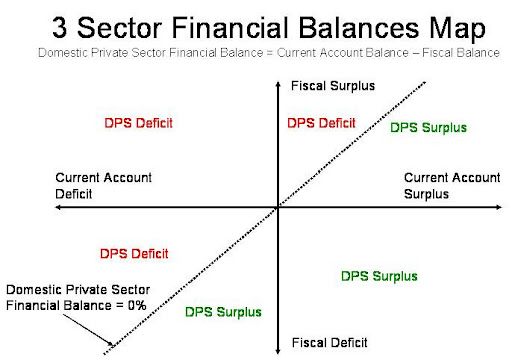
On the vertical axis we track the fiscal balance, and on the horizontal axis we track the current account balance. If we rearrange the financial balance identity as follows, we can also introduce the domestic private sector financial balance to the map:

Domestic Private Sector Financial Balance = Current Account Balance – Fiscal Balance

That means at every point on this map where the current account balance is equal to the fiscal balance, we know the domestic private sector financial balance must equal zero. In other words, the income of households and businesses just matches their expenditures (or alternatively, if you prefer, the saving out of income flows by the domestic private sector just matches the investment expenditures of the sector). The dotted line that passes through the origin at a 45 degree angle marks off the range of possible combinations where the domestic private sector is neither net issuing financial liabilities to other sectors, nor is it net accumulating financial assets from other sectors.

Once we mark this range of combinations where the domestic private sector is in financial balance, we also have determined two distinct zones in the financial balance map. To the left of the dotted line, the current account balance is less than the fiscal balance: the domestic private sector is deficit spending. To the right of the dotted line, the current account balance is greater than the fiscal balance, and the domestic private sector is running a financial surplus or net saving position.

This follows from the recognition that a current account surplus presents a net inflow to the domestic private sector (as export income for the domestic private sector exceeds their import spending), while a fiscal surplus presents a net outflow for the domestic private sector (as tax payments by the private sector exceed the government spending they receive).

Accordingly, the further we move up and to the left of the origin (toward the northwest corner of the map), the larger the deficit spending of households and firms as a share of GDP, and the faster the domestic private sector is either increasing its debt to income ratio, or reducing its net worth to income ratio (absent an asset bubble). Moving to the southeast corner from the origin takes us into larger domestic private surpluses.

The financial balance map forces us to recognize that changes in one sector’s financial balance cannot be viewed in isolation, as is the current fashion. If a nation wishes to run a persistent fiscal surplus and thereby pay down government debt, it needs to run an even larger trade surplus, or else the domestic private sector will be left stuck in a persistent deficit spending mode.

When sustained over time, this negative cash flow position for the domestic private sector will eventually increase the financial fragility of the economy, if not insure the proliferation of household and business bankruptcies. Mimicking the military planner logic of “we must bomb the village in order to save the village”, the blind pursuit of fiscal sustainability may simply induce more financial instability in the private sector.

Leading the PIIGS to an (as yet) Unrecognized Slaughter

The rules of the eurozone are designed to reduce the room for policy maneuver of any one member country, and thereby force private markets to act as the primary adjustment mechanism. Each country is subject to a single monetary policy set by the European Central Bank (ECB). One policy rate must fit the needs of all the member nations in the Eurozone. Each country has relinquished its own currency in favor of the euro. One exchange rate must fit the needs of all member nations in the Eurozone. The fiscal balance of member countries is also, under the provisions of the Stability and Growth Path, supposed to be limited to a deficit of 3% of GDP. The principle here is one of stabilizing or reducing government debt to GDP ratios. Assuming economies in the Eurozone have the potential to grow at 3% of GDP in nominal terms, only fiscal deficits greater than 3% of GDP will increase the public debt ratio.

In other words, to join the European Monetary Union, nations have substantially diluted their policy autonomy. Markets mechanisms must achieve more of the necessary adjustments – policy measures are circumscribed. Policy responses are constrained by design, and experience suggests relative price adjustments in the marketplace have a difficult time at best of automatically inducing private investment levels consistent with desired private saving at a level of full employment income.

Now let’s layer on top of this structure three complicating developments of late. First, current account balances in a number of the peripheral nations have fallen, in part due to the prior strength in the euro. Second, fiscal shenanigans along with a very sharp global recession have led to very large fiscal deficits in a number of peripheral nations. Third, following the Dubai World debt restructuring, global investors have become increasingly alarmed about the sustainability of fiscal trajectories, and there is mounting pressure for governments to commit to tangible plans to reduce fiscal deficits over the next three years, with Ireland and Greece facing the first wave of demands for fiscal retrenchment.

We can apply the financial balances approach to make the current predicament plain. If, for example, Spain is expected to reduce it’s fiscal deficit from roughly 10% of GDP to 3% of GDP in three years time, then the foreign and private domestic sectors must be together willing and able to reduce their financial balances by 7% of GDP. Spain is estimated to be running a 4.5% of GDP current account deficit this year. If Spain cannot improve its current account balance (in part because it relinquished its control over its nominal exchange rate the day it joined EMU), the arithmetic of sector financial balances is clear. Spain’s households and businesses would, accordingly, need to reduce their current net saving position by 7% of GDP over the next three years. Since they are currently estimated to be net saving 5.5% of GDP, Spain’s domestic private sector would move to a 1.5% of GDP deficit, and thereby enter a path of increasing leverage.

Spain already is running one of the higher private debt to GDP ratios in the region. In addition, Spain had one of the more dramatic housing busts in the region, which Spanish banks are still trying to dig themselves out from (mostly, it is alleged, by issuing new loans to keep the prior bad loans serviced, in what appears to be a Ponzi scheme fashion). It is highly unlikely Spanish businesses and households will voluntarily raise their indebtedness in an environment of 20% plus unemployment rates, combined with the prospect of rising tax rates and reduced government expenditures as fiscal retrenchment is pursued.

Alternatively, if we assume Spain’s private sector will attempt to preserve its estimated 5.5% of GDP financial balance, or perhaps even attempt to run a larger net saving or surplus position so it can reduce its private debt faster, Spain’s trade balance will need to improve by more than 7% of GDP over the next three years. Barring a major surge in tradable goods demand in the rest of the world, or a rogue wave of rapid product innovation from Spanish entrepreneurs, there is an additional way for Spain to accomplish such a significant reversal in its current account balance.

Prices and wages in Spain’s tradable goods sector will need to fall precipitously, and labor productivity will have to surge dramatically, in order to create a large enough real depreciation for Spain that its tradable products gain market share (at, we should mention, the expense of the rest of the Eurozone members). Arguably, the slack resulting from the fiscal retrenchment is just what the doctor might order to raise the odds of accomplishing such a large wage and price deflation in Spain. But how, we must wonder, will Spain’s private debt continue to be serviced during the transition as Spanish household wages and business revenues are falling under higher taxes or lower government spending?

Part II Spain Ensnared in the EMU Trap

As evident from the financial balances map, there are a whole range of possible combinations of current account and domestic private sector financial balances which could be consistent with the 7% of GDP reduction in Spain’s fiscal deficit. But the simple yet still widely unrecognized reality is as follows: both the public sector and the domestic private sector cannot deleverage at the same time unless Spain produces a nearly unimaginable trade surplus – unimaginable especially since Spain will not be the only country in Europe trying to pull this transition off.

As an admittedly rough exercise, we can assume each of the peripheral nations will be constrained to achieving a fiscal deficit that does not exceed 3% of GDP in three years time. In addition, we will assume each nation finds some way to improve its current account imbalances by 2% of GDP over the same interval. What, then, are the upper limits implied for domestic private sector financial balances as a share of GDP for each nation?

Greece and Portugal appear most at risk of facing deeper private sector deficit spending under the above scenario, while Spain comes very close to joining them. But that obscures another point which is worth emphasizing. With the exception of Italy, this scenario implies declines in private sector balances as a share of GDP ranging from 3% in Portugal to nearly 9% in Ireland.

Private sectors agents only tend to voluntarily target lower financial balances in the midst of asset bubbles, when, for example home prices boom and gross personal saving rates fall. Alternatively, during profit booms, firms issue debt and reinvest well in excess of their retained earnings in order take advantage of an unusually large gap between the cost of capital and the expected return on capital. We have no compelling reasons to believe either of these conditions is immediately on the horizon.

The above conclusion regarding the need for a substantial trade balance swing flows in a straightforward fashion from the financial balance approach, and yet it is obviously being widely ignored, because the issue of fiscal retrenchment is being discussed as if it had no influence on the other sector financial balances. This is unmitigated nonsense. It is even more retrograde than primitive tales of “twin deficits” (fiscal deficits are nearly guaranteed to produce offsetting current account deficits) or Ricardian Equivalence stories (fiscal deficits are nearly guaranteed to produce offsetting domestic private sector surpluses) mainstream economists have been force feeing us for the past three decades. Both of these stories reveal an incomplete understanding of the financial balance framework – or at best, one requiring highly restrictive (and therefore highly unrealistic) assumptions.

The EMU Triangle

This observation is especially relevant in the Eurozone, as the combination of the policy constraints that were designed into the EMU, plus the weak trade positions many peripheral nations have managed to achieve, have literally backed these countries into a corner. To illustrate the nature of their conundrum, consider the following application of the financial balances map.
First, a constraint on fiscal deficits to 3% of GDP can be represented as a line running parallel to and below the horizontal axis. Under Stability and Growth Pact rules, we must define all combinations of sector financial balance in the region below this line as inadmissible. Second, since current account deficits as a share of GDP in the peripheral nations are running anywhere from near 2% in Ireland to over 10% in Portugal, and changes in nominal exchange rates are ruled out by virtue of the currency union, we can provisionally assume a return to current account surpluses in these nations is at best a bit of a stretch. This eliminates the financial balance combinations available in the right hand half of the map.

If peripheral European nations wish to avoid higher private sector deficit spending – and realistically, for most of the peripheral countries, the question is whether private sectors can be induced to take on more debt anytime soon, and whether banks and other creditors will be willing to lend more to the private sector following a rash of burst housing bubbles, and a severe recession that is not quite over – then there is a very small triangle that captures the range of feasible solutions for these nations on the financial balance map.

It is the height of folly to expect peripheral Eurozone nations to sail their way into the EMU triangle under even the most masterful of policy efforts or price signals. More likely, since reducing trade deficits is likely to prove very challenging (Asia is still reliant on export led growth, while US consumer spending growth is still tentative), the peripheral nations in the Eurozone will find themselves floating somewhere out to the northwest of the EMU triangle. The sharper their fiscal retrenchments, the faster their private sectors will run up their debt to income ratios.

Alternatively, if households and businesses in the peripheral nations stubbornly defend their current net saving positions, the attempt at fiscal retrenchment will be thwarted by a deflationary drop in nominal GDP. Demands to redouble the tax hikes and public expenditure cuts to achieve a 3% of GDP fiscal deficit target will then arise. Private debt distress will also escalate as tax hikes and government expenditure cuts the net flow of income to the private sector. Call it the paradox of public thrift.

As it turns out, pursuing fiscal sustainability as it is currently defined will in all likelihood just lead many nations to further private sector debt destabilization. European economic growth will prove extremely difficult to achieve if the current fiscal “sustainability” plans are carried out. Realistically, policy makers are courting a situation in the region that will beget higher private debt defaults in the quest to reduce the risk of public debt defaults through fiscal retrenchment. European banks, which remain some of the most leveraged banks, will experience higher loan losses, and rating downgrades for banks will substitute for (or more likely accompany) rating downgrades for government debt. A fairly myopic version of fiscal sustainability will be bought at the price of a larger financial instability.

Summary and Conclusions

These types of tradeoffs are opaque now because the fiscal balance is being treated in isolation. Implicit choices have to be forced out into the open and coolly considered by both investors and policy makers. It is not out of the question that fiscal rectitude at this juncture could place the private sectors of a number of nations on a debt deflation path – the very outcome policy makers were frantically attempting to prevent but a year ago.

There may be ways to thread the needle – Domingo Cavallo’s recent proposal to pursue a “fiscal devaluation” by switching the tax burden in Greece away from labor related costs like social security taxes to a higher VAT could be one way to effectively increase competitiveness without enforcing wage deflation. Cavallo’s claims to the contrary, however, it was not the IMF that tripped him up. Fiscal cuts begat lower domestic income flows, which led to tax shortfalls, missed fiscal balance targets, and another round of fiscal retrenchment, in a vicious spiral fashion. But more innovative solutions than these, where financial stability, not just fiscal sustainability, is the primary objective, will not even be brought to light unless policy makers and investors begin to think coherently about how financial balances interact.

Or to put it more bluntly, if European countries try to return to 3% fiscal deficits by 2012, as many of them are now pledging, unless the euro devalues enough, then either a) the domestic private sector will have to adopt a deficit spending trajectory, or b) nominal private income will deflate, and Irving Fisher’s paradox will apply (as in the very attempt to pay down debt leads to more indebtedness), thwarting the ability of policy makers to achieve fiscal targets. In the case of Spain, with large private debt/income ratios, this is an especially critical issue.

The underlying principle flows from the financial balance approach: the domestic private sector and the government sector cannot both deleverage at the same time unless a trade surplus can be achieved and sustained. We remain hard pressed to identify which nations or regions of the remainder of the world are prepared to become consistently larger net importers of Europe’s tradable products, but it is also said that necessity is the mother of all invention (and desperation, its father?). Pray there is life on Mars that consumes olives, red wine, and Guinness beer.

Rob Parenteau, CFA
MacroStrategy Edge
February 22, 2010
* This article originally appeared on NakedCapitalism here and here.

Control Fraud and the Financial Crisis

Part I:

Lance Taylor on Keynesianism and the Crisis