William Black was interviewed The Real News recently. See video below.


Comments Off on William Black interviewed on The Real News
Posted in Uncategorized
Tagged Uncategorized
This is the second column in a series responding to Stephen Moore’s central assaults on regulation and the prosecution of the elite white-collar criminals who cause our recurrent, intensifying financial crises. Last week’s column addressed his claim in a recent Wall Street Journal column that all government employees, including the regulatory cops on the beat, are “takers” destroying America.
This column addresses Moore’s even more vehement criticism of efforts to prosecute elite white-collar criminals in an earlier column decrying the Sarbanes-Oxley Act’s criminal provisions: “White-Collar Witch Hunt: Why do Republicans so easily accept Neobolshevism as a cost of doing business?” [American Spectator September 2005] This column illustrates one of the reasons why elite criminals are able to loot “their” banks with impunity – they have a lobby of exceptionally influential shills. Moore, for example, is the Wall Street Journal’s senior economics writer. Somehow, prominent conservatives have become “bleeding hearts” for the most wealthy, powerful, arrogant, and destructive white-collar criminals in the world. Criminology research has demonstrated the importance of “neutralization.” Criminals don’t like to think of themselves as criminals and their actions as criminal. They have to override their societal inhibitions on criminality to commit their crimes. When prominent individuals like Moore call their actions lawful and demonize the regulatory cops on the beat and the prosecutors it becomes more likely that CEOs will successfully neutralize their inhibitions and commit fraud. People like Moore have never studied white-collar crime, have no knowledge of white-collar criminology, do not understand control fraud, and do not understand sophisticated financial fraud mechanisms. They show no awareness of the economics literature on accounting control fraud, particularly George Akerlof & Paul Romer’s famous 1993 article – “Looting: the Economic Underworld of Bankruptcy for Profit.” People like Moore not only spur neutralization, they actively campaign to minimize the destructiveness of elite white-collar crime and to deny the regulators and the prosecutors the resources to prosecute the criminals.
My favorite in this genre was authored by Professor John S. Baker, Jr. and published by Heritage on October 4, 2004.
Baker concludes his article with this passage:
“The origin of the “white-collar crime” concept derives from a socialist, anti-business viewpoint that defines the term by the class of those it stigmatizes. In coining the phrase, Sutherland initiated a political movement within the legal system. This meddling in the law perverts the justice system into a mere tool for achieving narrow political ends. As the movement expands today, those who champion it would be wise to recall its origins. For those origins reflect contemporary misuses made of criminal law–the criminalization of productive social and economic conduct, not because of its wrongful nature but, ultimately, because of fidelity to a long-discredited class-based view of society.”
We “stigmatize” criminals precisely to increase the difficulty potential criminals face in neutralizing restraints against engaging in crime. Stigmatization is an important restraint reducing crime. Indeed, it is likely that stigmatization can be most effective in reducing crime in the context of elite white-collar criminals because such individuals have more valuable reputations that can be harmed by stigma. A violent street criminal may find a reputation for violence useful. Sutherland’s research demonstrated that elite white-collar criminals were often able to violate the law with impunity. The corporation they controlled might pay a fine, but the CEO was typically not sanctioned when the corporation violated the law – even when the violations were repeated and egregious. Class proved, empirically, to be a powerful predictor of criminal prosecutions, convictions, and sentencing. Sutherland correctly sought to stigmatize elite white-collar criminals and to get policy-makers, academics, and the criminal justice system to view their crimes as important. Sutherland’s partial success in doing so is what enrages people like Moore and Baker. By the way, in order to publish his famous book on white-collar crime, Professor Sutherland was forced to delete his tables setting forth the violations of law by many of America’s top corporations – even though it was all public record information. The censorship had the ironic effect of demonstrating the accuracy of Sutherland’s observation that class mattered when it came to how we framed and responded to fraud by elite criminals. What aspect of holding fraudulent CEOs criminally responsible for their crimes is “socialist”, “anti-business”, or “neo-Bolshevism”? Baker claims that “class” has long been discredited as an important variable. Baker is not a social scientist and he is flat out wrong about class. There are literally thousands of empirical studies demonstrating the explanatory power of class in a host of settings. Baker is also flat out wrong empirically in claiming that white-collar prosecutions target “productive social and economic conduct.” White-collar prosecutions of elites are overwhelmingly based on fraud. Fraud is one of the most destructive of all social and economic conduct. Consider six forms of economic injury caused by accounting control fraud.
Eroding Trust
The essence of fraud is convincing the victim to trust the perpetrator – and then betraying that trust. The result is that fraud, particularly by elites, is the most destructive acid for eroding trust. Research in economics, political science, psychology, and sociology concurs on the enormous value that trust provides in each of these settings. We have all attended conferences that provided the participants with bottled water. If we knew that one bottle in a hundred were contaminated how many of us would drink our bottle? This dynamic explains why hundreds of markets collapsed during the events leading to the Great Recession – bankers no longer trusted other bankers’ representations as to asset quality. Accounting control fraud can cause systemic risk by eroding trust.
Bubbles
When bubbles hyper-inflate they can cause catastrophic economic damage and systemic risk. Accounting control fraud can hyper-inflate bubbles. The first two ingredients in the recipe for lenders engaged in accounting control fraud (extreme growth though lending to uncreditworthy borrowers) have the effect of right-shifting the demand curve. Because particular assets are superior devices for accounting fraud and because accounting frauds will tend to cluster in industries in which entry is easier and regulation and supervision are weak, accounting frauds tend to cluster in particular industries and regions. Accounting control frauds drove the Southwest bubble in commercial real estate during the S&L debacle and the U.S. residential real estate bubble in the current crisis. Hyper-inflated bubbles cause catastrophic losses to lenders and (late) owners, trigger severe recessions, and misallocate credit and assets (causing real economic losses).
Misallocation of credit and human talent
Even when accounting control fraud does not lead to a hyper-inflated bubble, it misallocates credit and human and non-human capital. Accounting control fraud substantially inflates individual asset values. Individuals with strong science and mathematics skills – critical shortages in our real economy – are wasted in making models designed to inflate asset values by fraudulently ignoring or minimizing risk. Accounting control fraud commonly produces reverse Pareto optimality – the borrower and the lender on a liar’s loan made in 2006 and 2007 typically suffered losses while the unfaithful agents become wealthy by betraying their principals and customers. (It is important to recall that it was the lenders and their agents who normally prompted by false statements in liar’s loans.) Fraud makes markets profoundly inefficient.
Gresham’s dynamics
“Private market discipline” becomes perverse under accounting control fraud. Capital is allocated in abundance, at progressively lower spreads (despite massively increased risk), to fraudulent firms and professionals. In this form of Gresham’s dynamic, bad ethics drives good ethics out of the marketplace. Note that once, for example, a significant number of appraisers are suborned by the fraudulent lenders to inflate appraised value it is more likely that such appraisers will go on to commit other frauds during their career. If cheaters prosper, then honest businesses are placed at a crippling competitive disadvantage. Effective regulation and prosecution is essential to make it possible for honest firms to compete.
“Echo” fraud epidemics
Fraud begets fraud. Or to put it in criminology terminology – accounting control fraud is criminogenic. Fraudulent lenders created perverse incentives that produced endemic fraud (often by generating Gresham’s dynamics) in other fields. Fraudulent lenders making liar’s loans, for example, created overwhelming financial incentives they knew would lead their loan officers and loan brokers to engage in pervasive fraud. Indeed, fraudulent lenders embraced liar’s loans because they facilitated endemic fraud by eviscerating underwriting.
Accounting control fraud also leads to the spontaneous generation of criminal profit opportunities, causing opportunistic fraud. Liar’s loans, for example, generated a host of fraudulent entrepreneurs offering illicit opportunities to use someone else’s credit score to secure a loan. (Austrian school economists should recognize this dynamic.)
Undesired frauds arising from control fraud
Lenders engaged in accounting control fraud must suborn or render ineffective their underwriting and internal and external controls. They also select, praise, enrich, and promote the most unethical officers. The real “tone at the top” of a control fraud is pro-fraud – often overlaid with a cynical propaganda campaign extolling the Dear Leader’ astonishing virtues. The result is that the firm environment is criminogenic. Some officers may loot the firm through private schemes, e.g., embezzlement at Charles Keating’s Lincoln Savings and self-dealing at Enron.
White-collar crime prosecutions are overwhelmingly taken against frauds. There is nothing economically productive about fraud. When Heritage and the Wall Street Journal feature odes to elite frauds they are fertilizing the seeds of the destruction of capitalism and its replacement by crony capitalism.
Moore’s article has the same tone and themes as Baker’s complaints against prosecuting elite white-collar criminals.
“[T]he anti-capitalist left … [is] using the criminal law for the endgame purpose of striking down the productive class in American that they so envy and despise….”
Moore decries the passage of “Sarbanes-Oxley and other such laws criminalizing economic behavior….” He claims that prosecuting CEOs leading control frauds will harm shareholders – which he plainly sees as prohibiting criminal liability for corporate officers. Moore’s complaints about SOX are confusing because Sarbanes-Oxley does not criminalize honest “economic behavior.” “Economic behavior” is not privileged. It can be honest or dishonest. Only honest economic behavior is potentially productive. Even honest economic behavior may prove unproductive or cause severe negative externalities. Dishonest economic behavior can benefit shareholders. A firm that gains a competitive advantage over its market rivals through fraud will be more profitable and should have a higher share price. That increased profit and share price is bad for the world. It creates a Gresham’s dynamic and misallocates capital. It may also maim and kill if the competitive advantage arises from selling harmful products to consumers or firms.
Moore eventually explains that what disturbs him most about white-collar prosecutions is that the CEO of a publicly traded company can be prosecuted for accounting fraud. SEC rules require that registrants comply with GAAP, so material accounting fraud constitutes securities fraud (a felony). Criminologists have long pointed out that accounting is the “weapon of choice” for financial firms. Moore objects to prosecuting the most destructive property crimes committed by elite white-collar criminals. Accounting control fraud drove the second phase of the S&L debacle. The first phase was interest rate risk and ultimately led to roughly $25 billion in losses. The Enron-era frauds prosecuted by the federal government were accounting control frauds. The current crisis was driven by the accounting control frauds – the largest nonprime lenders, Fannie, and Freddie. The officers that were prosecuted during the S&L debacle and the Enron-era frauds were not members of the “productive class.” No one destroyed more wealth, for purposes of personal greed, than these fraudulent elites. Their crimes and the harm they caused, however, pale in comparison to the accounting control frauds that drove the current crisis. That makes it all the more astonishing that not a single fraudulent senior officer at the major nonprime lenders, Fannie, or Freddie has been convicted. The shills for elite white-collar criminals have swept the field. The administration they constantly deride as socialist has continued the Bush administration’s policy of de facto decriminalization of accounting control fraud. Moore and Baker have, once more, proven Sutherland correct – we treat elite white-collar criminals in a way that bears no relationship to street criminals. We now bail them out after they loot and cause “their” banks to fail and change the accounting rules at their demand to hide their losses. We even invite them repeatedly to the White House to advise us on what policies we should follow.
The anti-regulators got their wish – they took the regulatory cops off the beat. The banking regulatory agencies ceased making criminal referrals, the SEC ceased bringing even their wimpy consent actions against the massive accounting control frauds, and the Justice Department ceased prosecuting the accounting control frauds during the run up to the crisis. The results were multiple echo epidemics of fraud, a hyper-inflated bubble, and the Great Recession. If Baker and Moore think these fraudulent CEOs constitute the “productive class” – then capitalism was killed by the producers. The financial frauds, however, were not productive. They were weapons of mass financial destruction. Their fraudulent CEOs were motivated by the most banal of motivations that every major religion warns against – unlimited greed, ego, and a radical lack of empathy for their victims. The most pathetic figures in the crisis, however, are not the CEOs but their shills. Why aren’t the honest bankers leading the charge to prosecute their fraudulent rivals?


By Michael Hudson
About 75% of Iceland’s voters turned out on Saturday to reject the Social Democratic-Green government’s proposal to pay $5.2 billion to the British and Dutch bank insurance agencies for the Landsbanki-Icesave collapse. Every one of Iceland’s six electoral districts voted in the “No” column – by a national margin of 60% (down from 93% in January 2010).
The vote reflected widespread belief that government negotiators had not been vigorous in pleading Iceland’s legal case. The situation is reminiscent of World War I’s Inter-Ally war debt tangle. Lloyd George described the negotiations between U.S. Treasury Secretary Andrew Mellon and Stanley Baldwin regarding Britain’s arms debt as “a negotiation between a weasel and its quarry. The result was a bargain which has brought international debt collection into disrepute … the Treasury officials were not exactly bluffing, but they put forward their full demand as a start in the conversations, and to their surprise Dr. Baldwin said he thought the terms were fair, and accepted them. … this crude job, jocularly called a ‘settlement,’ was to have a disastrous effect upon the whole further course of negotiations …”
And so it was with Iceland’s negotiation with Britain. True, they got a longer payment period for the Icesave payout. But how is Iceland to obtain the pounds sterling and Euros in the face of its shrinking economy. This is the major payment risk that is still unaddressed. It threatens to plunge the krona’s exchange rate.
Furthermore, the settlement included running interest charges on the bailout since 2008, even the extra-high interest charges that led depositors to put their funds in Icesave in the first place. Icelanders viewed these interest premiums as compensation for risks – that were taken and should be lost by the high-interest Internet depositors.
So the Icesave problem will now go to the courts. The relevant EU directive states “that the cost of financing such schemes must be borne, in principle, by credit institutions themselves.” As priority claimants Britain and the Netherlands will indeed get the lion’s share of what is left from the Landsbanki corpse. That was not the issue before Iceland’s voters. They simply aimed at saving Iceland from an open-ended obligation to take the bank’s losses onto the public balance sheet without a clear plan of just how Iceland is to get the money to pay.
Prime Minister Johanna Sigurdardottir warns that the vote may trigger “political and economic chaos.” But trying to pay also threatens this. The past year has seen the disastrous experience of Greece, Ireland and now Portugal in taking reckless private sector bank debts onto the public balance sheet. It is hard to expect any sovereign nation to impose a decade or more of deep depression on its economy inasmuch as international law permits every nation to act in its own vital interests.
Attempts by creditors to persuade nations to bail out their banks at public expense thus is ultimately an exercise in public relations. Icelanders have seen how successful Argentina has been since it imposed a crew haircut on its creditors. They also have seen the economic and political disruption in Ireland and Greece resulting from trying to pay beyond their means.
Creditors did not give accurate advice when they told Ireland that it could pay for its bank failures without plunging the economy into depression. Ireland’s experience stands as a warning to other countries about trusting overly optimistic forecasts by central bankers. In Iceland’s case, in November 2008 the IMF staff projected yearend-2009 gross external public and private debt at 160% of GDP – but observed that an exchange rate depreciation of 30% would push the ratio to 240% of GDP, which would be “clearly unsustainable.” But the most recent IMF staff report (January 14, 2011) shows end-2009 gross external debt at 308% of GDP, and estimates end-2010 gross external debt at 333% – even before taking the Icesave and other debts into account!
The main problem with Iceland’s obligation to Britain and the Netherlands is that foreign debt is not paid out of GDP. Apart from what is recovered from Landsbanki (now with the help of Britain’s Serious Fraud Office), the money must be paid in exports. But there has been no negotiation with Britain and Holland over just what Icelandic goods and services these countries would be willing to take in payment. Already in the 1920s, John Maynard Keynes pointed out that the Allied creditor nation had to take some responsibility just how Germany could pay its reparations, if not by exporting more to these countries. In practice, German cities borrowed in New York, turned the dollars over to the Reichsbank, which paid Britain and France, which paid the money back to the U.S. Government for their Inter-Ally Arms debts. In other words, Germany tried to “borrow its way out of debt.” It never works over time.
The normal practice would be for Iceland to appoint a Group of Experts to lay out the strongest possible case. No sovereign nation can be expected to acquiesce in imposing a generation of financial austerity, economic shrinkage and forced emigration of labor to pay for the failed neoliberal experiment that has dragged down so many other European economies.

Posted in Michael Hudson, Uncategorized
Tagged Financial crisis, Iceland, International Finance, Michael Hudson
By Michael Hudson
A year ago, in March 2010, Iceland’s economy was so small that it did not warrant much attention when 93% of its voters rejected the Social Democratic-Green government’s surrender to demands by Gordon Brown and the Dutch, the European Union (EU) bureaucracy and IMF that the island nation impose austerity. Britain and the Netherlands wanted to be reimbursed for having paid out more than $5 billion to some 340,000 of their own depositors – whom their own bank oversight agencies had failed to warn about the looting that was going on.
Iceland’s taxpayers were told to bear the cost, as virtual tribute. In effect, it was to be penance for believing the neoliberal fairy tales about how bank deregulation and “free markets” would make it the richest, happiest country in the world. Indeed it seemed to be, according to United Nations data. But the dream was dashed after the Icesave electronic Internet bank branches abroad were emptied out by their proprietors.
The dream was the neoliberal promise that running into debt was the way to get rich. Nobody at the time anticipated that taking private (and indeed, fraudulent) bank losses onto the public balance sheet would become the theme dividing Europe over the coming year, dividing European politics and even threatening to break up the Eurozone.
A landmark in this fight is to occur this Saturday, April 9. Icelanders will vote on whether to subject their economy to decades of poverty, bankruptcy and emigration of their work force. At least, that is the program supported by the existing Social Democratic-Green coalition government in urging a “Yes” vote on the Icesave bailout. Their financial surrender policy endorses the European Central Bank’s lobbying for the neoliberal deregulation that led to the real estate bubble and debt leveraging as if it were a success story rather than the road to national debt peonage. The reality was an enormous banking fraud and insider dealing as bank managers lent the money to themselves, leaving an empty shell – and then saying that this was all how “free markets” operate. Running into debt was promised to be the way to get rich. But the price to Iceland was for housing prices to plunge 70% (in a country where mortgage debtors are personally liable for their negative equity), a falling GDP, rising unemployment, defaults and foreclosures.
To put Saturday’s vote in perspective, it is helpful to see what has occurred in the past year along remarkably similar lines throughout Europe. For starters, the year has seen a new acronym: PIIGS, for Portugal, Ireland, Italy, Greece and Spain.
The eruption started in Greece. One legacy of the colonels’ regime was tax evasion by the rich. This led to budget deficits, and Wall Street banks helped the government conceal its public debt in “free enterprise” junk accounting. German and French creditors then made a fortune jacking up the interest rate that Greece had to pay for its increasing credit risk.
Greece was told to make up the tax shortfall by taxing labor and charging more for public services. This increases the cost of living and doing business, making the economy less competitive. That is the textbook neoliberal response: to turn the economy into a giant set of tollbooths. The idea is to slash government employment, lowering public-sector salaries to lead private-sector wages downward, while sharply cutting back social services and raising the cost of living with tollbooth charges on highways and other basic infrastructure.
The Baltic Tigers had led the way, and should have stood as a warning to the rest of Europe. Latvia set a record in 2008-09 by obeying EU Economics and Currency Commissioner Joaquin Almunia’s dictate and slashing its GDP by over 25% and public-sector wages by 30%. Latvia will not recover even its 2007 pre-crisis GDP peak until 2016 – an entire lost decade spent in financial penance for believing neoliberal promises that its real estate bubble was a success story.
In autumn 2009, Socialist premier George Papandreou promised an EU summit that Greece would not default on its €298bn debt, but warned: “We did not come to power to tear down the social state. Salaried workers will not pay for this situation: we will not proceed with wage freezes or cuts.” [1] But that seems to be what socialist and social democratic parties are for these days: to tighten the screws to a degree that conservative parties cannot get away with. Wage deflation is to go hand in hand with debt deflation and tax increases to shrink the economy.
The EU and IMF program inspired the modern version of Latin America’s “IMF riots” familiar from the 1970s and ‘80s. Mr. Almunia, the butcher of Latvia’s economy, demanded reforms in the form of cutbacks in health care, pensions and public employment, coupled with a proliferation of taxes, fees and tolls from roads to other basic infrastructure.
The word “reform” has been turned into a euphemism for downsizing the public sector and privatization sell-offs to creditors at giveaway prices. In Greece this policy inspired an “I won’t pay” civil disobedience revolt that grew quickly into “a nationwide anti-austerity movement. The movement’s supporters refuse to pay highway tolls. In Athens they ride buses and the metro without tickets to protest against an ’unfair’ 40 per cent increase in fares.” [2] The police evidently are sympathetic enough to refrain from fining most protesters.
All this is changing traditional political alignments not only in Greece but throughout Europe. The guiding mentality of Tony Blair-style “New Labour” policy is economic loyalty to Europe’s financial centers as government spending is slashed, public infrastructure privatized and banks bailed out with “taxpayer” burdens that fall mainly on labor. “Both the conservative and communist leaders have refused to support the EU-IMF programme. ‘This programme is strangling the Greek economy … it needs renegotiation and radical change,’ said Antonis Samaras, the conservative leader.” (Ibid.)
A Le Monde article accused the EU-IMF plan of riding “roughshod over the most elementary rules of democracy. If this plan is implemented, it will result in a collapse of the economy and of peoples’ incomes without precedent in Europe since the 1930s. Equally glaring is the collusion of markets, central banks and governments to make the people pay the bill for the arbitrary caprice of the system.” [3]
Ireland is the hardest hit Eurozone economy. Its long-term ruling Fianna Fail party agreed to take bank losses onto the public balance sheet, imposing what looks like decades of austerity – and the largest forced emigration since the Potato Famine of the mid-19th century. Voters responded by throwing the party out of office (it lost two-thirds of its seats in Parliament) when the opposition Fine Gael party promised to renegotiate last November’s $115-billion EU-IMF bailout loan and its accompanying austerity program.
A Financial Times editorial referred to the “rescue” package (a euphemism for financial destruction) as turning the nation into “Europe’s indentured slave.” [4] EU bureaucrats “want Irish taxpayers to throw more money into holes dug by private banks. As part of the rescue, Dublin must run down a pension fund built up when Berlin and Paris were violating the Maastricht rules. … so long as senior bondholders are seen as sacrosanct, fire sales of assets carry a risk of even greater losses to be billed to taxpayers.” EU offers to renegotiate the deal promise only token concessions that fail to rescue Ireland from making labor and industry pay for the nation’s reckless bank loans. Ireland’s choice is thus between rejection of or submission to EU demands that its government “make bankers whole” at the expense of labor and industry. It is reminiscent of when the economist William Nassau Senior (who took over Thomas Malthus’s position at the East India College) was told that a million people had died in Ireland’s potato famine. He remarked succinctly: “It is not enough.” So neoliberal junk economics has a long pedigree.
The result has radically reshaped the idea of national sovereignty and even the basic assumption underlying all political theory: the premise that governments act in the national interest. As Yves Smith’s Naked Capitalism website has pointed out:
The eurozone is up against Dani Rodrik’s trilemma: Democratic politics and the Nation State vs globalism based on the Bretton Woods system. You cannot have all three corners of the triangle at once. The creators of the European Union knew that the end game was the dissolution of nation states. …
But what they failed to anticipate is that the costs of these crises would be visited on the inhabitants of particular nation states, and that would lead them to rebel against the “inevitable” integration. As long as democratic mechanisms are intact in enough of the countries being pressed to wear the austerity hairshirt, revolt is indeed possible. Economists argue that the cost for any nation to exit the eurozone is prohibitive. But how does that stack up with a “rescue” program that virtually guarantees continued economic contraction and depopulation for Ireland? Faced with two unattractive alternatives, the desire for self-determination and for punishment of coercive European technocrats may make supposedly irrational moves seem compelling. [5]
The shape of Europe that is emerging is not the original view of mobilizing technology to raise living standards. The leaders who originally sponsored the EU viewed nation states as having plunged the continent into a millennium of warfare. But today, finance is the new mode of warfare. Its objective is the same as military conquest: to seize the land and basic infrastructure, and to levy tribute – euphemized as bailout repayments, as if the financial system were necessary to fuel industry and labor rather than siphoning off their surplus.
The Irish government’s €10 billion interest payments are projected to absorb 80% of the government’s 2010 income tax revenue. This is beyond the ability of any national government or economy to survive. It means that all growth must be paid as tribute to the EU for having bailed out reckless bankers in Germany and other countries that failed to realize the seemingly obvious fact that debts that can’t be paid won’t be. The problem is that during the interim it takes to realize this, economies will be destroyed, assets stripped, capital depleted and much labor obliged to emigrate. Latvia is the poster child for this, with a third of its population between 20 and 40 years old already having emigrated or reported to be planning to leave the country within the next few years.
The EU’s nightmare is that voters may wake up in the same way that Argentina finally did when it announced that the neoliberal advice it had taken from U.S. and IMF advisors had destroyed the economy so much that it could not pay. As matters turned out, it had little trouble in imposing a 70% write-down on foreign creditors. Its economy is now booming – because it became credit-worthy again, once it freed itself from its financial albatross!
Much the same occurred in Latin America and other Third World countries after Mexico announced that it could not pay its foreign debts in 1982. A wave of defaults spread – inspiring negotiated debt write-downs in the form of Brady Bonds. U.S. and other creditors calculated what debtors realistically could pay, and replaced the old irresponsible bank loans with new bonds. The United States and IMF members applauded the write-downs as a success story.
But Ireland, Greece and Iceland are now being told horror stories about what might happen if governments do not commit financial suicide. The fear is that debtors may revolt, leading the Eurozone to break up over demands that financialized economies turn over their entire surplus to creditors for as many years as the eye of forecasters can see, acquiescing to bank demands that they subject themselves to a generation of austerity, shrinkage and emigration.
That is the issue in Iceland’s election this Saturday. It is the issue now facing European voters as a whole: Are today’s economies to be run for the banks, bailing them out of unpayably high reckless loans at public expense? Or, will the financial system be reined in to serve the economy and raise wage levels instead of imposing austerity.
It seems ironic that the Socialist parties (Spain and Greece), the British Labour Party and various Social Democratic parties have moved to the pro-banker right wing of the political spectrum, committed to imposing anti-labor austerity not only in Europe, but also in New Zealand (the 1990s poster child for Thatcherite privatization) and even Australia. Their policy of downsizing public social services and embrace of privatization is the opposite of their position a century ago. How did they become so decoupled from their original labor constituencies? It seems as if their function is to impose whatever right-wing agenda the Conservative parties cannot get away with – not unlike Obama neutering possible Democratic Party alternatives to Republican lobbying for more Rubinomics.
Is it simply gullibility? That may have been the case in Russia, whose leaders seemed to have little idea of how to fend off destructive advice from the Harvard Boys and Jeffrey Sachs. But something more deliberate plagues Britain’s own Labour Party in out-Thatchering the Conservatives in privatizing the railroads and other key economic infrastructure with their Public-Private Partnership. It is the attitude that led Gordon Brown to threaten to blackball Icelandic membership in the EU if its voters oppose bailing out the failure of Britain’s own neoliberal bank insurance agency to prevent banksters from emptying out Icesave.
What seems remarkable is that Icelandic voters may take seriously their prime minister’s threat that a “No” vote on the Icesave bailout would lead the UK and Holland to blackball Icelandic entry. The new Conservative Prime Minister has little love for Mr. Brown, and realizes that his own voters are not eager to support membership of a country that is willing to sacrifice the domestic economy to pay bankers for what looks like shady loans. And what of the rest of Europe? Is buckling under to unfair bank demands really the way to make friends with the indebted PIIGS countries? Do these countries want to admit another neoliberal advocate favoring banks over their domestic economies? Or would Iceland make more friends by voting “No”?
Last weekend half a million British citizens marched in London to protest the threatened cutbacks in social services, education and transportation, and tax increases to pay for Gordon Brown’s bailout of Northern Rock and the Royal Bank of Scotland. The burden is to fall on labor and industry, not Britain’s financial class. The Daily Express, a traditionally campaigning national paper, is now running a full throttle campaign for Britain to leave the EU, on much the same ground that Britain has long rejected joining the euro.
What is the rationale of Iceland and other debtor countries paying, especially at this time? The proposed agreements would give Britain and Holland more than EU directives would. Iceland has a strong legal case. Social Democratic warnings about the EU seem so overblown that one wonders whether the Althing members are simply hoping to avoid an investigation as to what actually happened to Landsbanki’s Icesave deposits. Britain’s Serous Fraud Office recently became more serious in investigating what happened to the money, and has begun to arrest former directors. So this is a strange time indeed for Iceland’s government to agree to take bad bank debts onto its own balance sheet.
The EU has given Iceland bad advice: “Pay the Icesave debts, guarantee the bad bank loans, it really won’t cost too much. It will be fairly easy for your government to take it on.” One now can see that this is the same bad advice given to Ireland, Greece and other countries. “Fairly easy” is a euphemism for decades of economic shrinkage and emigration.
The problem is that the more Iceland’s economy shrinks, the more impossible it becomes to pay foreign debts. Iceland’s government is desperately begging to join Europe without asking just what the cost will be. It would plunge the krona’s exchange rate, shrink the economy, drive young workers to emigrate to find jobs and to avoid the bankruptcy foreclosures that would result from subjecting the nation to austerity.
Nobody really knows just how deep the hole is. Iceland’s government has not made a serious attempt to make a risk analysis. What is clear is that the EU and IMF have been irresponsibly optimistic. Each new statistical report is “surprising” and “unexpected.” On the basis of the IMF’s working assumption about the króna’s exchange rate at end-2009, for example, the IMF staff projected that gross external debt would be 160% of GDP. To be sure, they added that a further depreciation of the exchange rate of 30 percent would cause a precipitous rise in the debt ratio. This indeed has occurred. Back in November 2008, the IMF warned that the foreign debt it projected by yearend 2009 might reach 240% of GDP, a level it called “clearly unsustainable.” But today’s debt level has been estimated to stand at 260% of Icelandic GDP – even without including the government-sponsored Icesave debt and some other debt categories.
Creditors lose nothing by providing junk-economic advice. They have shown themselves quite willing to encourage economies to destroy themselves in the process of trying to pay – something like applauding nuclear power plant workers for walking into radiation to help put out a fire. For Ireland, the EU pressed the government to take responsibility for bank loans that turned out to be only about 30% (not a misprint!) of estimated market price. It said that this could “easily” be done. Ireland’s government agreed, at the cost of condemning the economy to two or more decades of poverty, emigration and bankruptcy.
What makes the problem worse is that foreign-currency debt is not paid out of GDP (whose transactions are in domestic currency), but out of net export earnings – plus whatever the government can be persuaded to sell off to private buyers. For Iceland, the question would become one of how many of its products and services – and natural resources and companies – Britain and the Netherlands would buy.
It is supposed to be the creditor’s responsibility to work with debtors and negotiate payment in exports. Instead of doing this, today’s creditors simply demand that governments sell off their land, mineral resources, basic infrastructure and natural monopolies to pay foreign creditors. These assets are forfeited in what is, in effect, a pre-bankruptcy proceeding. The new buyers then turn the economy into a set of tollbooths by raising access fees to transportation, phone service and other privatized sectors.
One would think that the normal response of a government in this kind of foreign debt negotiation would be to appoint a Group of Experts to lay out the economy’s position so as to evaluate the ability to pay foreign debts – and to structure the deal around the ability to pay. But there has been no risk assessment. The Althing has simply accepted the demands of the UK and Holland without any negotiation. It has not even protested the fact that Britain and Holland are still running up the interest clock on the charges they are demanding.
Why doesn’t Iceland’s population behave like that of Ireland or Greece, not to mention Argentina or the United States, and say to Europe’s financial negotiators: “Nice try! But we’re not falling for it. Your creditor game is over! No nation can be expected to keep committing financial suicide Ireland-style, imposing economic depression and forcing a large portion of the labor force to emigrate, simply to pay bank depositors for the crimes or negligence of bankers.”
The credit rating agencies have tried to reinforce the Althing’s attempt to panic the population into a “Yes” vote. On February 23, Moody’s threatened: “If the agreement is rejected, we would likely downgrade Iceland’s ratings to Ba1 or below.” If voters approve the agreement, however, “we would likely change the outlook on the government’s current Baa3 ratings to stable from negative,” in view of a likely “cut-off in the remaining US$1.1 billion committed by the other Nordic countries and probably also to delays in Iceland’s IMF program.”
Perhaps not many Icelanders realize that credit ratings agencies are, in effect, lobbyists for their clients, the financial sector. One would think that they had utterly lost their reputation for honesty – not to mention competence – by pasting AAA ratings on junk mortgages as prime enablers of the present global financial crash. The explanation is, they did it all for money. They are no more honest than was Arthur Andersen in approving Enron’s junk accounting.
My own view of ratings agencies is based in no small part on the story that Dennis Kucinich told me about the time when he was mayor of Cleveland, Ohio. The banks and some of their leading clients had set their eyes on privatizing the city’s publicly owned electric company. The privatizers wanted buy it on credit (with the tax-deductible interest charges depriving the government of collecting income tax on their takings), and sharply raise prices to pay for exorbitant executive salaries, outrageous underwriting fees to the banks, stock options for the big raiders, heavy interest charges to the banks and a nice free lunch to the ratings agencies. The banks asked Mayor Kucinich to sell them the bank, promising to help him be governor if he would sell out his constituency.
Mr. Kucinich said “No.” So the banks brought in their bullyboys, the ratings agencies. They threatened to downgrade Cleveland’s rating, so that it could not roll over the loan balances that it ran as a normal course with the banks. “Let us take your power company or we will wreck your city’s finances,” they said in effect.
Mr. Kucinich again said no. The banks carried out their threat – but the mayor had saved the city from having its incomes squeezed by predatory privatization charges. In due course its voters sent Mr. Kucinich to Congress, where he subsequently became an important presidential candidate.
So returning to the problem of the credit rating agencies, how can anyone believe that agreeing to pay an unpayably high debt would improve Iceland’s credit rating? Investors have learned to depend on their own common sense since losing hundreds of billions of dollars on the ratings agencies’ reckless ratings. The agencies managed to avoid criminal prosecution by noting that the small print of their contracts said that they were only providing an “opinion,” not a realistic analysis for which they could be expected to take any honest professional responsibility!
Argentina’s experience should provide the model for how writing off a significant portion of foreign debt makes the economy more creditworthy, not less. And as far as possible lawsuits are concerned, it is a central assumption of international law that no sovereign country should be forced to commit economic suicide by imposing financial austerity to the point of forcing emigration and demographic shrinkage. Nations are sovereign entities.
It thus would be legally as well as morally wrong for Iceland’s citizens to spend the rest of their lives paying off debts owed for money that should rather be an issue between Britain’s Serious Fraud Office and the British bank insurance agencies.
Overarching the vote is how high a price Iceland is willing to pay to join the EU. In fact, as the Eurozone faces a crisis from the PIIGS debtors, what kind of EU is going to emerge from today’s conflict between creditors and debtors? Fears have been growing that the euro-zone may break up in any case. So Iceland’s Social Democratic government may be trying to join an illusion – one that now seems to be breaking up, at least as far as its neoliberal extremism is concerned. Just yesterday (Thursday, April 7) a Financial Times editorial commented on what it deemed to be Portugal’s premature cave-in to EU demands:
Another eurozone country has been humbled by its banks. Earlier this week, Portugal’s banks were threatening a bond-buyers’ go-slow unless the caretaker government sought financial help from other European Union countries. … Lisbon should have stuck to its position. … it should still resist doing what the banks demanded: seeking an immediate bridging loan. … By jumping the gun, the government risks having scared markets away entirely. That may prejudice the outcome of negotiations about the longer-term facility.
The caretaker government has neither the moral nor the political authority to determine Portugal’s future in this way. It should not precipitately abandon the markets. That may mean paying high yields on debt issues in coming months – higher than they might have been had the government not folded its hand too soon. … The right time to opt for an external rescue would have been at the end of a national debate.” [6]
The same should be true for Iceland. Looking over the past year, it seems that the island nation has been used as a target for a psychological and political experiment – a cruel one – to see how much a population will be willing to pay that it does not really owe for what bank insiders have stolen or lent to themselves.
This is not only an Icelandic problem. It remains a problem in Ireland, and in the United States for that matter, as well as in Britain itself.
The moral is that creditor foreclosure – or voluntary forfeiture to pay international bankers – has become today’s preferred mode of economic warfare. It is cheaper than military conquest, but its aim is similar: to gain control of foreign property and levy tribute – in a way that the tribute-payers accept voluntarily. Land is appropriated and foreclosed on – or, what turns out to be the same thing, its rental income is pledged to foreign bank branches extending mortgage credit that absorbs the net rent. The result is economic austerity and chronic depression, ending the upsweep in living standards promised a generation ago.
Iceland’s government seems to have become decoupled from what is good for voters and for the very survival of Iceland’s economy. It thus challenges the assumption that underlies all social science and economics: that nations will act in their own self-interest. This is the assumption that underlies democracy: that voters will realize their self-interest and elect representatives to apply such policies. For the political scientist this is an anomaly. How does one explain why a national parliament is acting on behalf of Britain and the Dutch as creditors, rather than in the interest of their own country? Voters in other countries have removed their governments for agreeing to pay such questionable debts.
[1] Ambrose Evans-Pritchard, “Greece defies Europe as EMU crisis turns deadly serious,” The Telegraph (UK), December 18, 2009.
[2] Kerin Hope, “Greeks adopt ‘won’t pay’ attitude,” Financial Times, March 10, 2011.
[3] Olivier Besancenot and Pierre-François Grond, “The Greek People are the Victims of an Extortion Racket,” Le Monde, May 14, 2010.
[4] Ireland’s winter of discontent,” Financial Times editorial, March 1, 2011.
[5] Yves Smith, “Will Ireland Threaten to Default?” Naked Capitalism, March 15, 2011
[6] “Banks 1, Portugal 0,” Financial Times editorial, April 7, 2011.

Every year, the Trustees of Social Security and Medicare issue an annual report that examines the financial status of the various “trust funds” that purportedly sustain these vital programs. Social Security’s (OASI) and (DI) Trust Funds, as well as Medicare’s (HI) Trust Fund all face chronic problems, some in the not-too-distant future. In contrast, Medicare’s (SMI) Trust Fund always receives a clean bill of health. Why is that?
The answer is so simple it apparently escapes notice, but here it is, straight from the annual report:
The Hospital Insurance (HI) Trust Fund is expected to remain solvent until 2029. The Disability Insurance (DI) fund is projected to become exhausted in 2018. And the Old-Age and Survivors Insurance (OASI) Trust Fund is considered adequately financed until 2040. In contrast:
Part B of Supplemental Medical Insurance (SMI), which pays for doctors’ bills and other outpatient expenses, and Part D, which pays for access to prescription drug coverage, are both projected to remain adequately financed into the indefinite future because current law automatically provides financing each year to meet the next year’s expected costs.
In other words, it is sustainable — INDEFINITELY — because the government is committed to making the payments. Indefinitely.
And, as we have argued many times on this site (and elsewhere), the same commitment can easily be made to sustain Social Security (OASI and DI) and Medicare (HI) in their current form. There is no economic justification for cuts to either program. The decision is entirely political.
The American people must realize this before it is too late.

In a Wall Street Journal article this week three Hoover Institute economists (Gary Becker, George Schultz and John Taylor) endorsed Republican efforts to make large federal government budget cuts. I will not address all the arguments made in defense of a “Hooverian” approach to economics (we tried that in the early 1930s!). Here I want to focus on the two main points made:
The authors supply a graph showing investment and government spending as a share of GDP to demonstrate these two points. Based on that data, these economists argue that the solution is to cut federal spending and then to hold its growth rate below that of GDP. This will allow the share of government spending to fall—while economic growth will let tax revenues rise a bit faster so that the budget will move toward balance.
By framing their argument in terms of ratios to GDP, the authors provide a misleading characterization of cause and effect. It is true that high investment spending tends to increase GDP while lowering unemployment—that is the Keynesian “multiplier” at work. High growth of GDP, in turn, lowers the ratio of government spending to GDP so that we will observe a correlation between falling unemployment and a falling government share of GDP—but that is a correlation of no causal significance. When an investment boom collapses—as it did in 2006-2007—GDP growth then falls and the government share of a smaller GDP will rise. Our Hooverians interpret that as “proof” that a rising government share does not help to fight unemployment.
In fact, however, relatively stable government spending over a cycle helps to cushion a private sector “bust”. While it is hard to prove the counterfactual—how bad would things have been without sustained government spending—it is hard to believe their argument that a loss of 8% of GDP due to reduction of private spending would not have led to a much deeper recession (or depression) without the stabilizing force of our government spending.
Let us take a look at the components of GDP over the past two decades. Recall from your Econ 101 course that the aggregate measure of a nation’s output of goods and services (GDP) is equal to the sum of consumption, private investment, government purchases, and net exports (for the US that is of course negative). We can further divide investment into residential (housing) and nonresidential (investment by firms). Finally, we can divide government spending between federal government and state and local government. The following chart graphs the domestic components of GDP (net imports are left out), indexing each component to 100 in 1990. (This makes the scale easier to show in the graph, and simplifies comparison of growth by component. For example, if consumption spending doubles between 1990 and 2000, its index increases from 100 to 200.)
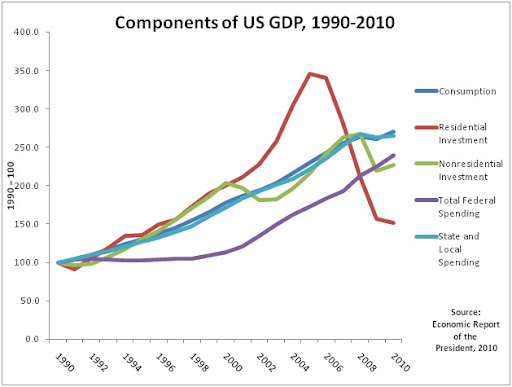
What we see in this graph is that the slowest growing component over the two decades was federal government spending—it actually did not grow much until the term of President George W. Bush. (A substantial portion of federal government growth since 2000 can be attributed to our multiple wars, as well as to domestic spending on security.) By 2010, federal government spending was just over 2.3 times bigger (in nominal terms) than its spending in 1990. Private consumption as well as state and local government spending grew steadily, increasing by about 267% before the deep recession led to some retrenchment. By contrast, residential investment boomed in the real estate bubble, growing by 350% until 2005. It then collapsed so that it stood at an index of just 150 in 2010 (fifty percent higher than in 1990). Nonresidential investment shows a clear cyclical nature, and it too collapsed in the aftermath of the global financial collapse. Viewed in this light, it is not at all surprising that when total investment (residential plus nonresidential) is growing rapidly, unemployment tends to fall; but when investment spending collapses we lose jobs at a stupendous pace.
This has long been the concern of Keynesian economists: investment by its very nature is highly cyclical, subject to what J.M. Keynes called “whirlwinds of optimism and pessimism”. That is not all bad. J. Schumpeter referred to the “creative destruction” that makes capitalism dynamic—waves of innovation generate new investment, wiping out firms that get left behind. But if an entire economy is whipped about by unstable investment, we oscillate between the extremes of boom and bust. That is why we need some spending that is more stable—better yet, we need a source of spending that can act in a countercyclical manner to offset the swings of investment.
And that is precisely what we created in the aftermath of the Great Depression. First, we grew the federal government—from about 3% of GDP in 1929 to above 20% after WWII. As the chart above shows, federal government spending is not subject to the wild swings that afflict investment, so it helps to stabilize GDP and jobs. Second, we put in place a variety of federal government programs that help to stabilize household consumption (unemployment benefits, Social Security retirement, and “welfare” for households, firms, and farms). That is, again, reflected in the chart above—even when the financial sector crashed and unemployment exploded, consumption dipped only slightly, thanks in large part to government “transfer” payments like unemployment benefits.
Our modern Hooverians would like to return to the “good old days” of President Hoover, when the government was smaller and both unwilling and unable to offset the swings of private investment spending. Back then, when investment collapsed unemployment did not go to 9 or 10 percent, it went all the way to 25 percent. Hooverian economics would turn back the clock to ring in another Great Depression with the same old pre-Keynesian ideas that failed us in the 1930s.


(Cross-posted at All Life Is Problem Solving and Fiscal Sustainability)
Ah…. my fellow Americans, be very, very, afraid of the terrible Social Security crisis that will sink us as a nation. According to Government projections, we won’t be able to pay full Social Security benefits, in 2037 and beyond, unless we cut benefits now, because the Social Security “Trust Fund” will be short of money.
So, say Paul Ryan, Peter Peterson and his minions, Mike Pence, Alice Rivlin, Erskine Bowles and Alan Simpson, and also many other deficit hawks. In reply, the most liberal of the deficit doves say that even though there will be a solvency crisis in 2037; it’s really nothing to worry about because all we have to do to end it is to lift “the cap” on FICA contributions entirely, so that wealthier income earners are paying the same rate on their total earnings, as workers whose wages or salaries are below $106,800 per year.
(cross-posted with Benzinga.com)
My next columns address three writings by Stephen Moore, the Wall Street Journal’s “senior economics writer.”
White Collar Witch Hunt: Why do Republicans so easily accept Neobolshevism as a cost of doing business? [The article appeared in the American Spectator in September 2005.] “Bullish on Bush: How the Ownership Society Is Making America Richer.” [Madison Books, 2004.] We’ve Become a Nation of Takers, Not Makers. [Wall Street Journal, April 1, 2011.]
Moore’s column deplores the debasement of the American economy by government employees.
“More Americans work for the government than work in construction, farming, fishing, forestry, manufacturing, mining and utilities combined. We have moved decisively from a nation of makers to a nation of takers.”
The claim that employees involved in making physical things that are purchased in the markets are uniquely valorous is an odd argument for someone with his professional career (Moore ran the ultra conservative, “supply side” anti-tax group, the Club for Growth). The trade and tax policies he embraces encouraged U.S. businesses to export their manufacturing plants (and their jobs) to low-wage/low-tax nations and to import food produced in those low-wage/low-tax nations. Moore has praised both states and nations that serve as tax havens. He has singled out the Texas model – low wage, low tax, low government services, and hostile to safety rules. Moore has worked for years to punish the “makers” and produce the condition he deplores in which the number of U.S. “makers” has fallen sharply. His column decries the budgetary crises in states and localities, but it was the Great Recession driven by the criminogenic environment his anti-regulatory policies created together with the anti-tax hysteria generated by his repeatedly falsified fantasy that slashing taxes for the rich increases tax revenues that drove that budgetary crisis. Architects of the crisis like Moore who write primarily to excuse their consistent failures should stop. They have done enough damage to the world for a dozen lifetimes.
Consider the implications of Moore’s assertion that people who do not work in manufacturing and farming are “takers.” Under this dichotomy the world is divided between “makers” and “takers,” the biggest “takers” in the world work on Wall Street, the City of London, and the worst kleptocracies – the Wall Street Journal’s core readership. If “makers” of manufactured goods and crops are uniquely valorous, then Moore’s logic requires that it is the workers in these sectors – not the managers, professionals, and clerical workers – who are the actual “makers” who embody that unique valor. (Again, it is passing strange that Moore has dedicated his life to rewarding these uniquely valorous Americans by exporting their jobs and leaving them unemployed or employed at lower wages.) If one can claim to be a “maker” by performing functions that merely assist the actual “makers” make things, then we are all “makers.”
Moore, however, implicitly makes two assertions about government employees – all government employees are “takers” and only government employees are “takers.” Moore doesn’t attempt to support any of his assertions, and they are logically inconsistent. These truths are apparently self-evident to Mr. Moore – people are not created equal. Americans who choose to be government employees are inferior because they are not endowed by their creator with an adequate taste for risk.
“Surveys of college graduates are finding that more and more of our top minds want to work for the government. Why? Because in recent years only government agencies have been hiring, and because the offer of near lifetime security is highly valued in these times of economic turbulence. When 23-year-olds aren’t willing to take career risks, we have a real problem on our hands. Sadly, we could end up with a generation of Americans who want to work at the Department of Motor Vehicles.”
In Moore’s world, an American who wishes to work as a “maker” and develops the skills to be a “maker” has no inalienable right to a job as a “maker” at a living wage. Why? If (1) there really is something particularly virtuous about working in manufacturing or farming, (2) there are too few Americans working in those industries, and (3) the Americans who wish to work in those industries embrace “tak[ing] career risks” and have prepared themselves by education to be able to be productive “makers” why not commit the U.S. to ensure that these virtuous, risk-loving young people can find jobs in manufacturing and farming in the U.S.
Moore is not strong on nuance. All government employees are “bureaucrats” in his parable of “makers” and “takers.” No corporations are bureaucratic. Moore’s fable is crude propaganda. Let us add some reality. Our largest group of federal employees provides national security (DoD, CIA, NSA, DHS, DOJ/FBI, VA, etc.). Many of these “bureaucrats” are living their parasitical life of ease as “takers” in Iraq and Afghanistan. (The virtuous Taliban are busy being “makers” – cultivating poppies.) I do not recommend telling our troops that they are risk-averse “takers” and bureaucrats. The exact number of federal employees engaged in national security is unknown because many employees in other agencies, e.g., NASA, actually work on national security under various degrees of deliberately misleading information. There are over a million federal military personnel. DoD, Homeland Security (DHS), and the VA have nearly a million civilian employees.
The only other federal sector with very large numbers of employees is the Postal Service (around 600,000 – less than one-third the size of the federal workforce in the national security sector). The Postal Service, of course, provides a productive service – communications. Moore does not even attempt to explain why our federal troops or our federal communications workers are supposedly parasitical “takers.” Moore does not even attempt to prove that Americans choose to work for the nation or their State because they fear taking risks. I took far more risks as a federal employee than as a private sector employee. Charles Keating hired private detectives twice to investigate me. He sued me for $400 million in my individual capacity. Another fraudulent CEO also sued me for millions of dollars. Speaker of the House James Wright sought to get me fired. One of the presidential appointees running my agency conducted what he claimed was an investigation of me with the hope that he would be able to get me fired or sued. Charles Keating gave a “secret file” to senior members of my agency that he purported had adverse information about me. The agency excluded me from meetings with Keating and removed our jurisdiction over Lincoln Savings. The head of my agency attacked me publicly in the press and in congressional testimony. (I returned the favor – he resigned in disgrace.) I was a mere financial regulator.
The overwhelmingly dominant sectors of state and local governmental employment are teaching, police, fire, and prison officers and staff. Each of these jobs would be shunned by those afraid to take risks. Moore views this hypothetical as his nightmare of American decline:
“Sadly, we could end up with a generation of Americans who want to work at the Department of Motor Vehicles.”
I have never met a college graduate (the context of this excerpt from Moore’s column) who aspires to work at DMV. I doubt that Moore has ever met one with that career goal. Moore chooses DMV as his example in order to disparage government and government employees. Moore believes that government workers are mediocre. Too scared and too incompetent to work in real jobs, government workers are parasitical “takers.”
“One way that private companies spur productivity is by firing underperforming employees and rewarding excellence. In government employment, tenure for teachers and near lifetime employment for other civil servants shields workers from this basic system of reward and punishment. It is a system that breeds mediocrity, which is what we’ve gotten.”
Ah, yes, the “rank and yank” system and executive and professional compensation have been a brilliant success in “private companies.” Private systems have worked so brilliantly that they destroyed tens of trillions of dollars of wealth by creating a criminogenic environment in which private incentives became so perverse that they drove the epidemic of accounting control fraud that produced a massive financial crisis and the Great Recession. Moore thinks that failed private system should be our model for the public sector. Moore has been disastrously wrong about nearly every major economic policy issue of importance. He has learned nothing useful from his failures.
Mr. Raines explained in response to a media question what was causing the repeated scandals at elite financial institutions:
We’ve had a terrible scandal on Wall Street. What is your view?
Investment banking is a business that’s so denominated in dollars that the temptations are great, so you have to have very strong rules. My experience is where there is a one-to-one relation between if I do X, money will hit my pocket, you tend to see people doing X a lot. You’ve got to be very careful about that. Don’t just say: “If you hit this revenue number, your bonus is going to be this.” It sets up an incentive that’s overwhelming. You wave enough money in front of people, and good people will do bad things.
Mr. Raines was speaking on behalf of the Business Roundtable, which picked him as its spokesperson to explain to the media why the epidemic of Enron-era accounting control frauds was occurring. (You can’t compete with unintended self-parody.) Raines knew what he was talking about – as Fannie’s CEO he employed an executive compensation system that created these perverse incentives. During the crisis, the fraudulent CEOs running the fraudulent liar’s lenders deliberately created intense, perverse incentives among their loan brokers, loan officers, appraisers, auditors, and rating agencies by creating a “Gresham’s” dynamic in which bad ethics drove good ethics out of the marketplace. They were exceptionally effective in achieving the desired results. The CEOs were consistently able to get overstated appraisals, overstated borrower income, clean opinions for financial statements that were not prepared in accordance with GAAP, and “AAA” ratings for toxic waste. CEOs can and do use compensation for good or evil.
Moore’s discussion reveals more about him than about government employees. He can’t imagine employee excellence not based overwhelmingly on fear or quasi-bribery. He can’t imagine anyone wanting to be a teacher, a regulator, a soldier, a firefighter, a CDC scientist, a VA doctor, an FBI special agent, or a police officer. He can’t imagine people who voluntarily accept lower pay than they could get in the private sector because they want to protect people from harm. He can’t even imagine people who want a job in the local prison because they live in rural areas with high unemployment and the prison job is the best way to continue to live and work where they can help a sick mother. People work for the government for myriad reasons. Effective leaders, whether they are in the private or public sector, do not rely on threats or bribes to motivate their teams. They choose good people, train them, praise them, and give them constructive feedback. Effective leaders demonstrate through their actions integrity and dedication to the mission. Accomplishing that mission – teaching a child to read, closing fraudulent banks, putting out fires, arresting rapists, preventing a terrorist attack, or preventing criminals from escaping prison – becomes a matter of the best kind of pride and purpose. Government employees often work far longer hours than required for no additional compensation. This is, for example, overwhelmingly true of teachers.
Why does Moore believe that human capital is so unimportant? His supposed “takers” are the leading “makers” and protectors of the “makers” he claims epitomize valor. It is teachers that help us become productive (and civilized). The police, firefighters, CDC, and the FDA safeguard lives. Does Moore find that unproductive?
The literature on performance pay shows that even when it is not used deliberately by fraudulent leaders to create perverse incentives it can often disrupt work teams and make them less effective by creating divisiveness. It is as if a mother declared that certain of her children were superior to others.
The effort to create performance pay is also perverse because it leads to demands for quantification of performance. Moore errs when he claims the government does not use performance pay. The “Reinventing Government” movement (championed by Vice President Gore and (then) Texas Governor Bush as well as many academics was premised on applying private sector management practices in the public sector. For example, Moore’s column complains about students’ test scores not improving. Student test scores did, infamously, improve dramatically in Houston, as did graduation rates, in response to performance pay tied to test performance and dropout rates. The Houston “miracle” led to Bush’s education program (“No child left behind”). The miracle was actually a fraud. The dropout rates were scammed by the Houston leadership and teachers simply taught to the test.
The SEC and Justice Department use “objective” performance measures to determine bonuses. This increases the perverse incentive to bring cases against minor wrongdoers rather than against the most damaging frauds in which it is far more difficult and time-consuming to obtain convictions.
The other bright idea of Reinventing Government was to order the bank regulators to refer to the banks they were supposed to regulate as their “customers.” That too was a direct steal from private sector management. It is a destructive practice in the regulatory context.
Moore claims that the private sector is always more efficient in providing services.
“Most reasonable steps to restrain public-sector employment costs are smothered by the unions. Study after study has shown that states and cities could shave 20% to 40% off the cost of many services—fire fighting, public transportation, garbage collection, administrative functions, even prison operations—through competitive contracting to private providers. But unions have blocked many of those efforts. Public employees maintain that they are underpaid relative to equally qualified private-sector workers, yet they are deathly afraid of competitive bidding for government services.”
Yes, there are badly designed studies that make these claims, and then there is the reality of privatization. For example, some studies on prison operations find that private prisons are cheaper than public prisons. The problem is that these studies compare average costs of public imprisonment with the costs of private prisons for the lowest risk prisoners. Security drives prison expense, so these studies are meaningless. Privatization can also create perverse incentives. The most notorious example is the CEO of the private prison who bribed judges to sentence innocent juveniles to extensive imprisonment in order to increase the CEO’s compensation.
The private sector can always cream skim some aspects of public services at what appears to the uninformed to be a saving. A private school that does not provide services to special needs students is not more efficient – it is simply taking advantage of a cross subsidy from the public sector.
Privatization does not typically lead to “competitive bidding for government services” by “equally qualified private-sector workers.” The sales of public assets are often not competitive and are not made at market prices. Privatization tends to be a giveaway, making the cronies with the strongest political connections wealthy (think Mexico). I have provided examples of why the “government services” provided under privatization of prisons and schools are often not equivalent because the private sector cream skims the lowest cost aspects of those services, which does nothing to reduce overall costs. The private parties often do not provide “equally qualified private-sector workers.” In college education, for example, GAO studies have found that “for profit” schools have a terrible reputation for endemic fraud. They do not provide equally qualified staff. Private prisons often do the same. Private military contractors are more expensive than government troops and produce recurrent scandals because of their CEOs’ perverse incentives.
American workers do fear the dynamic Moore has long championed. What is the American worker supposed to do if the outsourcing to the private sector is to India and the wages there are one-twentieth of the U.S. wages? That dynamic would lead to the impoverishment of tens of millions of American workers.
In the regulatory world we have just run a real world experiment with applying private sector management theories to the private sector. We privatized many regulatory activities by adopting self-regulation. We used “early outs” to shrink the FDIC (losing many of our most experienced federal employees). We shrank the FDIC by more than three-quarters. The FDIC adopted “MERIT” (non) examination of banks (the “M” and “E” stood for “maximum efficiency). We brought the bank lobbyists “inside the tent” in financial rulemaking, i.e., in creating Basel II. We gave performance bonuses to senior FDIC officials for dramatically reducing FDIC employees. We preempted the State regulators and AGs seeking to protect consumers from predatory nonprime lenders. Each of these actions contributed to the abject regulatory failure.
To sum it up, private sector financial employees, due to the perverse incentives their CEOs put in place and that Moore wishes to spread, were far worse than “mediocre” at hundreds of lenders. The incentives became so perverse that they produced multiple epidemics of fraud and led our most prestigious professionals to aid those frauds. The results were catastrophic. Moore wants to spread those perverse compensation systems and incentives throughout the public sector, where they are even more inappropriate and destructive. We have a catastrophe because the private sector incentives were perverse and the political leaders appointed anti-regulatory leaders to run the agencies. Moore invariably bases his solutions to the problems of the public sector on the private sector approach without examining the problems of the private sector approach or whether that approach makes sense in the public sector. Moore’s theme song is a straight steal from My Fair Lady: “Why can’t a woman be more like a man?” Real men (“makers”) embrace risk and work in the private sector. If only government workers (“takers” – women and men too scared to take those risks) could be made more like the private sector employees all would be solved. In the movie, the song is satire designed to expose male prejudice. Moore doesn’t get the satire.


Comments Off on Randall Wray and Bill Mitchell Interviewed
Posted in Uncategorized
Tagged Uncategorized
Click images to view details