Tag Archives: fraud

“Pervasive” Fraud by our “Most Reputable” Banks

By William K. Black

A recent study confirmed that control fraud was endemic among our most elite financial institutions.  Asset Quality Misrepresentation by Financial Intermediaries: Evidence from RMBS Market.  Tomasz Piskorski, Amit Seru & James Witkin (February 2013) (“PSW 2013”).

The key conclusion of the study is that control fraud was “pervasive” (PSW 2013: 31).

“[A]lthough there is substantial heterogeneity across underwriters, a significant degree of misrepresentation exists across all underwriters, which includes the most reputable financial institutions” (PSW 2013: 29).

Continue reading

Why are there no famous financial whistleblowers in this crisis?

By William K. Black

This column discusses one of the more subtle issues raised by the Department of Justice’s (DOJ’s) civil fraud action against Bank of America (B of A).  The issue was so subtle that of the three articles about the lawsuit that I choose to review the night after the suit was filed, only the NYT article mentioned one of the most important aspects of the suit – the key role that the whistleblower played in making the action possible.  The AP and the WSJ articles ignored the fact.

Continue reading

How “Brazen” does a Bankster’s Fraud have to be before he’s Prosecuted?

By William K. Black

I’ll get the obvious out of the way first and then turn in future columns to the aspects of the Department of Justice’s (DOJ) civil suit against Bank of America (B of A)/Countrywide that are vital to understand but are more subtle.  The obvious issue arises from the facts that the DOJ alleges that its investigation has found.  The complaint and the DOJ press release state that elite financial criminals committed tens of thousands of “brazen” frauds targeting U.S. government funds.  Continue reading

Krugman Now Sees the Perversity of Economics’ “Culture of Fraud”

By William K. Black

Paul Krugman has written an article entitled “Culture of Fraud” about the Romney economics team.

Continue reading

Who is Steven Krystofiak

By William K. Black

“My name is Steven Krystofiak, President of the Mortgage Brokers Association for Responsible Lending.”  That is how Krystofiak began his written statement to the Federal Reserve concerning mortgage fraud.  It is a follow-up to his oral testimony at a Federal Reserve hearing on June 16, 2006 at the FRB San Francisco entitled: “Responsible Lending and Informed Consumer Choice, Public Hearing on the Home Equity Lending Market.”  Continue reading

Dimon Lambastes Loans and Expresses His Devotion to Derivatives

By William K. Black

The ongoing U.S. crisis was driven largely by financial derivatives.  Nine of America’s systemically dangerous institutions (SDIs) failed or had to be bailed out – Bear Stearns, Lehman, Merrill Lynch, Fannie, Freddie, AIG, Countrywide, Wachovia, and Washington Mutual (WaMu).  The SDI failures were primarily due to losses caused or aided by the sale and purchase of enormous amounts of fraudulent derivatives, and deregulation, desupervision, and de facto decriminalization proved exceptionally criminogenic.  The Commodities Futures Modernization Act of 2000 and the Gramm, Leach, Bliley Act of 1999, respectively, made credit default swaps (CDS) into a regulatory black hole and repealed the Glass-Steagall Act’s prohibition against banks mixing commercial and investment banking. Continue reading

William K. Black: Abacus Bank Indicted for Mortgage Fraud – More Prosecutions to Come?

William K. Black on “Career Limiting Gestures”

Senator Grassley calls Attorney General Holder’s Bluff

By William K. Black

On March 7, 2012, I testified before the Senate Committee on the Judiciary on the failure to prosecute the elite fraudulent financial CEOs who drove the ongoing crisis.  The first witness testifying to the committee was Assistant Attorney General for the Civil Rights Division, Thomas Perez.  The focus of the hearing was Countrywide’s massive racial and ethnic discrimination against minorities.  Perez testified that there were over 200,000 identified victims of discrimination by Countrywide and that the settlement his office negotiated led to a payment that was 50 times larger than the largest previous settlement.  Perez testified that each of these victims of Countrywide’s discrimination will receive between one and two thousand dollars.

Continue reading

A Dimon Repeatedly in the Rough who Demands Winter Rules (aka Preferred Lies)

By William K. Black
(Cross-posted from Benzinga.com)

Golf is one of the sports associated with the CEOs of big banks, so it is not surprising that Jamie Dimon is expert at seeking to invoke Winter Rules whenever JPMorganChase (NYSE: JPM) finds that its actions have placed it in an unfavorable lie.

Golfers know that they cannot unilaterally invoke Winter Rules – only the folks in charge of the course can put Winter Rules in effect. When Winter Rules are put in effect the golfer can improve his lies by placing his ball in a preferred lie.


A New York Times investigation by Edward Wyatt documented the depth of the rot at the SEC in a February 3, 2012 article entitled “S.E.C. is Avoiding Tough Sanctions for Large Banks.”

“JPMorganChase, for example, has settled six fraud cases in the last 13 years, including one with a $228 million settlement last summer, but it has obtained at least 22 waivers, in part by arguing that it has “a strong record of compliance with securities laws.””

SEC investigations have found that JPMorganChase is a serial violator of the securities laws. The bank gets caught, promises to clean up its act, gets fined, signs a typically useless consent decree that has no admissions, creates no precedent, and undercuts deterrence, and gets waived out of the few detriments there are to banks with records of serial SEC staff findings of violations.

JPMorganChase exemplifies this pattern of the SEC winking at serial fraud by the systemically dangerous institutions (SDIs). The SEC routinely allows the SDIs to operate under Winter Rules and the SDIs routinely and repeatedly employ preferred lies.

But the metaphor is inexact for three reasons. First, Winter Rules are not supposed to be routinely available. They are reserved for unusual circumstances where the course is unusually unplayable due to weather. Second, Winter Rules are available due to problems with the course not caused by the player. Third, when Winter Rules are invoked by the golf course the course posts that information publicly and Winter Rules are available to all players rather than to a subset, i.e., the wealthiest players.

Consider what the world would be like if we had a “three strikes law” for corporations. Assume that the corporations were only assessed a “strike” if the violations were attributable to the actions of a senior officer. Assume further that the SEC and the Department of Justice (DOJ) actually brought actions against the SDIs and required admissions of violations of the law in settlements and pleas. The SDIs would have been dissolved (the equivalent of being sent away for life) decades ago.

Consider the chutzpah of JPMorganChase claiming “a strong record of compliance with securities laws” after SEC staff investigations found six violations in 13 years. But that kind of arrogance and indifference to complying with the law is inevitable under an SEC regime that allows the SDIs to play by Winter Rules. “Improved lies” captures perfectly the perverse incentives that the SEC has created.

The CEOs of SDIs who know that they can commit fraud with effective impunity (the SEC fines are typically chump change from the SDIs’ standpoint) develop a belief in their divine right to transcend the law and conventional morality. Jamie Dimon captures the mindset that Nietzche celebrated for the Superman. Dimon extends the logic of transcendence to its ultimate, absurd, extreme. He is enraged that the CEOs running the SDIs have been criticized. It turns out that the SDIs’ CEOs are sensitive types. Nobody exemplifies this Rich White Whine motif better than Dimon.

“I’ve disagreed right from the beginning of this blanket blame of all banks,” Dimon said in an interview with Charlie Gasparino of the Fox Business Network Tuesday. “I don’t like that. I think that’s just a form of discrimination that should be stopped.”

The interview was taped shortly before Dimon left for the World Economic Forum summit in Davos, Switzerland, where Dimon said he will be speaking with other attendees about financial regulation. At last year’s Davos summit, Dimon made similar remarks pushing back against the vilification of the banking industry, calling it “a really unproductive and unfair way of treating people.”

No serious critic has a “blanket blame of all banks.” The blame is focused on SDIs, particularly SDIs like JPMorganChase that investigations find engaged in recurrent fraud, yet were treated to Winter Rules because they were SDIs. These SDIs are not only the bane of the world economy; they are the bane of honest banks.

Dimon has also reached the logical, albeit absurd, conclusion about the legitimacy of investigating JPMorganChase. He is tired of the investigations finding fraud, so he has decided, in the context of the settlement negotiations of the widespread foreclosure fraud by five large mortgage servicers including JPMorganChase, to offer a settlement in return for prohibiting the government from investigating his banks’ mortgage origination and foreclosure fraud.

When news reports claimed that the federal government was reducing its disgraceful offer of widespread impunity from investigation and prosecution, Dimon responded that it was likely that JPMorganChase would not enter into a settlement that did not have a broad prohibition on investigating JPMorganChase’s frauds.

“The new unit “has a pretty good chance of derailing it,” JPMorgan Chase CEO Jamie Dimon told CNBC on Thursday, referring to the settlement. JPMorgan is one of the five banks involved in those negotiations.”

Dimon is the face and mindset of crony capitalism. It is long past time for the SEC to end selective Winter Rules and Preferred Lies for the SDIs.

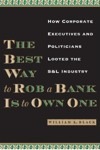
Bill Black is the author of The Best Way to Rob a Bank is to Own One and is an associate professor of economics and law at the University of Missouri-Kansas City. He spent years working on regulatory policy and fraud prevention as Executive Director of the Institute for Fraud Prevention, Litigation Director of the Federal Home Loan Bank Board and Deputy Director of the National Commission on Financial Institution Reform, Recovery and Enforcement, among other positions.

Bill writes a column for Benzinga every Monday. His other academic articles, congressional testimony, and musings about the financial crisis can be found at his Social Science Research Network author page and at the blog

Follow him on Twitter: @WilliamKBlack