Tag Archives: great recession

Latest in Deficit Terrorism: Postal Service Default

By Mitch Green

Americans living in rural areas should brace themselves for a new dose of pain.  As the USPS approaches the end of its fiscal year, where it will be unable to make payment of $5.5 billion to its employees health benefits fund, it is considering closing over 3600 facilities nationwide.  Just yesterday they placed on the chopping block another 250 processing centers.  Most of these closures are distributed throughout rural areas, a demographic that has borne a considerable amount of hardship throughout this entire contraction. For an interactive map of the proposed closures go here.

Naturally, this has a lot of people seeing red.  Both Senators Tester and Baucus of Montana, a fine example of rural America, protest:

The decisions being made by postmaster general are really going to cement the post office as a thing of the past. The proposals he’s put forth are absolutely devastating on rural America, and the economies in those communities are going to be very negatively impacted. – Sen. John Tester

Closing a post office in Alzada or Rapelje is not like closing a post office in Washington, D.C., or suburban Virginia and Maryland. Folks simply cannot drive a few blocks to reach another.  Sen. Max Baucus
Great Falls Tribune

I could go on about how this proposal is shortsighted, or it doesn’t even make much of a dent in their budget woes anyway, but I won’t.  I reject the premise the post office faces a budget crisis on its face.  I reject the whole frame that it entails.  The notion that an agency of the federal government can default on its obligation to – gasp, another agency of the same federal government – indicates a wholesale collapse in mental capacity.  

Deficit terrorists, small government conservatives and other such ideologues, like to point to the fiscal condition of the postal service as proof that governments activities are inherently inefficient and unsustainable.  Since I find this sort of nonsensical, fallacious reasoning annoying I usually dismiss these claims.  Of course the postal service doesn’t do well as a business – it is charged with the task of providing timely, affordable, and universal mail coverage throughout the entire United States.  Profit maximizing firms corporations would never do such a thing; it would violate their fiduciary responsibilities and create a rift in the space-time continuum.  But, more recently I’ve heard, in growing chorus, that the USPS is facing a default.  Umm…what?

If it is not obvious to you now why I was surprised to learn this, don’t worry I’ll get to that. But first, I need to provide a little background information on how the post office has evolved over the years.  One of America’s earliest acts following its independence was the establishment of a postal service.  The founding fathers recognized its importance in promoting both the civil and economic development of a new democratic nation.   Adam Smith, who is often relied upon by free-market fundamentalists for his “invisible hand” metaphor, stressed the importance of a postal service as an essential government function.  Here’s what Smith had to say about the role of government in the economy:

[A] duty of the sovereign or commonwealth is that of erecting and maintaining those public institutions and those public works, which, though they may be in the highest degree advantageous to a great society, are, however, of such a nature, that the profit could never repay the expence [sic] to any individul or small number of individuals, and which it, therefore, cannot be expected that any individual or small number of individuals should erect or maintain. – Book V, Wealth of Nations [bold words selected for emphasis]

The founding fathers, like Adam Smith, were all Enlightenment philosophers and recognized that a free society requires free communication.  So, we established the postal service with the intent of facilitating the exchange of ideas for everybody, not just those who can afford the service of a private courier.

Fast forward to the present (sorry, this isn’t intended to be an exhaustive history).  The most significant change to the postal service in recent history occurred in 1971, with the Postal Reorganization Act.  Previously, the service existed as a cabinet level position within the executive branch.  Following reorganization the postal service was established as an independent agency of the government, where it would no longer be funded through direct appropriations.  The goal was to make the USPS function more as a business, relying upon its own revenues to cover operational and legacy costs.  In the event that revenues proved insufficient to defray costs, it would assume debt through the Federal Financing Bank.  The change also placed a statutory limit on both outstanding and periodic borrowing, which has been modified through subsequent legislation to accommodate inflation.  Currently, the limits are $15 billion in outstanding obligations and a maximum of $3 billion in new obligations per year.

As I write this the post office is running up against its borrowing limit for this year, and is roughly $13 billion in total debt to the FFB.  As a result, it will not be able to meet its pre-payment obligation towards its retiree health benefits fund ($5.5 billion) by September 30 2011, which will force it into a technical default.  Let me explain why this whole “crisis” is insane.

First, the USPS is a federal agency.  Yes, it thinks it’s a business, but that doesn’t change the fact that it is an entity of the federal government.  The FFB is also a federal entity which operates under the supervision of the Treasury Dept.  To the extent that one agency owes the other money is an accounting problem.  Nothing more.  There’s no risk of insolvency at all here.  Now, interest payments to the FFB are not that important as a proportion of USPS overall expenses, instead it is their contractual obligation to make good on their commitment to fund its retirement health benefits account.  This requirement, by the way, has been exacerbated by a legislative change in 2006 that mandates the service to front load a 75 years obligation horizon into the health fund, within ten years.  But, if after fulfilling that obligation they cannot make an interest payment to the FFB what happens?  Nothing.  The FFB can write off its “bad” assets from the USPS.  In fact, there’s no reason why they can’t forgive the entire $13 billion and give the USPS a clean slate.

Second, the whole notion that we ought to place a debt-ceiling on the postal service is almost as ludicrous as the idea that it should float bonds at all.  The post office ought to be a direct appropriations entity anyway, and if we can’t accomplish that simple task then we should at least raise its statutory debt ceiling to reflect collapse in revenues during this recession.  I know, what you are going to say:  ”But, the post office is going broke because they can’t adapt to things like the Internet.”  I’ve heard that more than a few times.  Perhaps, they’ve lost revenue to increased electronic correspondence. (Although the effect of the Internet on USPS revenues is probably ambiguous given the increase in shipping due to online orders) .  But, like most other budget problems that exist today, the Great Recession is primarily to blame.  When you have a contraction on the scale we’ve been living through for the last several years, the demand for shipping through the USPS falls through the floor.  Normal levels of shipping just haven’t recovered, hence the light revenues.

The idea that the post office needs to shutdown in rural areas is a lie.  The post office wants to shutdown in rural areas (or at least the guys running the show in Washington prefer it).  The only constraint on postal activities is the insatiable drive to enact further job-killing budget cuts, in an attempt to break one of the last bastions of organized labor.  The USPS is one of the nations largest employers and its labor force is represented by the National Association of Letter Carriers.  Shutting down these offices will not only add to the already swollen ranks of the unemployed, but impose a cost upon the elderly and poor who rely upon home delivery.  It is unnecessary, wrong and criminal.  It is just the latest in an enduring process to unravel the American Dream.

So, don’t be fooled.  The post office ain’t broke…yet.

UPDATE:  A thoughtful reader has pointed out an error in my original post.  Originally I suggested that the Postal Service Regulatory Commission was issuing the order to close the offices.  The agency is actually the Postal Regulatory Commission which only issues an advisory statement regarding the closures; the USPS retains responsibility in the closures.

After Great Recession: A Bleaker Employment Recovery than after the Great Depression

By Eric Tymoigne

The last employment numbers provide yet another disappointing bit of news for millions of households all around the country. No net employment gain. However, I am afraid that this is only the very tip of the iceberg because a long-term view shows a much bleaker picture.

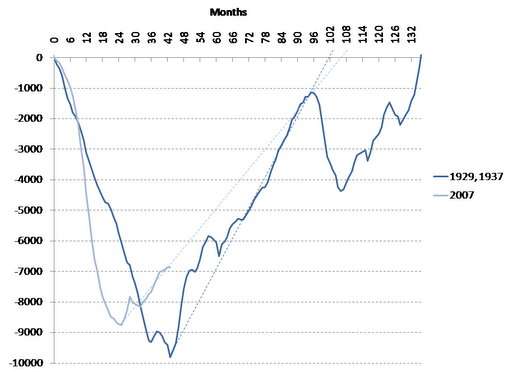
Figure 1 shows how long it took for the employment level to return to its peak level after a recession, and how much job loss occurred relative to that peak. The employment numbers exclude people that were employed in the WPA, NYA and CCC, and focuses on individuals employed in nonfarm activities.

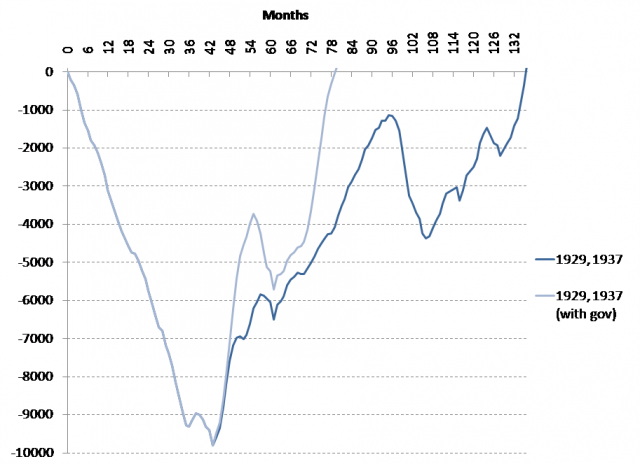
During the Great Depression, the employment level declined for 4 years and almost 10 million jobs were lost compared to the peak employment level that prevailed in August 1929. It took 136 months (over 11 years) to return to this level of employment, but, without the avoidable 1937 recession, the full recovery would have occurred after 102 months (8.5 years) if one takes the trend of recovery that prevailed from 1933.

The Great Recession led to a loss of almost 9 million jobs compared to the peak employment level of January 2008. The loss of jobs occurred at a faster rate than the Great Depression but employment recovered sooner and started to rise after 2 years. However, once the employment recovery started, it occurred at a slower rate than during the Great Depression. If the recovery continues at the same pace, AND assuming that no recession occurs during the recovery phase, it will take about 9 years to return to the employment level of January 2008. Thus, given everything else, it will take longer for employment to fully recover than during the years prior to the 1937 recessions.

The picture is even bleaker today if one included New Deal employment programs. Figure 2 shows that those programs allowed employment to recover fully after 80 month (less than 7 years) and only three years after the New Deal Programs were implemented. The timid Bush and Obama stimulus have barely made a dent in the employment problem over the past two years.

This, once again, suggest a powerful employment policy to help the economy. Instead of concentrating its efforts on tax rebates and bailing out banks, and waiting for them to lend to businesses, the federal government should directly hire people and involve them in activity that benefited the entire country. We do not need a temporary stimulus; we need a permanent institutionalized and decentralized government program that hires anybody willing to work and unable to find a job in the private sector. By sustaining income and the productivity of workers, a government employment program would tremendously helps to sustain the employability of workers and would improve the confidence of private business, which would in turn improve private employment.

Figure 1. Difference between peak employment level and current employment level. Nonfarm payroll employment, seasonally adjusted, millions of people.
 

Sources: BLS (Current Employment Survey), Federal Reserve Bulletin (June and September 1941).
Note: People employed in the WPA, NYA and CCC are not included.

Figure 2. Same as Figure 1 with New Deal Federal Employment Programs.
Sources: Federal Reserve Bulletin, Social Security Bulletin.

Where is the “Recovery”? Where Did the “Stimulus” Go?


The new BEA figures about economic activity continue to point to a replay of a Japanese-style lost decade or, even worse, a 1937 scenario. The current expansion has been the weakest on record since World War Two and the trend since the early 1980s does not provide much comfort. Figure 1 shows that each economic expansion since the 1980s has been weaker and weaker and the rate of decline has accelerated.

The current debate in Washington does not provide any comfort for the short run or the long run with both political parties willing to jeopardize whatever economic growth we have left over a fictitious ceiling that serves no economic purpose. All this suffering is supposed to help in the long run because of the good that will come from “reforming” (read “dismantling”) pillars of economic progress like Social Security.

The 2009 Obama “stimulus” is long gone and all levels of government negatively contributing to economic growth. Since the third quarter of 2009, the contribution of the government to economic growth has been nil on average. 

Figure 1. Economic growth and its sources
Source: BEA (NIPA Table 1.1.2), NBER.
Note: Last period is an on-going expansion.


All this provides one more clue that the current large deficits have nothing to do with government spending running wild. This also provides a clue about how little has been done in terms of productive spending by the government since the beginning of the expansion. Most of the help provided by the government was to hopelessly insolvent institutions that should have disappeared from the face of the earth a long time ago.